
Western Europe’s crypto economy hits $2.08 trillion as stablecoin use surges

 Prefer us on Google
Western Europe's cryptocurrency economy has reached $2.08 trillion in annual activity, with stablecoin holdings rising 131% even as the region's largest market, the United Kingdom, recorded a decline.
Summary
- Western Europe's crypto economy reached $2.08 trillion, growing 1.2% despite a global market downturn.
- Stablecoin holdings across the region surged 131%, compared with global growth of 52%.
- The UK remained the largest regional crypto market at $424.5 billion, although overall activity fell 8%.
- Domestic stablecoin transfers in the UK climbed to $2.09 billion, while French self custody balances rose 192%.
According to a November 9 report from blockchain analytics firm Chainalysis, crypto activity across Western Europe grew 1.2% between July 2025 and June 2026, making it the world's second-largest regional crypto economy.
The region was among only three worldwide to record positive growth during the period, alongside Sub-Saharan Africa and Latin America.
The UK remained Europe's largest crypto market, handling $424.5 billion in activity despite an 8% annual contraction, largely attributed to lower decentralized exchange trading.
Germany followed with $288.8 billion, while France recorded $215.8 billion. The Netherlands accounted for $207.8 billion, followed by Spain at $156.1 billion and Switzerland at $132.8 billion.
Together, the six countries represented roughly two-thirds of the region's cryptocurrency activity.
Stablecoin holdings grow much faster than the global average
Stablecoin holdings in personal wallets across Western Europe rose 131% during the reporting period, compared with global growth of 52%.
Chainalysis found that the region's share of worldwide stablecoin balances climbed from 3.4% to 5.1%, with Austria and France recording particularly strong growth.
The expansion comes as European financial institutions develop regulated stablecoin products under the Markets in Crypto-Assets Regulation, or MiCA.
In October, the European Banking Authority classified Circle's USDC as the first significant electronic money token under the framework, placing specified reserve and redemption safeguards under its direct supervision from November 12.
European banks have been entering the market as well. The Qivalis banking consortium secured authorization in October to operate as an electronic money institution in the Netherlands, although its proposed euro stablecoin had not yet entered circulation.
Jan-Oliver Sell, CEO of Qivalis, told Chainalysis that regulated euro stablecoins could serve "as the on-chain cash leg for tokenised assets" and support programmable business payments.
UK stablecoin transfers surge despite declining crypto activity
Although overall cryptocurrency activity declined in the UK, domestic stablecoin transfers climbed from $109 million to $2.09 billion over the reporting period.
The country accounted for 60% of Western Europe's domestic stablecoin transfer value, exceeding the $1.41 billion recorded across the rest of the region combined.
Domestic transfers in the UK were 1.32 times the value of the cross-border activity measured by Chainalysis, while other Western European markets continued to rely more heavily on international transfers.
Retail investors showed a similar preference for stablecoins.
Around 1.03% of eligible UK retail wallets converted at least 80% of their cryptocurrency holdings into stablecoins, compared with 0.66% during the previous year.
The findings come as the Financial Conduct Authority prepares to introduce a more comprehensive regulatory framework for digital assets.
As crypto.news previously reported, cryptocurrency businesses were given an application window running from September 30, 2026, through February 28, 2027, ahead of the new regime scheduled for October 2027.
France sees growing self-custody as Spanish exchanges attract foreign users
In France, stablecoin balances held in personal wallets rose 192% as the country faced mounting fiscal pressure and political uncertainty.
The number of French personal wallets holding stablecoins climbed from 3,577 in June 2025 to 12,255 in June 2026.
Stablecoins accounted for 54.2% of French withdrawals from centralized exchanges by the end of the period, the highest proportion among the major Western European markets examined.
Spain experienced a different trend, with registered cryptocurrency exchanges attracting more funds from other European countries than from domestic users.
Cross-border inflows from Western Europe rose 79.1%, compared with 24.6% growth in Spain's overall crypto economy.
Italy and Portugal were major contributors, with inflow growth accelerating to 329% and 751%, respectively.
Gabriel Ayala, director of API and banks at Spanish exchange Bit2Me, attributed part of the trend to fragmented domestic exchange markets in neighboring countries.
"In Italy, regulatory complexity and sector fragmentation have historically made it difficult to consolidate certain operators," Ayala said.
This content is provided for general informational purposes only and doesn't constitute financial, investment, legal, or tax advice. Any events, rewards, online promotions, or related information mentioned herein should not be considered a recommendation, solicitation, or invitation to purchase, sell, trade, or otherwise deal in any crypto assets. Crypto assets are highly volatile and may result in loss. The availability of WEEX services, products, and related events may vary by region. You are responsible for ensuring that your participation is in accordance with applicable local laws and regulations.
You may also like

Zilliqa, Gnosis, and Ronin Join the Ethereum Ecosystem: Is the Era of Layer 1 Over?

Chainstack Traces Customer Data Breach to Exposed Admin Tools

Anthropic Yet to Go Public, Crypto Players Already Cashing In

Interpretation of FATF Report on Scam Compound Funds: Virtual Assets Become Core Money Laundering Channels

How Much Is Anthropic Really Worth?

Microsoft System Outage Disrupts Markets, Traders Forced to Communicate via Phone

Goldman Sachs Predicts 10-Year U.S. Treasury Yield Will Fall to 4.6% by 2027

Coffeezilla investigates Trump’s crypto empire and $500 million UAE deal

Lessons from Five Years of Real Estate Tokenization: Why Only Two Models May Succeed?

Yen Fluctuations Highlight Current Trading Difficulties, Investors Have Huge Divergence on Long-term Outlook

Bloom Energy vs. Constellation Energy: On-Site Power or Grid Power, Which Wins the Data Center?

BNY Mellon Adds to Invesco Galaxy Bitcoin ETF: What Changes with the Custody Filing?

JPMorgan's Q3 Holdings: Significant Increase in Nvidia, AI Powerhouses Remain 'Cornerstone', Semiconductor Hardware Stocks Face Systematic Reductions
Czech central bank tests DLT bonds, boxing out stablecoins

South Korea Proposes Withdrawal Suspension for Cryptocurrency: What Happens When Exchanges Suspect a Hack

These 6 Data Software Stocks Help Companies Put AI to Work
Revenue Becomes the Toughest Crypto Narrative This Year

Chainlink and Moody’s Complete Testnet Pilot for Cross-Chain Credit Ratings

Bit Digital Q3 2026: Analyzing the Relationship Between ETH Treasury and Collateral

Canton Coin ETF and November 13: What the SEC Filing States and Does Not State

Exclusive: Canton Strategic CEO warns MEV could raise costs for tokenized stock traders

CARF Customer Transaction Information Report: What Data Processing is Required from On-Chain Transactions to Tax Reporting?

Former Polychain Partner Launches Startup: Enters Tokenized Real Estate, Secures $50 Million Seed Round Funding to Create the 'S&P 500' of Real Estate

Seminar: The History of Hyperliquid and On-Chain Finance Guest: Takuya Fujita (11/18 19:30 @ Gentosha)
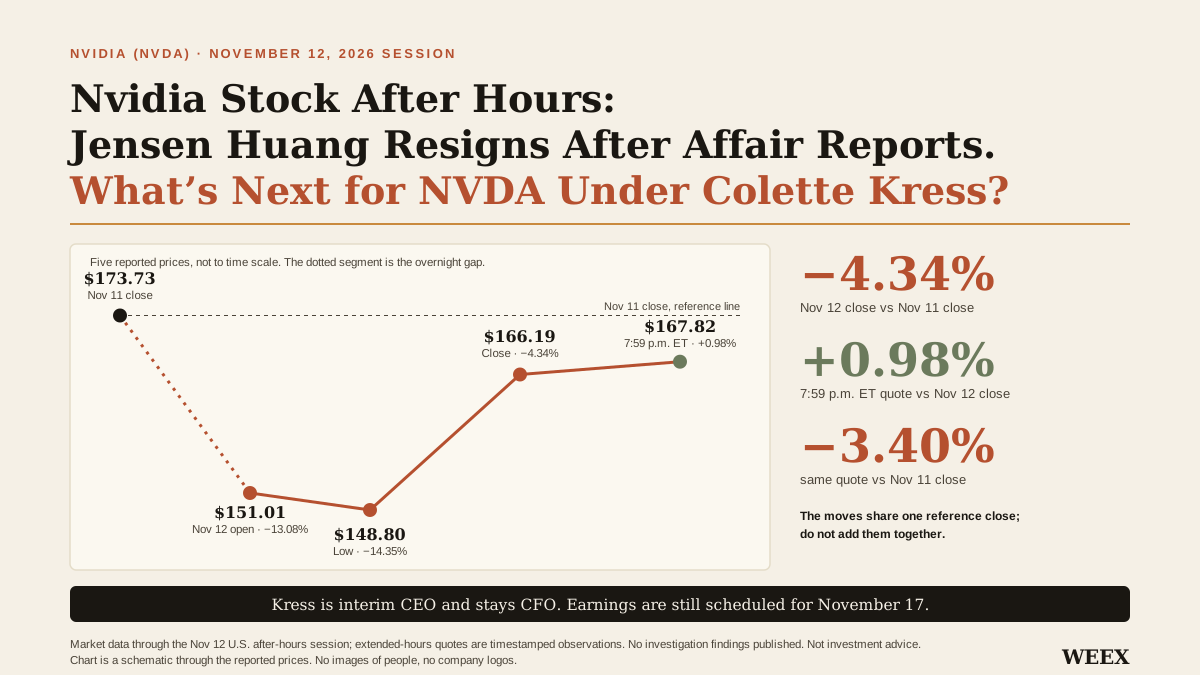
Nvidia Stock After Hours: Jensen Huang Resigns After Affair Reports. What’s Next for NVDA Under Colette Kress?
Nvidia fell 4.34% after Jensen Huang resigned, then rose 0.98% after hours. See what Colette Kress’s appointment means for NVDA and November 17 earnings.

Nvidia CEO Resignation Impacts Tech Stocks; Bitcoin Falls to $70,000 Support | WEEX Daily Market Brief (November 13, 2026)
Technology-stock selling pushed Bitcoin down to the $70,000 support level, while Ethereum briefly fell below $2,000. Spot Bitcoin ETFs recorded net outflows for the fifth consecutive trading day. Nvidia CEO’s resignation triggered sharp share-price volatility. Nebius’s full-year guidance missed expectations. The October PPI is the key release to watch on November 13.

Kidnapping of the 'Crypto King': Defense Claims Setup

Aave Proposal Targets $3.5M in Added Annual Revenue Through Reserve-Factor Changes

Injective Veyra upgrade heads to governance vote ahead of November 24 launch

Jensen Huang's Sudden Departure Raises Questions: Did the White House Intervene? Is a Return Possible?
Zilliqa, Gnosis, and Ronin Join the Ethereum Ecosystem: Is the Era of Layer 1 Over?
Chainstack Traces Customer Data Breach to Exposed Admin Tools
Anthropic Yet to Go Public, Crypto Players Already Cashing In
Interpretation of FATF Report on Scam Compound Funds: Virtual Assets Become Core Money Laundering Channels
How Much Is Anthropic Really Worth?
Microsoft System Outage Disrupts Markets, Traders Forced to Communicate via Phone
Latest articles




Latest coin listings on WEEX


