
Bloom Energy vs. Constellation Energy: On-Site Power or Grid Power, Which Wins the Data Center?

 Prefer us on Google
According to the International Energy Agency (IEA), global data center electricity consumption is projected to roughly double by 2030, reaching approximately 945 terawatt-hours (TWh), while Goldman Sachs forecasts a 165% jump in power demand by the end of the decade, compared to 2023 levels.
This push for power has put energy providers in the spotlight, from power equipment providers like Bloom Energy (BE -3.60%) to utility power producers like Constellation Energy (CEG +2.79%).
The choice between Bloom Energy and Constellation Energy boils down to one question: Do hyperscalers prefer on-site, "behind-the-meter" power solutions or baseload utility-scale grid power for their data centers? Here's who data centers are going with.
Image source: Getty Images.
Bloom Energy helps data centers get power quickly
Bloom Energy's biggest advantage for technology companies seeking on-site solutions is its time-to-power advantage. For many data center developers, the biggest bottleneck is interconnection wait times. It can take up to seven years or more in constrained energy regions.
Bloom's solid-oxide fuel cells have become a popular solution after the company in 2025 delivered to Oracle's data center in just 55 days, well ahead of its 90-day target. This led to a massive deal with Oracle, which the companies expanded upon earlier this year.
On top of that, Brookfield Asset Management, another major data center developer, expanded its financing framework with Bloom Energy fivefold, from $5 billion to $25 billion, earlier this year.
Constellation Energy is the largest nuclear operator in the U.S.
Constellation Energy's advantage is its massive nuclear energy fleet, the largest in the United States, and its merchant power producer business model. For technology companies looking to reduce carbon emissions while meeting growing electricity demand, nuclear energy has emerged as a popular solution.
Constellation is structuring its deals with hyperscalers through power purchase agreements (PPAs) that provide long-term revenue for Constellation while data centers secure long-term power.
Regulators have scrutinized deals by power producers, primarily concerned that residential customers will have to foot the bill for rising electricity costs and power grid build-out. To address these concerns, Constellation is bringing new energy capacity online, including Three Mile Island Unit 1 as part of its deal with Microsoft , to reduce strain on the grid. It has similar arrangements in place with Meta Platforms , Amazon , Alphabet , and Walmart.
Bloom Energy vs. Constellation Energy: Which is the better investment?
Technology companies are leaving no stone unturned in their search for power solutions, benefiting both Bloom and Constellation.
Bloom Energy offers higher upside potential, especially in the next few years as data centers scramble to install on-site power for data centers coming online. That said, its solid-oxide fuel cells use natural gas (with the option for hydrogen), which still produces emissions and is viewed as a bridge fuel.
Constellation Energy is a better long-term play, given its massive nuclear energy fleet and long-term agreements with major technology companies. For investors seeking a long-term stock poised to benefit from growing energy demand in the coming decades, Constellation is an excellent choice.
This content is provided for general informational purposes only and doesn't constitute financial, investment, legal, or tax advice. Any events, rewards, online promotions, or related information mentioned herein should not be considered a recommendation, solicitation, or invitation to purchase, sell, trade, or otherwise deal in any crypto assets. Crypto assets are highly volatile and may result in loss. The availability of WEEX services, products, and related events may vary by region. You are responsible for ensuring that your participation is in accordance with applicable local laws and regulations.
You may also like

Coffeezilla investigates Trump’s crypto empire and $500 million UAE deal

Lessons from Five Years of Real Estate Tokenization: Why Only Two Models May Succeed?

Yen Fluctuations Highlight Current Trading Difficulties, Investors Have Huge Divergence on Long-term Outlook

BNY Mellon Adds to Invesco Galaxy Bitcoin ETF: What Changes with the Custody Filing?

JPMorgan's Q3 Holdings: Significant Increase in Nvidia, AI Powerhouses Remain 'Cornerstone', Semiconductor Hardware Stocks Face Systematic Reductions

Czech central bank tests DLT bonds, boxing out stablecoins

South Korea Proposes Withdrawal Suspension for Cryptocurrency: What Happens When Exchanges Suspect a Hack

These 6 Data Software Stocks Help Companies Put AI to Work
Revenue Becomes the Toughest Crypto Narrative This Year

Chainlink and Moody’s Complete Testnet Pilot for Cross-Chain Credit Ratings

Bit Digital Q3 2026: Analyzing the Relationship Between ETH Treasury and Collateral
Canton Coin ETF and November 13: What the SEC Filing States and Does Not State

Exclusive: Canton Strategic CEO warns MEV could raise costs for tokenized stock traders

CARF Customer Transaction Information Report: What Data Processing is Required from On-Chain Transactions to Tax Reporting?

Former Polychain Partner Launches Startup: Enters Tokenized Real Estate, Secures $50 Million Seed Round Funding to Create the 'S&P 500' of Real Estate

Seminar: The History of Hyperliquid and On-Chain Finance Guest: Takuya Fujita (11/18 19:30 @ Gentosha)
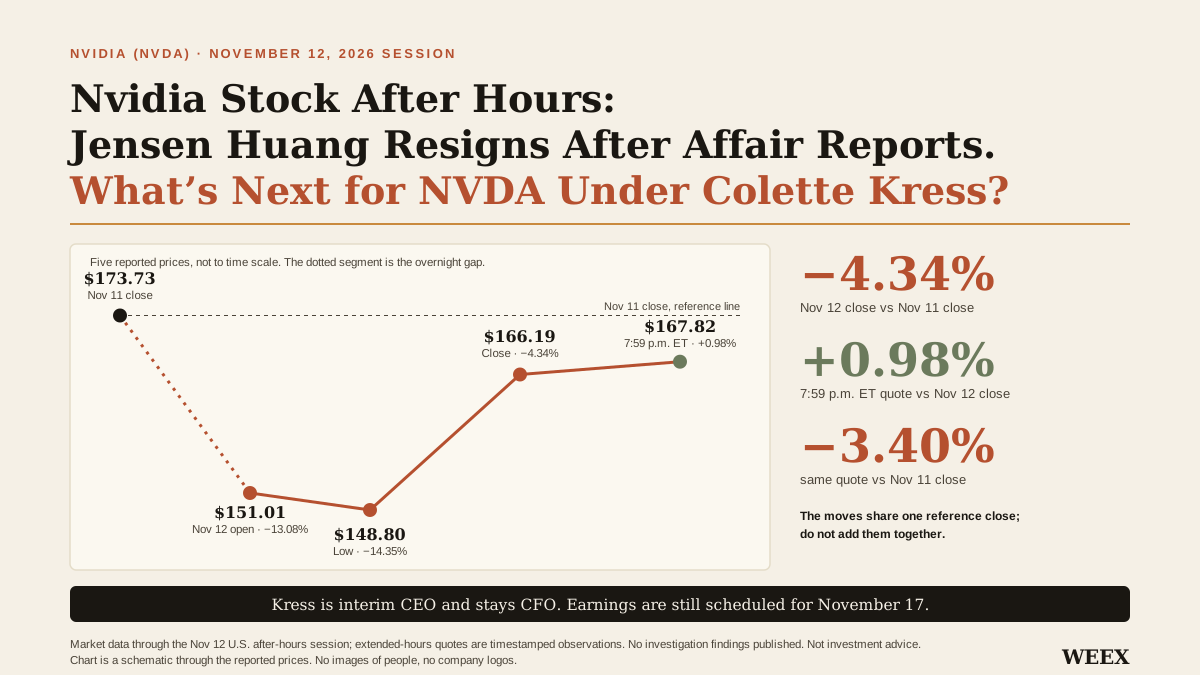
Nvidia Stock After Hours: Jensen Huang Resigns After Affair Reports. What’s Next for NVDA Under Colette Kress?
Nvidia fell 4.34% after Jensen Huang resigned, then rose 0.98% after hours. See what Colette Kress’s appointment means for NVDA and November 17 earnings.

Nvidia CEO Resignation Impacts Tech Stocks; Bitcoin Falls to $70,000 Support | WEEX Daily Market Brief (November 13, 2026)
Technology-stock selling pushed Bitcoin down to the $70,000 support level, while Ethereum briefly fell below $2,000. Spot Bitcoin ETFs recorded net outflows for the fifth consecutive trading day. Nvidia CEO’s resignation triggered sharp share-price volatility. Nebius’s full-year guidance missed expectations. The October PPI is the key release to watch on November 13.

Kidnapping of the 'Crypto King': Defense Claims Setup

Aave Proposal Targets $3.5M in Added Annual Revenue Through Reserve-Factor Changes

Injective Veyra upgrade heads to governance vote ahead of November 24 launch

Jensen Huang's Sudden Departure Raises Questions: Did the White House Intervene? Is a Return Possible?
How Do Third-Party Rating Agencies Assess WEEX’s Asset Security?

In-Depth Interview | Fu Peng: I Have No Faith in BTC

Cerebras Conference Call: Secures Major Deal with Microsoft, HBM Shortage Becomes an Opportunity, WSE-5 Chip to Enter Mass Production Next Summer

SoundHound AI Stock Is Down Almost 60% in 2026, but Wall Street Thinks It Can Soar 155% By the End of 2027. Here’s Why It Could Be One of the Best Buys Amid the Tech Sell-Off.
What is being said at the tables: the market begins to see 2027 as an all-or-nothing scenario
ASA Presses Court to Halt Stock Perpetuals, Putting Retail Risk at Center of Fight

PNC’s Coinbase Pilot Turns Incoming USDC Into Business Bank Deposits

Aave user loses $305,000 after Across Protocol website hijack
Coffeezilla investigates Trump’s crypto empire and $500 million UAE deal
Lessons from Five Years of Real Estate Tokenization: Why Only Two Models May Succeed?
Yen Fluctuations Highlight Current Trading Difficulties, Investors Have Huge Divergence on Long-term Outlook
BNY Mellon Adds to Invesco Galaxy Bitcoin ETF: What Changes with the Custody Filing?
JPMorgan's Q3 Holdings: Significant Increase in Nvidia, AI Powerhouses Remain 'Cornerstone', Semiconductor Hardware Stocks Face Systematic Reductions
Czech central bank tests DLT bonds, boxing out stablecoins
Latest articles
Latest coin listings on WEEX


