
Exclusive: Canton Strategic CEO warns MEV could raise costs for tokenized stock traders

 Prefer us on Google
Canton Strategic Holdings CEO Mark Wendland has warned that maximum extractable value (MEV) could leave tokenized stock investors paying hidden trading costs as financial institutions choose which blockchain networks to use.
Summary
- Canton Strategic CEO Mark Wendland warns that MEV can leave onchain traders with hidden costs.
- Wendland told crypto.news that Canton prevents validator tips and restricts visibility of pending blockchain trades.
- Helius tracked 1.55 million sandwich transactions and $13.43 million in profits from one Solana program.
- Canton Strategic completed tokenized share trades as issuers consider where their securities may trade onchain.
Wendland told crypto.news that issuers and investors need protection against traders who gain priority over other transactions. His comments followed Digital Asset co-founder and CEO Yuval Rooz's article on X, "Front-Running Is Not Payment for Order Flow," which questioned how some public blockchains handle transaction ordering. Digital Asset and Rooz hold minority stakes in Canton Strategic Holdings.
"Issuers and market participants deserve an onchain market structure that prevents front-running and protects users from hidden costs," Wendland said.
He argued that payments to validators can give some traders preferential execution while other users receive less favorable prices.
Canton Strategic CEO criticizes paid transaction ordering
MEV describes profits that can arise when traders or network operators influence the sequence of blockchain transactions. One form, known as a sandwich attack, involves buying an asset immediately before another trader's order and selling afterward at a higher price. The targeted trader may complete the transaction without seeing a separate charge for the price difference.
"When transacting on a chain that permits MEV, the true trading costs are paid by users who receive subpar execution," Wendland said.
He described validator tips as payments that let certain orders move ahead of others.
Rooz drew a distinction between harmful MEV practices and payment for order flow, which allows brokerages to receive compensation for directing customer orders to market makers. The latter operates within securities-market requirements, including best execution and disclosures. Under FINRA Rule 5310, broker-dealers must use reasonable diligence to obtain favorable execution terms for customers.
The Digital Asset executive argued that the amount a bot pays for transaction priority does not show the full loss incurred by affected users. He cited research on Solana sandwich trading to explain why bot profits and validator tips should be examined separately.
Solana research shows how sandwich attacks generate profits
A Helius report documented 1.55 million sandwich transactions by one Solana trading program during the 30 days ending January 5, 2025. The program generated 65,880 SOL, worth approximately $13.43 million, in profit while paying 22,760 SOL, or $4.63 million, in Jito tips.
Helius found that 16 of the 20 tokens most frequently targeted by the program had originated on Pump.fun. The report examined one program, not all Solana transactions, and distinguished tips paid to validators from profits captured by trading bots.
Rooz's article cited these findings while arguing that the same transaction-ordering concerns deserve scrutiny as blockchains begin supporting securities. He acknowledged that not every form of MEV is harmful, distinguishing sandwich attacks from arbitrage that helps align prices between trading venues.
Canton Network says its design blocks MEV
Wendland said Canton's network architecture is intended to remove the conditions that make sandwich attacks possible: public visibility of pending transactions and payments that influence transaction ordering.
"Importantly, the Canton Network is designed to prohibit MEV both in structure and practice," he told crypto.news.
He said its privacy protections prevent universal visibility of orders and that validators cannot accept payments to change their position in the transaction sequence.
Canton's published documentation describes a system in which parties only receive transaction information relevant to them. The Global Synchronizer coordinates ordering, while network operators can access limited metadata needed to confirm transactions, not the full transaction contents. Network usage fees are burned, and Canton Coin rewards support infrastructure operators and other contributors.
Rooz said the absence of a public mempool and paid priority ordering prevents the kind of sandwiching he described. His article was prompted in part by SupaNova, a memecoin trading application operating on Canton, where the network's transaction protections are intended to apply to individual trades.
Tokenized stock trading raises questions over venue selection
Canton Strategic completed its first tokenized share trades on November 4 under a US Securities and Exchange Commission exemption. Five North sold tokenized CNTN shares to DRW Cumberland, with Flowdesk supplying liquidity through a permissioned trading pool. Fairmint, an SEC-registered transfer agent, maintains the ownership record.
The issue of issuer control has surfaced elsewhere in tokenized securities trading. At least 67 companies had objected to OKXICE's tokenization plans by November 5, while the venue announced a November 23 launch for eligible US customers. The exemption allows issuers to object to third-party tokenization of their shares on a specific venue.
Meanwhile, Formation Securities has proposed Solana-based stock trading beginning in 2027, subject to applicable requirements. Its proposed securities include shares of Exodus Movement, Forward Industries and Galaxy Digital.
"As we speak, decisions are being made by institutions and regulators that will shape onchain markets well into the future," Wendland said.
He added that issuers are choosing which venues and blockchains may carry tokenized versions of their shares, while firms assess cost, speed and compliance.
This content is provided for general informational purposes only and doesn't constitute financial, investment, legal, or tax advice. Any events, rewards, online promotions, or related information mentioned herein should not be considered a recommendation, solicitation, or invitation to purchase, sell, trade, or otherwise deal in any crypto assets. Crypto assets are highly volatile and may result in loss. The availability of WEEX services, products, and related events may vary by region. You are responsible for ensuring that your participation is in accordance with applicable local laws and regulations.
You may also like
Canton Coin ETF and November 13: What the SEC Filing States and Does Not State

CARF Customer Transaction Information Report: What Data Processing is Required from On-Chain Transactions to Tax Reporting?

Former Polychain Partner Launches Startup: Enters Tokenized Real Estate, Secures $50 Million Seed Round Funding to Create the 'S&P 500' of Real Estate

Seminar: The History of Hyperliquid and On-Chain Finance Guest: Takuya Fujita (11/18 19:30 @ Gentosha)
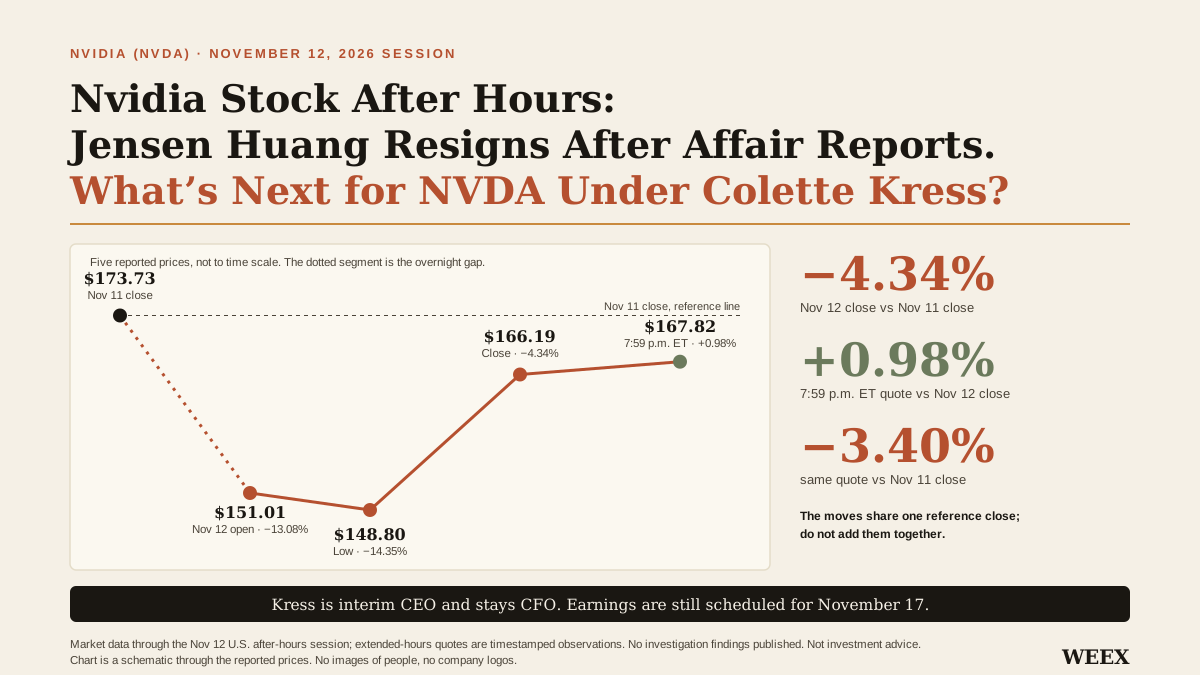
Nvidia Stock After Hours: Jensen Huang Resigns After Affair Reports. What’s Next for NVDA Under Colette Kress?
Nvidia fell 4.34% after Jensen Huang resigned, then rose 0.98% after hours. See what Colette Kress’s appointment means for NVDA and November 17 earnings.

Nvidia CEO Resignation Impacts Tech Stocks; Bitcoin Falls to $70,000 Support | WEEX Daily Market Brief (November 13, 2026)
Technology-stock selling pushed Bitcoin down to the $70,000 support level, while Ethereum briefly fell below $2,000. Spot Bitcoin ETFs recorded net outflows for the fifth consecutive trading day. Nvidia CEO’s resignation triggered sharp share-price volatility. Nebius’s full-year guidance missed expectations. The October PPI is the key release to watch on November 13.

Kidnapping of the 'Crypto King': Defense Claims Setup

Aave Proposal Targets $3.5M in Added Annual Revenue Through Reserve-Factor Changes

Injective Veyra upgrade heads to governance vote ahead of November 24 launch

Jensen Huang's Sudden Departure Raises Questions: Did the White House Intervene? Is a Return Possible?

How Do Third-Party Rating Agencies Assess WEEX’s Asset Security?

In-Depth Interview | Fu Peng: I Have No Faith in BTC

Cerebras Conference Call: Secures Major Deal with Microsoft, HBM Shortage Becomes an Opportunity, WSE-5 Chip to Enter Mass Production Next Summer

SoundHound AI Stock Is Down Almost 60% in 2026, but Wall Street Thinks It Can Soar 155% By the End of 2027. Here’s Why It Could Be One of the Best Buys Amid the Tech Sell-Off.
What is being said at the tables: the market begins to see 2027 as an all-or-nothing scenario

ASA Presses Court to Halt Stock Perpetuals, Putting Retail Risk at Center of Fight

PNC’s Coinbase Pilot Turns Incoming USDC Into Business Bank Deposits

Aave user loses $305,000 after Across Protocol website hijack

Circle and Global Citizen Plan USDC Vendor Payments for Move Afrika in 2027

Cisco's Q1 Earnings Exceed Expectations: AI Infrastructure Revenue Expected to Double This Fiscal Year

Cerebras Soars! Q3 Revenue Exceeds Expectations, Cloud Business Surges 272%, Raises Full-Year Guidance

BitGo and TOPPAN Conduct Proof of Concept for Decentralized Key Management of Digital Assets Amid Rising Fraudulent Outflows

Bottomline Completes First USDC Transfers Inside Its Enterprise Payments Platform
Ethereum Plans to Advance Its Post-Quantum Transition to 2027

Republican Senator Wants to Freeze AI Data Center Boom as Congress Pushes to Expand It
DOJ's Operation TorNado Arrests 354 And Seizes $234 Million In Cash And Crypto

Google Releases Gemini 4 Hydrogen: 5x Reduction in Hallucinations, Doubling of Speed

USDC Enters Dual EU Supervision as EBA Oversight Takes Effect

CoreWeave Says Its AI Demand Is 10 Times Its Capacity Through 2027. I Think Micron Stock Is Still Worth Buying.
Why the Path to Quantum Resistance Runs Uphill for Bitcoin Wallet Makers
Canton Coin ETF and November 13: What the SEC Filing States and Does Not State
CARF Customer Transaction Information Report: What Data Processing is Required from On-Chain Transactions to Tax Reporting?
Former Polychain Partner Launches Startup: Enters Tokenized Real Estate, Secures $50 Million Seed Round Funding to Create the 'S&P 500' of Real Estate
Seminar: The History of Hyperliquid and On-Chain Finance Guest: Takuya Fujita (11/18 19:30 @ Gentosha)
Nvidia Stock After Hours: Jensen Huang Resigns After Affair Reports. What’s Next for NVDA Under Colette Kress?
Nvidia fell 4.34% after Jensen Huang resigned, then rose 0.98% after hours. See what Colette Kress’s appointment means for NVDA and November 17 earnings.
Nvidia CEO Resignation Impacts Tech Stocks; Bitcoin Falls to $70,000 Support | WEEX Daily Market Brief (November 13, 2026)
Technology-stock selling pushed Bitcoin down to the $70,000 support level, while Ethereum briefly fell below $2,000. Spot Bitcoin ETFs recorded net outflows for the fifth consecutive trading day. Nvidia CEO’s resignation triggered sharp share-price volatility. Nebius’s full-year guidance missed expectations. The October PPI is the key release to watch on November 13.
Latest articles


Latest coin listings on WEEX


