
Canton Coin ETF and November 13: What the SEC Filing States and Does Not State

 Prefer us on Google
Key Points: The filing submitted by ETF Opportunities Trust designates November 13, 2026, as the new effective date for the proposed REX-Osprey Canton Coin ETF among the previously filed post-effective amendments. The purpose of this filing is to establish that date. It does not announce the listing, trading commencement, or investment inflows, nor does it represent the SEC's endorsement of Canton Coin. As of the verification point of this article (November 13, 03:45 UTC), the trading status should be treated as unconfirmed until the issuer and the listing exchange publish valid documents.
What Does the Filing State?
The Form 485BXT amendment hosted by the SEC states that the sole purpose is to designate November 13, 2026, as the new effective date for Post-Effective Amendment No. 486 to the existing registration statement. The fund is identified as the REX-Osprey Canton Coin ETF. This is an administrative filing that serves a specific legal function and is not a press release reporting initial trading, listing notifications including tickers and exchange opening times, or fund flow reports.
This date is significant because it is a prerequisite for proceeding with the registration under the fund structure. However, it does not serve as evidence that all steps regarding sales, listing, and operations have been completed. The issuer may still require a final prospectus, agreements with exchanges, authorized participants (APs), market makers, and operational readiness. These may be completed around the registration date, but cannot be inferred solely from the text of 485BXT.
The wording of the form also refers back to a post-effective amendment initially filed on December 1, 2025, changing its effective date. Readers who only see "November 13" on the calendar should verify which document was amended and to which actions the new date applies. Otherwise, procedural extensions may be misinterpreted as new fund approvals. Previous filings have similarly shifted dates, and the latest schedule item should be read as part of that context.
Is the Effective Date the Same as SEC Approval?
No. The registration statement becoming effective through statutory procedures does not imply that the regulatory authority supports the assets or recommends the fund. Securities registration statements typically state that the SEC has neither approved nor disapproved the securities and has not judged the adequacy or accuracy of the prospectus. Investors should not convert the mechanism of the effective date into a quality assurance stamp for the underlying tokens.
The filing itself states that it was made under Rule 485(b)(1)(iii). This is a provision used to designate a new effective date for previously submitted amendments. The text establishing the date does not include any substantive new investment thesis. To evaluate the proposed fund, one must review the incorporated prospectus and its subsequently finalized versions. The prospectus describes investment strategies, fees, custody, tax structures, and risks, not a calendar display on social media.
This distinction is particularly important for token-linked funds. The expression "ETF has been applied for" can refer to any of the initial registration, amendments, exchange rule filings, effective date notifications, or actual listings. The evidential weight varies at each stage. Articles stating "approved" based on documents in the SEC database are inaccurate. The SEC merely publishes filings from market participants, and publication does not imply endorsement.
How Does the Fund Provide Exposure to Canton?
The economic exposure of the proposed fund must be derived from a valid prospectus. Depending on the structure, token-linked ETFs may gain exposure by directly holding assets, through subsidiaries, using derivatives, or holding cash and short-term financial products alongside assets. These choices affect tracking, custody, costs, and tax treatment. One should not assume that one share of the ETF is equivalent to a certain amount of Canton Coin or that the fund will seamlessly track token prices.
The initial registration-related materials discuss the exposure to Canton and the risks associated with the fund structure. These details may have been amended in the current prospectus. What should be questioned on the launch date is what the ultimately valid documents state, not what the initial drafts anticipated. Fees can suppress returns. Premiums or discounts to net asset value (NAV) can cause stock prices to diverge from the value of the underlying exposure. Additionally, in younger products, the activities of authorized participants (APs) may be restricted.
Custody of tokens adds another layer. If the fund holds tokens or uses subsidiaries, investors will rely on the fund's custody and management systems rather than holding Canton Coin in their own crypto asset wallets. This simplifies broker access but does not provide control on the blockchain or direct involvement in the network. If tokens are sought for on-chain use, the ETF shares may not be compatible with the tokens. If exposure is sought through a brokerage account, the fund's costs and tracking methods become important.
What Information Can Confirm Trading Commencement?
Look for date-stamped announcements from the issuer, the final prospectus detailing fund conditions, exchange listing notifications, and live quotes with tickers. This allows for verification of initial trading against exchange data. Any listing announcements made after the verification time of this article should be added as date-stamped updates. Regulatory filings with only the effective date do not provide these facts.
Even after listing, initial trading does not necessarily indicate stable demand. The trading volume during the session may be due to inventory for market making, seed trades, or crypto asset arbitrage, and may not reflect allocations from long-term investors. Assets under management (AUM) and net creation numbers are better indicators of fund acceptance but require official fund data with observation dates. Even if there is a rise in Canton token prices during the same period, it cannot be proven that this is due to the filing. There may also be movements in the overall market or pre-existing positions.
If conducting a market impact analysis, identify the initial public filing date, subsequent amendment dates, the final prospectus creation date, and the actual trading commencement. Then examine the token prices and liquidity around each timestamp. If the fund's registration date was publicly known weeks in advance, the price fluctuations on November 13 may reflect different information. The explanation of "buy on rumor, sell on news" is an interpretation, not a fact provided by the filing.
What Does This Mean for Canton Coin Holders?
The immediate conclusion is procedural. The proposed fund has passed (or is expected to pass) registration milestones according to the submitted schedule. Token holders continue to face the specific market risks, network risks, and custody risks associated with that token. Potential demand stemming from the fund may hold significance in the future, but this filing does not quantify inflows or obligate the issuer to purchase a certain amount of tokens on November 13. Claims regarding supply and demand require observable settings, redemptions, holdings, and reliable exchange data.
Holders should distinguish between the regulated wrapper of the fund and the regulatory positioning of the underlying asset or the Canton network itself. A particular security product may be offered under a specific fund framework, but it does not turn all token transactions into securities, nor does it regulate all network activities similarly. The fund's prospectus may describe risks that remain with investors despite being outside the wrapper.
A practical watchlist includes the following four items: the ultimately valid prospectus, confirmed listings and tickers, the spread and depth on the first day, and subsequent official holding and creation data. These are observable milestones that help assess accessibility and acceptance without implying price targets. If any stage is missing, it should be stated as lacking without filling it with assumptions.
Frequently Asked Questions (FAQ)
Did the SEC Approve Canton Coin on November 13?
The mentioned filing designates the effective date for the fund registration amendment. It does not state that the SEC supports Canton Coin or recommends the fund.
Can Investors Currently Purchase This ETF?
As of the verification point (UTC 03:45), this article has not confirmed the commencement of trading on the exchange. Please check the issuer's and listing exchange's final notifications and live tickers before making such claims.
Does the ETF Filing Guarantee Demand for CC?
No. Purchases by investors, share creations, and the associated fund's token exposure require observable activities thereafter. The filing date alone does not provide any of these figures.
This content is provided for general informational purposes only and doesn't constitute financial, investment, legal, or tax advice. Any events, rewards, online promotions, or related information mentioned herein should not be considered a recommendation, solicitation, or invitation to purchase, sell, trade, or otherwise deal in any crypto assets. Crypto assets are highly volatile and may result in loss. The availability of WEEX services, products, and related events may vary by region. You are responsible for ensuring that your participation is in accordance with applicable local laws and regulations.
You may also like

Exclusive: Canton Strategic CEO warns MEV could raise costs for tokenized stock traders

CARF Customer Transaction Information Report: What Data Processing is Required from On-Chain Transactions to Tax Reporting?

Former Polychain Partner Launches Startup: Enters Tokenized Real Estate, Secures $50 Million Seed Round Funding to Create the 'S&P 500' of Real Estate

Seminar: The History of Hyperliquid and On-Chain Finance Guest: Takuya Fujita (11/18 19:30 @ Gentosha)
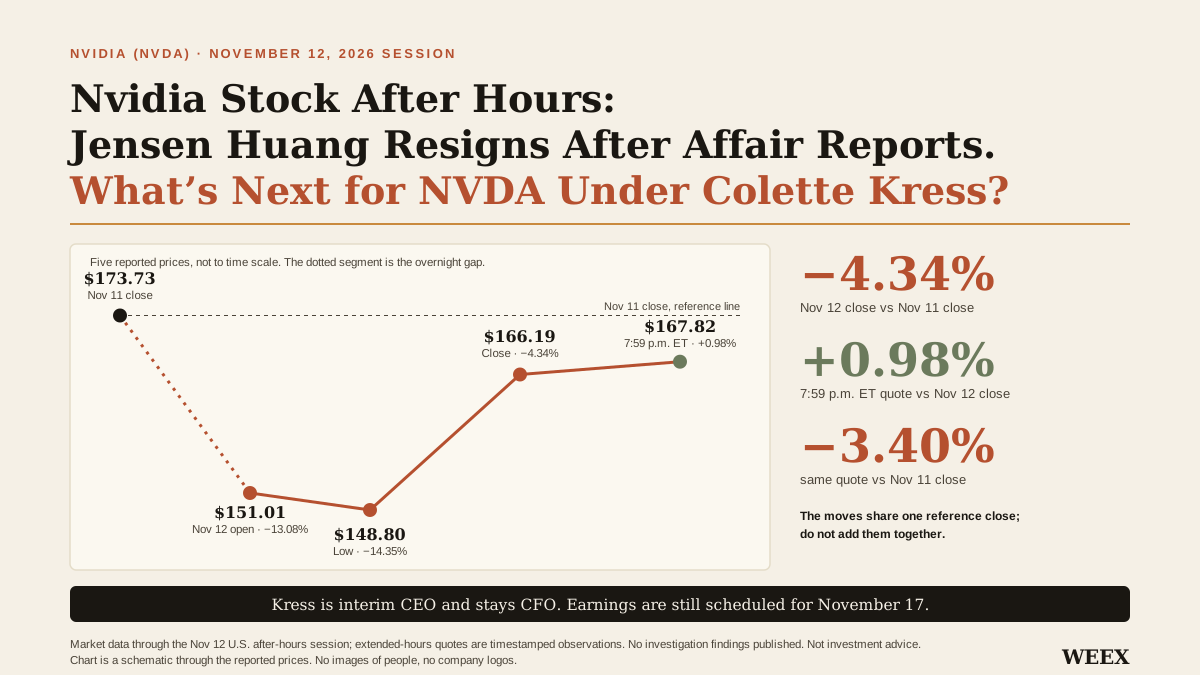
Nvidia Stock After Hours: Jensen Huang Resigns After Affair Reports. What’s Next for NVDA Under Colette Kress?
Nvidia fell 4.34% after Jensen Huang resigned, then rose 0.98% after hours. See what Colette Kress’s appointment means for NVDA and November 17 earnings.

Nvidia CEO Resignation Impacts Tech Stocks; Bitcoin Falls to $70,000 Support | WEEX Daily Market Brief (November 13, 2026)
Technology-stock selling pushed Bitcoin down to the $70,000 support level, while Ethereum briefly fell below $2,000. Spot Bitcoin ETFs recorded net outflows for the fifth consecutive trading day. Nvidia CEO’s resignation triggered sharp share-price volatility. Nebius’s full-year guidance missed expectations. The October PPI is the key release to watch on November 13.

Kidnapping of the 'Crypto King': Defense Claims Setup

Aave Proposal Targets $3.5M in Added Annual Revenue Through Reserve-Factor Changes

Injective Veyra upgrade heads to governance vote ahead of November 24 launch

Jensen Huang's Sudden Departure Raises Questions: Did the White House Intervene? Is a Return Possible?

How Do Third-Party Rating Agencies Assess WEEX’s Asset Security?

In-Depth Interview | Fu Peng: I Have No Faith in BTC

Cerebras Conference Call: Secures Major Deal with Microsoft, HBM Shortage Becomes an Opportunity, WSE-5 Chip to Enter Mass Production Next Summer

SoundHound AI Stock Is Down Almost 60% in 2026, but Wall Street Thinks It Can Soar 155% By the End of 2027. Here’s Why It Could Be One of the Best Buys Amid the Tech Sell-Off.
What is being said at the tables: the market begins to see 2027 as an all-or-nothing scenario

ASA Presses Court to Halt Stock Perpetuals, Putting Retail Risk at Center of Fight

PNC’s Coinbase Pilot Turns Incoming USDC Into Business Bank Deposits

Aave user loses $305,000 after Across Protocol website hijack

Circle and Global Citizen Plan USDC Vendor Payments for Move Afrika in 2027

Cisco's Q1 Earnings Exceed Expectations: AI Infrastructure Revenue Expected to Double This Fiscal Year

Cerebras Soars! Q3 Revenue Exceeds Expectations, Cloud Business Surges 272%, Raises Full-Year Guidance

BitGo and TOPPAN Conduct Proof of Concept for Decentralized Key Management of Digital Assets Amid Rising Fraudulent Outflows

Bottomline Completes First USDC Transfers Inside Its Enterprise Payments Platform
Ethereum Plans to Advance Its Post-Quantum Transition to 2027

Republican Senator Wants to Freeze AI Data Center Boom as Congress Pushes to Expand It
DOJ's Operation TorNado Arrests 354 And Seizes $234 Million In Cash And Crypto

Google Releases Gemini 4 Hydrogen: 5x Reduction in Hallucinations, Doubling of Speed

USDC Enters Dual EU Supervision as EBA Oversight Takes Effect

CoreWeave Says Its AI Demand Is 10 Times Its Capacity Through 2027. I Think Micron Stock Is Still Worth Buying.
Why the Path to Quantum Resistance Runs Uphill for Bitcoin Wallet Makers
Exclusive: Canton Strategic CEO warns MEV could raise costs for tokenized stock traders
CARF Customer Transaction Information Report: What Data Processing is Required from On-Chain Transactions to Tax Reporting?
Former Polychain Partner Launches Startup: Enters Tokenized Real Estate, Secures $50 Million Seed Round Funding to Create the 'S&P 500' of Real Estate
Seminar: The History of Hyperliquid and On-Chain Finance Guest: Takuya Fujita (11/18 19:30 @ Gentosha)
Nvidia Stock After Hours: Jensen Huang Resigns After Affair Reports. What’s Next for NVDA Under Colette Kress?
Nvidia fell 4.34% after Jensen Huang resigned, then rose 0.98% after hours. See what Colette Kress’s appointment means for NVDA and November 17 earnings.
Nvidia CEO Resignation Impacts Tech Stocks; Bitcoin Falls to $70,000 Support | WEEX Daily Market Brief (November 13, 2026)
Technology-stock selling pushed Bitcoin down to the $70,000 support level, while Ethereum briefly fell below $2,000. Spot Bitcoin ETFs recorded net outflows for the fifth consecutive trading day. Nvidia CEO’s resignation triggered sharp share-price volatility. Nebius’s full-year guidance missed expectations. The October PPI is the key release to watch on November 13.
Latest articles


Latest coin listings on WEEX


