
Ethereum Plans to Advance Its Post-Quantum Transition to 2027

 Prefer us on Google


- The proposal contemplates that Ethereum will operate at reduced capacity if its current cryptography is compromised.
- Ethlabs proposes to remove Quick Slots, which would reduce Ethereum's block time from 12 to 10 seconds.
The race to keep cryptocurrency networks secure could force Ethereum to change the order of its priorities. Ethlabs presented a proposal on November 11 to accelerate the network's preparation against technological threats that could compromise current cryptographic systems.
The plan, dubbed <
Ethlabs argues that advancements in artificial intelligence are accelerating both the search for computer vulnerabilities and mathematical research. As an example, it cites a work by OpenAI that allowed the identification and correction of nearly 1,000 vulnerabilities in Linux using an advanced AI model.
The lab also warns that advancements in quantum computing could arrive sooner than expected. It notes that the U.S. government has moved its timeline for addressing quantum risks from 2035 to 2030, while Google aims to complete its transition to quantum-resistant systems by 2029.
The proposal establishes two levels of preparedness. The first, called <
The second level, <
To meet this timeline, the lab proposes to reorganize the planned changes for the Hegotá update. Among them, it seeks to maintain Frames (EIP-8141), a proposal that would allow for more flexible authorization rules for Ethereum accounts, as explained in CriptoNoticias. Instead, it proposes to remove Quick Slots, an improvement that would reduce the time between blocks from 12 to 10 seconds. It also conditions the inclusion of FOCIL, a proposal aimed at strengthening resistance to censorship, on it not delaying the transition.
Another pending point is to decide whether it is advisable to adapt Gasper, the current consensus mechanism, or to move towards a decoupled consensus system. To achieve full capacity, improvements in signature aggregation and data availability would also be necessary. The Glamsterdam update would continue as planned.
For now, the plan does not have the approval of the key developers. The roadmap published by the Ethereum Foundation maintained December 2029 as the target for completing quantum resistance, although Justin Drake expressed during Devcon his expectation of advancing it to December 2028.
The debate goes beyond replacing algorithms: Ethereum needs to coordinate the migration of users, validators, and developers without compromising its operation. If it succeeds, security could become an advantage to attract institutions and protect the value stored in its infrastructure.
-- Price
This content is provided for general informational purposes only and doesn't constitute financial, investment, legal, or tax advice. Any events, rewards, online promotions, or related information mentioned herein should not be considered a recommendation, solicitation, or invitation to purchase, sell, trade, or otherwise deal in any crypto assets. Crypto assets are highly volatile and may result in loss. The availability of WEEX services, products, and related events may vary by region. You are responsible for ensuring that your participation is in accordance with applicable local laws and regulations.
You may also like

Davie Analyzes ETH Strategy, Focuses on Key Support and Resistance Levels

Arch Lending launches Bitcoin refinancing with 1-point rate target

Unocoin Submits Investigation into BitGo Ethereum Address Withdrawals
xStocks Tokenized Stocks Natively Run on OP Mainnet, ether.fi Launches Minting and Redemption Features

SoFi Integrates SoFiUSD into Polygon Payment Network

Deutsche Bank Introduces Custody Services for Five Cryptocurrencies

BitGo Mint Adds USDC Minting and Redemption Features
Aave Proposes to Limit the Use of Several Crypto Assets as Collateral Worth $1.33 Billion

BlockUnion and Lido Ecosystem Foundation Reach Strategic Cooperation

Bankless: After Shrinking On-chain TVL, MEGA Bets $30 Million on AI Inference Market

Péter Szilágyi Suggests Disconnecting Smart Devices from the Network

US 401(k) Rule Proposal Allows Cryptocurrency Allocation, Barriers for Altcoins

Canaan turns to Bitcoin holdings as mining machine sales fall 96%
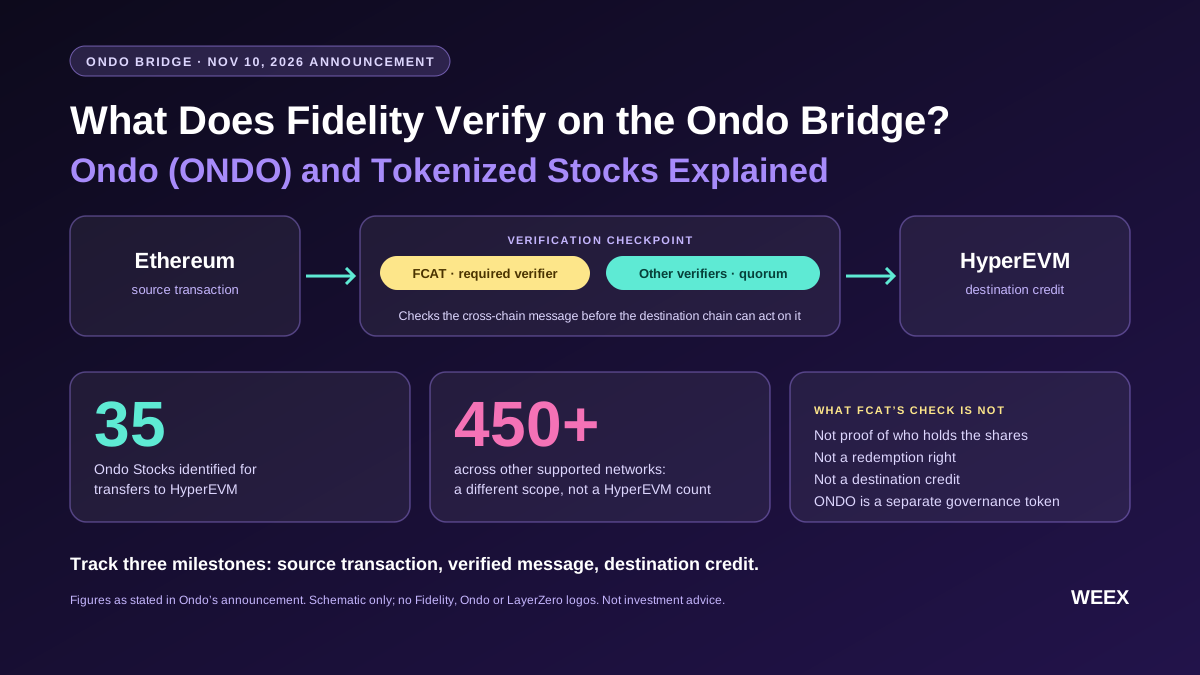
What Does Fidelity Verify on the Ondo Bridge? Ondo (ONDO) and Tokenized Stocks Explained
Learn what Fidelity’s FCAT verifies on the Ondo Bridge, how to check a tokenized stock transfer, and why Ondo Stocks differ from the ONDO token.

Hawkeye's Plan for Tokenized Shares: How Will the Shareholder Register Work?
Base’s USDC transfer footprint does not prove merchant reach, data shows

Willy Woo Argues Bitcoin Not in Bear Market Amid Fear Sentiment

Ethereum Spot ETF Sees Net Outflow of $145 Million Yesterday, Continuing Five-Day Trend

Ethereum Releases eth/73 Proof Wrapper Propagation EIP Draft
BitMine posts $2.8B quarterly profit driven by Ethereum gains, but yearly net loss surpasses $6B

[Full Text] Han Seo-hee: "Even if trade payments are sent via stablecoins, they may not be received domestically"

Ethlabs Proposes Post-Quantum and AI Security for Ethereum by 2027

How Should Institutions Manage Exchange Exposure After a Series of Thefts?

NVIDIA Board Prepares to Dismiss Jensen Huang, Hong Kong Police Arrest 22 in Money Laundering Operation
Golem Project Raises 820,000 ETH on Its 10th Anniversary, 100,000 ETH Staked

Dogecoin's Mainnet DogeOS Launch Imminent

MSCI to Remove Strategy from Global Index, Billions in Fund Flows at Risk

PNC lets businesses accept USDC without keeping the crypto

Israel Discount Bank to Open Bitcoin and Ethereum Trading in App Starting November 26

Israel Discount Bank to Open Bitcoin and Ethereum Trading in App from November 26
Davie Analyzes ETH Strategy, Focuses on Key Support and Resistance Levels
Arch Lending launches Bitcoin refinancing with 1-point rate target
Unocoin Submits Investigation into BitGo Ethereum Address Withdrawals
xStocks Tokenized Stocks Natively Run on OP Mainnet, ether.fi Launches Minting and Redemption Features
SoFi Integrates SoFiUSD into Polygon Payment Network
Deutsche Bank Introduces Custody Services for Five Cryptocurrencies
Latest articles


Latest coin listings on WEEX


