
Former Polychain Partner Launches Startup: Enters Tokenized Real Estate, Secures $50 Million Seed Round Funding to Create the 'S&P 500' of Real Estate

 Prefer us on Google
Author: Zen, PANews
The U.S. residential real estate market is valued at over $50 trillion, but unlike the stock market, investors still lack a mature financial instrument that can provide direct exposure to the price movements of the entire U.S. housing market.
Institutions like FHFA and Case-Shiller have established mature housing price statistical systems, yet a broadly liquid index investment market similar to the S&P 500 ETF has yet to form.
A startup named Index Industries is attempting to change this situation. By utilizing a daily updated U.S. housing price index, tokenization technology, and related financial services, the company aims to transform price changes across tens of millions of homes into investable and tradable financial assets.
On November 10, 2026, Index Industries announced the completion of a $50 million seed round funding, led by Lightspeed Venture Partners, with participation from Polychain Capital, Galaxy Ventures, Wintermute Ventures, and others.
This previously stealth company was co-founded by Josh Rosenthal, former president and general partner of Polychain Capital, and Brian Hardecker, founder and CEO of the residential real estate platform Longmark. Top left: Josh Rosenthal, bottom right: Brian Hardecker (Image source: Lightspeed)
$55 Trillion Housing Market, Zero Investable Index Products
Residential real estate has always been a crucial component of household wealth.
According to the Federal Reserve's financial accounts data for the second quarter of 2026, the asset value of U.S. residents' owned homes reached $49.8 trillion, with net housing equity around $35.8 trillion. Index Industries estimates that the U.S. residential real estate market is worth $55 trillion. While there are differences in statistical scope and criteria, they all reflect the enormous scale of this asset class.
However, there is a significant gap between market size and investment accessibility.
For ordinary investors, participating in the U.S. real estate market primarily involves three methods: directly purchasing homes, investing in Real Estate Investment Trusts (REITs), and buying stocks of real estate developers. However, these models come with high entry costs, management expenses, and reliance on institutional operational capabilities, and they do not represent the overall price trends of the entire housing market.
This raises the question: Is it possible to gain direct exposure to the overall price movements of the U.S. housing market without owning any homes, similar to purchasing an S&P 500 index fund?
In fact, the U.S. already has a relatively mature housing price statistical system. The two most important indicators are the FHFA House Price Index published by the Federal Housing Finance Agency (FHFA) and the S&P CoreLogic Case-Shiller Home Price Index under S&P Global. These two indices have become important references for research on the U.S. real estate market, mortgage risk management, and asset valuation.
However, they remain statistical indicators rather than financial products that ordinary investors can directly purchase. This contrasts sharply with the stock market: the S&P 500 index allows investors to convert it into assets with continuous trading capabilities through ETFs, futures, and options. The real estate sector lacks similar mature market infrastructure.
Index Industries aims to address this long-standing gap in financial tools.
From Monthly Updates to Daily Updates: How the USHP Index Measures U.S. Home Prices
Index Industries' first core product is the USHP Index (U.S. Home Price Index), which serves as the benchmark index for U.S. residential home prices.
Traditional housing price indices primarily rely on completed home transactions. Due to the low frequency of real estate transactions and the lengthy data collection and processing cycles, indicators like FHFA and Case-Shiller are usually published monthly, making it difficult for investors to obtain continuous information on price changes.
The USHP Index aims to change this situation. Its index is based on traditional housing price indicators such as the FHFA Purchase-Only HPI and Freddie Mac House Price Index, integrating relevant data through statistical models and combining signals like trends, momentum, and mortgage affordability to form a nationally updated residential price curve on a daily basis.
The entire calculation process can be divided into four stages:
- Establishing a Price Benchmark: The USHP Index is based on traditional housing price indices to establish a relatively reliable price foundation for the new index.
- Statistical Smoothing: Traditional housing price indices have publication lags; the USHP attempts to smooth different data through statistical models to estimate the current market position based on already published price changes.
- Integrating Market Signals: In addition to historical price changes, the USHP model incorporates factors like trends, price momentum, and mortgage affordability to create a continuous national housing price estimation curve.
- Publishing On-Chain Data: After the index calculation is complete, the USHP Index and related pricing data are published on Ethereum via Chainlink oracles, providing pricing references for subsequent issuance, minting, and redemption of USHP products.
Since March of this year, the USHP index has entered a real-time operational phase, with previous historical data belonging to backtesting and hypothetical data. The official introduction states that its index methodology has been independently reviewed by Andrew Davidson & Co, a mortgage and housing data analysis company.
Based on the index, Index Industries has further designed two financial products: USHP and USHPi.
USHP is a tokenized index asset based on the USHP Index, issued by USHP Limited and supported by housing-related reserve assets. Holders can gain exposure to the U.S. residential price index through USHP. It is important to clarify that USHP does not represent ownership of residential property and does not involve slicing homes into numerous shares for sale. Its core function is to provide financial exposure linked to the U.S. price index.
USHPi is the income-generating version of USHP. Holders can convert USHP into USHPi, and the USHP Foundation can distribute a portion of the income generated from reserve assets to USHPi holders. This design attempts to address another issue with traditional housing price index products: while rising home prices can yield capital gains, the price index itself does not automatically generate cash flow like bond interest or rental properties.
Financialization of Real Estate Indices: A Failed Attempt 20 Years Ago
In fact, establishing a financial product around a housing price index is not a new idea.
As early as 2006, the Chicago Mercantile Exchange (CME) attempted something similar. In May of that year, CME launched real estate futures and options based on the S&P/Case-Shiller housing price index, covering 10 major U.S. cities and a composite index. Its design concept shares similarities with today's USHP, allowing investors to bet on price changes in the real estate market without needing to purchase homes through standardized contracts.
However, this theoretically sound venture capital product did not develop as the designers had anticipated in reality.
Throughout 2007, CME's real estate futures only traded 2,935 contracts, while the total contract trading volume across all CME futures markets reached 2.2 billion. In the first nine months of 2008, the average trading volume of real estate futures fell by 59% year-on-year, and the average number of open contracts dropped by 70%. Currently, CME's S&P/Case-Shiller real estate index futures have not disappeared, but they have never formed sufficient trading depth, becoming an extremely quiet niche market.
The question arises: why is it so difficult for such a large real estate market to support a mature index derivatives market?
The first answer is liquidity. Stocks, bonds, and commodities all have relatively mature secondary markets, where market makers can hedge their risks through buying and selling related assets. However, residential real estate transactions have long cycles, high transaction costs, and relatively dispersed participants.
Secondly, the highly localized nature of the real estate market creates basis risk between the index and specific assets. The homes held by investors may experience price changes that differ from the index due to various factors such as location, age, and renovations. For institutions looking to hedge risks, deviations between the index and actual held assets reduce the utility of derivatives.
Thirdly, the market lacks sufficient natural trading counterparts. For real estate index derivatives to achieve liquidity, there must be investors willing to buy and sell simultaneously. Real estate developers, mortgage institutions, and homeowners may have hedging needs, but their risk exposures, investment horizons, and trading directions do not always align, making it difficult for market makers to maintain stable quotes and trading depth.
This history holds important lessons for Index Industries.
Although it is not entirely the same as CME's real estate futures from 20 years ago, which provided cash-settled derivatives based on housing price indices, USHP attempts to establish a holdable and redeemable index product through tokenization and reserve assets.
However, both face similar underlying issues: how to create sustained financial trading demand in a market with low transaction frequency and highly dispersed assets.
How Does Index Industries Change the Game?
CME's failure indicates that the obstacles facing real estate index products are not just the lack of trading tools, but also the absence of sustained trading counterparts and effective liquidity supply. Index Industries aims to change the financial structure behind the product.
Firstly, USHP no longer adopts the traditional futures contract model but transforms the housing price index into a tokenized asset that can be held, minted, and redeemed. This shifts real estate index investment from mere price speculation to a more asset allocation approach akin to index funds.
Secondly, USHP has set up a dedicated liquidity reserve to support investor redemptions. According to a reserve snapshot disclosed on the USHP official website as of August 31, 2026, approximately 86% of the reserves are housing-related assets, with cash and cash equivalents accounting for 8%, and stablecoins and tokenized government bonds making up 6%.
USHP uses the lower value between the index price and the net asset value corresponding to each token as the pricing basis for minting and redemption. This means that even if the U.S. housing price index rises, if the net value of the underlying reserve assets does not increase in tandem, investors can only redeem at the lower reserve net value. This mechanism aims to prevent tokens from being redeemed at prices above the underlying asset value, but it also means that USHP holders cannot always exit at the valuation corresponding to the housing price index.
This provides investors with an exit channel different from secondary market trading and links the product price to the underlying reserve status. However, reserve assets do not equate to cash. This pricing mechanism primarily addresses valuation constraints and does not independently resolve liquidity issues.
To this end, Index Industries has introduced institutional capital and professional market makers to establish initial trading depth for the product. USHP secured up to $100 million in institutional capital commitments before its official launch, with Galaxy and its affiliates not only participating in product financing but also expected to act as institutional minting and liquidity providers for USHP; Forward Industries, a Solana treasury company, has committed to invest up to $50 million.
Additionally, USHP plans to connect to lending markets, yield protocols, and trading platforms, allowing tokens to enter more on-chain financial scenarios. Compared to the relatively independent real estate index futures of the past, this design is expected to expand the product's usage scope, making real estate price exposure a type of asset allocation within on-chain investment portfolios.
From a product structure perspective, what Index Industries is attempting to establish is not just a housing price index investment tool, but a comprehensive financial infrastructure that integrates index pricing, reserve management, issuance and redemption, and institutional liquidity.
However, these arrangements are still primarily in the product design and launch preparation stages. The liquidity of housing-related reserve assets, the performance of the redemption mechanism under market pressure, and whether a secondary market can form sustained buy and sell demand all require actual operational data for validation. Index Industries needs to verify whether this tokenized financial structure can enable sustained trading.
This content is provided for general informational purposes only and doesn't constitute financial, investment, legal, or tax advice. Any events, rewards, online promotions, or related information mentioned herein should not be considered a recommendation, solicitation, or invitation to purchase, sell, trade, or otherwise deal in any crypto assets. Crypto assets are highly volatile and may result in loss. The availability of WEEX services, products, and related events may vary by region. You are responsible for ensuring that your participation is in accordance with applicable local laws and regulations.
You may also like

Canton Coin ETF and November 13: What the SEC Filing States and Does Not State

Exclusive: Canton Strategic CEO warns MEV could raise costs for tokenized stock traders

CARF Customer Transaction Information Report: What Data Processing is Required from On-Chain Transactions to Tax Reporting?

Seminar: The History of Hyperliquid and On-Chain Finance Guest: Takuya Fujita (11/18 19:30 @ Gentosha)
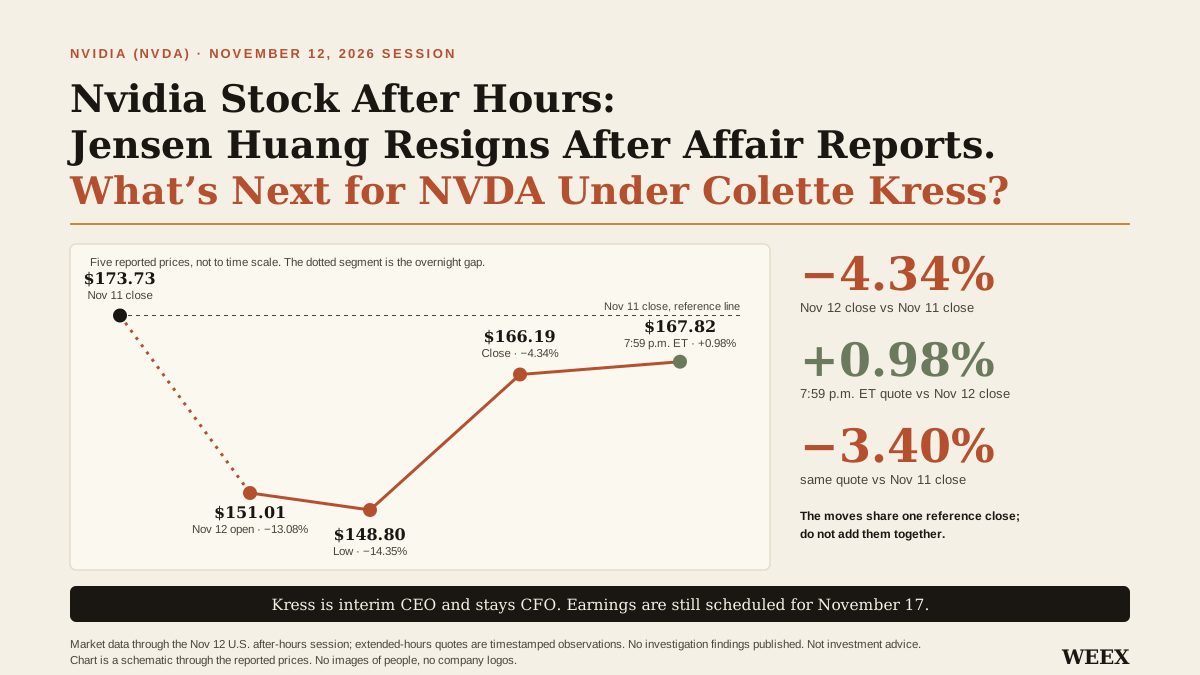
Nvidia Stock After Hours: Jensen Huang Resigns After Affair Reports. What’s Next for NVDA Under Colette Kress?
Nvidia fell 4.34% after Jensen Huang resigned, then rose 0.98% after hours. See what Colette Kress’s appointment means for NVDA and November 17 earnings.

Nvidia CEO Resignation Impacts Tech Stocks; Bitcoin Falls to $70,000 Support | WEEX Daily Market Brief (November 13, 2026)
Technology-stock selling pushed Bitcoin down to the $70,000 support level, while Ethereum briefly fell below $2,000. Spot Bitcoin ETFs recorded net outflows for the fifth consecutive trading day. Nvidia CEO’s resignation triggered sharp share-price volatility. Nebius’s full-year guidance missed expectations. The October PPI is the key release to watch on November 13.

Kidnapping of the 'Crypto King': Defense Claims Setup

Aave Proposal Targets $3.5M in Added Annual Revenue Through Reserve-Factor Changes

Injective Veyra upgrade heads to governance vote ahead of November 24 launch

Jensen Huang's Sudden Departure Raises Questions: Did the White House Intervene? Is a Return Possible?

How Do Third-Party Rating Agencies Assess WEEX’s Asset Security?

In-Depth Interview | Fu Peng: I Have No Faith in BTC

Cerebras Conference Call: Secures Major Deal with Microsoft, HBM Shortage Becomes an Opportunity, WSE-5 Chip to Enter Mass Production Next Summer

SoundHound AI Stock Is Down Almost 60% in 2026, but Wall Street Thinks It Can Soar 155% By the End of 2027. Here’s Why It Could Be One of the Best Buys Amid the Tech Sell-Off.
What is being said at the tables: the market begins to see 2027 as an all-or-nothing scenario

ASA Presses Court to Halt Stock Perpetuals, Putting Retail Risk at Center of Fight

PNC’s Coinbase Pilot Turns Incoming USDC Into Business Bank Deposits

Aave user loses $305,000 after Across Protocol website hijack

Circle and Global Citizen Plan USDC Vendor Payments for Move Afrika in 2027

Cisco's Q1 Earnings Exceed Expectations: AI Infrastructure Revenue Expected to Double This Fiscal Year

Cerebras Soars! Q3 Revenue Exceeds Expectations, Cloud Business Surges 272%, Raises Full-Year Guidance

BitGo and TOPPAN Conduct Proof of Concept for Decentralized Key Management of Digital Assets Amid Rising Fraudulent Outflows

Bottomline Completes First USDC Transfers Inside Its Enterprise Payments Platform
Ethereum Plans to Advance Its Post-Quantum Transition to 2027

Republican Senator Wants to Freeze AI Data Center Boom as Congress Pushes to Expand It
DOJ's Operation TorNado Arrests 354 And Seizes $234 Million In Cash And Crypto

Google Releases Gemini 4 Hydrogen: 5x Reduction in Hallucinations, Doubling of Speed

USDC Enters Dual EU Supervision as EBA Oversight Takes Effect

CoreWeave Says Its AI Demand Is 10 Times Its Capacity Through 2027. I Think Micron Stock Is Still Worth Buying.
Why the Path to Quantum Resistance Runs Uphill for Bitcoin Wallet Makers
Canton Coin ETF and November 13: What the SEC Filing States and Does Not State
Exclusive: Canton Strategic CEO warns MEV could raise costs for tokenized stock traders
CARF Customer Transaction Information Report: What Data Processing is Required from On-Chain Transactions to Tax Reporting?
Seminar: The History of Hyperliquid and On-Chain Finance Guest: Takuya Fujita (11/18 19:30 @ Gentosha)
Nvidia Stock After Hours: Jensen Huang Resigns After Affair Reports. What’s Next for NVDA Under Colette Kress?
Nvidia fell 4.34% after Jensen Huang resigned, then rose 0.98% after hours. See what Colette Kress’s appointment means for NVDA and November 17 earnings.
Nvidia CEO Resignation Impacts Tech Stocks; Bitcoin Falls to $70,000 Support | WEEX Daily Market Brief (November 13, 2026)
Technology-stock selling pushed Bitcoin down to the $70,000 support level, while Ethereum briefly fell below $2,000. Spot Bitcoin ETFs recorded net outflows for the fifth consecutive trading day. Nvidia CEO’s resignation triggered sharp share-price volatility. Nebius’s full-year guidance missed expectations. The October PPI is the key release to watch on November 13.
Latest articles





Latest coin listings on WEEX


