
Revenue Becomes the Toughest Crypto Narrative This Year

 Prefer us on Google
The market has fallen by 19%, while tokens with buyback plans have risen by an average of 62%.
Written by: WallStreetBets
Compiled by: Luffy, Foresight News
2026 is set to be a year of robust growth for crypto projects that generate revenue.
From the beginning of the year to now, we have seen total revenue across various protocols reach $11.68 billion. If November and December can maintain levels close to October, this figure should reach around $13.9 billion by the end of the year, only about $1 billion less than in 2025, when the market environment was much better.
Annual Revenue of Crypto Protocols
What we are witnessing is a trend driven by fundamentals, which continues to gain momentum despite the market's weakness. Whenever I see such a divergence, I want to understand what drives it and, more importantly, where the investment opportunities lie.
In this article, I will break down my findings, including:
- Why I believe the crypto "revenue narrative" is still in its early stages
- How to evaluate revenue-generating businesses and identify attractive token opportunities
- Why major teams from Hyperliquid to World Liberty Financial are embracing buybacks
- Where I look for the next wave of market-beating assets
The Basic Logic of the Revenue Narrative
Crypto has never lacked investment narratives; the problem is that most narratives do not last long.
We have seen investors chase after NFTs, the metaverse, SocialFi, and one "public chain season" after another. Money flows in, valuations soar, but the music always stops. When the music stops, investors are left with massive losses.
These stories share a common trait: market performance is driven more by narratives and speculation, with traditional business fundamentals weighing too little.
However, in the past few years, the industry has undergone changes that are fundamentally altering how investors allocate their funds.
First, we have a better understanding of "where blockchain creates real economic value and product advantages." After years of experimentation, some product categories have established clear product-market fit, even breaking out of the industry bubble with groundbreaking tracks like prediction markets and tokenization.
I also see more institutional funds flowing into this space through paths closer to traditional finance, such as DeFi treasuries, rather than just for speculation; there are more suits than hoodies at crypto conferences; and regulatory progress in Washington has also made substantial strides.
Overall, the industry has matured significantly. The result is that the major allocators of capital in the crypto market are increasingly shifting from speculative, high-risk bets to supporting teams that are closer to traditional business fundamentals. This shift has important implications for future investment trends.
When institutional investors driving the market and major allocators begin to prioritize sustainable business models, the investment narratives they drive will increasingly reflect the same priorities. This also changes the lifespan of narratives: when investment trends are driven by fundamentals, they are better able to maintain investor interest across market cycles, especially when the underlying business continues to grow beyond the short-term price of the token.
If we are heading toward a new crypto bull market, this is where I want my portfolio allocation to be: standing behind long-term trends supported by persistent demand that can compound over time.
This is also why I initially focused on the privacy track and now pay attention to the "revenue narrative."
The revenue narrative is an investment trend centered around a growing class of crypto businesses. They have an existing customer base, sustainable revenue, and can translate business success into meaningful real value for token holders. As the industry matures and investors increasingly value business fundamentals, the argument is: these companies are likely to become some of the biggest winners in the next bull market.
What makes this opportunity particularly interesting is its breadth: unlike other narratives that focus on specific technologies and applications, revenue generation spans every sector of the crypto market.
At first glance, the investment approach seems straightforward: applying the fundamental analysis that investors have used for decades to evaluate successful companies. But in an industry still catching up to these standards, I believe that investors willing to look beyond traditional financial metrics have additional opportunities.
This advantage lies in the fact that a successful crypto business does not necessarily mean that its token is a successful investment.
This is because, unlike equity, most crypto tokens do not grant holders legal ownership of the underlying business or its profits. Therefore, a protocol can generate hundreds of millions in revenue, but this economic value may not flow to the token held by investors.
So, finding the best money-making business is only half the battle.
The real opportunity lies in identifying those businesses that can maintain commercial success while also having effective mechanisms to translate that growth into value for token holders.
This is where token buybacks come into play:
- In traditional stock markets, publicly traded companies use excess cash to buy back shares, reducing the number of outstanding shares and increasing the ownership percentage of remaining shareholders.
- Cryptocurrency involves different economic and regulatory considerations. Unlike shareholders, most token holders do not have legal ownership of the business behind their tokens; explicitly tying token holder returns to the management efforts of the team may raise securities law issues.
- Thus, buybacks have become a popular mechanism for establishing a more direct relationship between "business success" and "token value."
The basic concept of buybacks is similar to traditional share repurchases. A protocol can use a portion of its revenue to buy tokens on the open market and then burn, lock, or deposit them into a treasury.
However, despite being similar to traditional finance, buybacks have been one of the most controversial topics in crypto over the past two years. Projects have spent hundreds of millions of dollars buying back tokens, yet the market results are often disappointing, leading many investors to question whether this strategy is effective at all.
My view is different.
At this stage, I believe we have accumulated enough evidence to move beyond the debate of "whether buybacks are useful" to a clearer understanding of: when, why, and under what conditions buybacks are truly effective.
And that is what I want to clarify.
The Great Debate on Cryptocurrency Buybacks
The buyback strategy really took off in 2025.
That year, 28 major crypto projects collectively spent over $1.4 billion to buy back their tokens. However, only three tokens' buyback plans outperformed Bitcoin during their buyback windows (AAVE, HYPE, SKY), while many projects' token valuations plummeted significantly. Needless to say, 2025 made many projects realize that spending millions of dollars on buybacks does not necessarily lead to better market performance.
Many investors looked at the disappointing results of the 2025 buyback plans, especially the stark contrast between "money spent" and "token performance," and concluded that this strategy is fundamentally useless.
I believe this conclusion overlooks important context.
Rather than just looking at the impact of buybacks on token prices to judge them, I am more concerned with the conditions under which they are executed and where effective and ineffective buyback strategies differ. Based on this, I believe we can establish four clear criteria for a "good buyback plan":
- Supported by revenue: Buybacks are funded by real business revenue, not existing treasury reserves or other unsustainable capital sources.
- Established product-market fit: The underlying business has demonstrated sufficient demand and repeatable revenue to support long-term buybacks.
- Execution transparency: Token holders can independently verify how the buyback mechanism works, including the source of funds, execution process, and the destination of the repurchased tokens.
- Sustainable capital allocation: Funding buybacks does not impair the company's ability to reinvest for growth, maintain financial stability, or seize higher return opportunities.
Beyond these fundamental standards, several factors can influence the effectiveness of buyback plans, which are worth considering when evaluating projects:
1) Market Environment
Jupiter is perhaps the most cited case of "buybacks failing to deliver expected market performance."
In February 2025, the platform began using 50% of its on-chain protocol revenue for JUP buybacks. By January 2026, the team had spent over $70 million buying back tokens, yet JUP continued to decline significantly.
This disappointing performance prompted Jupiter co-founder Siong Ong to speak out and redirect funds toward business growth. The plan ultimately continued.
Criticism surrounding Jupiter's buybacks largely focused on their failure to support JUP's price, raising questions about whether the team would have been better off using that money to grow the business.
But I believe it is more important to consider the market conditions under which these buybacks occurred.
January 2025 was the peak for many assets in the Solana ecosystem during a cycle. After that, SOL fell from a high of $294 to $96. Around the same time, major Solana protocol-related tokens like Sanctum, Kamino, and Jito all fell over 80%, and well-known meme coins like Fartcoin and WIF dropped over 90%.
In other words, Jupiter spent over $70 million buying back JUP during a period of extreme selling pressure across the entire Solana ecosystem. The lesson is: buybacks can create significant demand for tokens, but even large-scale purchases may struggle to offset a prolonged market-wide decline.
Sometimes, no matter how fast you paddle, you can't outrun the tide.
2) Token Issuance
Another important consideration is: how large is the new token supply entering circulation relative to the amount being bought back?
A protocol can spend tens of millions on buybacks, but if the supply from token unlocks, emissions, and other distributions exceeds the amount absorbed by the buybacks, the effect will be drowned out.
Research by Bill Hsu shows that the growth of token supply is negatively correlated with relative market performance. Ultimately, what matters is not how much the team spends on buybacks, but whether those purchases genuinely improve the supply-demand dynamics of the token.
Changes in Token Supply for the Top 10 Crypto Buyback Plans in 2025 vs. Excess Returns Relative to Bitcoin. Source: Bill Hsu
3) The Buyback Mechanism Itself
Many crypto protocols commit a fixed percentage of revenue to automatic buybacks, regardless of token valuations. While this creates predictable demand and demonstrates a clear commitment to token holders, it may not be the most efficient way to allocate capital.
This is not how traditional stock markets operate.
For example, Warren Buffett's Berkshire Hathaway has historically repurchased shares while maintaining sufficient liquidity. The logic is: buy back shares when they are undervalued, and retain capital when valuations are high or better investment opportunities arise.
I understand the appeal of "programmatic buybacks" in cryptocurrency, especially when many tokens—particularly those supported by strong revenue businesses—appear cheap for an extended period due to a long-term market downturn.
However, as market conditions improve and valuations expand, I expect more teams to shift toward discretionary buybacks, taking into account token prices, growth opportunities, and broader capital allocation priorities.
Ultimately, the goal should be to maximize the long-term value for token holders, rather than simply maximizing buyback expenditures. As an investor, your job is to assess which teams are executing the most effective strategies.
Fortunately, we now have an increasing amount of market data available to evaluate which buyback methods are truly effective. The performance in 2026 provides strong arguments for "seriously considering income-supported buybacks."
Buyback Performance in 2026
The cryptocurrency buyback sector has experienced another remarkable year this year.
Projects have allocated over $900 million for token buybacks and related burn mechanisms, with Hyperliquid and Pump.fun accounting for the vast majority. Uniswap, Jupiter, and Sky are also worth noting.
Hyperliquid's buyback tokens are in profit
Most importantly, many tokens associated with these plans have delivered impressive returns this year.
Taking the top 30 protocols by revenue over the past 30 days as an example: nearly half (14 projects) do not have publicly tradable native tokens, while among the remaining 16 projects with investable tokens, 12 have active buyback plans:
- 9 have positive year-to-date token returns
- 3 have negative year-to-date returns
- Average year-to-date return +62.2%, median +32.6%
In contrast, 4 projects without active buyback plans:
- 1 has a positive year-to-date return
- 3 have negative returns
- Average year-to-date return −31.6%, median −31.5%
The average year-to-date performance gap between the two groups is 93.8 percentage points.
Even more impressively, these token performances were achieved against a backdrop of approximately a 19% decline in the total cryptocurrency market cap this year.
With such results, I am not surprised when teams with strong revenues announce their embrace of buybacks. For example, World Liberty Financial just launched its WLFI buyback plan last week, and I expect more teams to follow suit in the first quarter of next year.
Equally important is comparing this year's buyback performance with other value distribution strategies—especially those that directly allocate income to token holders.
In September, DeFiLlama's research compared the performance of "tokens with buyback plans" versus "tokens that directly allocate income to holders."
The conclusion is: year-to-date, the median return for tokens with buyback mechanisms is 19.7%, while tokens with direct income distribution yield 11.1%.
When researchers weighted these returns by market capitalization, the gap widened significantly: buyback tokens at 190%, direct distribution tokens at 29%.
Buyback tokens outperform direct distribution tokens
We are also seeing a positive change in the proportion of protocol income flowing back to token holders.
The same study shows that as of September 2026, crypto protocols have consistently exceeded $1 billion in monthly revenue for 23 consecutive months. Two years ago, about 5% of this flowed to token holders; by September, this proportion had tripled to 15%, reflecting the growing prevalence of income distribution mechanisms.
So, summarizing the experiences of 2026:
- Teams with buybacks are outperforming in the public market overall
- Buybacks are outpacing other income distribution models
- An increasing amount of crypto business income is being allocated to tokens, indicating that this trend will continue
What I Am Watching
For me, future opportunities lie in identifying those crypto businesses that are "doing buybacks the right way," especially those in sectors with long-term growth potential.
Let’s look at a few directions worth exploring.
1) Where the Money Flows
Our analysis of the 30 highest-revenue crypto protocols identified 9 projects that have both active buybacks and positive year-to-date token returns.
If these businesses can deliver strong performances in adverse market conditions, I believe there is significant potential for what they can achieve when the broader market returns to a bull phase.
Beyond individual protocols, I think it’s equally important to examine where revenue is generated across the broader crypto industry. These sectors are most likely to have the conditions necessary for successful buyback plans.
In 2025, the crypto industry is estimated to generate $86.4 billion in revenue; by 2030, this figure is projected to reach $305 billion.
In the future, the fastest-growing segments are expected to be stablecoins and RWA lending: research predicts annual revenues of $60 billion and $15 billion for these two segments by 2030. I will focus on these two sectors.
2) World Liberty Financial
Until now, opportunities for investors to directly capture the economic upside of the stablecoin revolution have been relatively limited. I have always believed that stablecoins are one of the strongest product-market fit cases in crypto, with the potential to fundamentally reshape global finance.
Companies and protocols like Tether, Circle, World Liberty Financial, and Ethena have demonstrated that stablecoins are not just a use case for blockchain technology, but the foundation for building billion-dollar businesses. However, despite explosive growth, opportunities for investors to directly participate in the value they create remain quite limited.
Looking at the current landscape: Tether remains private; Circle has issued stock but shares a significant portion of revenue with distribution partners; Coinbase captures some of the economics of USDC, but its stock represents a broader business. Meanwhile, holding XRP or PayPal stock does not provide direct exposure to the income generated by RLUSD or PYUSD.
This is where World Liberty Financial's newly launched buyback plan caught my attention.
By allocating a portion of the USD1 reserve-related income (over $150 million annually) to its buyback plan, World Liberty Financial is establishing a more direct link between the economic success of the stablecoin business and the demand for WLFI tokens, allowing token holders to benefit as USD1 adoption increases.
As the circulation of USD1 expands, reserve income will also grow, creating more resources for buybacks. In my view, this is the most direct attempt yet to connect the "stablecoin issuer economy" with "publicly traded tokens."
3) Venice
The privacy-focused AI platform AskVenice recently surpassed 4 million users, with annual revenue exceeding $100 million. On November 9, the company executed a buyback, removing approximately $458,000 worth of tokens from circulation.
At the same time, automatic burns funded by new subscriptions and API quota purchases saw a month-on-month increase of 40% in October. In October, Venice burned approximately $1.07 million worth of VVV, with November expected to set a new record at $1.14 million.
What I find particularly interesting about Venice is that very few crypto-related businesses achieve this level of commercial success outside the industry.
Other investors have also taken notice this year. Their support, combined with Venice's own buybacks, has driven the price of VVV up over 1200% this year.
4) Bittensor
So far, examples have shown how buybacks can benefit individual projects, while Bittensor demonstrates what happens when this strategy is adopted across an entire ecosystem. I have not seen such an obsession with buybacks elsewhere in the crypto industry.
Bittensor operates through a "subnet" network, which you can think of as independent tech startups competing for the release of TAO tokens. The market demand for each subnet's alpha token (the startup's own native cryptocurrency) plays a crucial role in determining how emissions are allocated, so token performance may directly relate to whether a team can survive.
Thus, buybacks, burns, and emission management have become central to subnet strategies. This ecosystem has turned into an ongoing experiment in token economics; I believe any team considering buybacks, regardless of whether they are on Bittensor, is worth studying.
According to Subconnect data, as of August 2026, 14 of the 24 subnets with external revenue have used income to fund buybacks for their alpha tokens. These 24 subnets have a combined estimated annual revenue of $28 million to $35 million.
A recent interesting example comes from Targon, which is currently the third-largest subnet by market capitalization in Bittensor.
On October 27, Targon reported burning approximately $2.1 million worth of alpha tokens (SN4), of which about $445,000 was from new buybacks; this activity was funded by revenue from its AI computing business.
Targon SN4 price trend
Within seven hours of the announcement, SN4 rose over 13% on the weekly chart. Even against the backdrop of a market downturn, as of the time of writing, the token is still about 3% higher than its price before the announcement.
What stands out to me in this case, and many similar cases, is how responsive the Bittensor subnet market can be to buyback-related developments. Investors are highly attentive to how teams manage emissions, generate revenue, and support token demand.
I believe this provides an early sample of how the broader crypto market might evolve as buybacks become more commonplace.
5) Robinhood Chain
Robinhood Chain is another ecosystem worth watching for buyback innovations, especially in scenarios involving tokenized RWA.
longdotxyz is leading some of these experiments. In September, the platform launched LONG 500, a mechanism designed to connect community tokens with tokenized stocks through a shared economy model.
Here’s how it works:
- 5% of the transaction fees from newly generated stock tokens flow into the AI community treasury, accumulating tokenized stocks in the shared reserve.
- Another 5% is used to buy back and burn the community tokens paired with each stock, which anyone can trigger.
The interesting aspect of this approach is that LONG combines token buybacks with the accumulation of actual financial assets. As more stock communities go live and generate trading activity, this system can simultaneously reduce the supply of community tokens, support liquidity, and grow the asset reserves of the entire ecosystem.
This is a more complex value accumulation method than simply distributing protocol revenues to buy back native tokens, creating a model where growth in individual markets can feed back into a broader ecosystem.
In the future, I guess we will see far more of these kinds of experiments on the Robinhood Chain than we do now.
What Happens in a Real Bull Market?
We have spent years observing the crypto market rewarding narratives, speculation, and promises of future adoption. Now, the income narrative has fully unfolded, and what we see is an industry with commercial activity and financial performance sufficient to support a more fundamentally driven investment landscape.
Despite relatively unfavorable market conditions, several leading revenue-generating crypto protocols have still delivered impressive token returns, expanded their user bases, and continued to generate substantial income.
Now, imagine what happens when these conditions change.
For these businesses, increased adoption and market activity will directly translate into more revenue. And when a significant portion of that revenue funds token buybacks, the resulting demand can grow alongside the protocol itself. Coupled with improved market sentiment and a reflow of capital, the potential for excess returns becomes quite attractive.
In that scenario, buybacks are no longer just a means for teams to stay afloat in harsh environments, but more like pouring gasoline on an already roaring fire. Moreover, if the prediction that the crypto industry’s annual revenue reaches hundreds of billions by 2030 comes true, it also means there is still significant economic value to be created.
That’s why I believe the "income narrative" of crypto protocols is just beginning.
This content is provided for general informational purposes only and doesn't constitute financial, investment, legal, or tax advice. Any events, rewards, online promotions, or related information mentioned herein should not be considered a recommendation, solicitation, or invitation to purchase, sell, trade, or otherwise deal in any crypto assets. Crypto assets are highly volatile and may result in loss. The availability of WEEX services, products, and related events may vary by region. You are responsible for ensuring that your participation is in accordance with applicable local laws and regulations.
You may also like
BNY Mellon Adds to Invesco Galaxy Bitcoin ETF: What Changes with the Custody Filing?
JPMorgan's Q3 Holdings: Significant Increase in Nvidia, AI Powerhouses Remain 'Cornerstone', Semiconductor Hardware Stocks Face Systematic Reductions
Czech central bank tests DLT bonds, boxing out stablecoins

South Korea Proposes Withdrawal Suspension for Cryptocurrency: What Happens When Exchanges Suspect a Hack

These 6 Data Software Stocks Help Companies Put AI to Work

Chainlink and Moody’s Complete Testnet Pilot for Cross-Chain Credit Ratings

Bit Digital Q3 2026: Analyzing the Relationship Between ETH Treasury and Collateral
Canton Coin ETF and November 13: What the SEC Filing States and Does Not State

Exclusive: Canton Strategic CEO warns MEV could raise costs for tokenized stock traders

CARF Customer Transaction Information Report: What Data Processing is Required from On-Chain Transactions to Tax Reporting?

Former Polychain Partner Launches Startup: Enters Tokenized Real Estate, Secures $50 Million Seed Round Funding to Create the 'S&P 500' of Real Estate

Seminar: The History of Hyperliquid and On-Chain Finance Guest: Takuya Fujita (11/18 19:30 @ Gentosha)
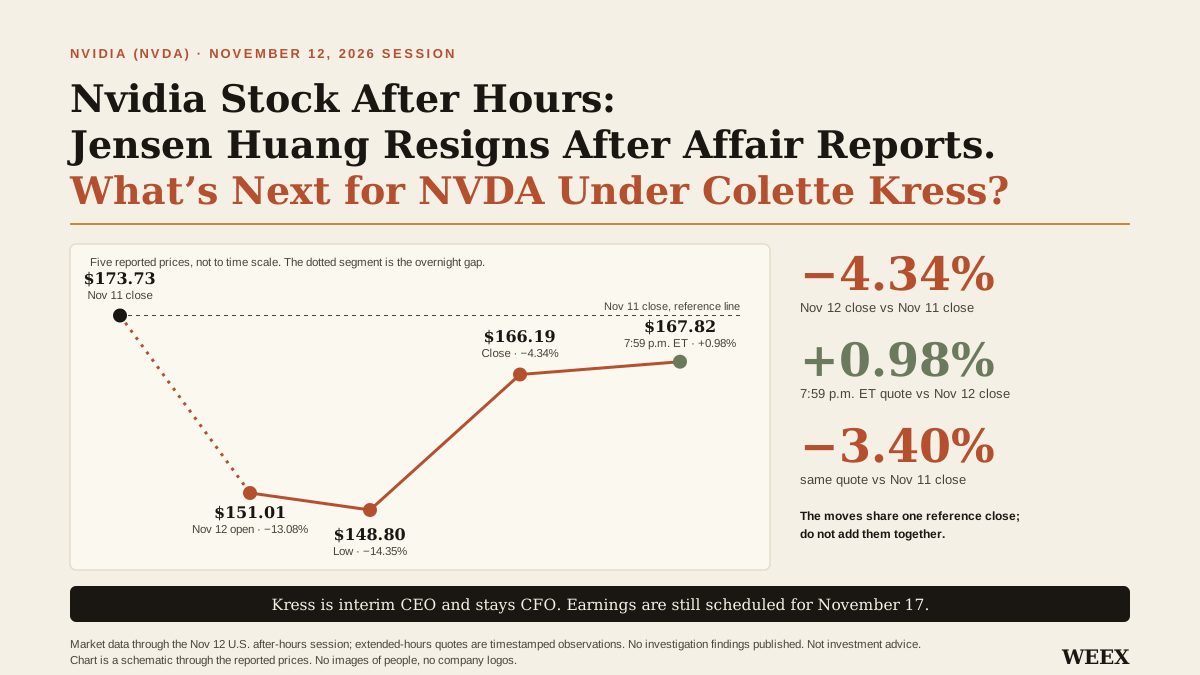
Nvidia Stock After Hours: Jensen Huang Resigns After Affair Reports. What’s Next for NVDA Under Colette Kress?
Nvidia fell 4.34% after Jensen Huang resigned, then rose 0.98% after hours. See what Colette Kress’s appointment means for NVDA and November 17 earnings.

Nvidia CEO Resignation Impacts Tech Stocks; Bitcoin Falls to $70,000 Support | WEEX Daily Market Brief (November 13, 2026)
Technology-stock selling pushed Bitcoin down to the $70,000 support level, while Ethereum briefly fell below $2,000. Spot Bitcoin ETFs recorded net outflows for the fifth consecutive trading day. Nvidia CEO’s resignation triggered sharp share-price volatility. Nebius’s full-year guidance missed expectations. The October PPI is the key release to watch on November 13.

Kidnapping of the 'Crypto King': Defense Claims Setup

Aave Proposal Targets $3.5M in Added Annual Revenue Through Reserve-Factor Changes

Injective Veyra upgrade heads to governance vote ahead of November 24 launch
Jensen Huang's Sudden Departure Raises Questions: Did the White House Intervene? Is a Return Possible?
How Do Third-Party Rating Agencies Assess WEEX’s Asset Security?

In-Depth Interview | Fu Peng: I Have No Faith in BTC

Cerebras Conference Call: Secures Major Deal with Microsoft, HBM Shortage Becomes an Opportunity, WSE-5 Chip to Enter Mass Production Next Summer

SoundHound AI Stock Is Down Almost 60% in 2026, but Wall Street Thinks It Can Soar 155% By the End of 2027. Here’s Why It Could Be One of the Best Buys Amid the Tech Sell-Off.
What is being said at the tables: the market begins to see 2027 as an all-or-nothing scenario

ASA Presses Court to Halt Stock Perpetuals, Putting Retail Risk at Center of Fight

PNC’s Coinbase Pilot Turns Incoming USDC Into Business Bank Deposits
Aave user loses $305,000 after Across Protocol website hijack

Circle and Global Citizen Plan USDC Vendor Payments for Move Afrika in 2027

Cisco's Q1 Earnings Exceed Expectations: AI Infrastructure Revenue Expected to Double This Fiscal Year
Cerebras Soars! Q3 Revenue Exceeds Expectations, Cloud Business Surges 272%, Raises Full-Year Guidance

BitGo and TOPPAN Conduct Proof of Concept for Decentralized Key Management of Digital Assets Amid Rising Fraudulent Outflows
BNY Mellon Adds to Invesco Galaxy Bitcoin ETF: What Changes with the Custody Filing?
JPMorgan's Q3 Holdings: Significant Increase in Nvidia, AI Powerhouses Remain 'Cornerstone', Semiconductor Hardware Stocks Face Systematic Reductions
Czech central bank tests DLT bonds, boxing out stablecoins
South Korea Proposes Withdrawal Suspension for Cryptocurrency: What Happens When Exchanges Suspect a Hack
These 6 Data Software Stocks Help Companies Put AI to Work
Chainlink and Moody’s Complete Testnet Pilot for Cross-Chain Credit Ratings
Latest articles
Latest coin listings on WEEX


