
How Much Is Anthropic Really Worth?

 Prefer us on Google
Anthropic CEO Dario Amodei.
Investors are still digesting the news of NVIDIA CEO Jensen Huang's resignation and the implications for the AI industry; meanwhile, they are also pondering another difficult question: How much is Anthropic really worth?
If all goes according to plan, the market will provide an answer next week when the company goes public on NASDAQ. Anthropic has initially set its valuation range for the IPO at $1.25 trillion to $1.4 trillion, although several investors we spoke to expect the final pricing to be above this range. {#quote_.IXIC}
Samantha Lau, Chief Investment Officer of Janus Henderson Small Cap Growth, stated, "If the IPO pricing is above the preset range, it indicates strong underlying demand, which is crucial for driving investor participation."
This initial range is lower than the $1.5 trillion or even higher valuations previously expected by investment banks. Several investors mentioned that the lower limit of the range is directly suppressed by the financing news from OpenAI (OpenAI aims to raise $9 billion, with a cap of $11 billion). However, Anthropic's business scale has already surpassed that of OpenAI: it reported revenue of $17 billion in the third quarter, while OpenAI's revenue during the same period was $10 billion. From this perspective, Anthropic's current valuation range appears conservative.
One valuation approach: assuming Anthropic's annualized revenue approaches $100 billion by the end of the year (with an October figure of $81 billion) and that revenue doubles over the next two years. Taking an adjusted operating profit margin of 25% (higher than the 19% level in June), this revenue projection suggests that operating profit could reach approximately $50 billion by 2028. In other words, the current valuation range corresponds to an EBIT multiple of over 25 times for 2028.
John Belton, a portfolio manager at Gabelli Funds, is considering participating in Anthropic's IPO subscription. He said, "From an EBIT multiple of around 25 times, this valuation seems cheap compared to software stocks; slightly expensive compared to large tech giants. Overall, it seems reasonable. The key point of contention in this valuation range is not the multiple itself, but the core question: after achieving such a large revenue scale, can it maintain this growth rate?"
Morningstar analyst Ahmed Khan has given a valuation of $1.7 trillion. He predicts a compound annual growth rate of 47% for Anthropic's revenue over the next five years. In a research report dated November 11, Khan mentioned that even in his optimistic scenario (valuation of $3.4 trillion), if Anthropic's models develop to the point of self-training and continuous iteration, this optimistic valuation might still be conservative.
However, some investors pointed out that the valuation on Anthropic's first day of trading is not solely based on the company's short-term financial fundamentals.
Willy Lee, head of Neostellar Investment Company, said, "The core determinant of valuation is not entirely how much free cash flow this company can ultimately generate, but whether it can grow to the scale of Google or Microsoft, and how long it will take to do so." Neostellar manages an ETF that includes unlisted companies like OpenAI and Canva. Lee stated that Neostellar currently does not hold equity in Anthropic but invested in OpenAI over a year ago. {#quote_MSFT}
A key question: Will the turmoil in NVIDIA's management trigger significant volatility in the AI sector, thereby impacting Anthropic's IPO?
On one hand, NVIDIA's substantial investments have deeply supported the entire AI sector; if NVIDIA faces setbacks, it would not bode well for Anthropic's valuation. Gabelli's Belton pointed out that model vendors like Anthropic "benefit from the continuous output of various technological innovations from NVIDIA." "If NVIDIA undergoes a leadership change and the pace of technological iteration slows, the progress of cutting-edge model development and the efficiency of model deployment will inevitably be affected."
On the other hand, an investor from a large UK asset management firm (who is participating in Anthropic's roadshow and considering a subscription) suggested: Companies that can withstand this round of turmoil are those that are chip-neutral and not tied to a single chip manufacturer, and Anthropic has an advantage over OpenAI and Google in this regard.
This investor indicated that asset management firms wishing to participate in new IPOs almost always have to sell part of their holdings to free up funds. To allocate funds for Anthropic, they may need to reduce their positions in the AI infrastructure sector, namely semiconductor stocks. "Recent declines in semiconductors have already reflected this reallocation expectation."
Another issue weighing on Anthropic: a significant portion of its growth this year comes from its AI code assistant business; can it continue to expand rapidly and penetrate vertical industries beyond coding?
Neostellar's Lee said, "If you are optimistic about the long-term growth of AI, you need to confirm two things: Can Anthropic continue to grow the AI market beyond knowledge work? And can it capture the corresponding market share? Currently, it has not fully proven this, which is why many investors find it difficult to accept this valuation."
Ultimately, Anthropic's valuation largely depends on external conditions that it cannot control—these factors could hinder its growth or prevent it from obtaining sufficient scarce computing power to train and run models.
Janus Henderson's Samantha Lau said, "If I were a large-cap investor, I wouldn't be overly concerned about profitability; I would only care about financing, not just for Anthropic itself, but for the entire AI ecosystem's funding supply.",
This content is provided for general informational purposes only and doesn't constitute financial, investment, legal, or tax advice. Any events, rewards, online promotions, or related information mentioned herein should not be considered a recommendation, solicitation, or invitation to purchase, sell, trade, or otherwise deal in any crypto assets. Crypto assets are highly volatile and may result in loss. The availability of WEEX services, products, and related events may vary by region. You are responsible for ensuring that your participation is in accordance with applicable local laws and regulations.
You may also like

Interpretation of FATF Report on Scam Compound Funds: Virtual Assets Become Core Money Laundering Channels

Microsoft System Outage Disrupts Markets, Traders Forced to Communicate via Phone

Goldman Sachs Predicts 10-Year U.S. Treasury Yield Will Fall to 4.6% by 2027

Coffeezilla investigates Trump’s crypto empire and $500 million UAE deal

Lessons from Five Years of Real Estate Tokenization: Why Only Two Models May Succeed?
Yen Fluctuations Highlight Current Trading Difficulties, Investors Have Huge Divergence on Long-term Outlook

Bloom Energy vs. Constellation Energy: On-Site Power or Grid Power, Which Wins the Data Center?

BNY Mellon Adds to Invesco Galaxy Bitcoin ETF: What Changes with the Custody Filing?
JPMorgan's Q3 Holdings: Significant Increase in Nvidia, AI Powerhouses Remain 'Cornerstone', Semiconductor Hardware Stocks Face Systematic Reductions

Czech central bank tests DLT bonds, boxing out stablecoins

South Korea Proposes Withdrawal Suspension for Cryptocurrency: What Happens When Exchanges Suspect a Hack

These 6 Data Software Stocks Help Companies Put AI to Work
Revenue Becomes the Toughest Crypto Narrative This Year

Chainlink and Moody’s Complete Testnet Pilot for Cross-Chain Credit Ratings

Bit Digital Q3 2026: Analyzing the Relationship Between ETH Treasury and Collateral
Canton Coin ETF and November 13: What the SEC Filing States and Does Not State

Exclusive: Canton Strategic CEO warns MEV could raise costs for tokenized stock traders

CARF Customer Transaction Information Report: What Data Processing is Required from On-Chain Transactions to Tax Reporting?

Former Polychain Partner Launches Startup: Enters Tokenized Real Estate, Secures $50 Million Seed Round Funding to Create the 'S&P 500' of Real Estate

Seminar: The History of Hyperliquid and On-Chain Finance Guest: Takuya Fujita (11/18 19:30 @ Gentosha)
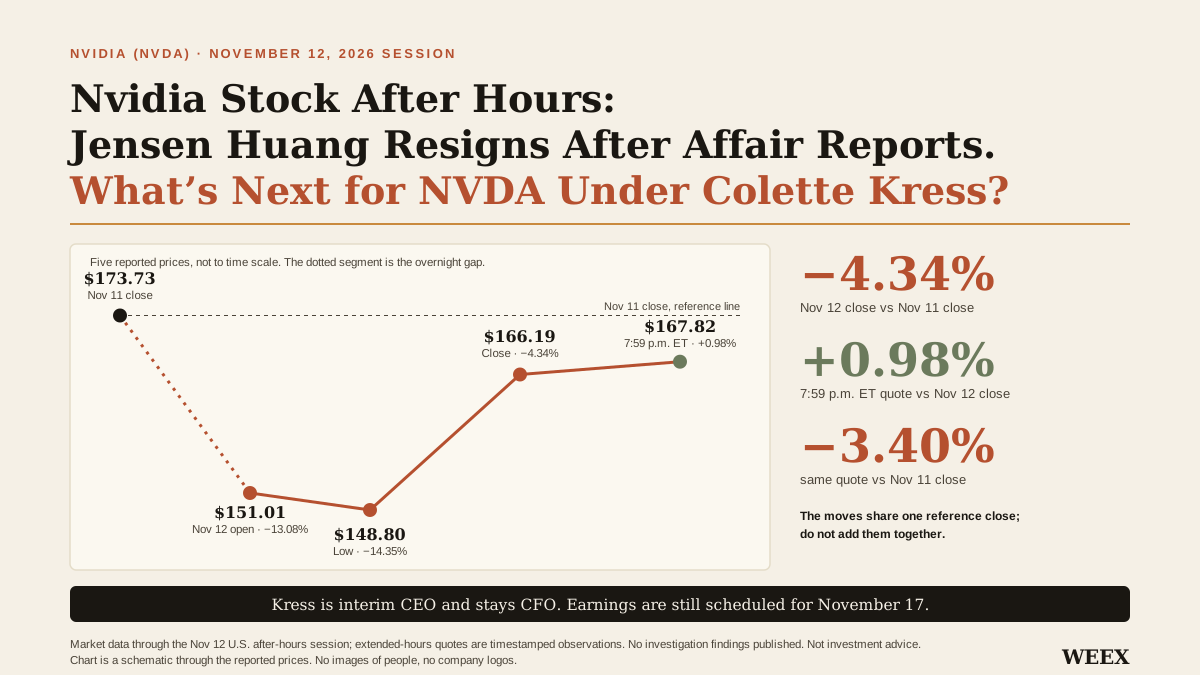
Nvidia Stock After Hours: Jensen Huang Resigns After Affair Reports. What’s Next for NVDA Under Colette Kress?
Nvidia fell 4.34% after Jensen Huang resigned, then rose 0.98% after hours. See what Colette Kress’s appointment means for NVDA and November 17 earnings.

Nvidia CEO Resignation Impacts Tech Stocks; Bitcoin Falls to $70,000 Support | WEEX Daily Market Brief (November 13, 2026)
Technology-stock selling pushed Bitcoin down to the $70,000 support level, while Ethereum briefly fell below $2,000. Spot Bitcoin ETFs recorded net outflows for the fifth consecutive trading day. Nvidia CEO’s resignation triggered sharp share-price volatility. Nebius’s full-year guidance missed expectations. The October PPI is the key release to watch on November 13.

Kidnapping of the 'Crypto King': Defense Claims Setup
Aave Proposal Targets $3.5M in Added Annual Revenue Through Reserve-Factor Changes

Injective Veyra upgrade heads to governance vote ahead of November 24 launch

Jensen Huang's Sudden Departure Raises Questions: Did the White House Intervene? Is a Return Possible?
How Do Third-Party Rating Agencies Assess WEEX’s Asset Security?

In-Depth Interview | Fu Peng: I Have No Faith in BTC
Cerebras Conference Call: Secures Major Deal with Microsoft, HBM Shortage Becomes an Opportunity, WSE-5 Chip to Enter Mass Production Next Summer

SoundHound AI Stock Is Down Almost 60% in 2026, but Wall Street Thinks It Can Soar 155% By the End of 2027. Here’s Why It Could Be One of the Best Buys Amid the Tech Sell-Off.
Interpretation of FATF Report on Scam Compound Funds: Virtual Assets Become Core Money Laundering Channels
Microsoft System Outage Disrupts Markets, Traders Forced to Communicate via Phone
Goldman Sachs Predicts 10-Year U.S. Treasury Yield Will Fall to 4.6% by 2027
Coffeezilla investigates Trump’s crypto empire and $500 million UAE deal
Lessons from Five Years of Real Estate Tokenization: Why Only Two Models May Succeed?
Yen Fluctuations Highlight Current Trading Difficulties, Investors Have Huge Divergence on Long-term Outlook
Latest articles


Latest coin listings on WEEX


