
TeraWulf Says AI Leasing Now Generates 83% of Revenue as Bitcoin Mining Recedes

 Prefer us on Google



TL;DR: TeraWulf's November 6 earnings release shows $63 million in third-quarter high-performance-computing lease revenue, around 83% of its $76.2 million total. The company is increasingly an AI infrastructure business, although large non-cash gains and long-dated construction plans require careful reading.
TeraWulf is becoming a clear example of how the economics of Bitcoin mining can lead an infrastructure operator into a rather different business. In its third-quarter results published November 6, the Nasdaq-listed company said high-performance computing, or HPC, generated $63 million of lease revenue in the three months to September 30.
That represented about 83% of its $76.2 million quarterly revenue. Investors who still describe the firm primarily as a Bitcoin miner risk missing where its business is now concentrated and what its future costs may look like.
The revenue mix has already changed
The company operates existing mining infrastructure at its Lake Mariner campus but is repurposing portions of that site to support contracted computing workloads. TeraWulf said 102 megawatts of revenue-generating critical IT capacity were online at Lake Mariner at quarter-end, with another 336 megawatts under construction.
These numbers are not interchangeable with power agreements or theoretical campus capacity. A contract for future electricity or land does not mean an equivalent amount of paying data-centre capacity is already operating. The distinction matters when a company is projecting revenue from facilities that require years and significant capital to complete.
TeraWulf also reported net income of approximately $709.9 million for the quarter. But it attributed a significant benefit to a non-cash change in the fair value of warrants, while adjusted EBITDA was negative at about $12.8 million. That makes the headline profit a poor substitute for analysing recurring rental revenue, financing costs and operating cash flow.
Big contracts come with big execution demands
The company's release described a 20-year Anthropic lease covering approximately 401 megawatts at its Justified development in Kentucky, representing around $19 billion in contracted revenue over the initial term. It also described a Google credit backstop supporting anticipated project financing and a definitive engineering, procurement and construction agreement with Fluor. These are material commercial commitments, not a claim that $19 billion has already been received.
TeraWulf expects phased service availability at Justified to begin in late 2027 and continue into 2028. At Muskie, it said contracted power capacity had expanded toward one gigawatt, subject to regulatory approval. Schedules, financing and utility infrastructure remain central risks.
NewsBTC has previously examined the mining industry's move towards AI infrastructure. TeraWulf's fresh results make that theme measurable: a majority of present revenue now comes from leases rather than mining.
Why this matters to Bitcoin markets
A miner switching to AI can reduce its exposure to Bitcoin production economics, including changes in difficulty, coin price and power cost. It can also create demand for the same grid connections, facilities and financing that historically supported mining. That transition need not be immediately positive or negative for Bitcoin's network; it depends on which machines are retired, which are redeployed and whether remaining miners take up capacity.
The contrast with NewsBTC's discussion of rising network hashrate is telling. Competition for mining rewards can intensify even while some large listed companies reshape themselves into computing landlords.
The milestones to watch are completed megawatts, actual rental commencement, capital spending against guidance, contractual counterparty exposure and cash generation. TeraWulf's results show a dramatic change in revenue mix, but the hardest part of its next chapter will be delivering enormous physical projects reliably and profitably.
This article was written by the News Desk and edited by Samuel Rae.
Featured image: Rows of server racks in a data centre (illustrative data-centre photograph only --- does NOT depict an actual TeraWulf, IREN, or BitFuFu facility). Photo: Carl Lender via Wikimedia Commons, licensed under CC BY 2.0.
-- Price
This content is provided for general informational purposes only and doesn't constitute financial, investment, legal, or tax advice. Any events, rewards, online promotions, or related information mentioned herein should not be considered a recommendation, solicitation, or invitation to purchase, sell, trade, or otherwise deal in any crypto assets. Crypto assets are highly volatile and may result in loss. The availability of WEEX services, products, and related events may vary by region. You are responsible for ensuring that your participation is in accordance with applicable local laws and regulations.
You may also like
Bitcoin: Fearing Kidnappings, Whales Entrust $5 Billion to BlackRock

Interpretation of FATF Report on Scam Compound Funds: Virtual Assets Become Core Money Laundering Channels

How Much Is Anthropic Really Worth?

Lessons from Five Years of Real Estate Tokenization: Why Only Two Models May Succeed?

South Korea Proposes Withdrawal Suspension for Cryptocurrency: What Happens When Exchanges Suspect a Hack
Canton Coin ETF and November 13: What the SEC Filing States and Does Not State

Exclusive: Canton Strategic CEO warns MEV could raise costs for tokenized stock traders

Former Polychain Partner Launches Startup: Enters Tokenized Real Estate, Secures $50 Million Seed Round Funding to Create the 'S&P 500' of Real Estate
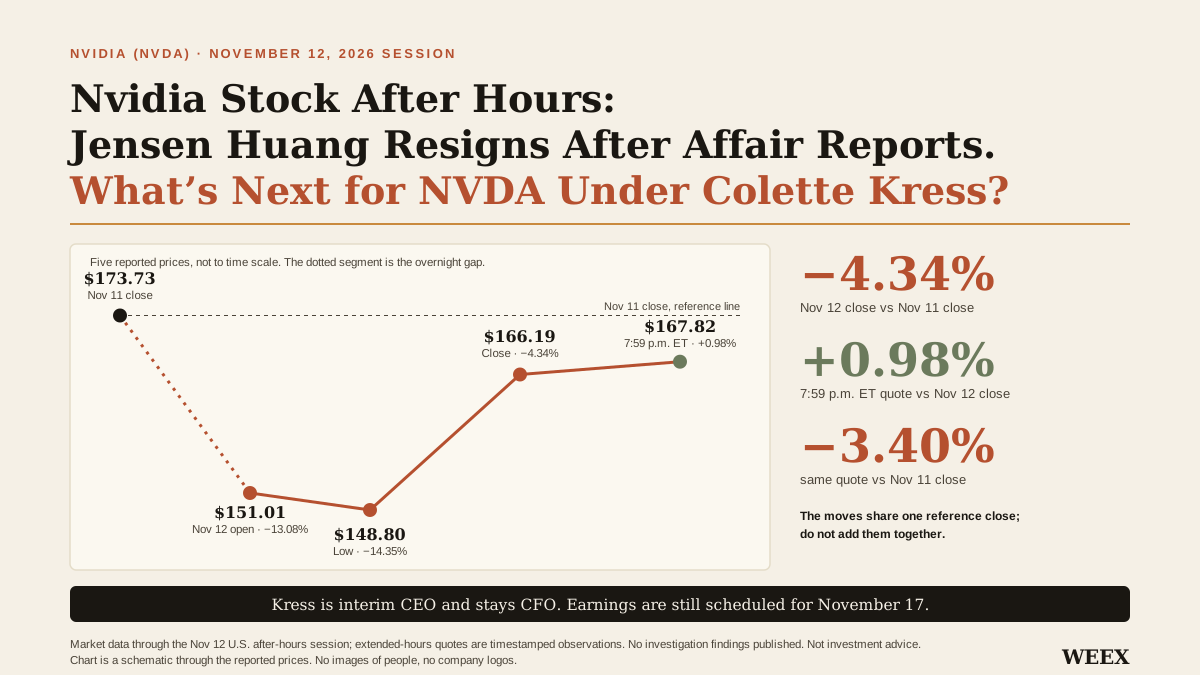
Nvidia Stock After Hours: Jensen Huang Resigns After Affair Reports. What’s Next for NVDA Under Colette Kress?
Nvidia fell 4.34% after Jensen Huang resigned, then rose 0.98% after hours. See what Colette Kress’s appointment means for NVDA and November 17 earnings.

Dai Zhifeng from Zhongtai Securities: A-shares Adjustment Does Not Change the Long-term Positive Foundation

PNC’s Coinbase Pilot Turns Incoming USDC Into Business Bank Deposits

CITIC Securities: Changes in Technology Company Management May Intensify Market Volatility

CITIC Securities: Changes in Technology Company Management May Intensify Market Volatility

Helius encrypts Solana transfers without removing operator trust

Apple's Market Cap Grew From $347 Billion to $4.6 Trillion During Tim Cook's 15 Years as CEO. Here's What That Growth Curve Means for Apple's Next Chapter Under John Ternus.

Rumble (RUM) Sells Two-Thirds Of Its Bitcoin As AI Business Grows

Apple Becomes a Safe Haven Amid AI Sell-off, Bernstein: 37x P/E Still Not Expensive

SpaceX Starship's 15th Test Flight to Challenge Two-Stage Capture, Aiming for Humanity's First Fully Reusable Orbital Rocket
Deutsche Bank Introduces Custody Services for Five Cryptocurrencies

Net Short Positions of Leveraged Funds Drop to 12,955 BTC, Down 89% from Peak

Intuitive Machines Q3 Revenue Reaches $269.3 Million, Raises Full-Year Guidance to $920 Million to $950 Million
The Hidden Costs of Sandwich Attacks: How Much Retail Investors Overpay for 'Free Trading'?

From Coinbase to Wall Street: Digital Asset Custody Enters a New Phase of Institutionalization

The Next Battle in Crypto Security: How to Rebuild the Authorization System Beyond Smart Contracts?
Greg Abel Has Plowed $14.4 Billion Into Warren Buffett's Favorite Stock This Year, and It's Not Apple
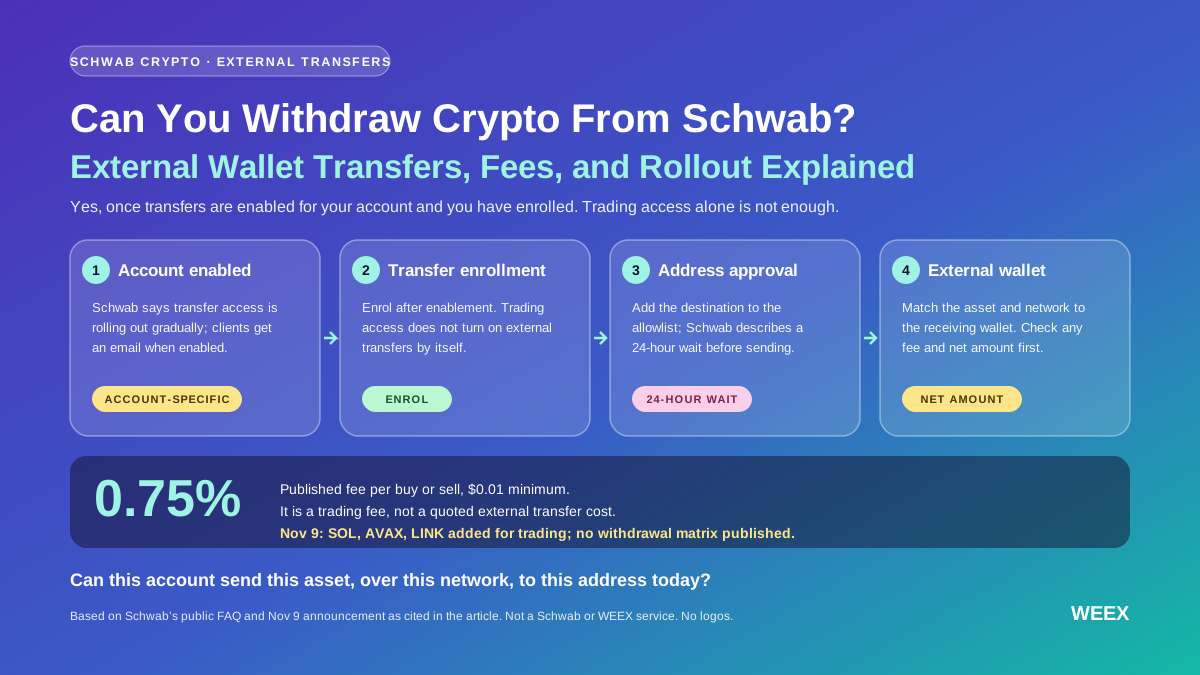
Can You Withdraw Crypto From Schwab? External Wallet Transfers, Fees, and Rollout Explained
Find out when Schwab Crypto allows external wallet withdrawals, how the 24-hour address wait works, and why the 0.75% trading fee is separate.

BAE Systems Raises Full-Year Free Cash Flow Guidance to £3 Billion

Zhang Yiming's Latest Statement: ByteDance Has the Capability to Compete with Anthropic and OpenAI, but Catching Up to the Cutting Edge Will Not Happen Until 2029 at the Earliest

End-of-2026 Review: Politics, AI, and the Federal Reserve - The Market is Experiencing a "Risk Repricing"
Saxo Bank: Uncertainty Surrounding Nvidia Provides Opportunities for Competitors
Bitcoin: Fearing Kidnappings, Whales Entrust $5 Billion to BlackRock
Interpretation of FATF Report on Scam Compound Funds: Virtual Assets Become Core Money Laundering Channels
How Much Is Anthropic Really Worth?
Lessons from Five Years of Real Estate Tokenization: Why Only Two Models May Succeed?
South Korea Proposes Withdrawal Suspension for Cryptocurrency: What Happens When Exchanges Suspect a Hack
Canton Coin ETF and November 13: What the SEC Filing States and Does Not State
Latest articles


Latest coin listings on WEEX


