
Apple Becomes a Safe Haven Amid AI Sell-off, Bernstein: 37x P/E Still Not Expensive

 Prefer us on Google



In the context of a recent sell-off in AI-related stocks, Apple (AAPL) has been viewed as a "safe haven" among tech stocks due to its extremely low capital expenditures and low reliance on AI servers, pushing its price-to-earnings (P/E) ratio to historical highs. Bernstein released a research report analyzing the reasonableness of Apple's 37x forward P/E ratio and maintained an "outperform" rating on the stock with a target price of $380.
Why is Apple Seen as a "Safe Haven" in Tech Stocks?
The report points out that Apple's capital expenditures account for only about 2% of its revenue, making it almost unaffected by the AI arms race. Apple has chosen to collaborate with Google to develop its "Apple Foundation Models" (AFMs) and has allowed many AFMs to run on devices when launching Siri AI, significantly reducing its dependence on expensive AI servers.
This asset-light model protects Apple from potential declines in capital expenditures for AI data centers, which currently trouble upstream semiconductor and storage stocks, and avoids the free cash flow contraction risks faced by large cloud providers. Furthermore, Bernstein believes that if the AI bubble were to burst, Apple could actually benefit, for example, by acquiring distressed low-cost assets at very low prices.
Safe Haven Status Drives Up Valuation: Relative P/E Hits Historical Highs
This "safe haven" attribute has directly pushed Apple's valuation to historical extremes. Currently, Apple's valuation stands at 37x the expected earnings per share for the calendar year 2027 (the highest in history), with its relative forward P/E reaching 2.0 times that of the S&P 500 (also a historical high).
Bernstein notes that among U.S. publicly traded companies with a market capitalization exceeding $200 billion and a consensus earnings per share growth rate below 15%, only four companies have a forward P/E ratio exceeding 30x: Costco (COST) (46x), Walmart (WMT) (39x), Apple (AAPL) (37x), and General Electric (36x).
Decoupling from Tech Stocks, Apple Begins to be Priced as a "High-Quality Consumer Stock"
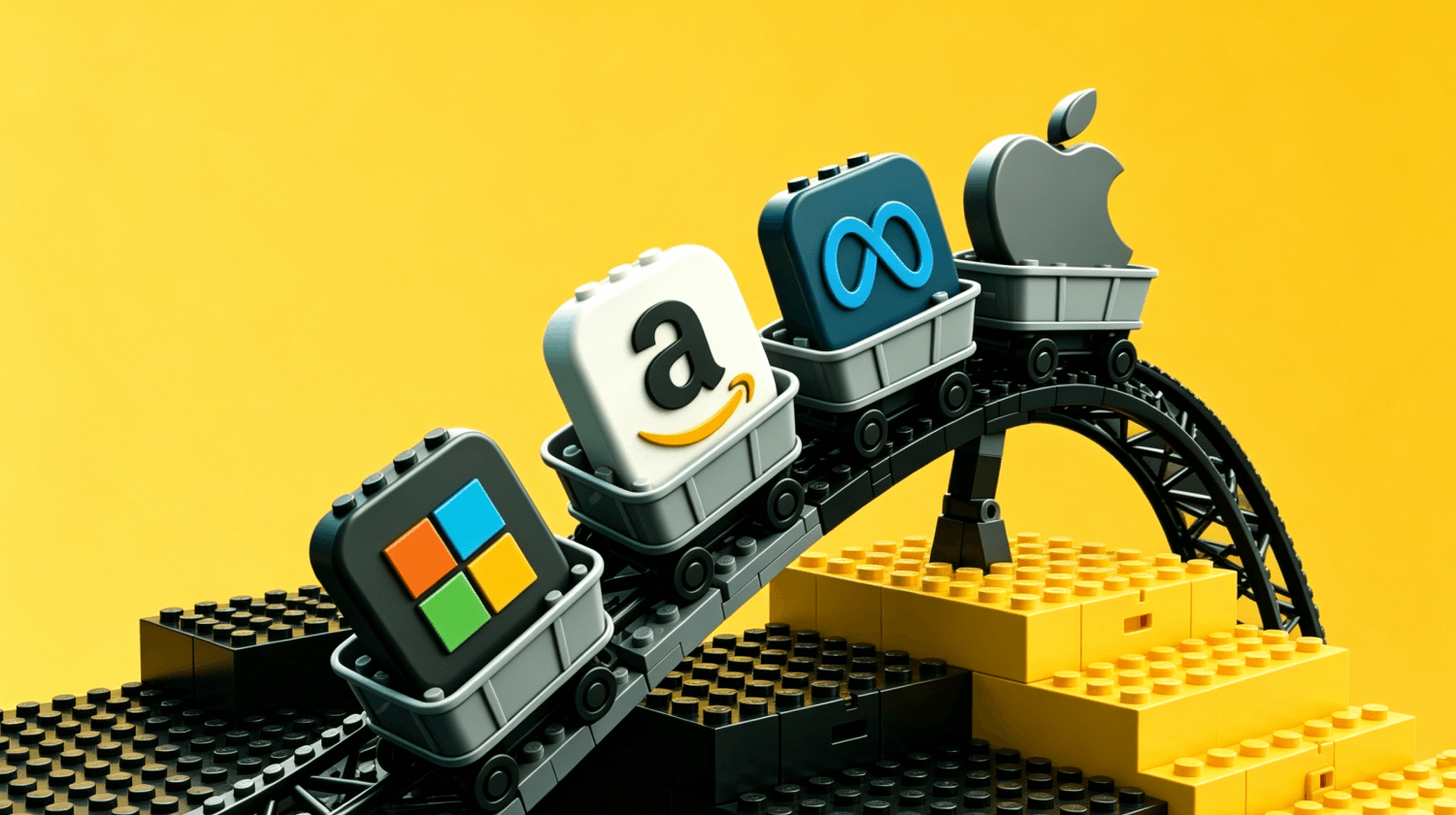
The report suggests that the market has already decoupled Apple from large tech stocks, reclassifying it as a "defensive compound asset." It points out that the linear correlation between P/E ratios and revenue/earnings growth among large tech stocks has significantly weakened. Apple exemplifies this phenomenon: it enjoys a valuation at the top of the sector (37x) despite having growth rates close to the bottom of the sector. For instance, Google's and Meta's (META) expected P/E ratios for 2027 are only about 17-19x, and Microsoft's (MSFT) is 24x, all of which have revenue and earnings growth rates equal to or higher than Apple's, yet their valuation multiples are significantly lower than Apple's.
In contrast, Apple's valuation characteristics are more akin to high-quality consumer stocks. In the consumer staples, large retail, and luxury goods sectors, P/E ratios are typically positively correlated with growth rates. Apple's current forward revenue growth rate (9%) is actually the fastest among this group; its 3.0% free cash flow yield and approximately 3% stock buyback plan mean it is returning almost all of its free cash flow to shareholders. Bernstein believes that compared to Costco (COST) (46x) and Walmart (WMT) (39x), Apple's 37x valuation appears even more cost-effective.
-- Price
Is a 37x P/E Ratio Absurd? Customer Loyalty and Cash Flow Support Premium
In response to doubts about whether Apple's (AAPL) valuation is too high, Bernstein argues that it is not absurd, citing that Apple possesses four key characteristics similar to consumer staples stocks:
High visibility of demand: Apple has a large base of about 1.4 billion active iPhone users, with a replacement cycle of about 4 years, coupled with recurring service revenue accounting for about 40% of gross profit, making its revenue and earnings highly visible for the coming year.
Extremely high customer loyalty: Surveys show that the brand retention rate for iPhone users is as high as 90%. Adjusted for the 3-4 year replacement cycle, Apple's annual retention rate is about 96%-97%, even higher than Costco's (COST) 92.3% (in the U.S. and Canada) membership renewal rate.
Strong pricing power: The iPhone has the lowest price sensitivity among mainstream smartphones. Its price elasticity is about 1.3, far below the average level of 2.5 for other smartphone manufacturers.
Stable shareholder returns: In fiscal year 2026, Apple returned about $102 billion to shareholders through buybacks and dividends. With about $57 billion in net cash and $136 billion in free cash flow, Apple is capable of continuing to repurchase shares equivalent to about 3.0% and 3.3% of its market capitalization in fiscal years 2027 and 2028, respectively.
Additionally, Apple has extremely strong earnings stability. Over the past 10 years (since the first quarter of fiscal year 2016), its earnings per share have exceeded sell-side expectations in 40 out of 44 quarters, with only 2 quarters falling short. Bernstein believes that the market's premium for Apple partly reflects its rare characteristic of "not missing earnings."
This content is provided for general informational purposes only and doesn't constitute financial, investment, legal, or tax advice. Any events, rewards, online promotions, or related information mentioned herein should not be considered a recommendation, solicitation, or invitation to purchase, sell, trade, or otherwise deal in any crypto assets. Crypto assets are highly volatile and may result in loss. The availability of WEEX services, products, and related events may vary by region. You are responsible for ensuring that your participation is in accordance with applicable local laws and regulations.
You may also like

Why AMD Shares Are Surging and What a $10,000 Investment in the Stock Could Be Worth in 3 Years

9-Minute Attack Window, 7.1 Million BTC Exposed: How Bitcoin Can Save Itself from Quantum Threats

Wall Street's Next Blockbuster Stock Split Could Come From This Chip Equipment Giant
Kraft Heinz's Revival Plan: Cheese Ramen and High-Protein Jell-O
Bernstein: Why You Absolutely Shouldn't Buy the Dip on Nvidia Right Now?

Progress in Arbitration of Financial Loan Contract Dispute Involving ST Sanmu
Pony Ma's Latest Internal Speech Exposed! Using AI to Improve Efficiency in Core Business, Exploring AI Native and New Battlefields
Kevin O'Leary Explains How Uncertainties in the U.S. Are Slowing Crypto Adoption

From London to Ras Al Khaimah: A Crypto Founder's Reason for Leaving
Two U.S. Senators Demand Answers on Insider Trading Prevention Measures in Trump White House's Prediction Market
Poland to Fund Long-Term U.S. Military Presence

As Whales Embrace ETFs, Security Anxiety in the Crypto World is Spreading
Binance Warns of Potential Leak of iPhone Users' Cryptocurrency Seed Phrases Due to iOS Vulnerability
Confidence at Zero! Goldman Sachs Interprets Hedge Fund Positions: 'Surrender Liquidation', Largest Loss Since the Pandemic
IPS has 500 million USD trapped in Ueno Bank
US Congress Calls for Limiting NVIDIA Chip Exports to China Amid Spy Scandal
Zcash Hits Record Network Hash Rate After NU7 Update

Collapse of Ueno Bank in Paraguay Exposes Issues Affecting 3 Million People
Global Outage: Your Cryptos Are Not Disappearing
Financial Services Agency and European Commission Exchange Views on Stablecoins and Tokenization at 7th Japan-EU Joint Financial Regulatory Forum, Sharing MiCA Implementation Status
Is RLUSD a Competitor to XRP? Evernote's 'Symbiosis Theory' Claims Token Value Connection
Cybersecurity: What the $6.3 Billion Hack Warns Argentina About
Monetary Authority of Singapore Warns Public Against Trading with Unregulated Companies

BCRA has already purchased over $16 billion this year, but reserves fell due to a payment to the IMF
VerifiedX launches Vault feature for vBTC recovery
Cryptocurrency Exchanges Enter the U.S. Stock Derivatives Market as CFTC Approves Perpetual Futures Amid Wall Street Backlash
Global Cyber Offensive: AI and Hackers are Shaking the Financial System
Why Bitcoin's Next Soft Fork Could Feel Like a Practice Run
Copom Expected to Pause Selic Cuts: What Changes for Investors
Let AI Lie on the Couch of Psychological Counseling: Gemini Says It Has a 'Graveyard' Inside
Why AMD Shares Are Surging and What a $10,000 Investment in the Stock Could Be Worth in 3 Years
9-Minute Attack Window, 7.1 Million BTC Exposed: How Bitcoin Can Save Itself from Quantum Threats
Wall Street's Next Blockbuster Stock Split Could Come From This Chip Equipment Giant
Kraft Heinz's Revival Plan: Cheese Ramen and High-Protein Jell-O
Bernstein: Why You Absolutely Shouldn't Buy the Dip on Nvidia Right Now?
Progress in Arbitration of Financial Loan Contract Dispute Involving ST Sanmu
Latest articles


Latest coin listings on WEEX


