
Crypto Convert vs Spot Trading: Which Should You Use On WEEX?

 Prefer us on Google


Crypto Convert vs Spot Trading: Which Should You Use On WEEX?
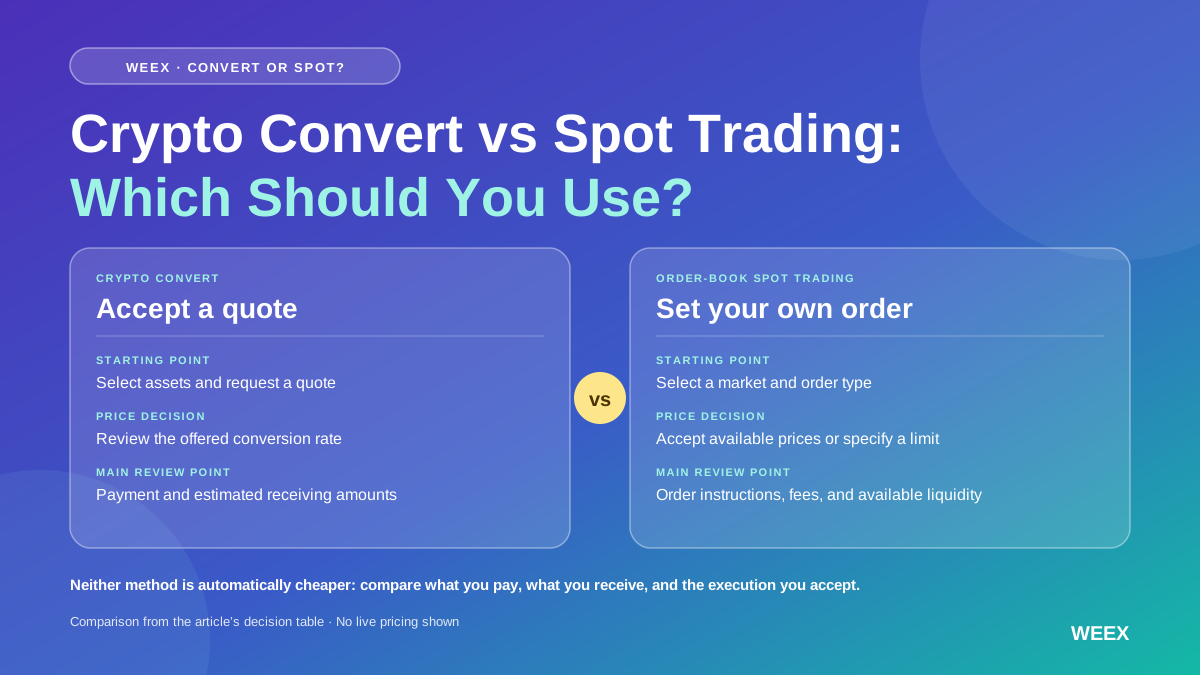
Crypto Convert is usually the more straightforward choice when you want to exchange supported assets after reviewing a quote. Spot trading is better suited to users who want to choose an order type, inspect an order book, or set a specific limit price. Neither method is automatically cheaper: the meaningful comparison is how much you pay, how much you receive, and what execution conditions you accept.
At WEEX, we see these as complementary ways to manage assets. Convert reduces the decisions needed for a straightforward exchange; spot trading gives you more control over how an order is submitted. The right choice depends on whether you want to accept an available quote or make execution conditional on your own price instructions.
What Is the Difference Between Crypto Convert and Spot Trading?
The main difference is the user-facing execution model. Convert presents a quote for an asset exchange. Order-book spot trading lets you submit instructions to buy or sell within a market.
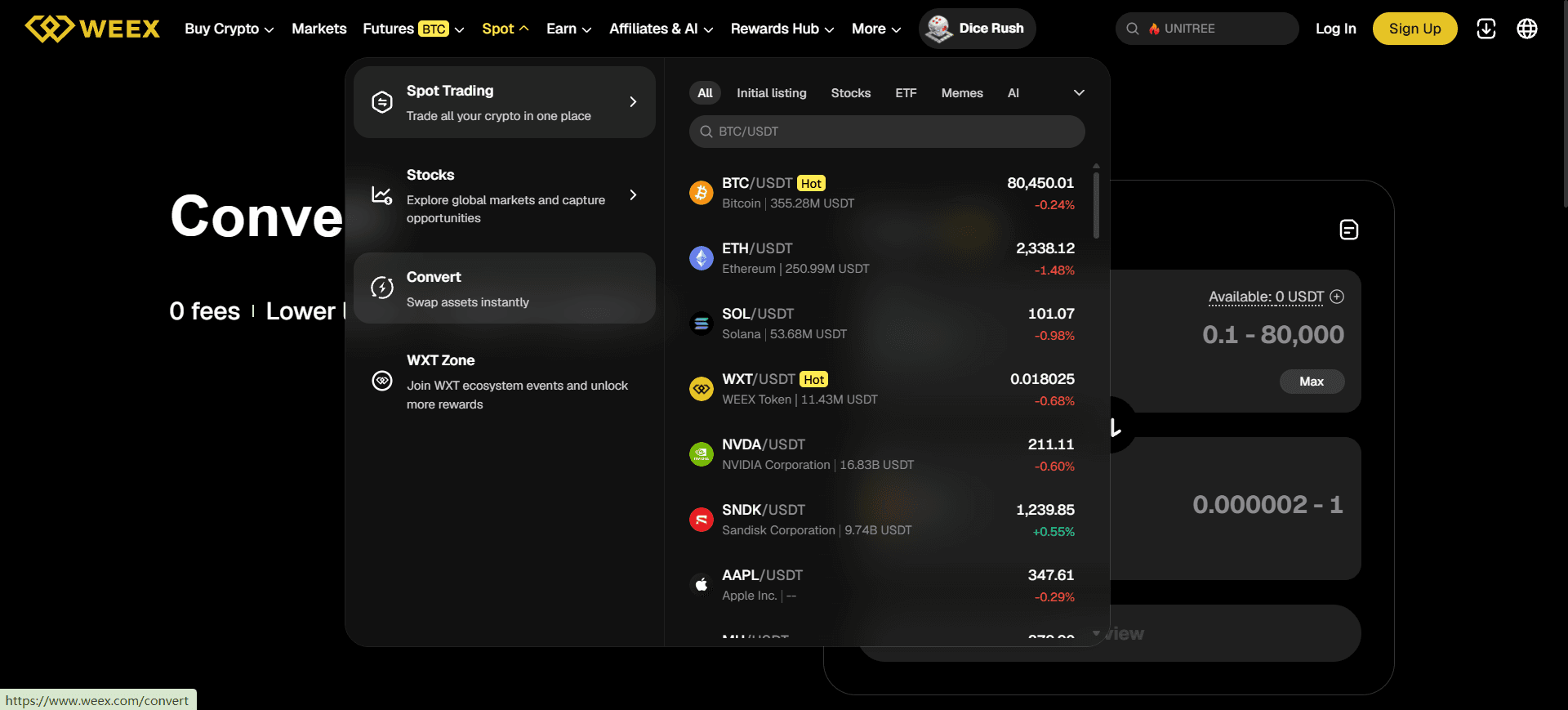
With WEEX Convert, you select the assets and amount, then review the conversion terms before submitting. You do not manually place an order into an order book.
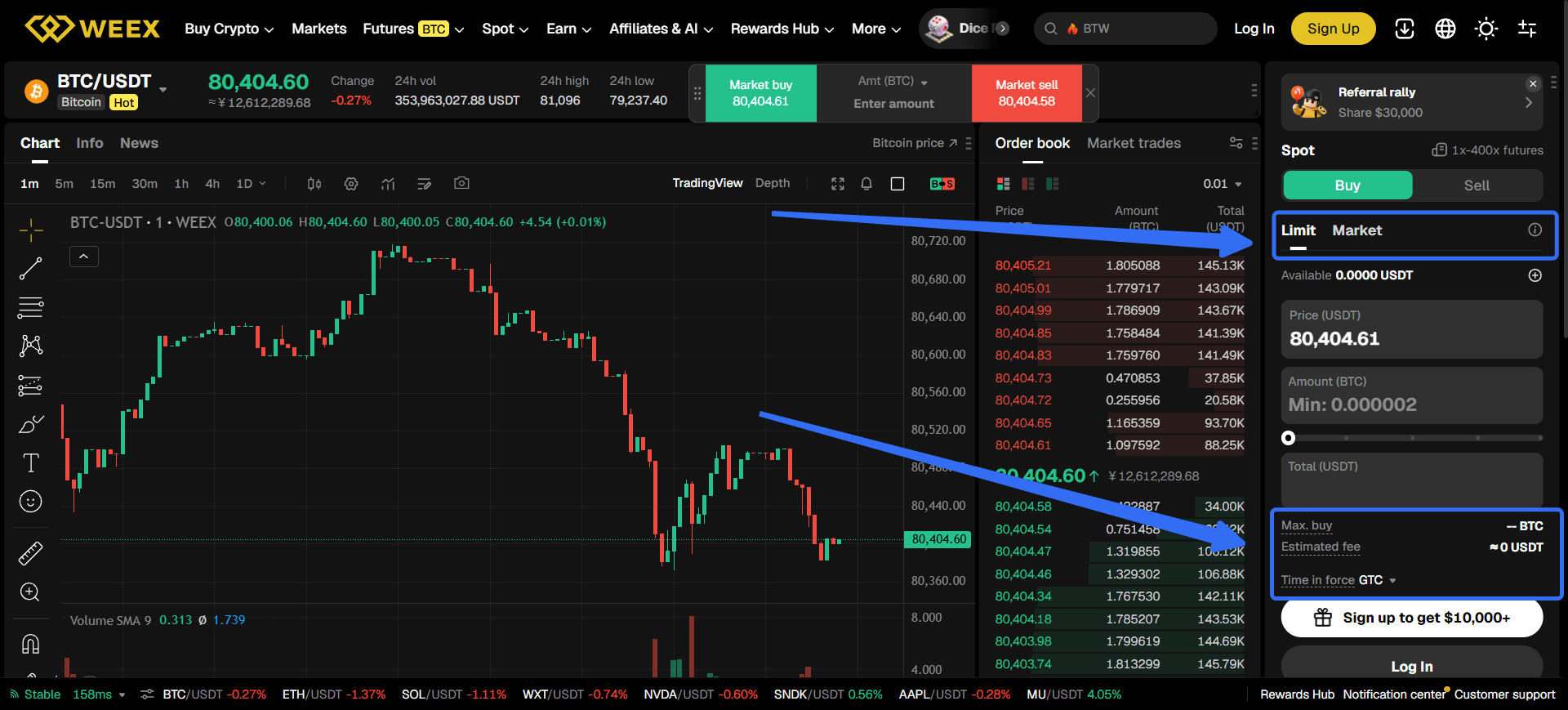
On an order-book trading interface, you typically choose a market and an order type. A market order prioritizes execution against available orders, while a limit order specifies a price boundary. That extra control comes with additional decisions about pricing, quantity, and whether to wait.
| Decision Area | Crypto Convert | Order-Book Spot Trading |
|---|---|---|
| Starting point | Select assets and request a quote | Select a market and order type |
| Price decision | Review the offered conversion rate | Accept available prices or specify a limit |
| Main review point | Payment and estimated receiving amounts | Order instructions, fees, and available liquidity |
| Execution uncertainty | Depends on quote validity and successful processing | Depends on order type, liquidity, and matching |
| Ongoing management | Check the conversion result | Monitor fills and any unfilled quantity |
| Typical use | A straightforward exchange of supported assets | Trading with more specific execution instructions |
This distinction is not a ranking of beginner and advanced users. An experienced trader may use Convert for a routine asset exchange, while a beginner may prefer a limit order when a specific price matters.
When Does Convert Make More Sense?
Convert makes sense when your immediate goal is to change the asset you hold and you are comfortable assessing the available quote. You know what you want to exchange, and you do not need to leave an order waiting at a target price.
For example, you might want to consolidate supported account balances or adjust your asset allocation. In those situations, the most relevant question may be, “Does this quote give me an acceptable amount of the asset I want?”
The simpler interface can reduce operational work. You do not need to interpret several order-book levels or decide how to manage a partially filled limit order. However, that simplicity does not remove your responsibility to evaluate the rate.
WEEX Convert also supports eligible small-amount exchanges. Whether a particular balance can be converted depends on the selected assets and the limits displayed in the product. Small balances are not automatically convertible simply because they appear in your account.
-- Price
When Does Spot Trading Make More Sense?
Spot trading makes more sense when your price instructions are part of the decision. You may want to buy only at a specified price, sell no lower than a chosen level, or inspect the available market depth before placing an order.
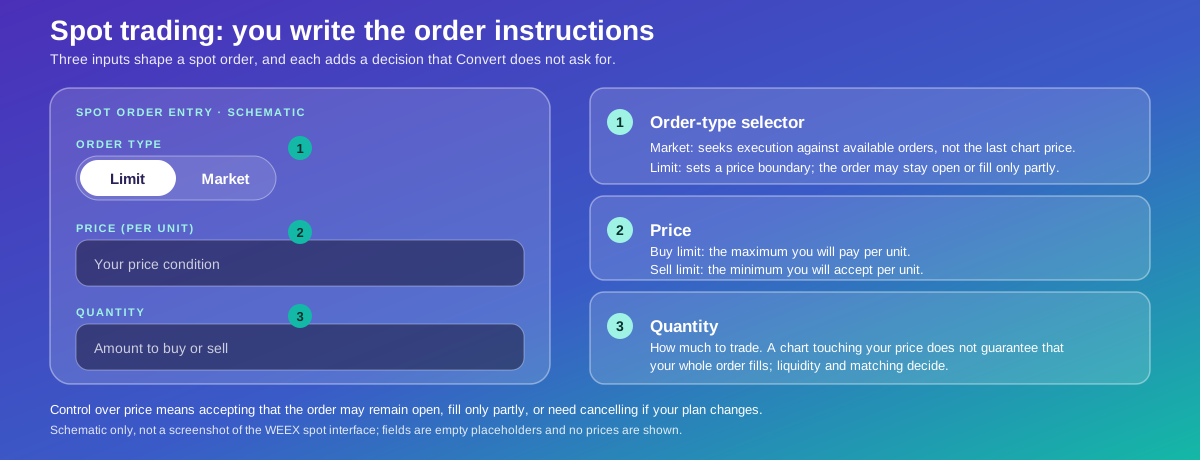
A limit order is particularly useful when you are willing to wait rather than accept the currently available price. A buy limit sets the maximum price you are willing to pay per unit; a sell limit sets the minimum price you are willing to accept per unit.
That control has a trade-off: the order may not fill. It can remain open, execute only partly, or require cancellation if your plan changes. A chart touching your limit price also does not guarantee that your entire order will execute, because other orders and available liquidity affect matching.
A market order takes a different approach. It seeks execution against available orders, but it does not promise that every unit will trade at the last price shown on a chart. For that reason, choosing spot trading does not automatically mean choosing a fixed execution price.
Is Convert Cheaper Than Spot Trading?
There is no universal answer. Compare the complete conversion or trade outcome, not a fee label in isolation.
WEEX Convert charges zero conversion fees, but its quoted rate may differ from the spot-market price. For a spot trade, the applicable trading fee and actual execution prices affect the result. Those are different pricing structures, so comparing only the separately displayed fee can be misleading.
A useful comparison keeps three things consistent: the amount you spend, the asset you receive, and the observation time.
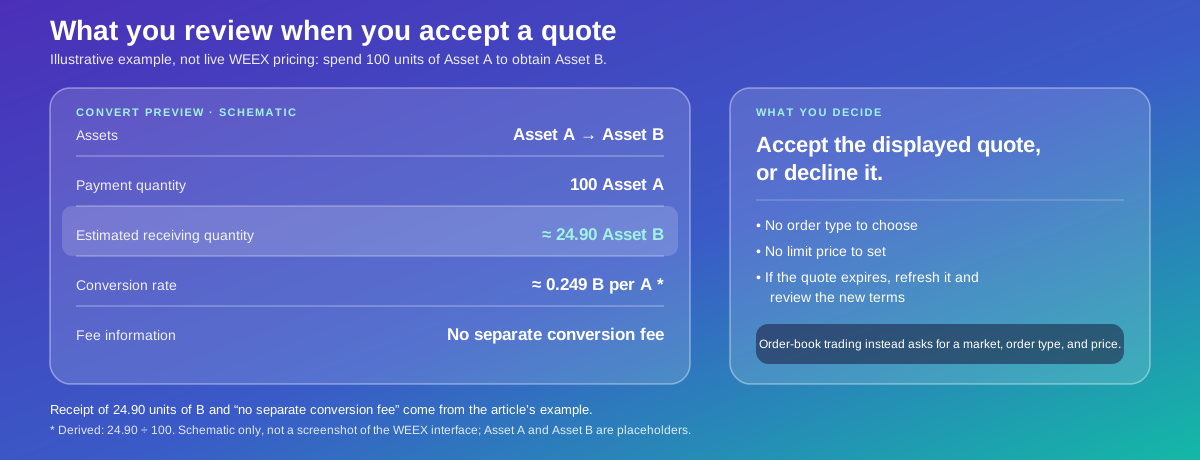
Illustrative example—not live WEEX pricing: assume you want to spend 100 units of Asset A to obtain Asset B.
| Route | Illustrative Result |
|---|---|
| Convert | Preview shows an estimated receipt of 24.90 units of B, with no separate conversion fee |
| Spot market order | Estimated gross receipt is 25.00 units of B; after a hypothetical 0.10% fee deducted in B, net receipt would be 24.975 units |
| Spot limit order | Could produce a different result if filled, but there is no guarantee of execution |
In this example, spot produces a slightly higher estimated net amount. Different quotes, fees, or execution prices could reverse the comparison. The numbers demonstrate the calculation—not a claim that either route is generally cheaper.
For an accurate comparison, also check the asset in which a spot fee is charged. A fee deducted from the receiving asset affects the quantity received; a fee charged separately affects the total cost instead.
Why Is the Convert Quote Different From the Chart Price?
A chart’s last traded price is a historical transaction reference. It is not a promise that your intended amount can be exchanged at that exact price.
A Convert quote applies to a specific asset direction and quantity at a particular moment. A spot market order interacts with available orders, which can exist at several price levels. These are not identical observations.
Even the best available bid or ask may cover only a limited quantity. If a market order is larger than the quantity available at that level, it can execute across additional levels. The resulting average execution price may therefore differ from the first price you saw.
For WEEX Convert, the appropriate decision point is the preview. If a quote expires, refresh it and evaluate the updated terms. Do not rely on an earlier receiving amount after the quote has changed.
This is why “the chart says a better price” is an incomplete comparison. The useful question is whether that alternative price is executable for your amount, including applicable costs.
How Much Price Control Does Each Method Give You?
Convert gives you control over whether to accept the displayed quote. Spot limit trading gives you control over a price boundary, but not over whether a willing counterparty will fill your order.
These are different forms of control.
With Convert, your decision is based on an available proposal. If you do not like the terms, you can decline to proceed. The preview should be reviewed before submission, and the final record should be checked afterward.
With a spot limit order, you define a condition and let the market determine whether execution becomes possible. The order may provide your desired price or better if filled, but waiting introduces another uncertainty: you might not obtain the asset at all.
A market order offers less price control than a limit order. It prioritizes execution, subject to market availability, rather than guaranteeing one specified price.
How Should You Choose for a Real Task?
Start with the condition that matters most to you. If it is an acceptable receiving amount available now, inspect Convert. If it is a specific price you are willing to wait for, inspect the spot market and relevant order type.
The following scenarios show how that decision works without assuming that either route always wins.
You Want a Straightforward Asset Exchange
Convert is worth considering when you have supported assets available and want to review a quote before exchanging them. Check the selected direction, payment amount, estimated receipt, and limits.
The convenience is meaningful only if the quote suits your needs. A shorter process is not a reason to accept an unfavorable outcome.
You Will Trade Only at a Particular Price
A spot limit order is a better match when a price condition is essential. You decide the boundary and accept that the order may remain unfilled.
Before placing it, decide what you will do if only part of the order executes or if the market moves away. Price control also requires order management.
You Are Comparing a Larger Amount
Compare the quote for the full intended amount with the market depth and applicable spot costs. Do not multiply a small sample quote and assume the same outcome scales indefinitely.
If you split a transaction, remember that conditions can change between submissions. Several smaller transactions do not automatically produce a better result.
You Are Unsure Which Route Has Better Value
Compare net outcomes for the same amount at approximately the same time. Avoid executing both routes simply to test them, and remember that conversion back to the starting asset is a new transaction with new terms.
The best choice is the one that matches your objective after costs and execution uncertainty are considered—not necessarily the interface with more controls.
What Should You Check After Submitting?
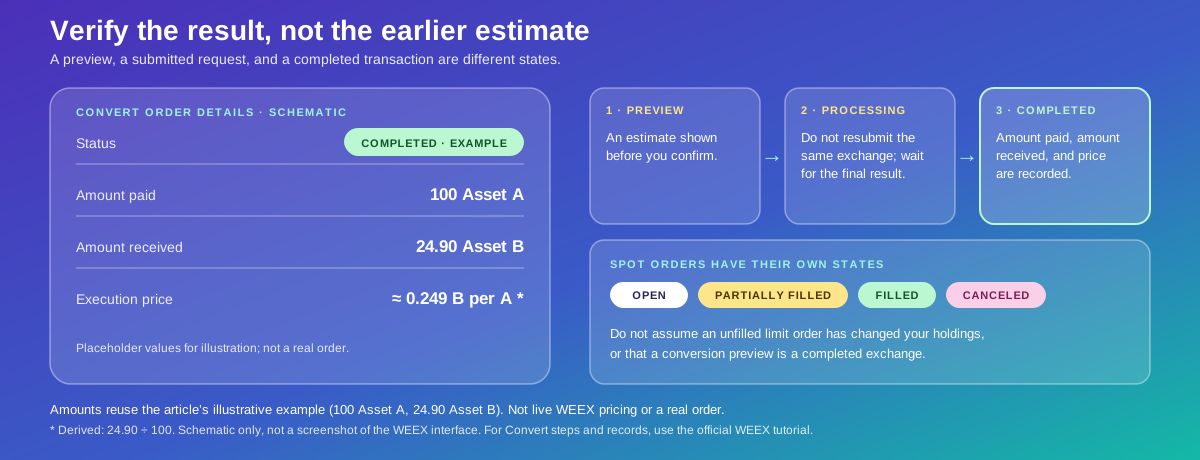
A preview, a submitted request, and a completed transaction are different states. Always verify the result before making another decision based on your expected balance.
For a conversion, review the order status and recorded amounts. If the request is still processing, avoid repeatedly submitting the same exchange. For a spot order, distinguish between open, partially filled, filled, and canceled quantities.
This matters most when you intend to use the receiving asset immediately afterward. Do not assume that an unfilled limit order has changed your holdings or that a conversion preview represents a completed exchange.
How Can You Compare the Options on WEEX?
You can begin with a quote on WEEX Convert, then decide whether the offered outcome fits your task. If your objective requires a user-defined price condition, compare that with the relevant spot market and order options.
For the exact Web and App workflow, including quote review and conversion records, follow our official WEEX Convert tutorial.
This comparison concerns account-based conversion and spot order execution. It does not treat Convert as a withdrawal, a blockchain bridge, or a substitute for choosing a compatible transfer network.
WEEX Editor‘s View: Choose the Execution Method Your Task Requires
We recommend Convert for users who value a straightforward quote-based exchange, and spot limit trading for users whose decision depends on a specific price condition.
Neither choice should be justified by an assumption that “zero fees” means the best rate or that an order book guarantees a better fill. Compare the amount received, understand whether execution can remain incomplete, and choose the level of control you actually need.
The strongest decision is not always the most complicated one. It is the one whose pricing and execution conditions you understand before committing.
FAQ
1. Is Crypto Convert the Same as Spot Trading?
Both can exchange one cryptocurrency for another, but the interface and execution model differ. Quote-based Convert centers on accepting an offered rate; order-book spot trading centers on submitting order instructions.
2. Is WEEX Convert Always Cheaper Than Spot Trading?
No. WEEX Convert has zero conversion fees, but the quote can differ from spot-market prices. Compare the estimated receiving amount with the net outcome of the alternative trade.
3. Does a Spot Limit Order Guarantee Execution?
No. A limit order controls the acceptable execution price, but it may remain unfilled or execute only partly depending on available liquidity and matching.
4. Is the Last Traded Price the Price I Will Receive?
Not necessarily. It describes a previous trade. Your result depends on the current quote or the actual prices at which your order executes.
5. Does “Swap vs Spot Trading” Always Mean the Same Comparison?
No. “Swap” can refer to exchange-based conversion or a blockchain transaction through a decentralized platform. Check the product’s mechanism rather than relying on the label alone.
This content is provided for general informational purposes only and doesn't constitute financial, investment, legal, or tax advice. Any events, rewards, online promotions, or related information mentioned herein should not be considered a recommendation, solicitation, or invitation to purchase, sell, trade, or otherwise deal in any crypto assets. Crypto assets are highly volatile and may result in loss. The availability of WEEX services, products, and related events may vary by region. You are responsible for ensuring that your participation is in accordance with applicable local laws and regulations.
You may also like
Crypto Convert vs Transfer vs Bridge: Which Action Do You Need?
Exchange Convert vs DEX Swap: What’s the Difference? Try Convert Crypto On WEEX!
What Is Crypto Convert and How Does It Work? Try Crypto Convert On WEEX Now!
What Is a Limit Order? How It Works and When to Use It
Best Crypto Wallet for Beginners 2025: Pick by What You Will Do
How to Buy USDT With NGN via Bank Transfer on WEEX?
WEEX API Key Setup: Permissions, IP Binding and Key Limits

How to Call a Crypto Exchange API Without Getting Blocked

WEEX Crypto Gift: The Perfect Gift for Every Crypto Lover in 2025
WEEX Exchange Review: A Complete Guide for Beginners
Bloom Crypto Bot Wallet Drains: What Happened and What Users Should Check
How to Use WEEX Bubbles: A Practical Guide to Crypto Bubbles and Market Trends
SK Hynix Stock Before Q3 Earnings: Special Dividend Reports, HBM4 and What Investors Want to See on October 28
Corporate Actions for Tokenized Stocks: How Dividends, Splits and Mergers Are Handled
WEEX Futures PnL: Why Your Three PnL Numbers Rarely Match
WEEX Reduce-Only Order: What It Does and When It Gets Cancelled
WEEX Stop Loss Not Triggered? Check the Trigger, Then the Fill
WEEX Funding Fee Explained: Rate, Countdown, Records and Math
WEEX Trading Pair Suspended or Delisted? Your Orders and Assets
WEEX Order History: How Orders, Fills and Fees Fit Together
WEEX Minimum Order Size Errors Explained With Rounding Examples
Cancel WEEX Spot Order: What Returns to Your Balance and When
WEEX Limit Order Not Filled? Read the Book, Then Fix the Order
How to Spot Trade on WEEX: From Pair Choice to a Confirmed Fill

Your Auto Earn Floor: Why Your Lowest Balance Sets the Day's Pay
How Transparent Is a Crypto Exchange? Checking Proof of Reserves and Protection Funds On WEEX Trust Center
HTX (Huobi) Russia Restrictions: Who Is Affected and What to Check

Is United States Dividend Fund (USDF) Legit? What Website Checks and Reddit Actually Show
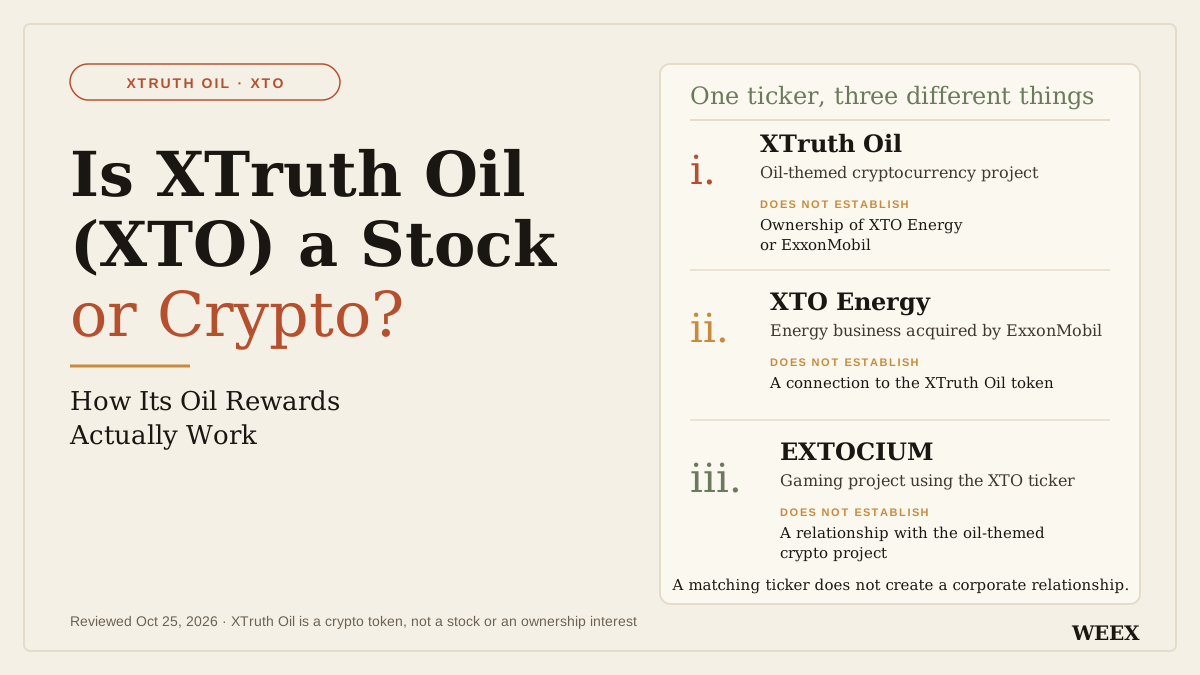
Is XTruth Oil (XTO) a Stock or Crypto? How Its Oil Rewards Actually Work
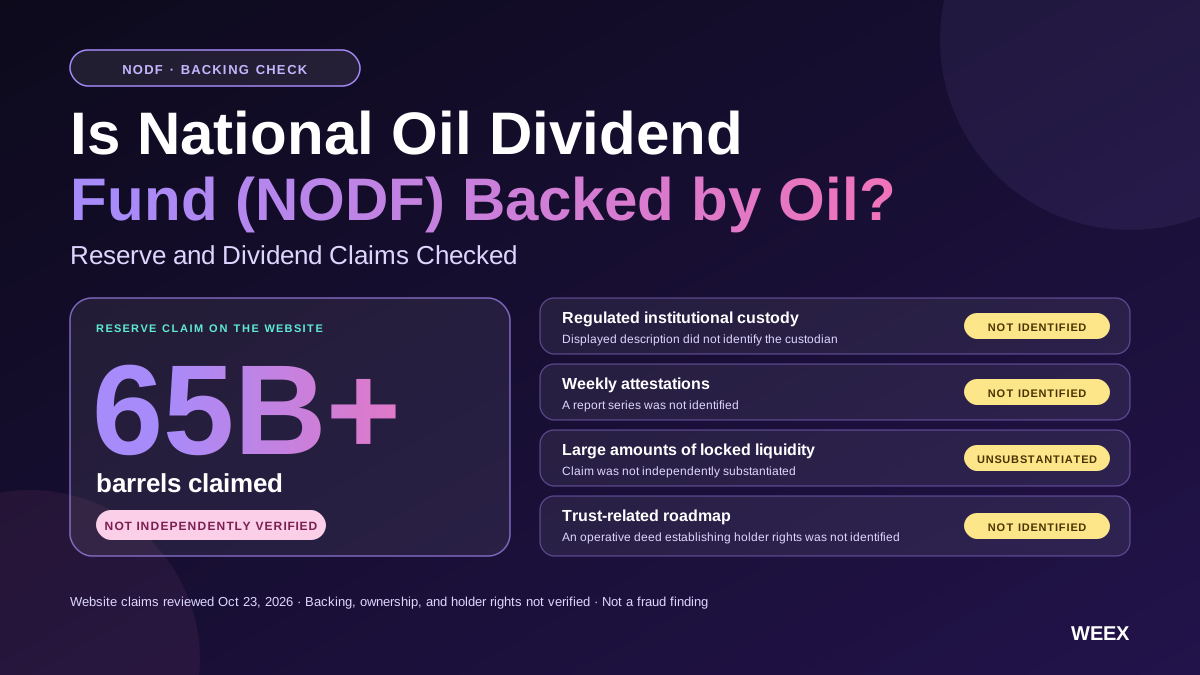
Is National Oil Dividend Fund (NODF) Backed by Oil? Reserve and Dividend Claims Checked
Crypto Convert vs Transfer vs Bridge: Which Action Do You Need?
Exchange Convert vs DEX Swap: What’s the Difference? Try Convert Crypto On WEEX!
What Is Crypto Convert and How Does It Work? Try Crypto Convert On WEEX Now!
What Is a Limit Order? How It Works and When to Use It
Best Crypto Wallet for Beginners 2025: Pick by What You Will Do
How to Buy USDT With NGN via Bank Transfer on WEEX?
Contents
Popular coins
Latest articles


