WEEX Exchange Review: A Complete Guide for Beginners
The world of cryptocurrency is always changing, and selecting the appropriate exchange from the numerous options can prove to be quite challenging.
When assessing an exchange, the key factors to consider are security, user-friendliness, liquidity, and the variety of cryptocurrencies available. In a market that is both risky and full of opportunities, having a dependable and easy-to-use platform can be crucial.
WEEX distinguishes itself as a secure, effective, and user-friendly trading platform. In this overview, we will provide you with a thorough introduction to WEEX and all the information you need.
What Is WEEX?
WEEX Exchange, founded in 2018 with a substantial $100 million backing from a leading blockchain investment company, is a robust digital asset trading platform. Positioned as a centralized exchange (CEX), WEEX offers users the opportunity to engage in spot trading, futures trading with leverage up to 400x, over-the-counter (OTC) trading, and copy trading. Supporting a wide range of over 1000 cryptocurrencies, the platform serves a diverse global community of tokens traders.
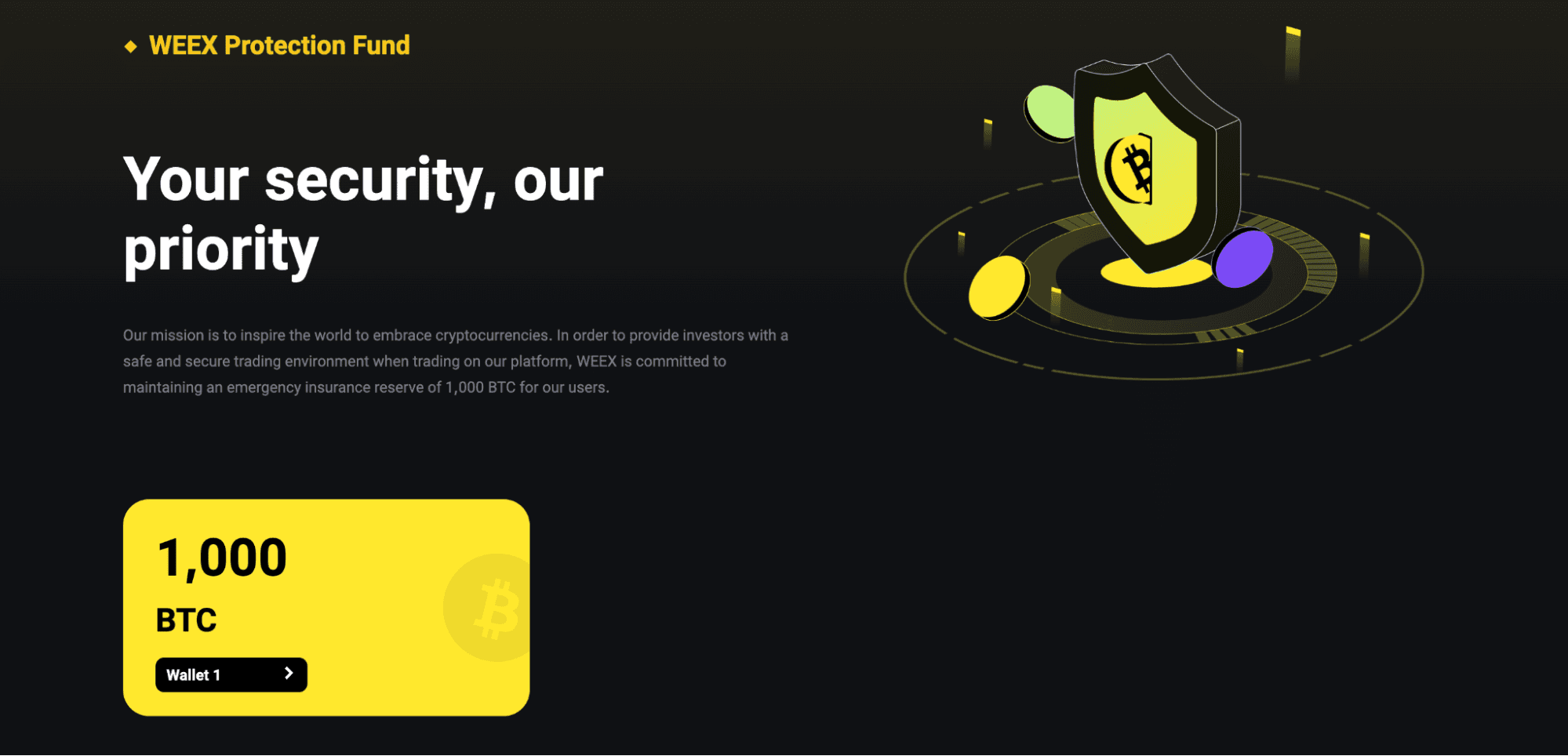
WEEX places great emphasis on security, boasting a 1,000 user protection fund and implementing advanced security protocols to safeguard user funds and information. This dedication to security, along with an intuitive interface and a wide range of trading tools, has resulted in a devoted and expanding user community at WEEX.
WEEX's affiliate and referral programs are notable for providing commissions of up to 50%, promoting community expansion and boosting user involvement. Whether you are interested in entering the trading realm or diversifying your investment holdings, WEEX integrates innovation, security, and user-focused functionalities to provide a premium cryptocurrency exchange experience.
How To Buy Cryptos On WEEX
Begin by accessing the WEEX website or downloading the app.
If you are currently in possession of a WEEX account, kindly access it by logging in.
Here is a concise manual, tap on this link to access A Step-by-Step Guide for How to Buy/Sell Cryptocurrency on WEEX.
Register and Complete KYC On WEEX
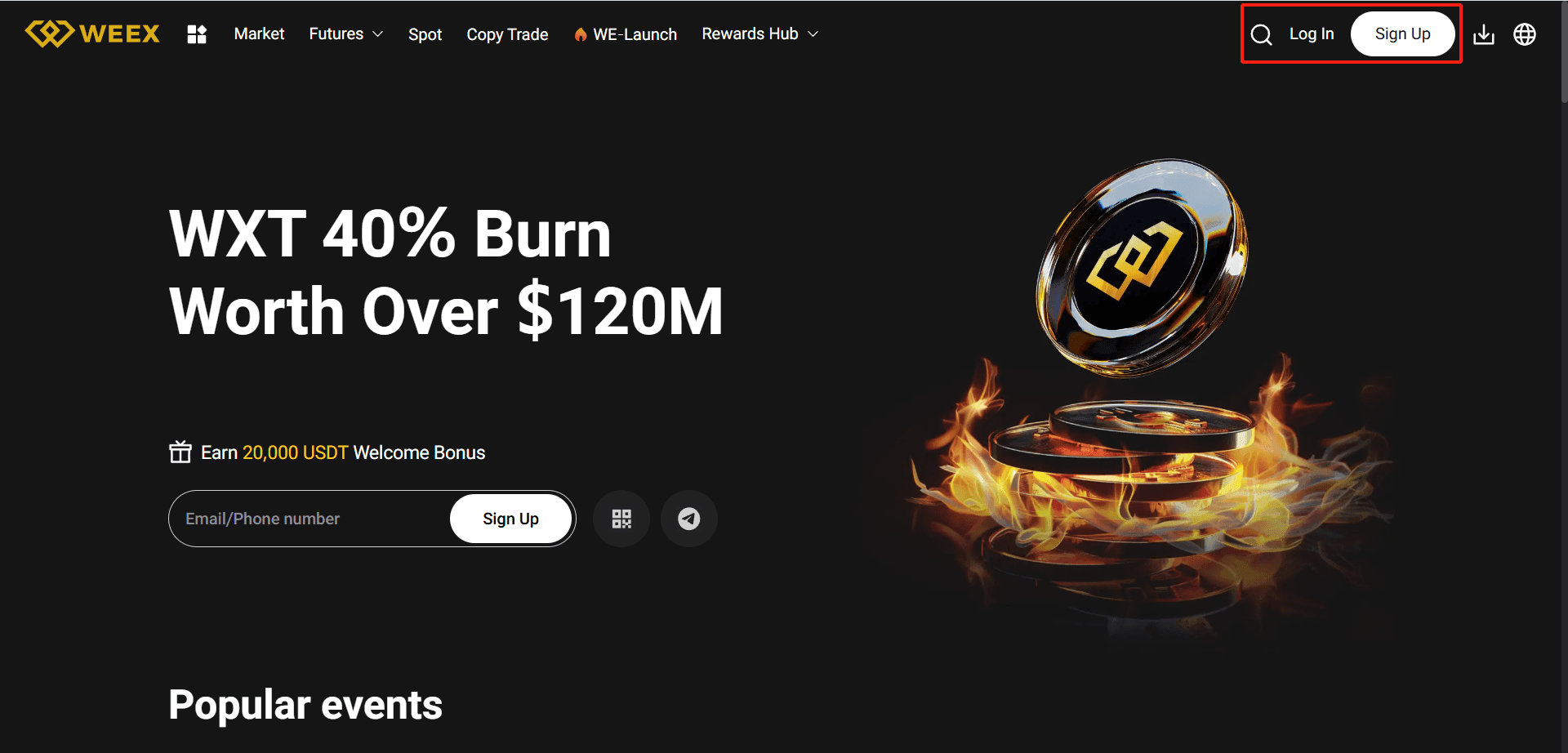
Access the WEEX registration portal or install the application and select [Sign up]. Register by providing the necessary information like email or mobile number. Ensure the accuracy of your email or phone number, and establish a strong and trustworthy password.
Please adhere to our straightforward registration procedure and make sure to input the referral code in the designated field.
In order to uphold the topmost security protocols, WEEX Exchange will take a proactive approach by mandating users to undergo KYC (Know Your Customer) identity verification according to their user tier.
To complete the KYC identity verification process, simply select the yellow profile icon located at the top left corner of your software's homepage and proceed to upload the required documents within the "Identity Verification" section.
Ensure that you do not input incorrect details, as this may result in the suspension of your account.
Take a look at our tutorial on how to set up an account and complete the WEEX KYC process. Once everything is ready, navigate to the WEEX referral program page to proceed.
Deposit and start trading
Deposits on WEEX are free.
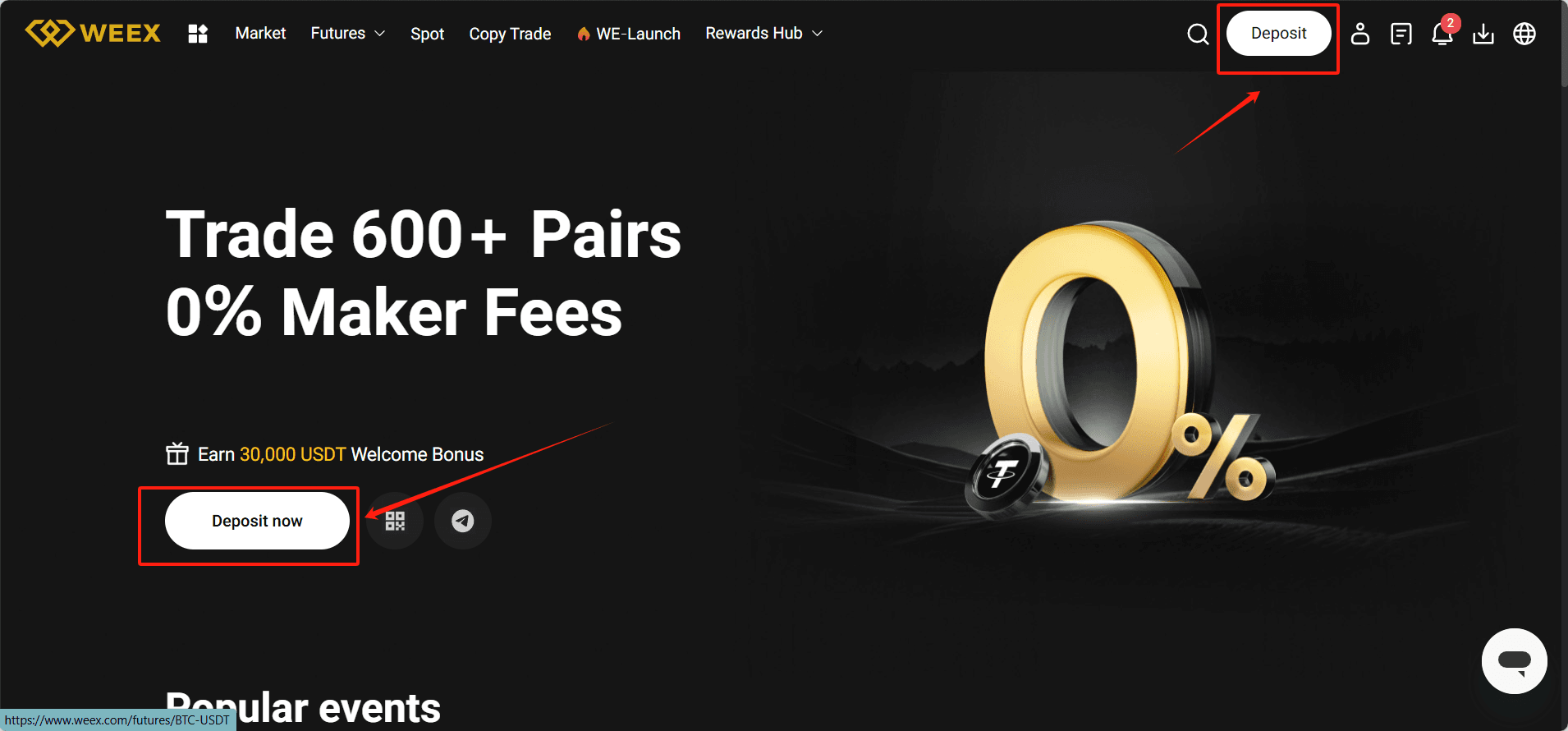
WEEX offers digital wallet services for token deposits. Upon logging into WEEX, you have the option to click [Assets] > click [Deposit] > select the cryptocurrency you own to deposit into the platform, select the desired cryptocurrency for deposit, and proceed to either manually copy the deposit address provided by WEEX or use the QR code scanning feature to initiate the transfer from an external digital wallet.
Explore our detailed instructions for a step-by-step guide on how to deposit on WEEX. By following these steps, you can kickstart your trading experience on WEEX.
Withdraw
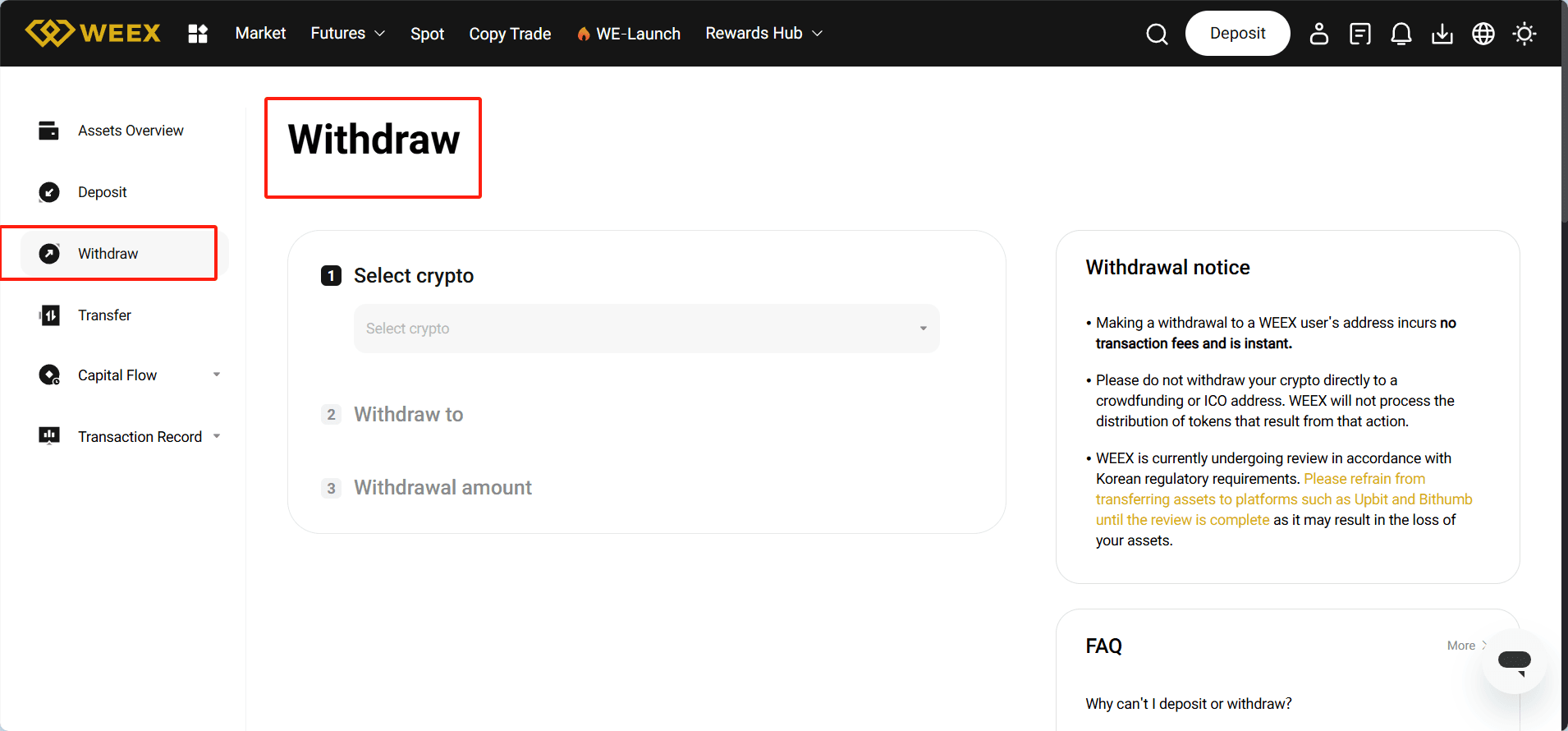
Making a withdrawal on WEEX is uncomplicated. If you are utilizing our WEEX application, once you have signed up or logged in, you can proceed by clicking on [Assets], then selecting [Withdraw], followed by choosing the cryptocurrency you wish to withdraw, the network, and entering the desired address and amount. Subsequently, you only need to exercise patience until the withdrawal process is finished.
Explore our guide for how to withdraw on WEEX to gain a better understanding.
Why Choose WEEX?
Strong Security and Trusted Trading:
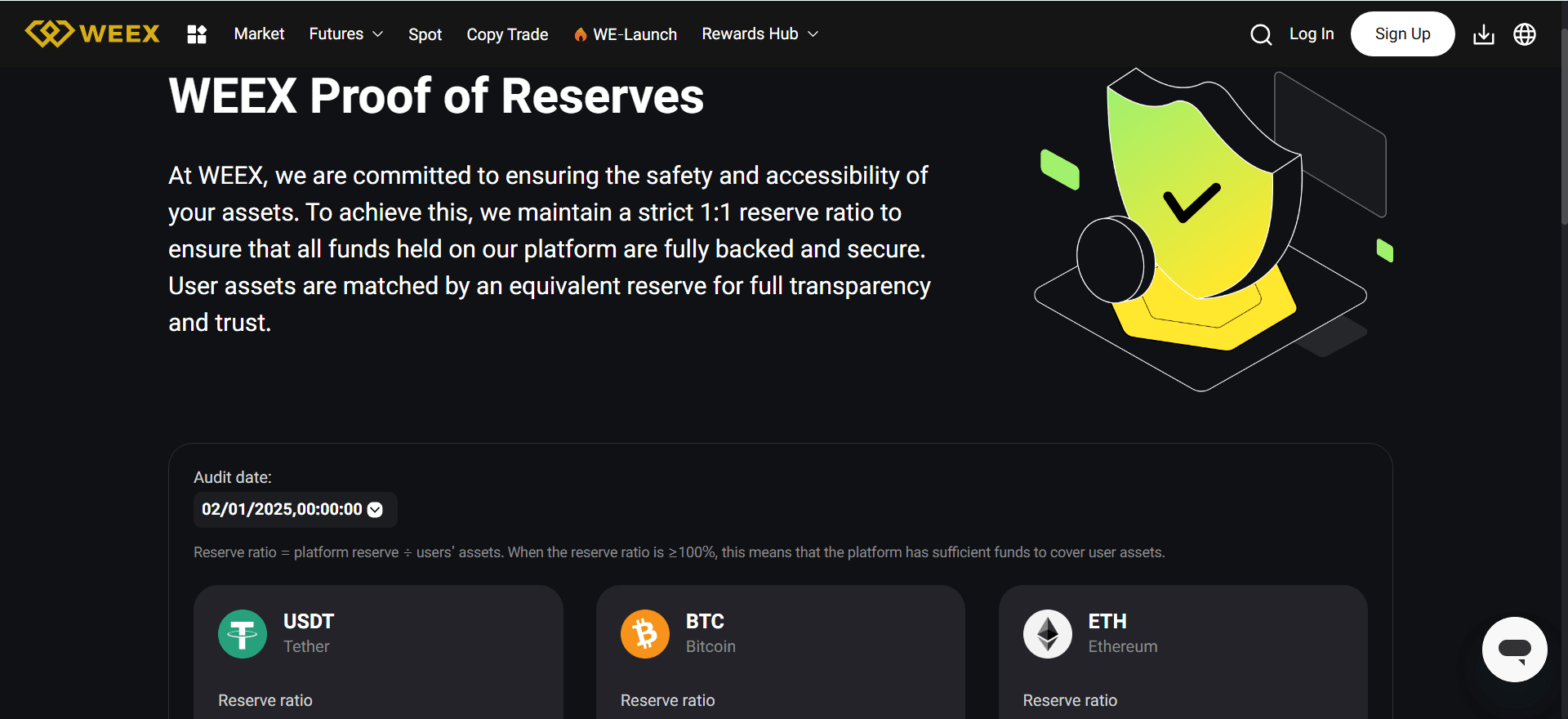
Security stands as a top priority in the operations of WEEX. The platform upholds a user protection fund of 1,000 BTC, along with transparently providing its address and Proof of Reserves (PoR). Additionally, WEEX implements sophisticated security protocols to safeguard user assets and information, guaranteeing a secure and reliable trading atmosphere.
Diverse Selection of Cryptocurrencies:
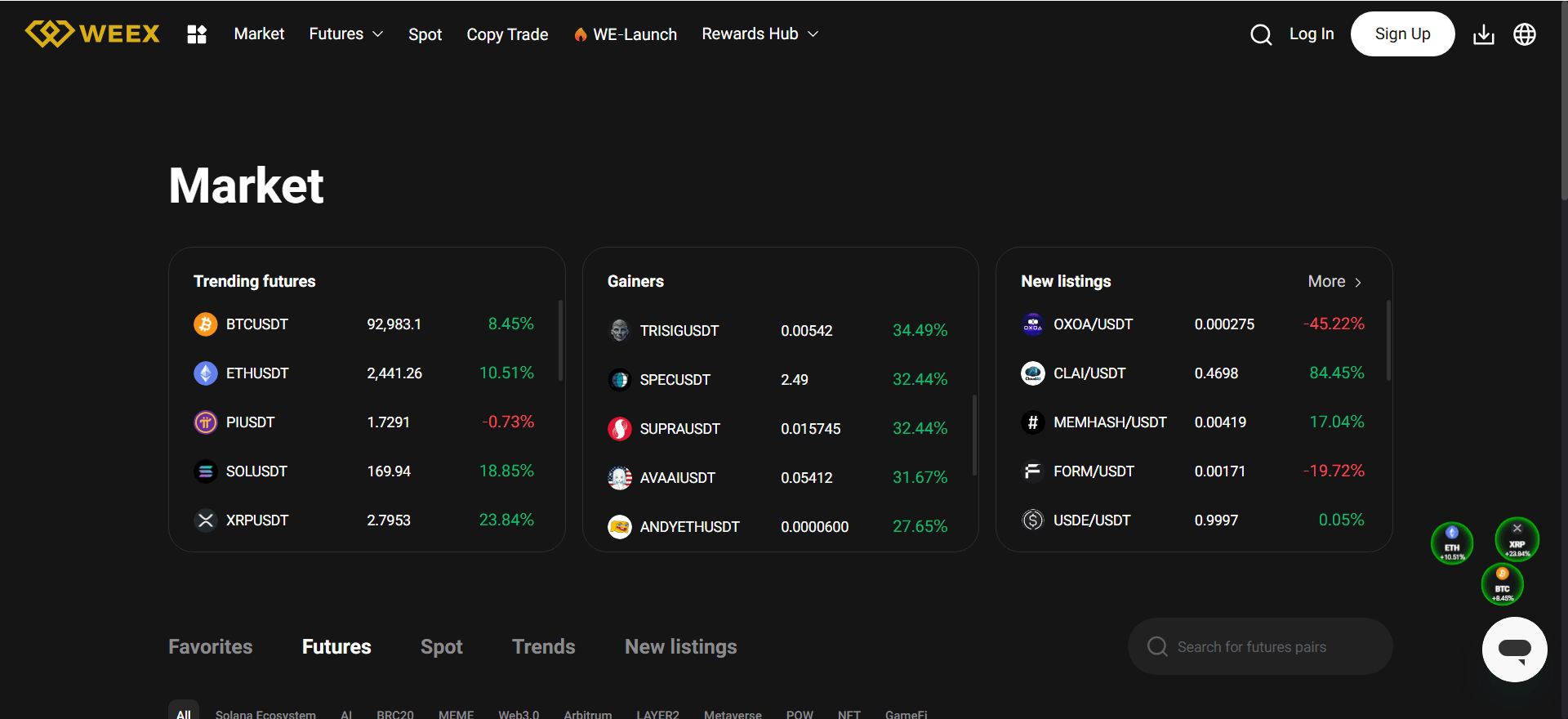
Supporting over 1000 cryptocurrencies, WEEX offers a wide range of digital assets for traders to diversify their investment portfolios. This includes popular cryptocurrencies such as BTC USDT, DOGE USDT, ETH USDT, ETC USDT, TRX USDT. By offering this extensive variety, WEEX enables users to capitalize on market trends, trade securely, and easily access their preferred assets.
Versatile Web and Mobile Trading Platform:
WEEX provides a functional trading experience on web as well as mobile apps, catering to traders seeking flexibility and convenience. Whether you are at home or on the go, the WEEX mobile application enables you to engage in cryptocurrency trading, monitor live market data, and manage all account preferences with just a few taps. Both platforms come equipped with advanced trading features, real-time price updates, and customizable charts, empowering users to make prompt and informed decisions. Regardless of your location or device, WEEX guarantees a seamless and effective trading journey.
Skilled Team:
WEEX's team brings together a team of experts hailing from prestigious backgrounds such as Wall Street, Silicon Valley, Citibank, and Google. Under the guidance of CEO and founder Peter, WEEX has emerged as a prominent player in the global crypto trading sphere, recognized for its cutting-edge solutions and user-centric design. Backed by a proficient technical squad, WEEX delivers a secure, seamless, and effective trading platform on a global scale. Responding to rapid expansion, WEEX has scaled its workforce to over 500 professionals, elevating service standards and fostering continuous product advancement. This strategic expansion enables WEEX to address the varied requirements of its worldwide user base, solidifying its position as a frontrunner in the cryptocurrency trading sector.
Varied Services and Tools:
WEEX functions as a centralized cryptocurrency exchange (CEX) that presents a complete set of trading instruments suitable for novices as well as seasoned traders. The platform delivers a variety of services, such as spot trading, futures trading with leverage of up to 400x, over-the-counter (OTC) trading, and copy trading. Whether one intends to engage in trading at prevailing market rates, leverage positions, or track skilled traders, WEEX furnishes all essential tools essential for achieving success.
Worldwide Presence:
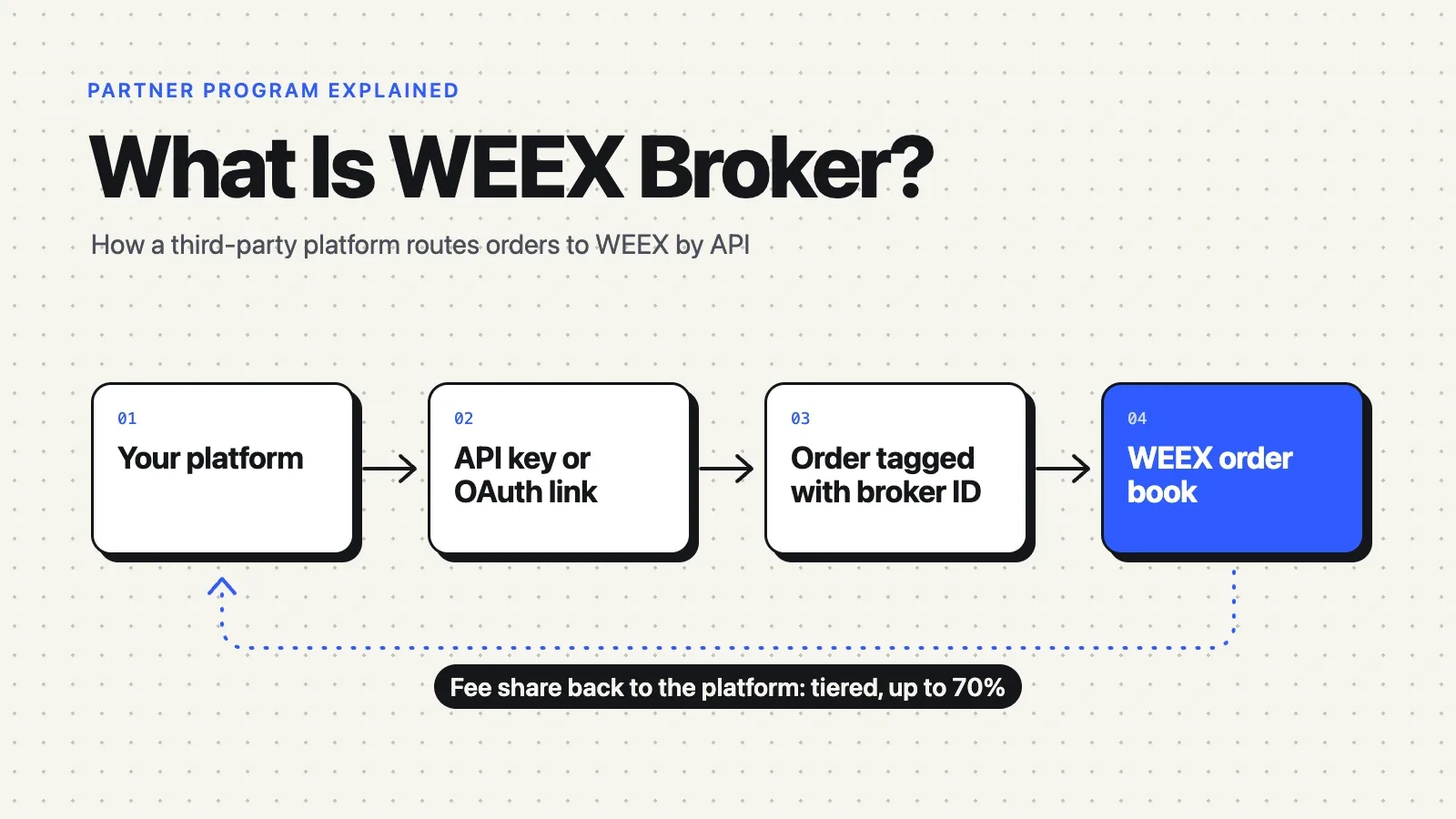
WEEX is proud of its extensive global presence, providing services in various countries including the Japan, Turkey, India, the Philippines, and other nations. This worldwide footprint is supported by robust technical infrastructure, expert services, and a Affiliate Program that offers commission rebates of up to 70%. Since its inception, WEEX has experienced rapid expansion, currently catering to more than 5 million active users in 134 different countries. With a daily trading volume surpassing \$50 billion, WEEX holds a position in the top 12 on CoinMarketCap.
WEEX, with its ongoing growth, continues to be a preferred option for traders looking for a dependable and effective trading platform. The confidence of users around the globe is evidenced by its success. Providing more than 1,000 trading pairs, state-of-the-art security measures, support in multiple languages, and user-friendly features, WEEX ensures an unparalleled trading journey for its international user base.
Multilingual Community Support:
The platform's success is significantly driven by The WEEX community, which caters to distinct segments of users from around the globe. Each group is committed to establishing a space where traders, investors, and cryptocurrency enthusiasts can engage, exchange ideas, and benefit from each other's knowledge. While the global community unites members worldwide, provide region-specific assistance and conversations.
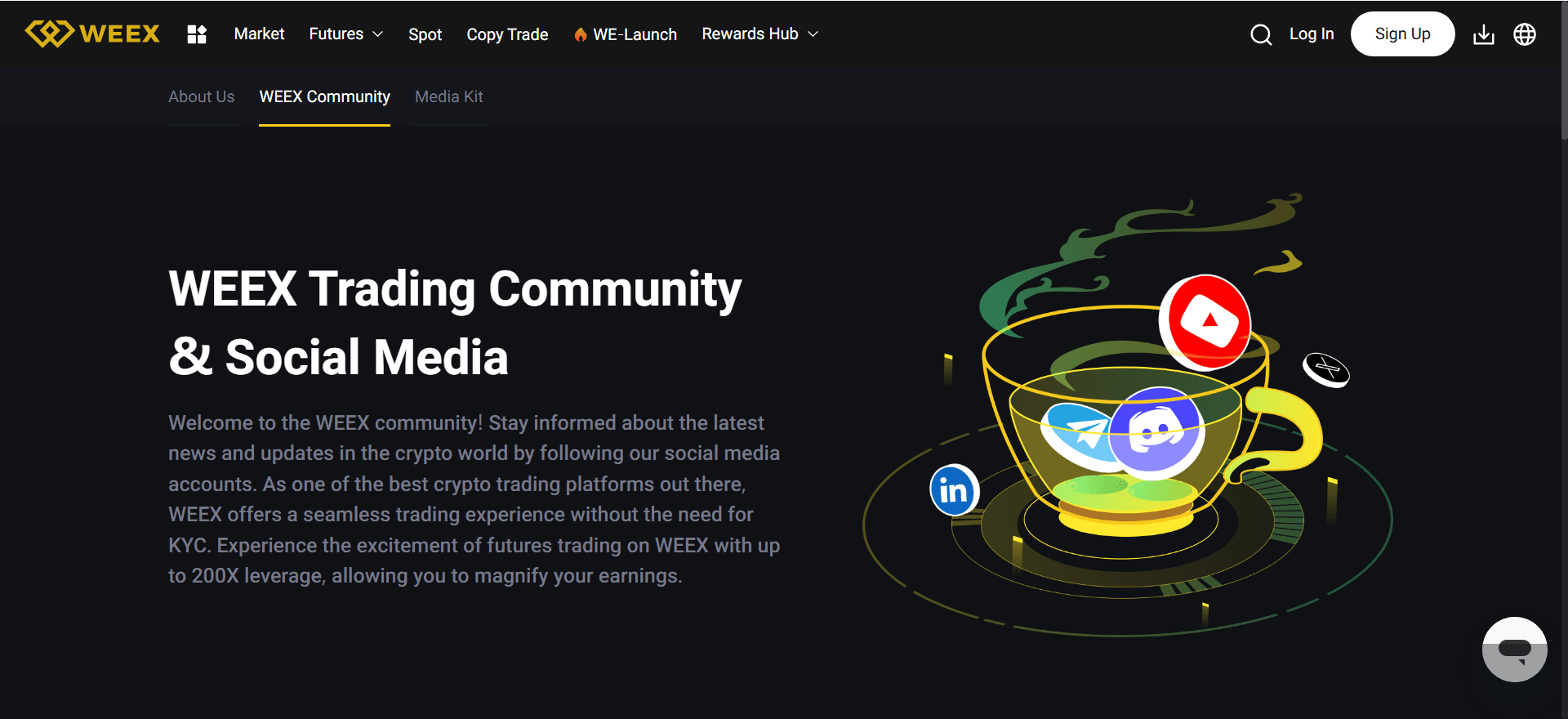
WEEX actively maintains a robust presence on various social media platforms to keep its communities informed and engaged. The community interacts via channels such as Twitter, Facebook, Medium, Telegram, and YouTube. Moreover, Discord and LinkedIn act as interactive platforms for more detailed discussions and professional networking. Whether sharing market updates, promotions, or community events, WEEX's social media engagement ensures that users remain well-connected and informed at all times.
Low Fees:
In normal circumstances, spot trading fees on WEEX are 0.1% for both makers and takers. Futures trading fees are 0.02% for makers and 0.08% for takers.
Yet, hold WXT, you have the opportunity to receive a discount of up to 70% on fees for trading futures, based on your WEEX VIP tier.
Excellent Customer Service
At WEEX, we are committed to delivering outstanding customer service in order to guarantee a fantastic customer experience. Should you come across any difficulties or require clarification, our proficient support staff is on standby to help. You have various options available to contact us effortlessly.
Telegram Support: Get the Telegram app on your device, then join our authorized channels for help:
Customer Support&Business Cooperation: @weikecs
English Assistance: @weexencs
VIP Support: support@weex.com
Artificial Intelligence Support: To receive immediate assistance, just utilize the AI-driven customer service function located at the bottom right of the WEEX site. Should the need arise, you have the option to engage with a live representative for tailored assistance.
Count on dependable and prompt support from WEEX whenever you require it.
WEEX Order Types
For a comprehensive understanding of the different types of orders on WEEX, their functionalities, and strategies for leveraging them effectively, refer to this complete guide to master different types of orders on WEEX.
Market Orders
Market orders are most appropriate for traders who value quick execution and assurance more than exact pricing. By placing a market order, the trade is promptly carried out at the prevailing market price, guaranteeing immediate completion without any delays. Such orders are well-suited for individuals looking to swiftly purchase or sell assets, unconcerned about minor price changes.
If Bitcoin (BTC/USDT) is priced at $96,000, initiating a market buy order guarantees immediate execution at the most favorable available price. This price may slightly differ, for instance $96,005 or $96,010, contingent upon market liquidity during the trade. While this ensures rapid transaction processing, the precise price may experience minor deviations from the listed market value due to market fluctuations and liquidity conditions.
Limit Orders
Limit orders provide traders with increased control over their transactions, enabling them to stipulate the precise price at which they want to purchase or sell an asset. In contrast to market orders, which are executed immediately at the current market price, limit orders are triggered only once the market reaches the designated price point. This precision feature prevents buying above or selling below the intended price, facilitating a more strategic approach to trading.
If Ethereum (ETH/USDT) is trading at $2,500, you have the option to set a buy limit order at $2,488. This particular order will be triggered solely if the market value decreases to $2,488 or less, guaranteeing the acquisition of ETH at your specified price point or a more favorable one.
At WEEX, traders can benefit from using limit orders to capitalize on price changes while retaining authority over their trading decisions. By incorporating limit orders, traders can improve trading flexibility and accuracy, enabling them to optimize their market participation.
Advanced Orders
Experienced traders can take advantage of WEEX's advanced order types, which offer increased flexibility and strategic choices for optimizing trading strategies.
Orders placed with the Good-Till-Canceled (GTC) option will remain active until they are fully executed or manually canceled by the trader, providing the trader with full control over the order's duration.
- A Good-Til-Canceled order for XRP USDT at $2 remains active in the order book until the price matches your condition or you cancel it manually.
Immediate-Or-Cancel (IOC) orders seek to execute the order immediately by filling as much of it as possible, while automatically canceling any portion that remains unfilled. This order type enables partial completion of trades when liquidity conditions allow.
- An Immediate-or-Cancel order for 2 SOL USDT at $135 may fill 1.5 SOL if liquidity allows, with the remaining 0.5 SOL canceled automatically.
Fill-Or-Kill (FOK) is an order type that mandates immediate execution of the entire order. In the event that the full order cannot be filled, it is promptly canceled to prevent any incomplete transactions.
- A Fill-or-Kill order for 3 MASK USDT at $2.1 executes only if all 3 MASK can be bought at that price; otherwise, it’s fully canceled.
By using the Post Only order type, your order will add liquidity to the market when acting as a maker order. If your order would match an existing one, it will be canceled to help you steer clear of taker fees. This approach supports market liquidity and taker fee avoidance, guaranteeing your advantages as a market maker.
- Placing a Post Only order at $92,900 ensures your order adds liquidity to the market, avoiding taker fees and rewarding you as a market maker.
Utilize Take Profit Orders to automatically exit a trade when a predetermined profit target is reached, allowing you to secure profits without constant monitoring. For example, if you bought Bitcoin (BTC) at $50,000 and set a take profit order at $55,000, the position would close automatically when the price reaches $55,000, locking in your gains.
- After buying AAVE USDT at $200, a take profit order set at $95,000 will automatically close your position when the price reaches $95,000, securing your gains.
The enhanced order varieties offered on WEEX enable users to enhance the efficiency of their trading strategies, control risk, and maximize profits in a volatile market setting.
WEEX Trading Types
Spot Trading
What is WEEX Spot Trading?
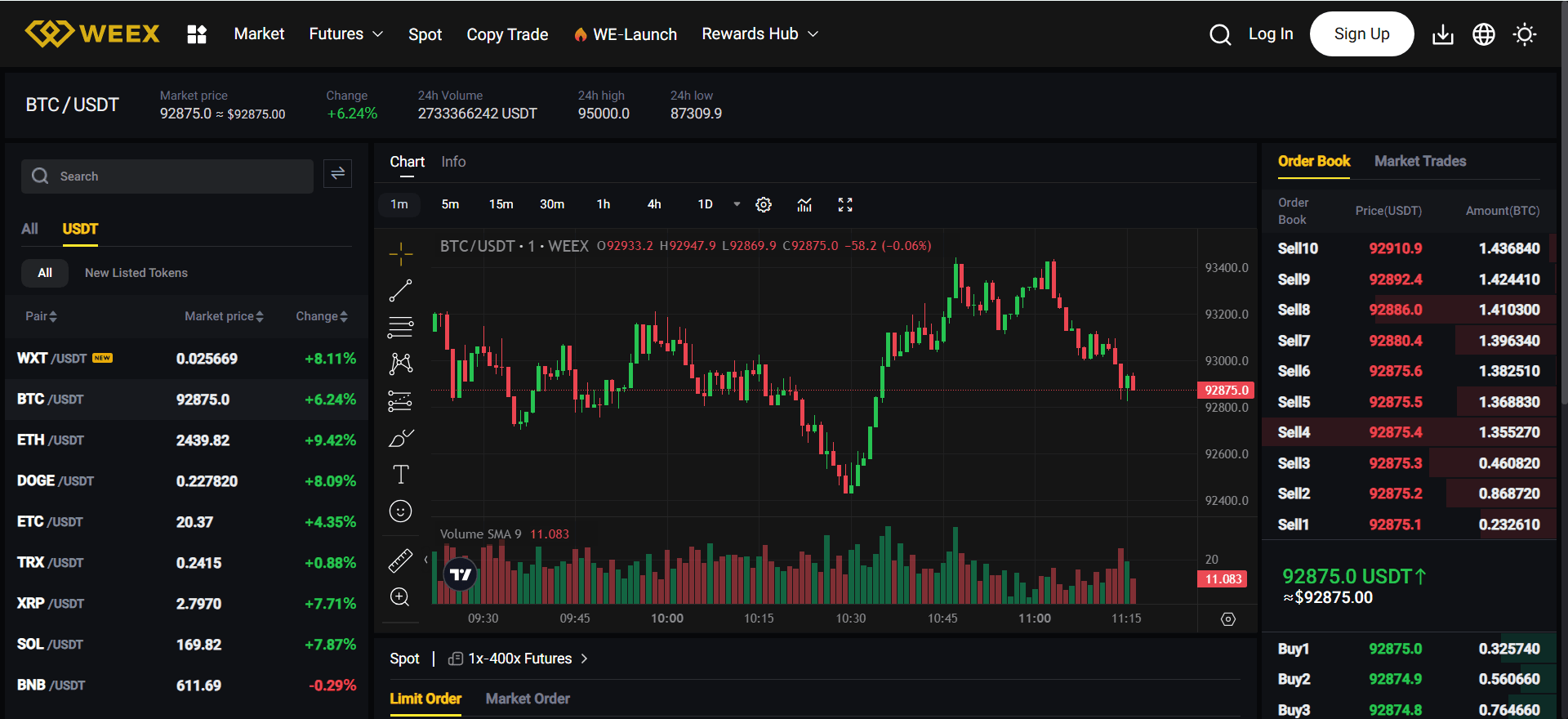
Spot trading is the most conventional method of trading in the cryptocurrency market, and WEEX Exchange offers a solid platform for traders to participate in these transactions. In spot trading, assets such as cryptocurrencies are purchased or sold immediately at the current market price. Essentially, spot trading involves swapping one cryptocurrency for another, with one coin serving as the pricing unit for acquiring other coins. Orders are matched based on a priority system that considers both price and time, ensuring that each trade is executed at the optimal price. This clear and open approach has made spot trading a favored option among many traders.
Here is a concise overview, access this comprehensive spot trading guide for beginners.
Step-By-Step-Guide
Step 1: Register or Log In
To access your account, select Log in at the top of the page. If you are new to WEEX, choose to sign up and refer to our detailed step-by-step instructions for assistance.
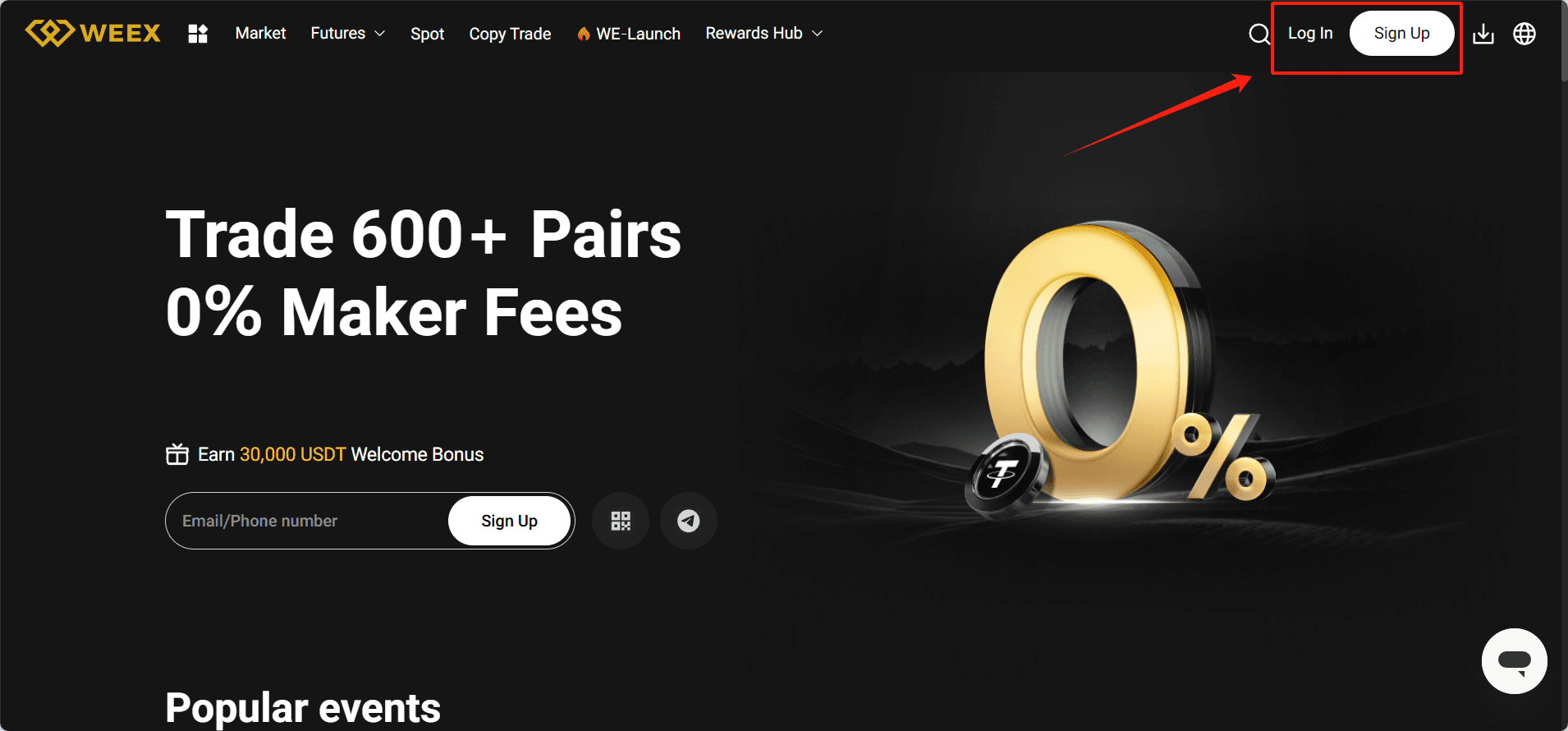
Ensure that you have finished the identity verification process for KYC (Know Your Customer).
STEP 2: Go to Spot Trading
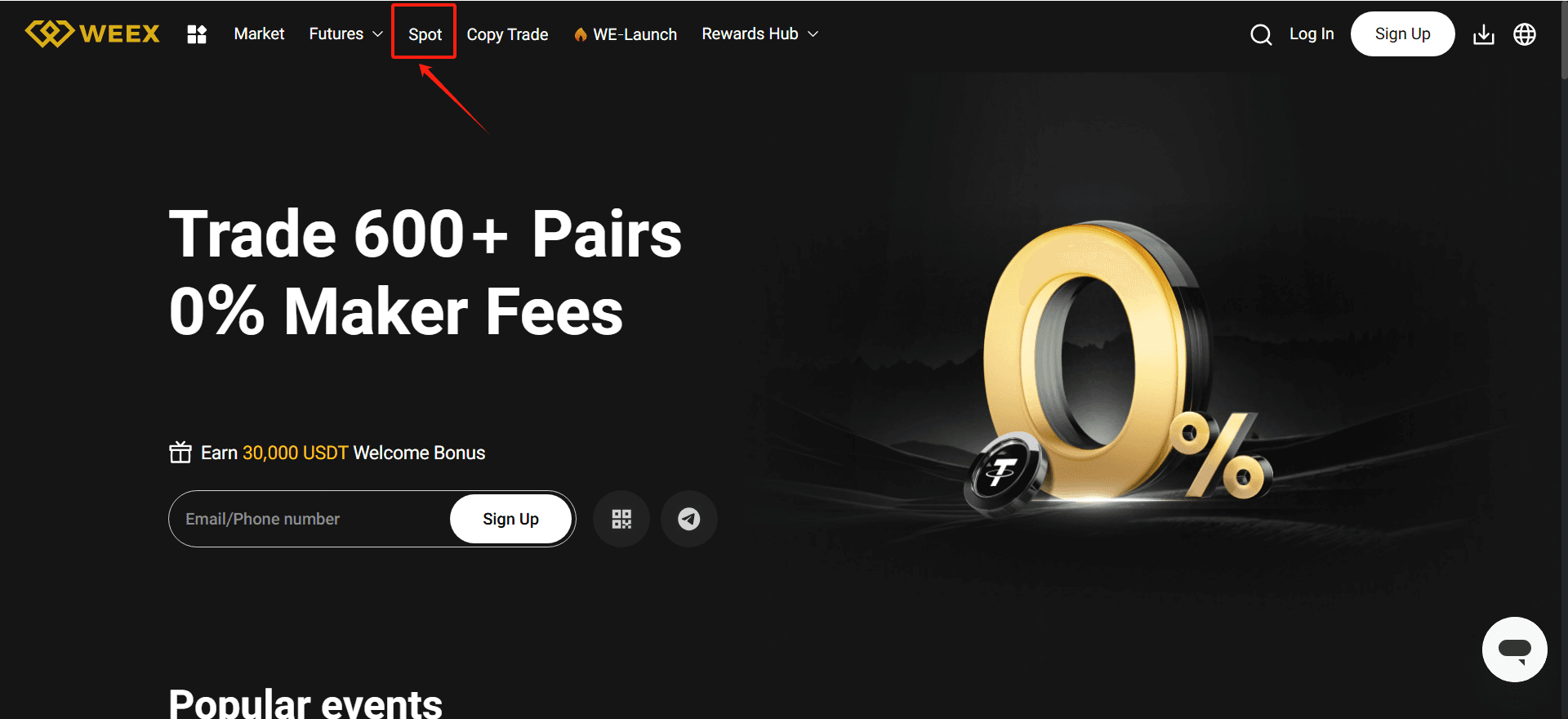
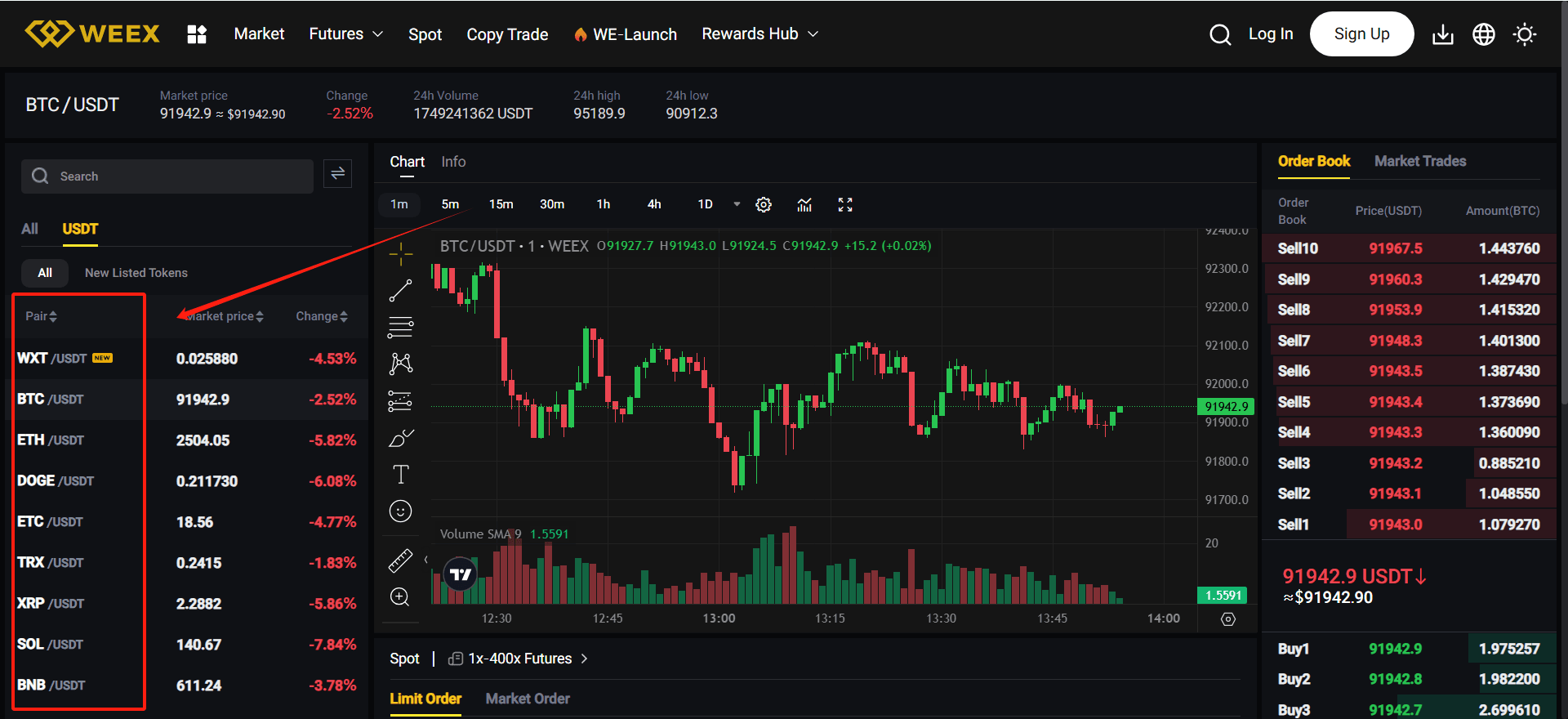
After logging in, simply select the "Spot" button located on the homepage's top section.
Accessing the Spot Trading Section within the WEEX platform.
Step 3: Select a Trading Pair
Explore the trading pairs that are offered and select the specific one you wish to engage in trading with.
STEP 4: Place Your Order
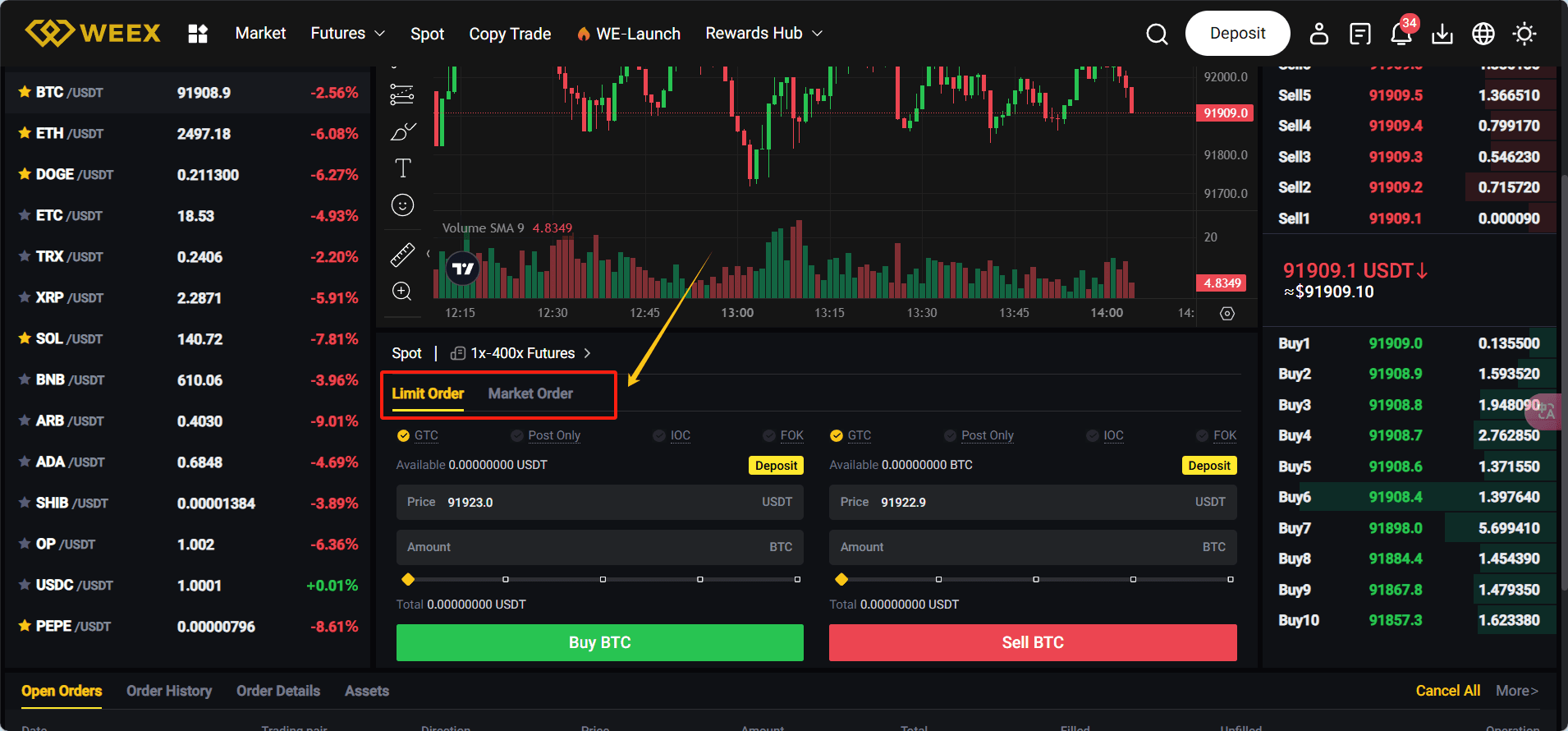
Choose the order type that best suits your needs from the options provided (for example, market or limit).
Select either "Buy" or "Sell" and input the quantity.
Please examine the information carefully before placing your order.
STEP 5: Track Your Orders
Access Open Orders to see all current orders that are still awaiting processing. It is possible to make adjustments or terminate them as necessary.
View Order History: Review all your previous transactions, comprising both fulfilled and revoked orders.
Copy Trading
What is WEEX Copy Trading?
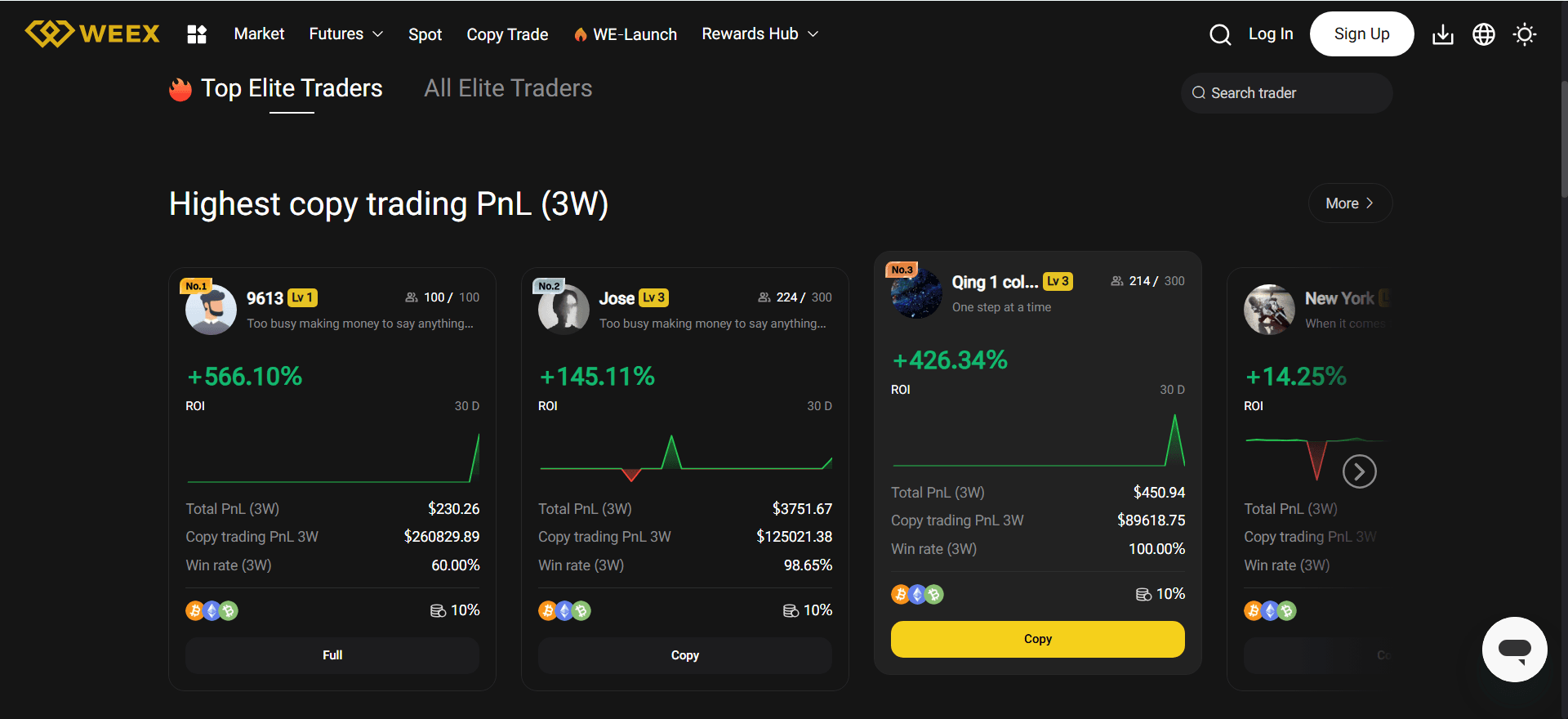
WEEX copy trading enables users to automatically replicate the trades of skilled and accomplished traders on the WEEX platform. By mimicking the strategies of top traders, novices or individuals with less experience can potentially benefit from their expertise. Users have the option to select traders to follow based on their performance, with the system automatically duplicating their trades in real-time. This functionality offers a straightforward entry point into cryptocurrency trading without requiring extensive market understanding, allowing for a hands-off trading experience while gaining insights from seasoned professionals.
What is WEEX Copy Trading Pro?
WEEX has launched the Copy Trading Pro function in order to streamline the process of entering the futures trading market. This feature offers traders and those who copy their trades a clear and easy-to-use platform for trading digital derivatives, with the goal of increasing profits and benefiting all involved parties.
Using WEEX Copy Trading Pro enables individuals to replicate the techniques used by professional traders. This feature allows users to generate income without having to conduct thorough market analysis or actively oversee trades. It is crucial to note that all trades, regardless of their outcomes, will be duplicated by followers. Therefore, it is vital to select traders whose methods are in line with your risk tolerance level.
Why WEEX Copy Trading?
For Copy Traders:
Traders who copy others' strategies can make profits effortlessly without the need to constantly keep an eye on charts all day long.
- Secure and Trustworthy:
WEEX meticulously picks out top traders globally, providing a range of leading strategists for users to select. Transparent and trustworthy trading is ensured through real-time trading data and trackable records of both leading and copied trades.
- Effortless Earnings:
- By simply clicking a button, users can copy multiple traders and sync their opening and closing actions to maximize profitability. Real-time monitoring of profit data from each copied trade allows for adjustments in the copied amount at any given moment. Users also have the flexibility to cease copying or secure profits by closing positions whenever they deem fit.
For Traders:
Traders have the opportunity to leverage the WEEX Traffic Pool, acquiring traffic as well as earning commissions from replicated trades.
- Lucrative Profit Sharing: Traders receive a 10% portion of profits from replicated trades.
- Greater Visibility: Connect with over 10,000 focused futures traders, with platform support to amplify your trading influence and increase your income.
Select this option to join the ranks of an Elite Trader.
Step-By-Step-Guide
STEP 1: Select a Copy Trader
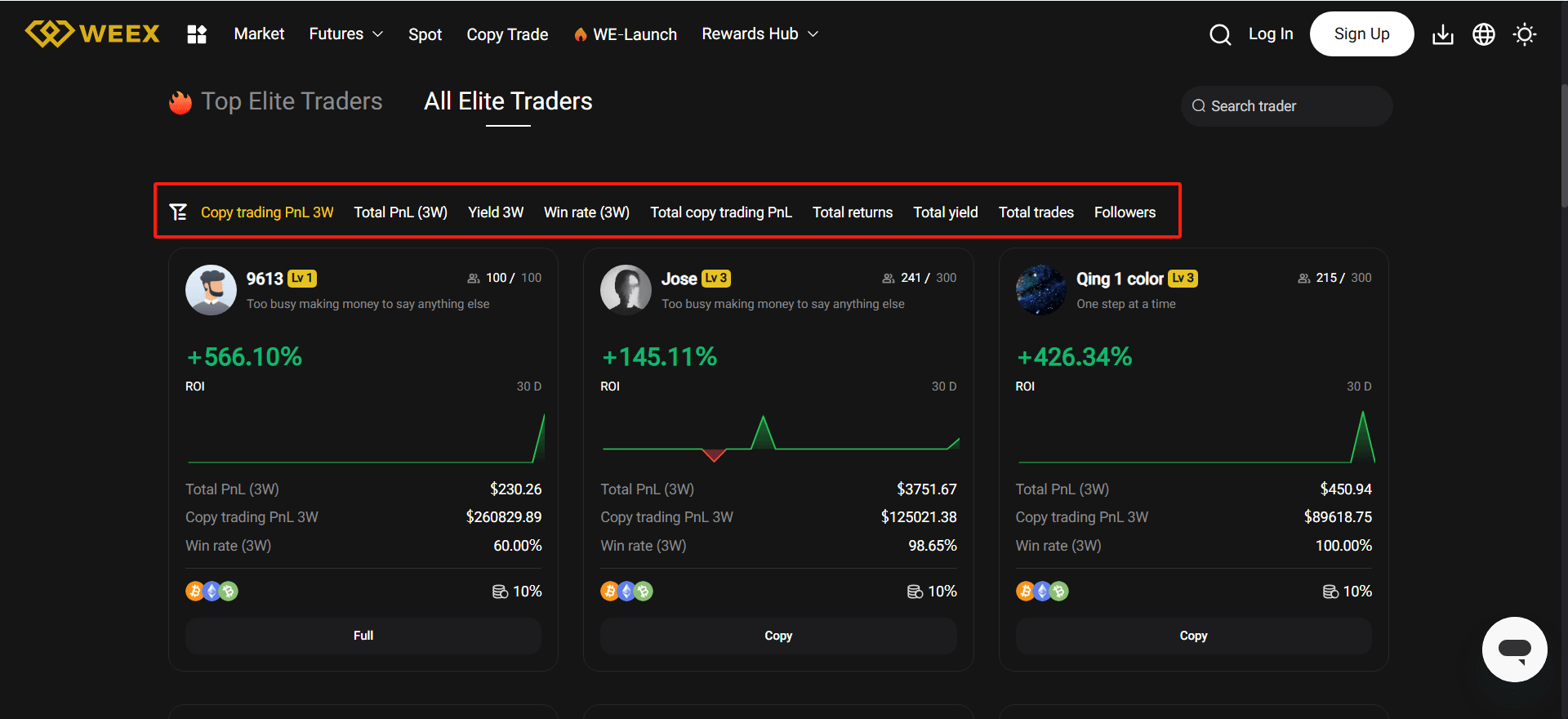
When choosing a top trader to replicate on the Copy Trading Pro platform, take into account various important performance metrics:
- Active Days: Duration counted from the registration date.
- 3-Week Copier Earnings: Total profits earned by copiers in the last three weeks.
- 3-Week PnL: Profit from the past three weeks ÷ the largest single opening position principal in that period.
- 3-Week Win Rate: Profitable orders in the last three weeks ÷ total orders in the same timeframe.
- 3-Week Profit (USDT): Total realized profits over the past three weeks.
- All-Time Copy Trading Profits: Total historical profits generated for copiers.
- Total PnL: Cumulative profits to date ÷ the largest single all-time opening position principal.
- Total Trades: Number of closed orders to date.
- Total Copiers: Number of unique copier accounts following this elite trader to date, counted once per account.
- Current Copiers: Number of users actively copying this elite trader at present.
STEP 2: Configure Copy Trading and Margin Settings
Select a copy trading mode:
- Uniform Mode: Consistent margin settings across all trading pairs.
- Separated Mode: Unique settings tailored for each trading pair.
Next, select your margin setting:
- Position Mode: Replicates your chosen leverage.
- Trader Mode: Adopts the leverage set by the trader.
- Custom Mode: Personalized leverage for individual trades.
Step 3: Set Copy Trade Amount and Customize Advanced Options
Specify the quantity for every trade (either fixed in USDT or based on portfolio ratio). Adjust risk control parameters like stop-loss, take-profit, and slippage ratios, and establish a maximum trading size.
Step 4: Validate and Initiate Copy Trading
Examine all configurations, select "Next" for validation, and verify that there are adequate funds in your futures account for executing the trades.
Futures
Know WEEX Futures Pro
A perpetual futures contract is a type of financial derivative that blends aspects of spot margin trading and futures trading. In contrast to regular futures contracts that have specific delivery dates, perpetual futures are standardized, incorporate margin trading, and settle instantly.
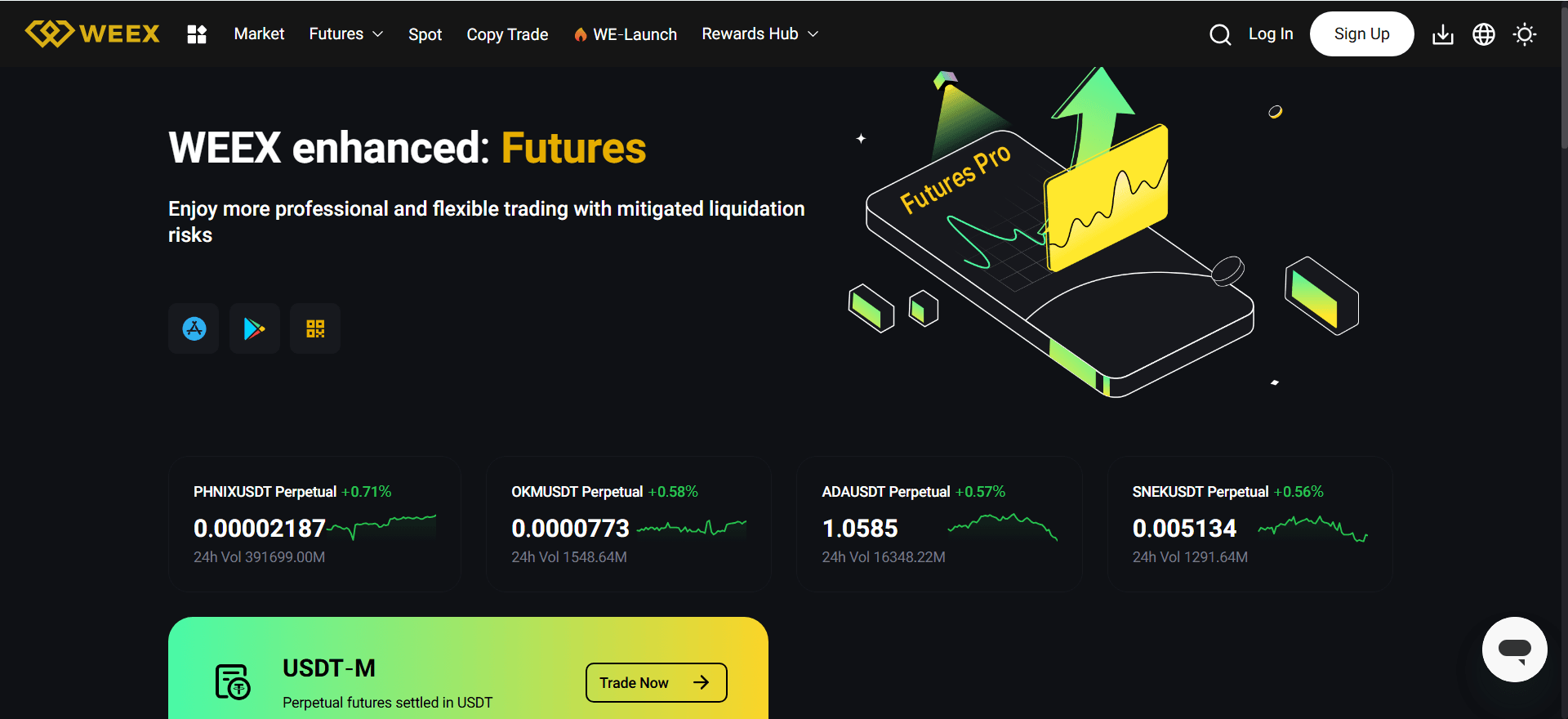
Perpetual futures contracts lack a set expiry date or delivery requirement, permitting traders to maintain their positions without time constraints. To keep the contract price aligned with the spot price, a funding system is implemented. This system involves the exchange of funding rates between long and short positions periodically, which serves to mitigate notable price discrepancies.
The WEEX Futures Pro platform is at the forefront of the cryptocurrency derivatives industry. It caters to seasoned traders seeking a comprehensive and sophisticated trading environment. Users can rely on this platform to manage cryptocurrency derivatives with precision and effectiveness.
WEEX Futures Pro is designed to cater to the requirements of cryptocurrency derivatives traders. It provides opportunities to engage in a wide range of financial products, going beyond the scope of just digital currencies. Users are able to participate in futures contracts trading and make predictions on the value of digital assets without possessing them.
Why WEEX Futures Pro?
The WEEX Futures Pro platform is equipped with a variety of functionalities specifically tailored for experienced traders. It includes sophisticated charting capabilities, live market information, and robust risk control functionalities. Furthermore, users have the option to access a trial edition to become acquainted with futures trading.
Notable characteristics consist of market, limit, and trigger orders, simulated trading, as well as a Futures Pro Calculator for determining PnL, settlement price, and break-even price. Additionally, it enables a maximum leverage of 400x.
Flexible Trading Solutions: Traders can utilize WEEX Futures Pro to conduct trades in different markets without the requirement to uphold margin for numerous positions, thereby enhancing effectiveness.
Broadened Investment Opportunities: Traders can enhance their investment portfolios by spreading their funds across various futures contracts, providing increased flexibility and more effective portfolio supervision.
Strong and Dependable: With smart risk control and a two-tier manual approach, WEEX Futures Pro guarantees safety, empowering traders to establish exact profit-taking and stop-loss levels for trading with security and assurance.
Here is a short overview, access this comprehensive guide for crypto traders on how to trade futures on WEEX.
Step-by-step Guide
After setting up your account and depositing funds, you can start trading futures on WEEX swiftly and effortlessly in three simple steps! Follow these instructions using the BTC Perpetual/USDT illustration:
Step 1: Move Funds to Your Futures Account
Select the Deposit option to transfer cryptocurrency from a different wallet, and proceed to move assets from either your spot or futures account to your Futures Pro account.
Step 2: Profit from a Rising Market by Going Long
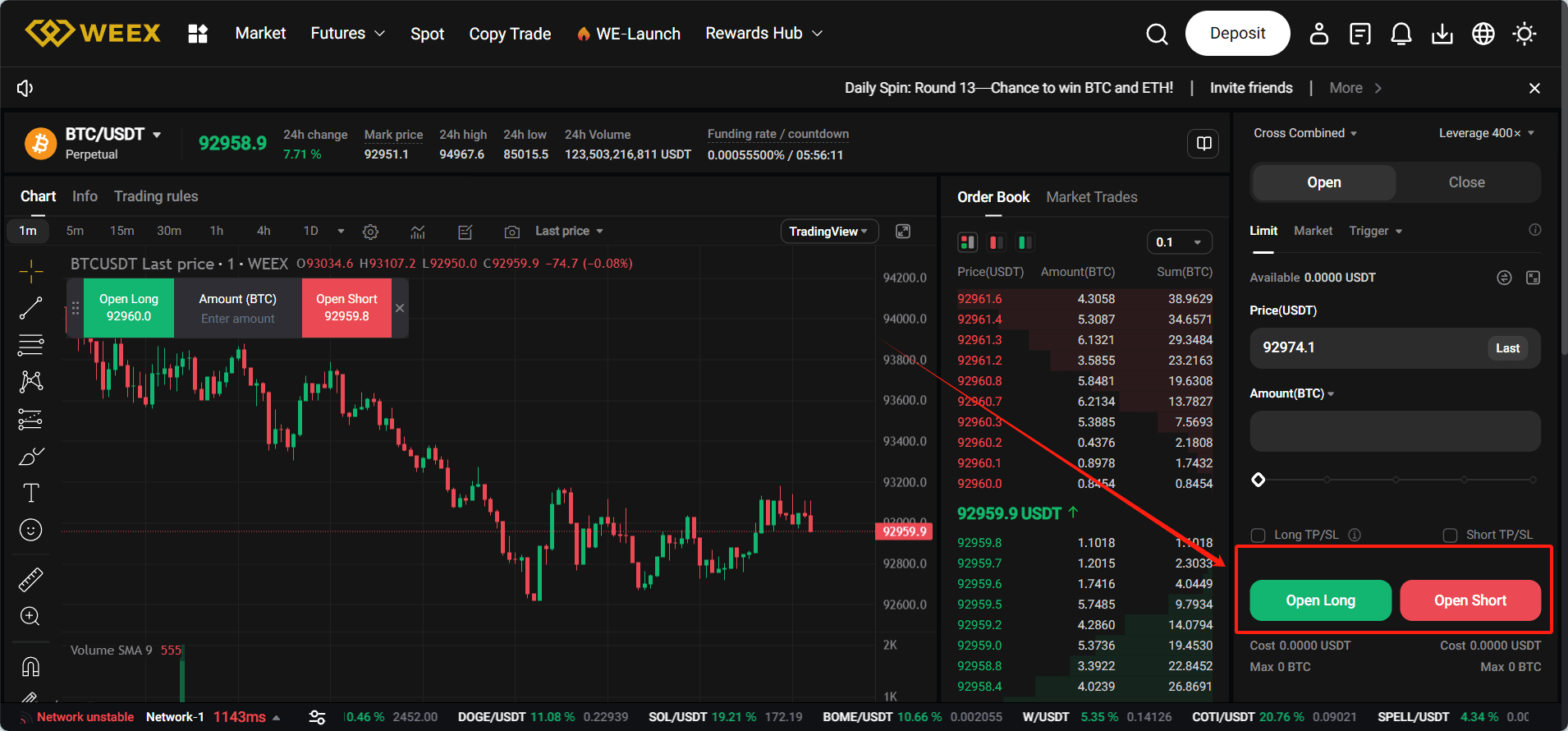
If you anticipate an increase in price and wish to initiate a long position, specify the price, quantity, and leverage. Subsequently, select "Open Long (Bullish)" to proceed.
To exit your position, simply select "Close," input the necessary information, and then choose "Close Long."
Step 3: Capitalize on a Falling Market by Going Short
If you anticipate a price decrease and wish to initiate a short position, specify the price, quantity, and leverage. Subsequently, select "Open Short (Bearish)" by clicking on it.
To exit your position, select "Close," input the required information, and then choose "Close Short."
WEEX Leverage
What is Margin?
When initiating a trade, the funds utilized as margin are secured and unavailable for additional trading activities.
Margin serves as a deposit in leveraged trading, enabling the amplification of the order size through the utilization of leverage.
Position Value = Margin x Leverage
This implies that the greater the leverage, the lesser the margin needed.
For instance, when trading Bitcoin using leverage at a market price of approximately 7,000 USDT, you would need to provide a margin of about 200 USDT (excluding fees) on our platform. This allows you to speculate on price fluctuations in both directions and potentially gain profits from them. Any losses incurred will be subtracted from the margin, and once the liquidation price is reached, your position will be automatically liquidated.
Consider the margin as a security deposit for your trade. When you close your position, we will refund the margin to you, adjusting for your profit or loss and any applicable fees. Lower margin usage results in higher leverage, amplifying the risk associated with market fluctuations. Conversely, higher margin utilization decreases leverage, widening the potential profit or loss margin and reducing overall risk. If you are worried about risk, you can choose the isolated position mode.
Margin can be calculated by dividing the product of Contract Quantity, Futures Face Value, and Open Price by Leverage. For instance, if you are trading 100 Dogecoins at an open price of 0.1779 with a leverage of 20x, the margin calculation is: Margin = (100 x 1 x 0.1779) ÷ 20 = 0.8895. For more precise results, utilize the [Calculator] located in the upper right corner of the futures page.
For additional margin details, please refer to the Margin section on the WEEX Futures website.
WEEX Margin Modes:
Cross margin mode
Cross margin functionality on WEEX enables leveraging all funds in a single futures account as margin for active positions. In case a position results in a loss surpassing the available account balance, it will be automatically closed. This feature enhances risk management capabilities, simplifying position management and evaluation. Moreover, the cross margin mode accommodates hedge trading, offering increased versatility in trading approaches.
Isolated margin mode
On WEEX, the isolated margin system assesses risks for short and long trades separately. If liquidation happens, only the margin assigned to that specific trade will be lost. Profits or losses from a closed position are settled into the margin for that trade. In the event of liquidation due to price fluctuations, the user will lose only the margin related to that position, with no impact on other funds in the futures account.
WEEX WE-Launch
What is We-Launch
Users have the opportunity to stake their WXT in pools and receive complimentary tokens from new WEEX WE-Launch premium projects. This platform provides a secure and uncomplicated method to participate in initial cryptocurrency offerings.
In past We-Launch initiatives, numerous well-received tokens like DOGS and TRUMP have taken part.
How to Join in WE-Launch?
In order to join the WEEX We-Launch event, you must register or sign in to your WEEX account and possess WXT tokens to qualify. For further information, refer to a detailed guide on the process.
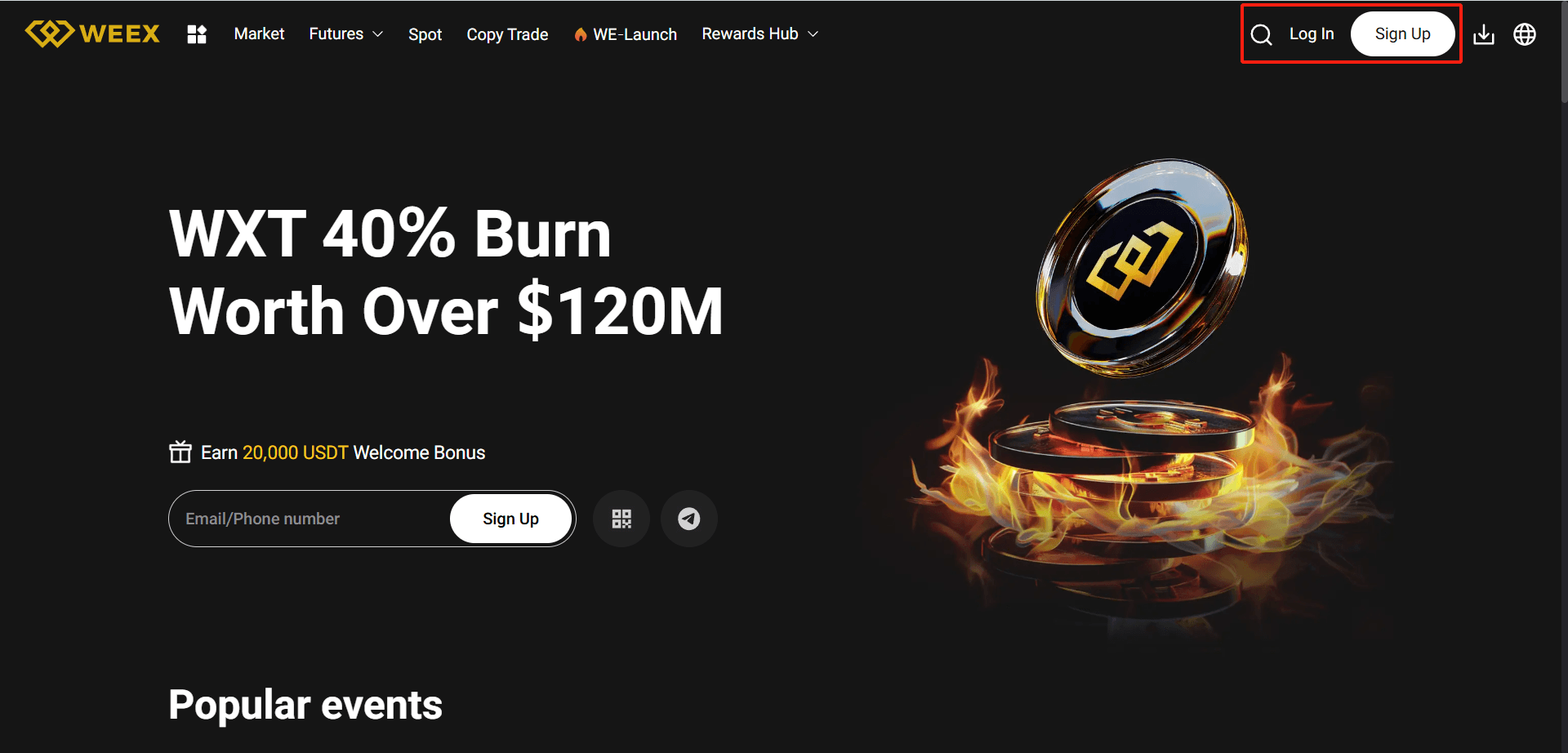
Step 1: Register or Log In to WEEX
New users can refer to the guide on setting up a WEEX account. Existing users with a WEEX account can proceed to log in.
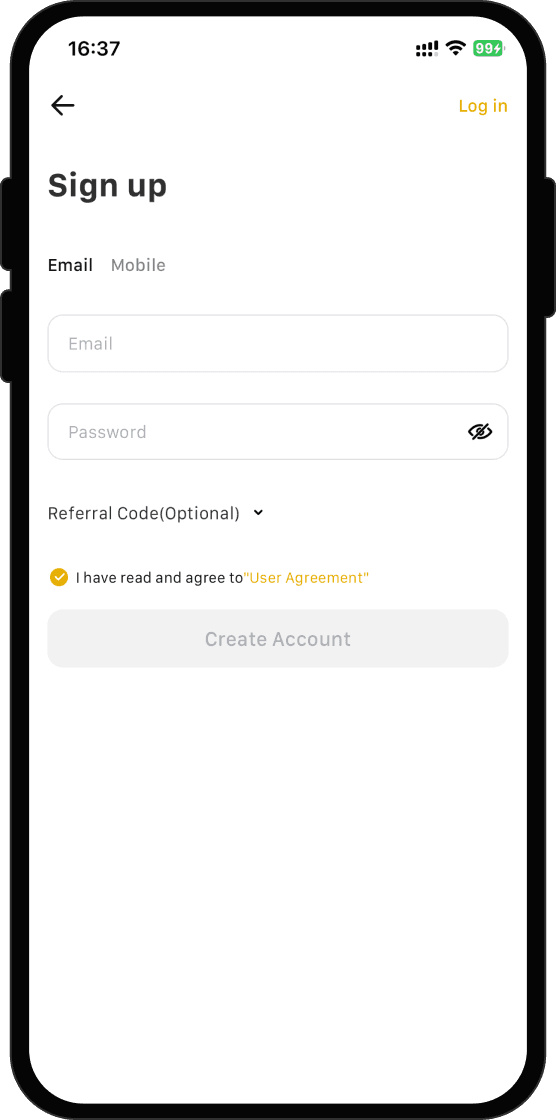
If you are utilizing a mobile device, kindly install the application in order to register or access your account on WEEX.
Step 2: Hold WXT to be qualified
To qualify, you need to maintain a minimum of 1000 WXT in your spot account for a period of two consecutive days. Below are the steps to purchase WXT on WEEX.
For Web
Engage in trading of WXT USDT on this platform or proceed to the We-Launch category located in the navigation menu and select it.
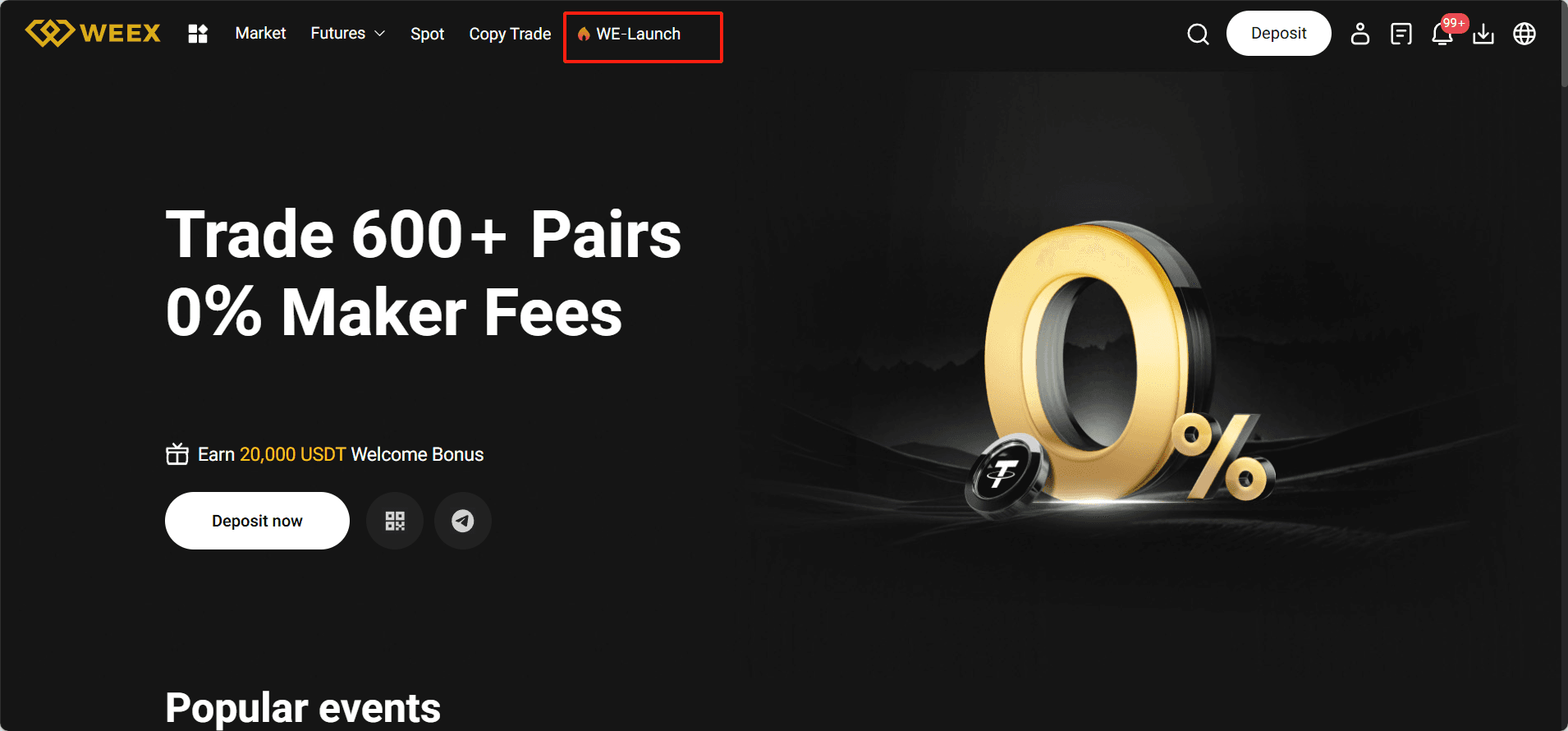
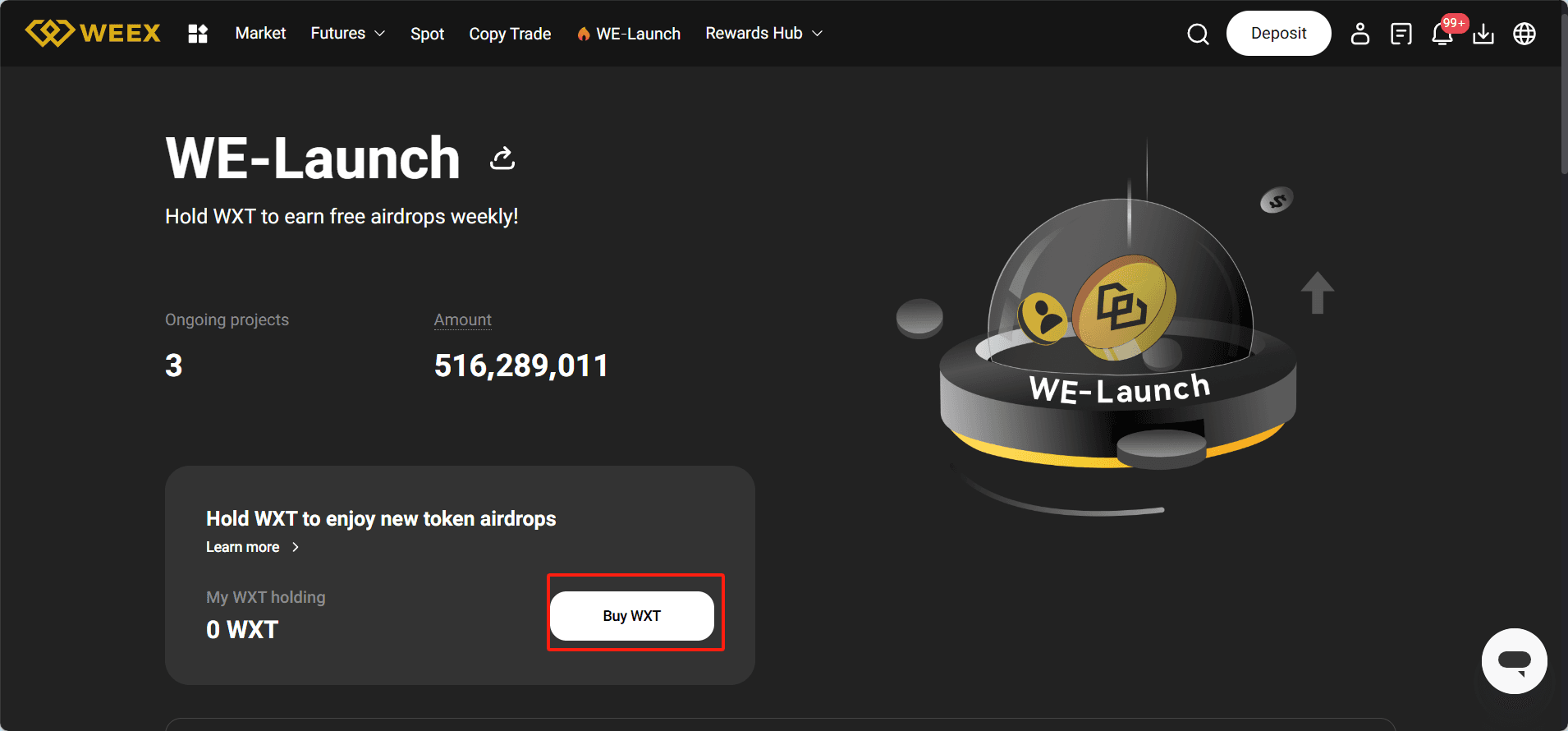
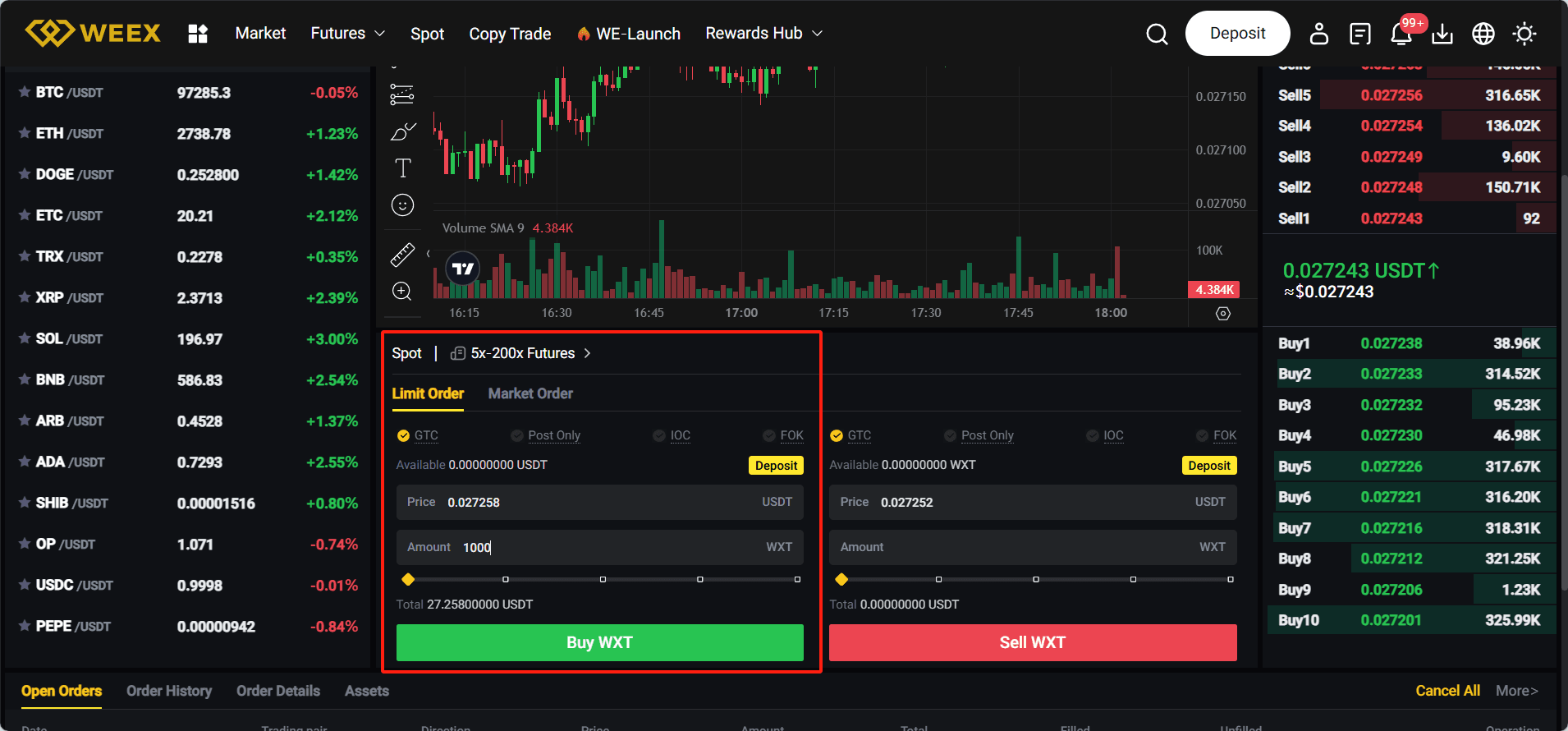
Press the Purchase button for WXT located on the webpage.
Please input the quantity of WXT you wish to purchase.
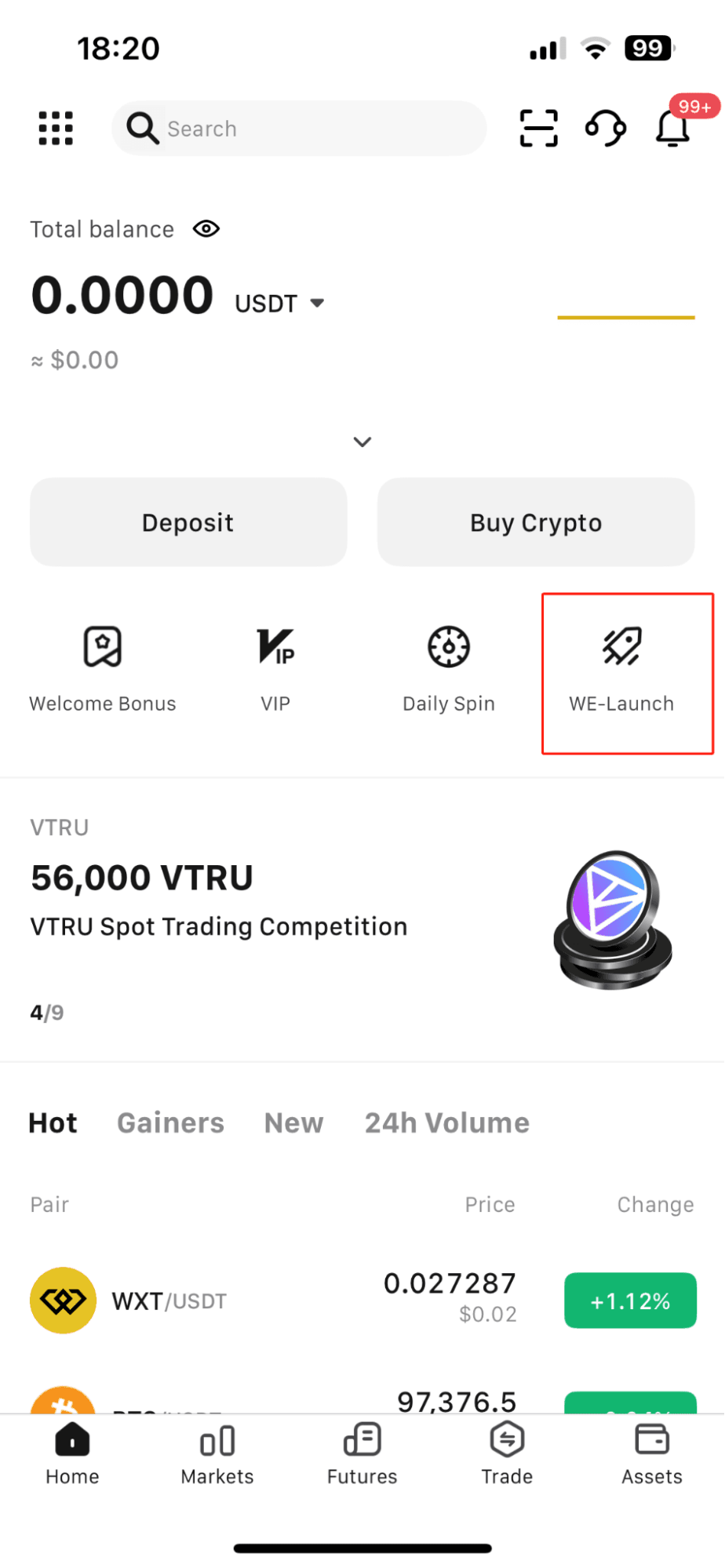
For Phone
If you are on a mobile device, select the "WEEX WE-Launch" feature from the WEEX main page and proceed by clicking on the "Purchase WXT" tab.
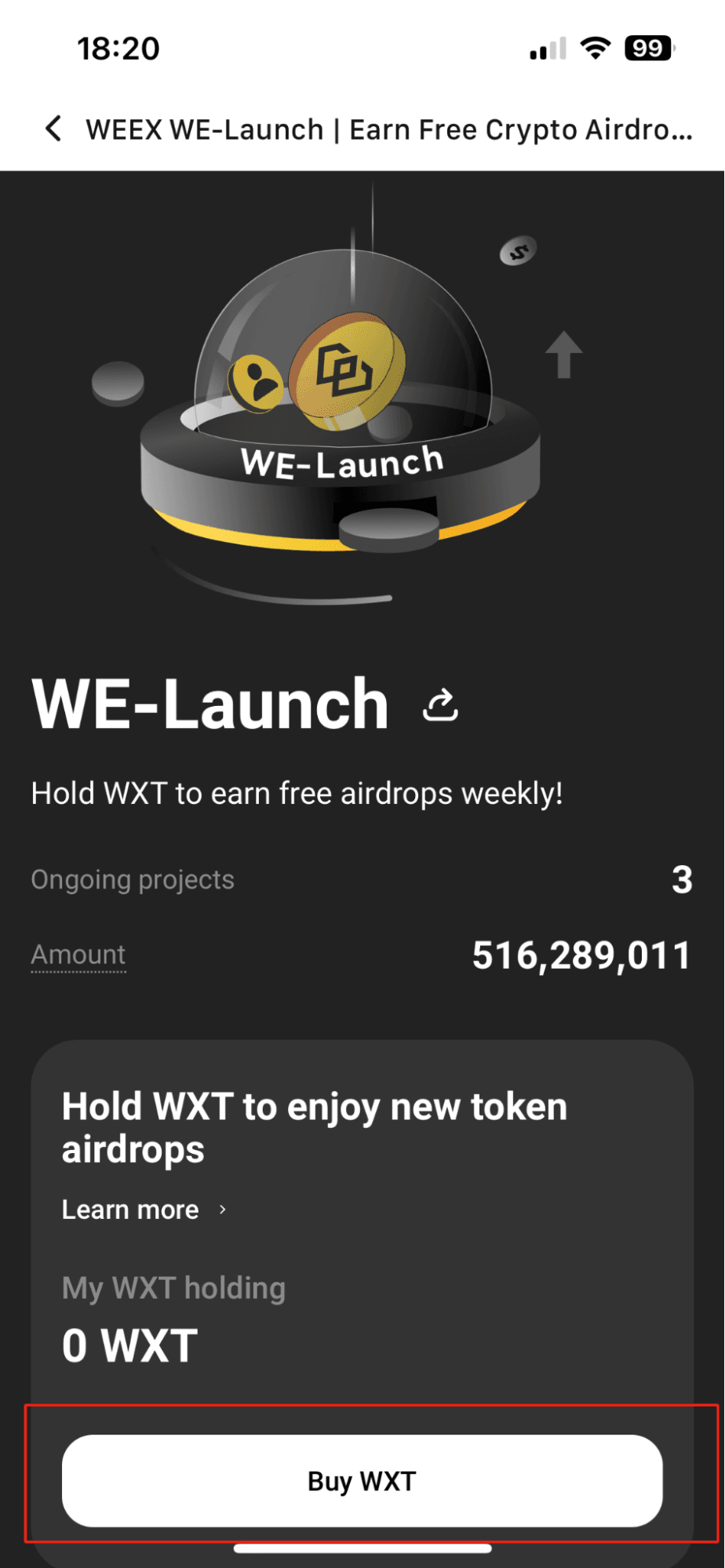
Input the quantity you wish to purchase, choose your preferred payment option, and assess the current exchange rate prior to finalizing the transaction.
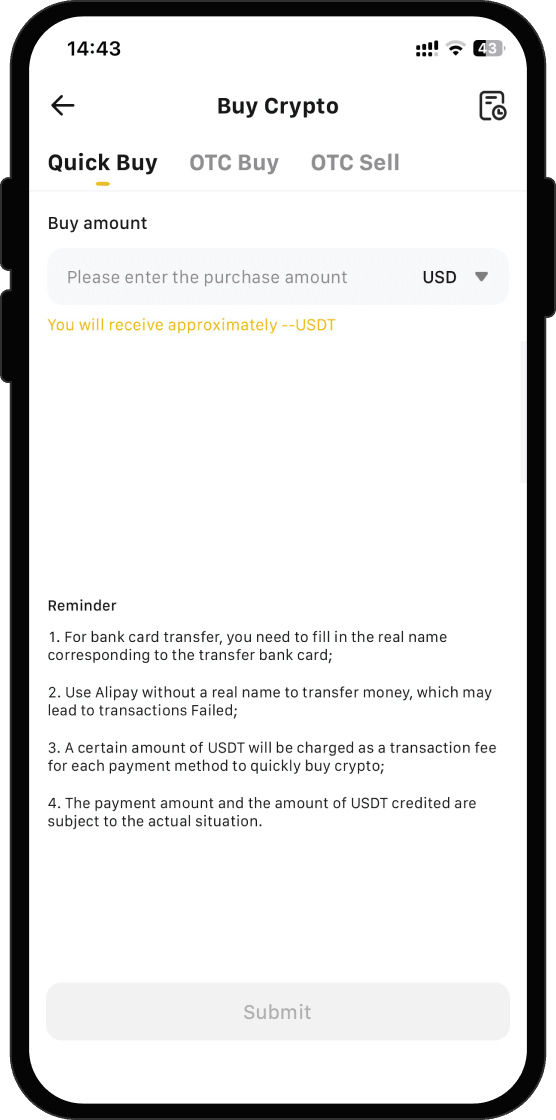
To learn additional information on purchasing WXT, refer to this guide and proceed.
Please note:
- If your WXT balance drops below 1000 WXT for two consecutive days, your account will be suspended.
- Coins that are locked will not count toward the available amount for commitment.
Step 3: Select a Project and Commit WXT
Navigate through the WEEX We-Launch webpage, review the current initiatives, select a project collection, and press the Commit WXT option.
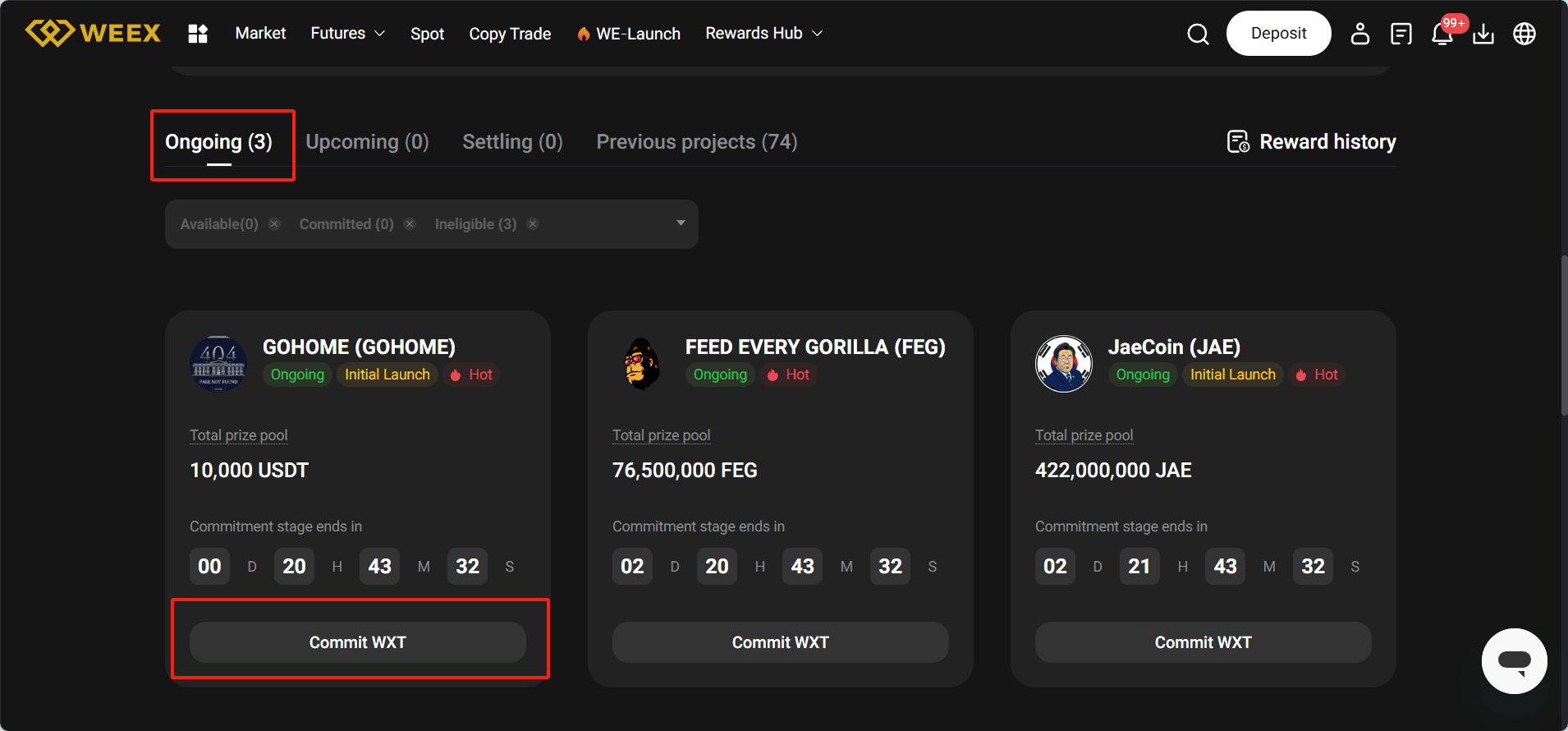
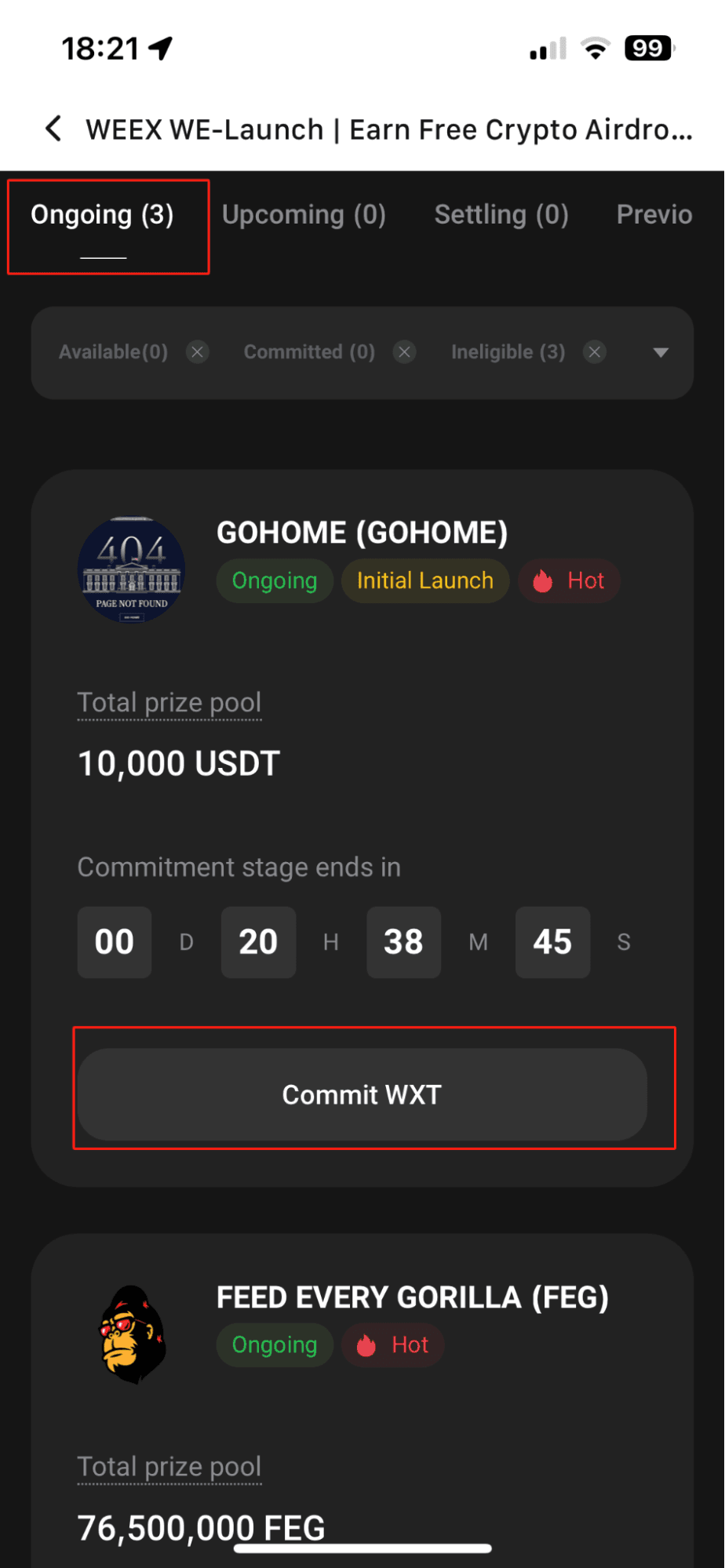
Note:
- If you qualify for a WE-Launch event, ensure you commit WXT during the designated period.
- The committed amount is solely for calculating rewards, and your WXT tokens will remain unfrozen.
Step 4: Monitor and Claim Your Rewards
The airdrop incentive for individual participants is determined following the conclusion of the commitment phase. Nevertheless, you have the ability to verify your precise rewards, anticipated rewards, and legitimate WXT commitment on the dashboard of the project to which you have committed.
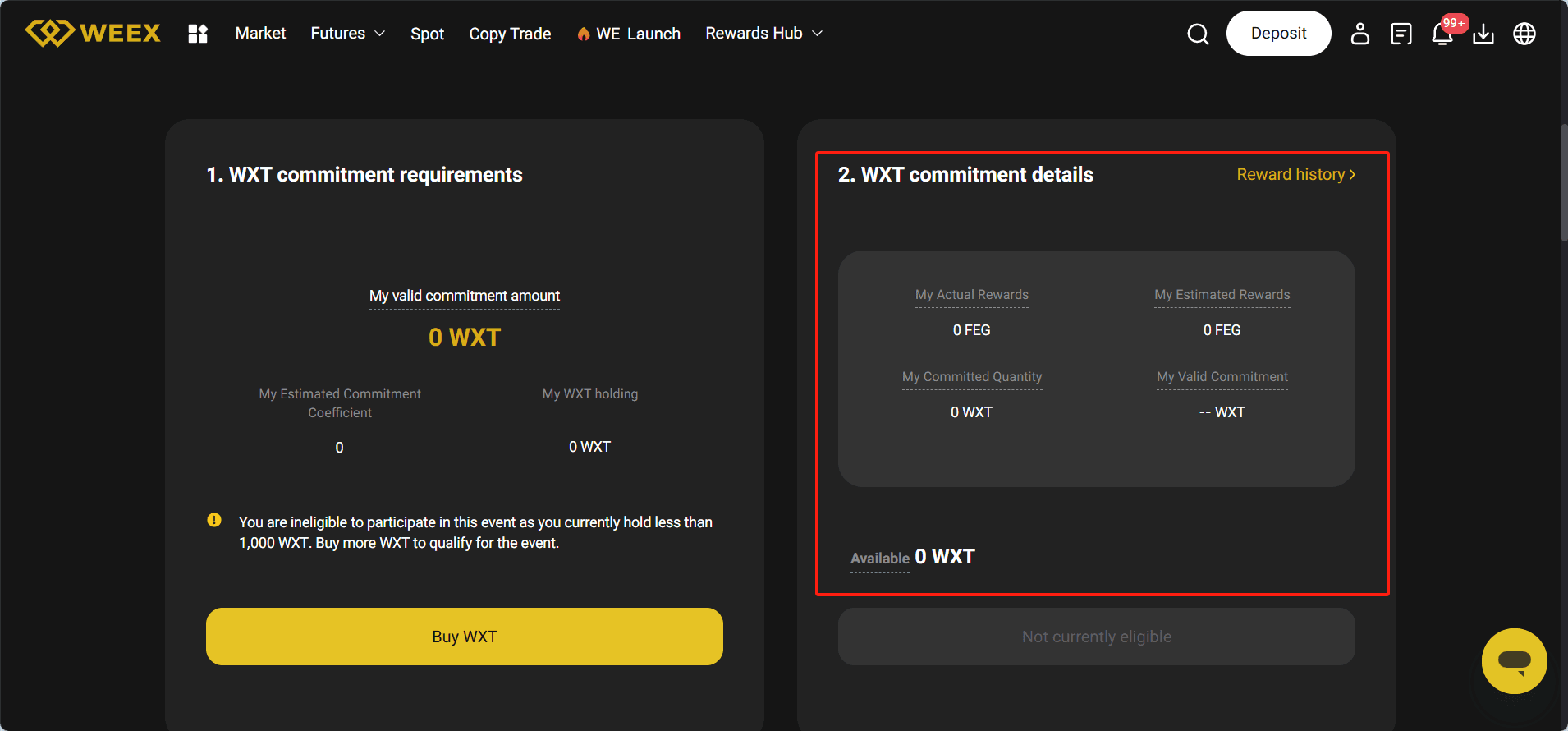
WEEX will determine the airdrop quantity by considering the proportion of a user's legitimate WXT commitment (quantity committed × commitment multiplier) in the overall prize pool, and then allocate the airdrops to the user's spot account.
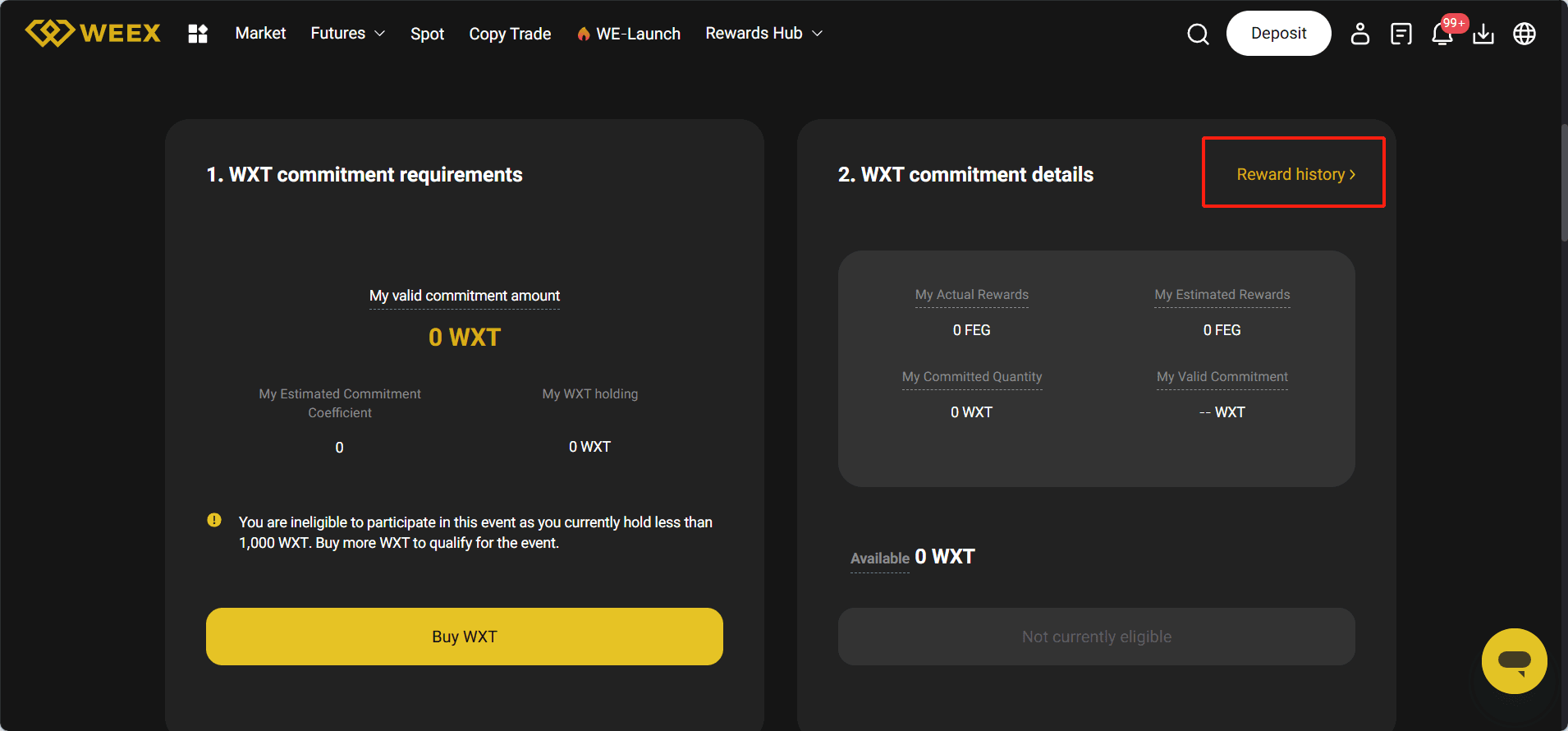
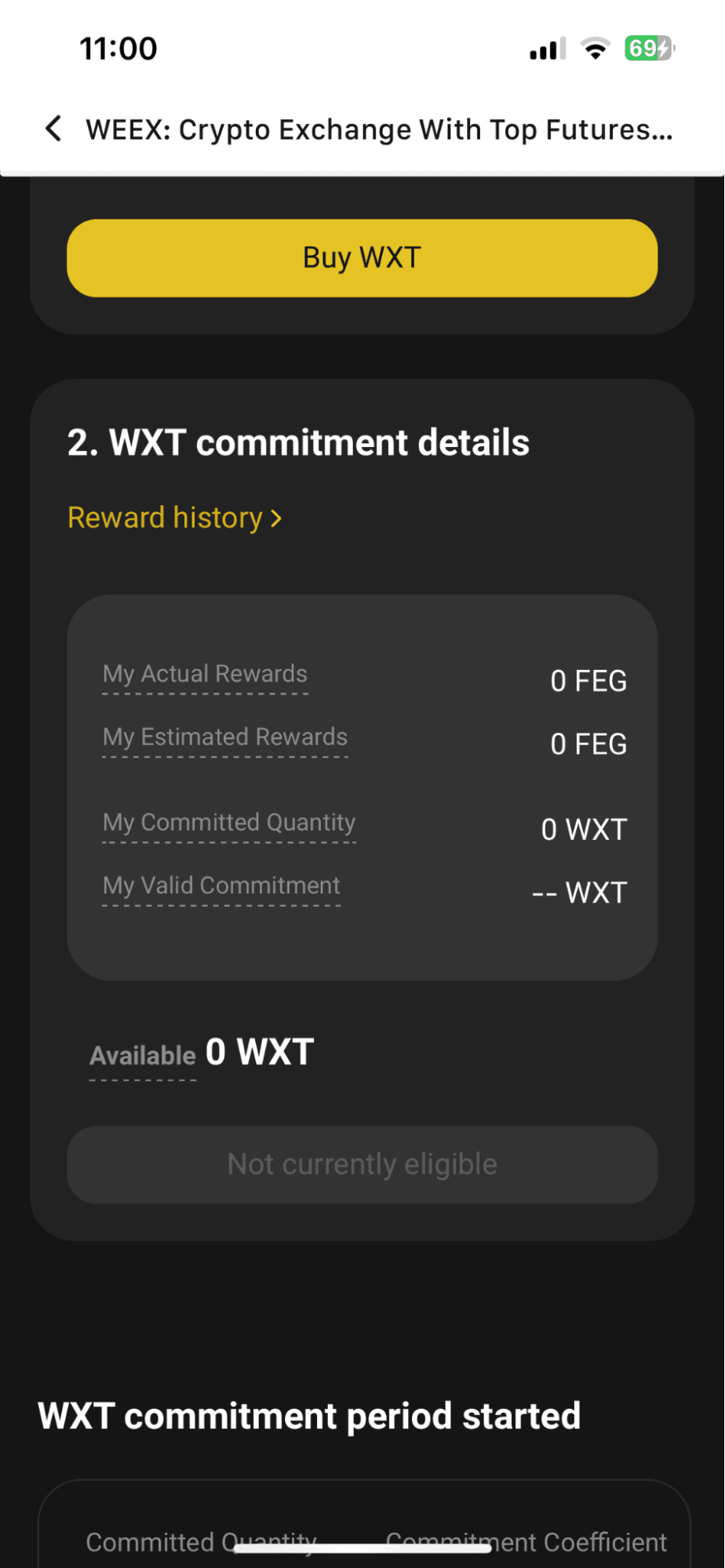
You have the ability to review your reward history at this location:
WEEX Affiliate & Referral Programs
WEEX Affiliate Program
What is the Affiliate Program
The WEEX Affiliate Program targets influencers, content producers, and people with a significant fan base, providing them with an opportunity to generate income through the promotion of WEEX and the recruitment of fresh users to the platform.
How to participate WEEX Affiliate Program
Getting started with the WEEX Affiliate Program is easy and uncomplicated. To learn more, refer to this quick guide that explains the process in detail.
To begin, simply follow these simple instructions:
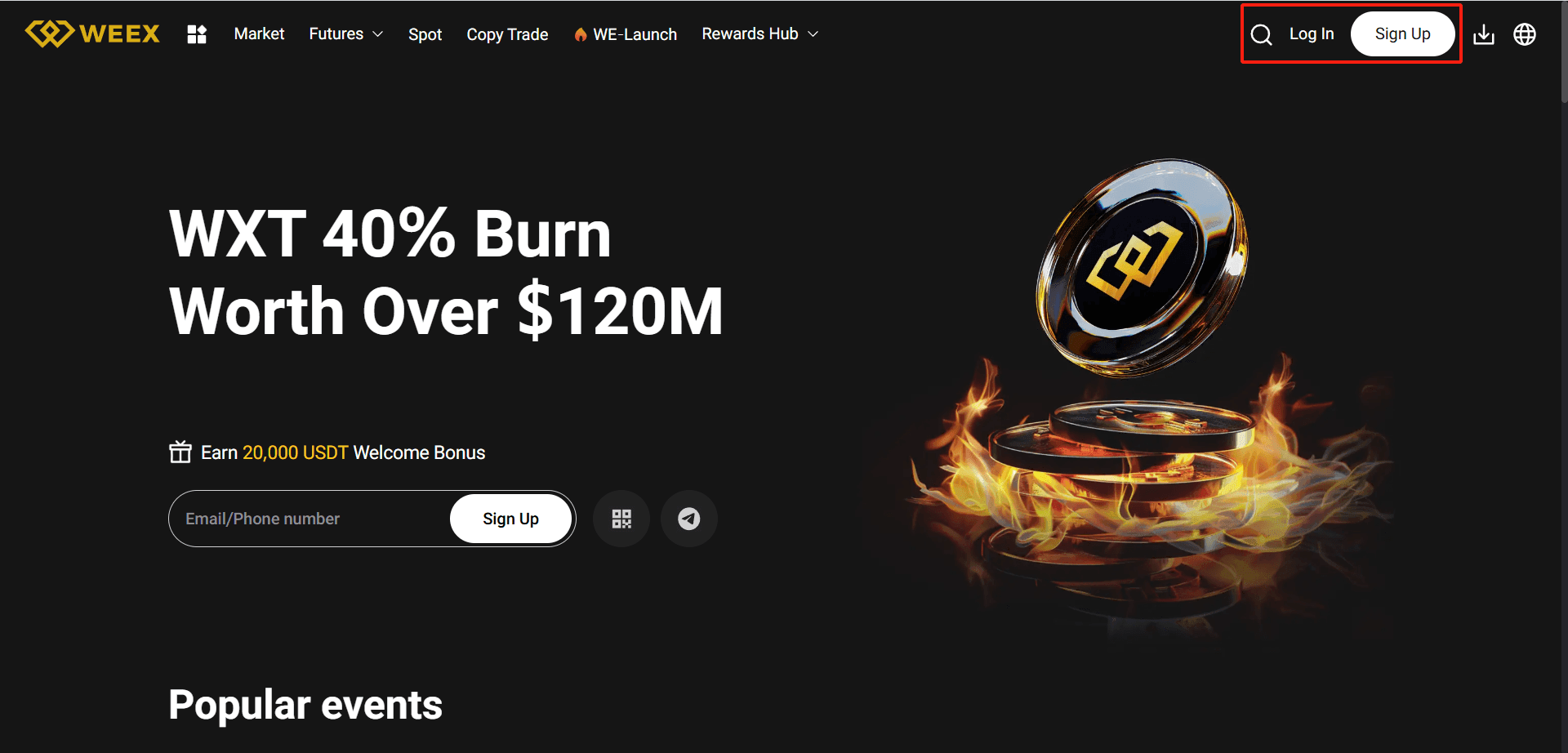
Step 1: Register or Log In
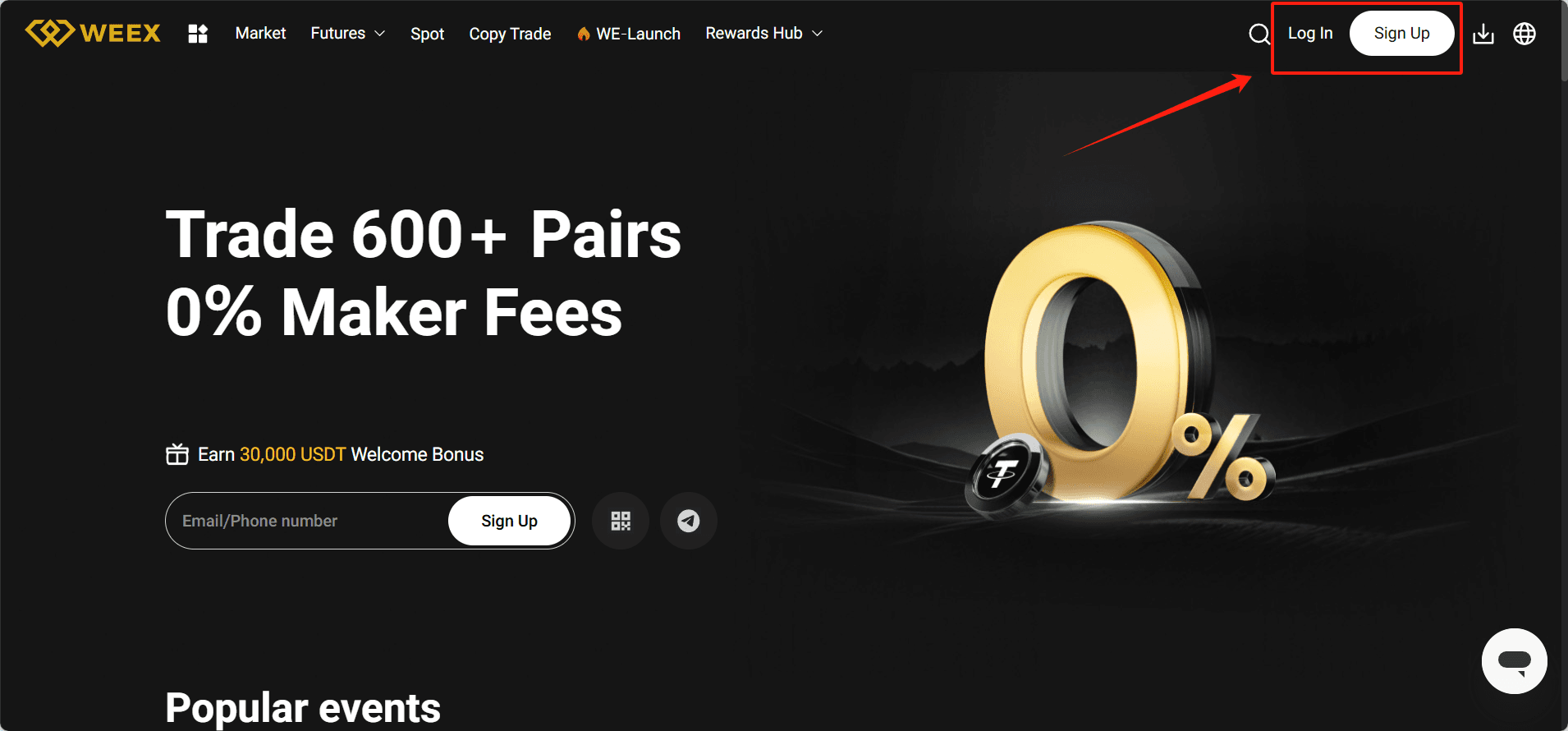
Explore the WEEX Affiliate Platform or get the app. Simply tap on the "Log In" option located at the top. If you are new, select "Sign Up" and refer to the detailed instructions. Remember to finalize the KYC (Know Your Customer) identity verification process.
Step 2: Complete Your Application
Simply press the "Apply Now" button and complete the application form by including information regarding your platform/channel, followers, members, and personal details. Furnish precise and thorough information to enhance the likelihood of your application being approved.

Step 3: Await Approval
Upon receipt of your application, WEEX will proceed with a review of your submission. This process generally requires 1-2 working days. Upon approval, an email confirmation will be sent to you, and you can expect to be contacted by the WEEX Affiliate team.
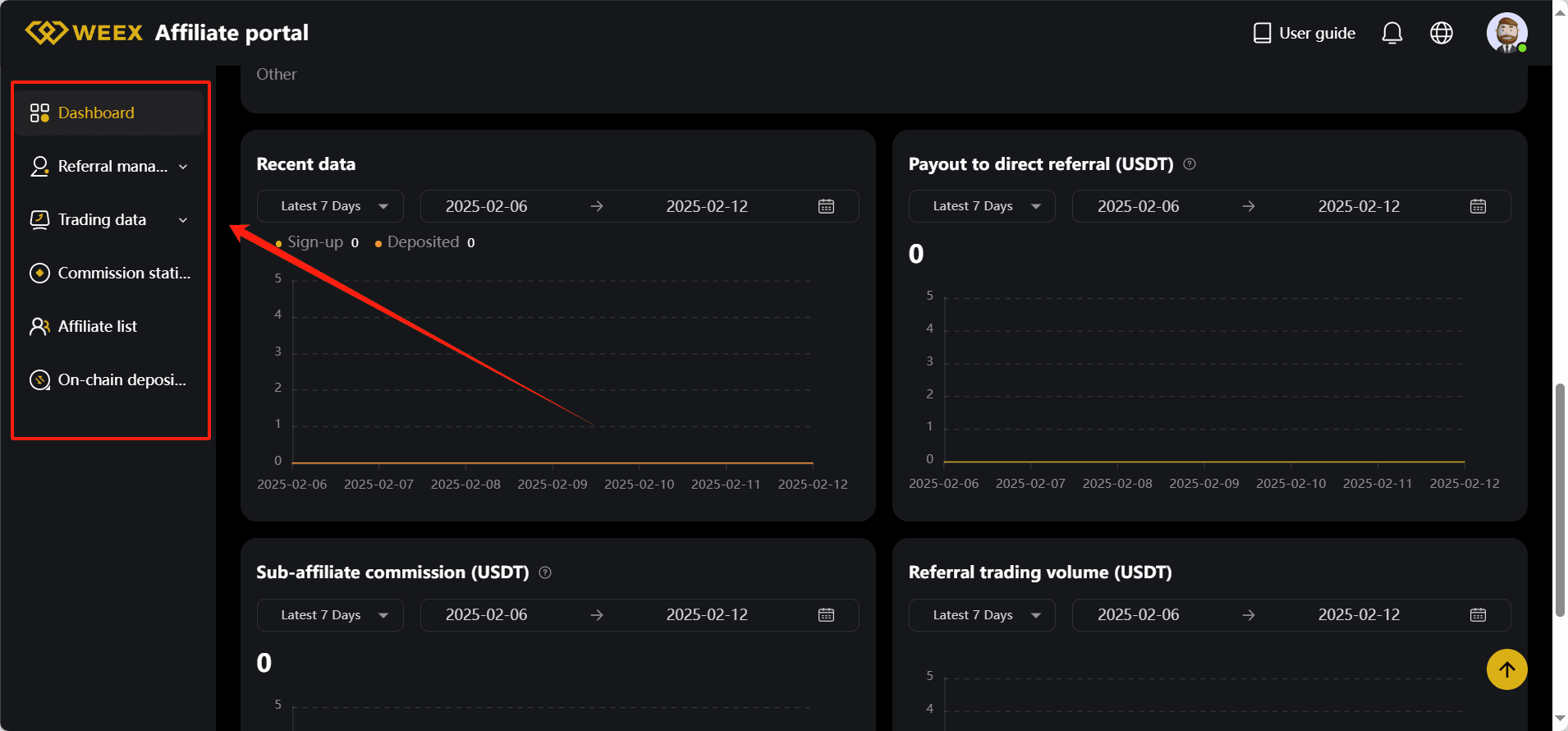
Step 4: Explore Your Affiliate Dashboard
After receiving authorization, access your WEEX affiliate dashboard. This platform enables you to oversee your referrals, monitor trading statistics, and review your overall earnings.
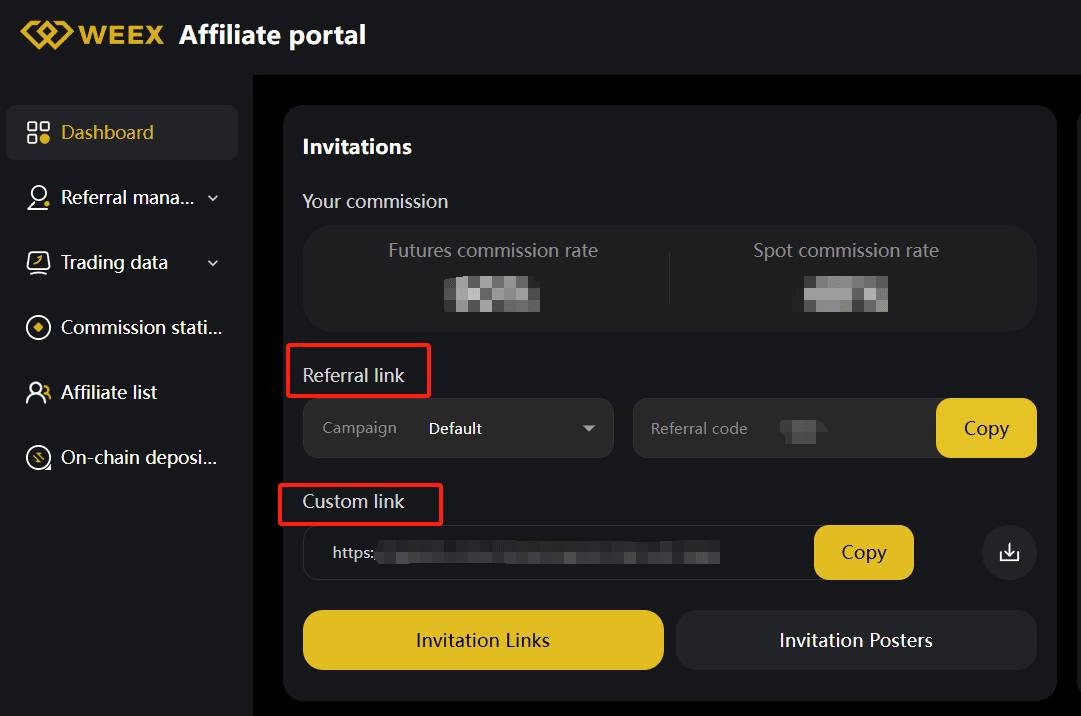
Step 5: Share Your Unique Affiliate Links
Create personalized referral links and codes, or obtain the QR code from the dashboard to distribute on your website, blog, social platforms, or advertising efforts.
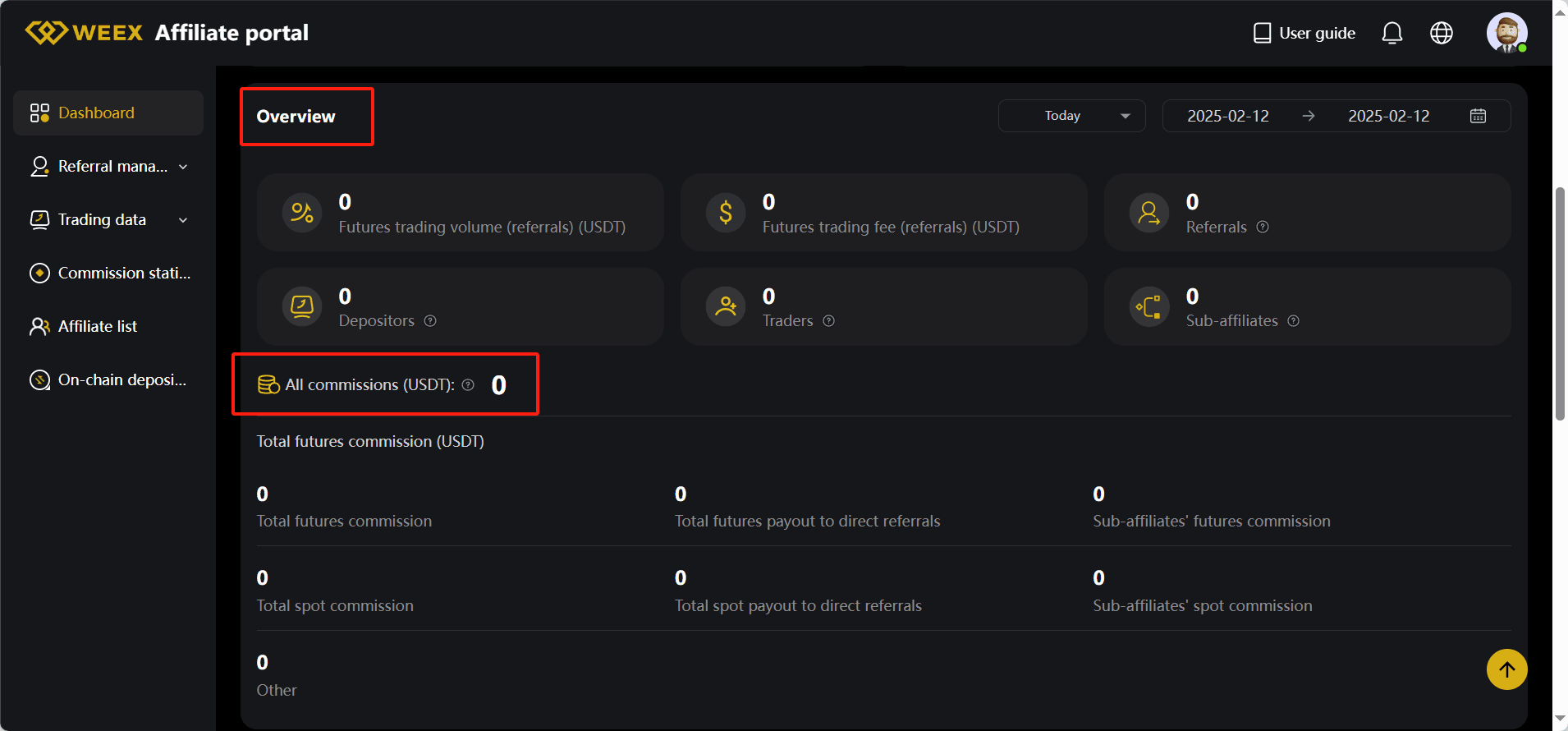
Step 6: Monitor Your Earnings and Results
Utilize the WEEX dashboard for real-time tracking of your commissions and performance. Evaluate your outcomes and adapt your tactics to optimize your profits.
WEEX Referral Program
What is WEEX Referral Program
The WEEX cryptocurrency exchange provides an affiliate program known as the WEEX referral program. Participants are given a referral code or invite link to share with their acquaintances, or they can opt to share a QR code for scanning. Upon registration by those they refer, the referrer will receive a commission equal to 50% of the fees generated.
For example, if a referral conducts a $120 crypto trade resulting in a $12 fee, the referrer will receive $6. Likewise, if the referral engages in a $2,000 trade incurring a $200 fee, the referrer will earn $100.
How to Participate In WEEX Referral Program
Participating in the WEEX referral program is easy. Just distribute your referral link or code, and when your referral signs up, you will receive a commission. For additional information, refer to this step-by-step guide of the process.
Prepared to begin making money? Simply adhere to these uncomplicated instructions:
Step 1: Register or Log In
- For New Users: Go to the WEEX signup page or download the app and select [Sign Up]. Enter your email or phone number, making sure it’s correct, and create a strong password. Finish the registration steps and input the referral code in the provided field.
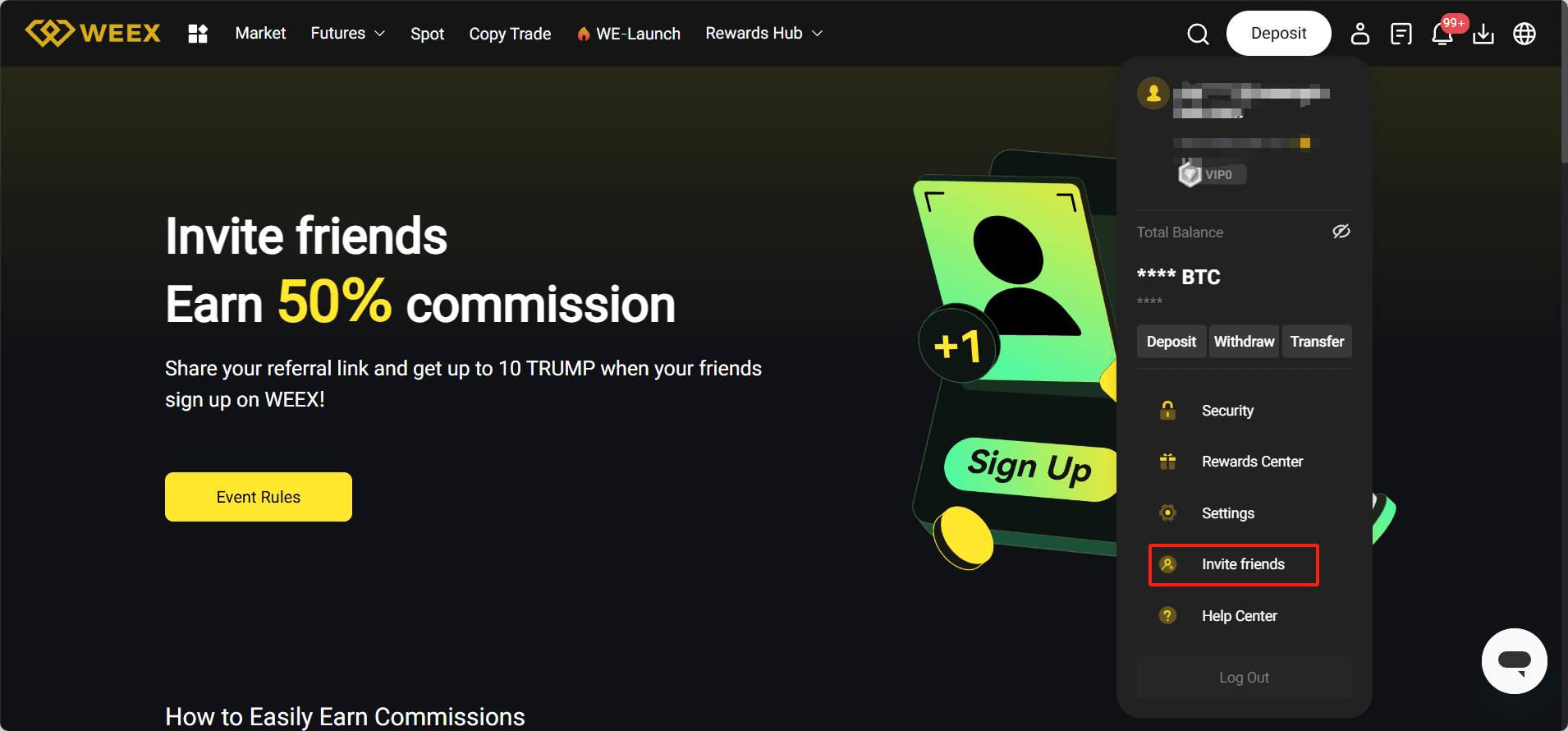
- For Existing Users: Sign into your account, hover over your profile, and select "Invite Friends," or go to the official WEEX Referral Program page.
Step 2: Fulfilling KYC Verification (Identity Verification)
In order to uphold the most stringent security protocols, WEEX mandates that users undergo KYC (Know Your Customer) verification corresponding to their level of access.
To complete the verification process, simply select the yellow profile icon located at the upper left corner of the homepage, and proceed to upload the required documents under the section labeled "Identity Verification."
Make sure to input precise data, as providing inaccurate information could lead to the suspension of your account. Refer to our KYC manual for guidance, and after verification, head to the WEEX referral scheme section.
Step 3: Distribute Your Referral Code/Link
You have the option to either copy your unique referral code using the designated button, spread your referral link, or circulate a QR code that serves as your referral identifier through email, social platforms, or instant messaging. The more you distribute, the higher the potential rewards you may receive.
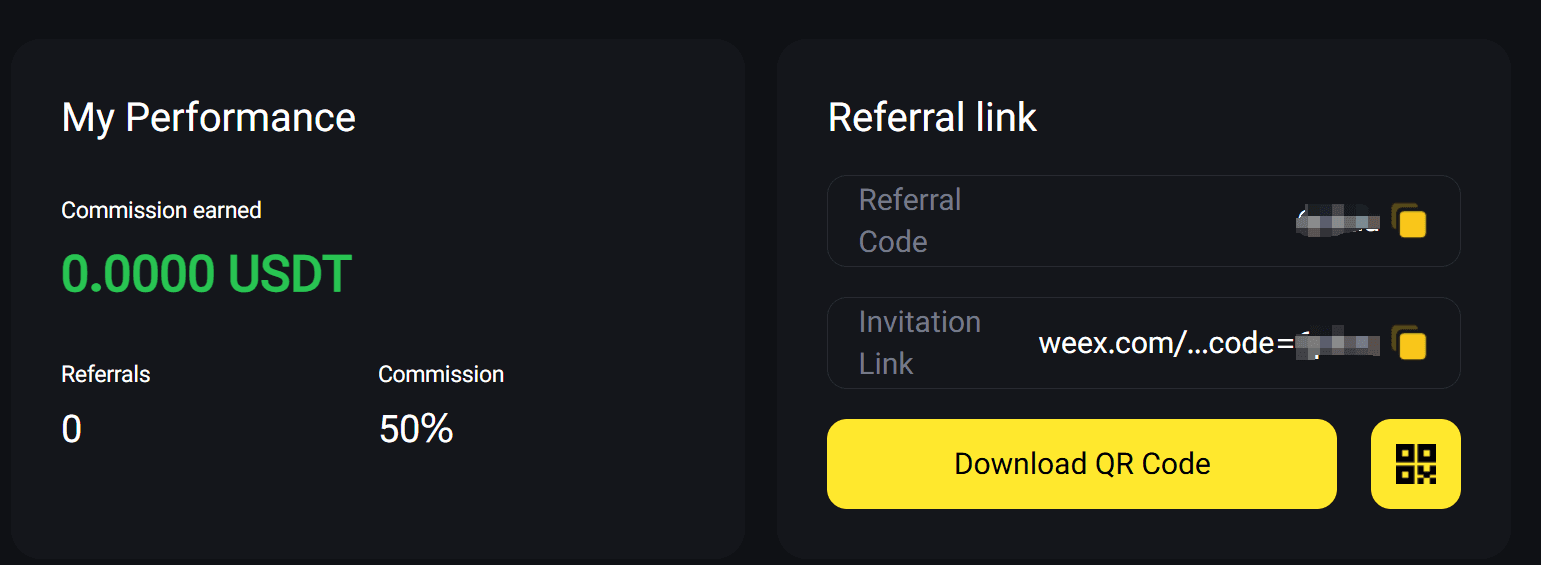
To ensure you receive your commission, it is essential that your referral code is applied by your referee when they register. Failure to do so will result in you not obtaining any bonus.
Step 4: Monitor Referrals & Earnings
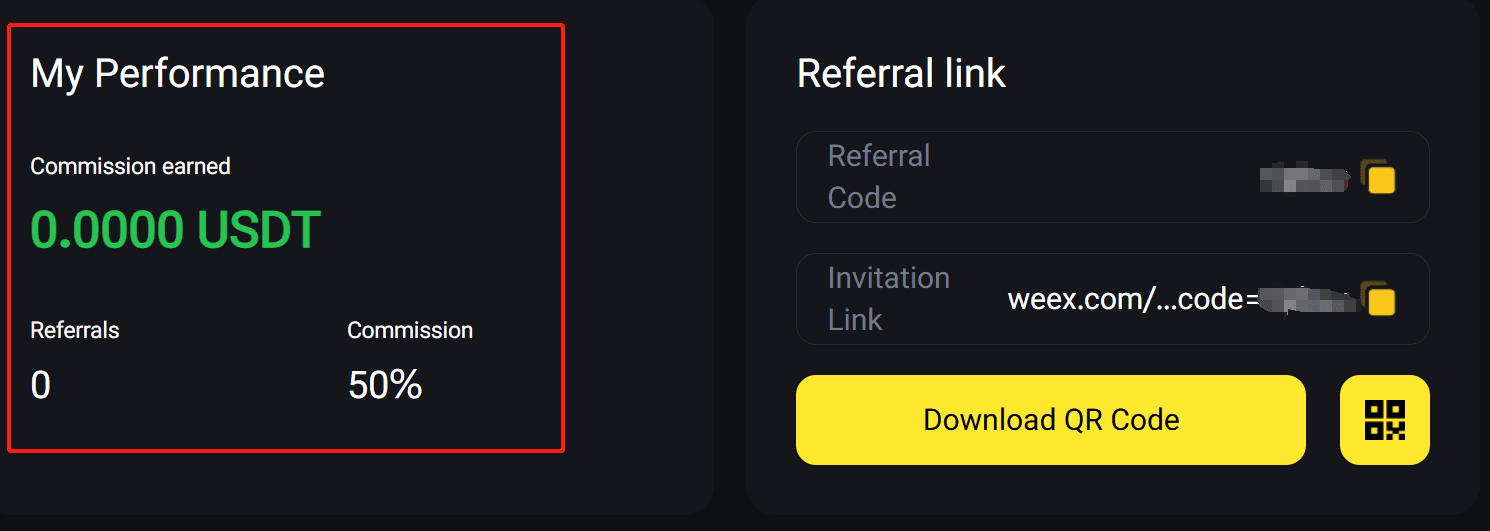
To keep track of the rewards and bonuses you've accumulated, you can simply access the WEEX referral program page and navigate to the section labeled "My Performance." Within this area, you will be able to oversee the commissions you have generated and view the total count of users you have referred. This feature enables you to stay informed about your advancements and potential income.
WXT
What Is WXT (WEEX Token)?
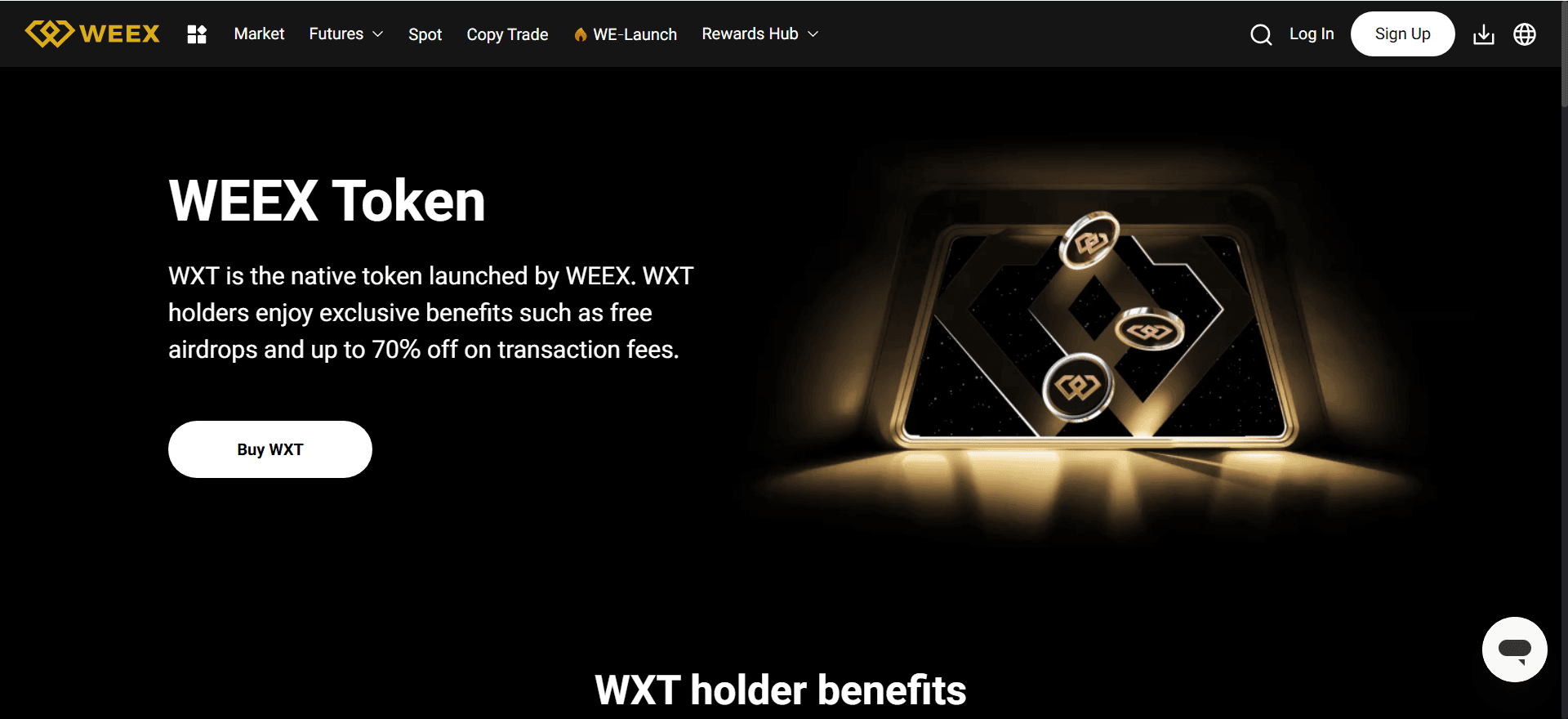
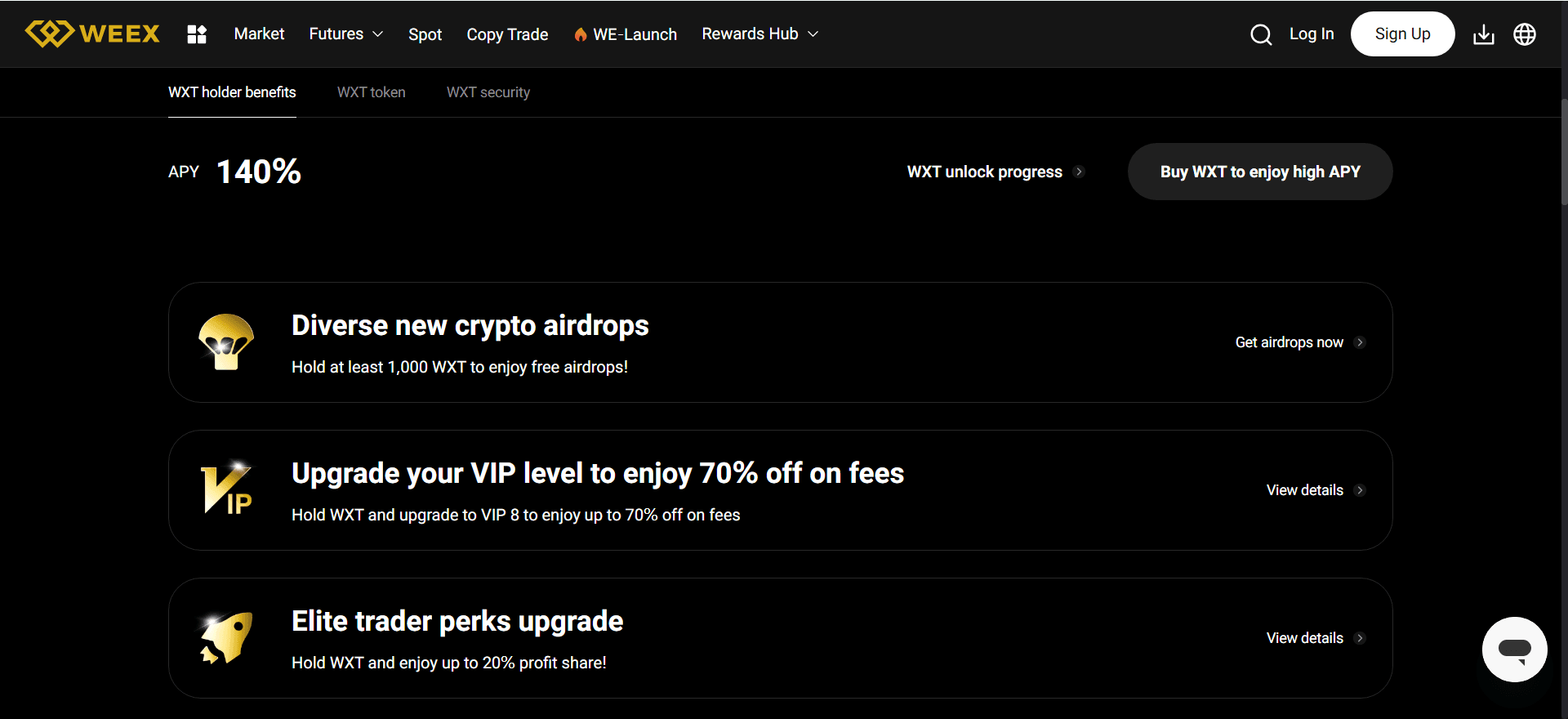
WEEX token is a key element of the WEEX ecosystem, aiming to enrich the platform and deliver a range of advantages to users. Following its launch, WXT has experienced a remarkable surge of 384%, hitting a record peak of \$0.03391. Boasting a total token supply of 6 billion, WXT provides perks such as giveaways, reduced fees, and an impressive annual yield of 140%. Additionally, it implements a deflationary approach to enhance its long-term value.
WXT acts as an incentive system for the WEEX community, providing special perks such as access to the launchpad, reduced trading fees, and early access to WEEX events. Through the possession and utilization of WXT, individuals can benefit from potential long-range profits and an enhanced trading environment as the WEEX platform expands further.
Learn how to buy WXT now!
Why Pick WXT?
The WXT token provides a wide array of advantages that enrich your WEEX platform experience. By participating in WXT events on WE-Launch, users can obtain complimentary token airdrops from well-known projects and benefit from a 140% APY by holding WXT. WXT holders receive priority access to WE-Launch events, increased reward multipliers, and the chance to purchase new project tokens at attractive prices.
Moreover, WXT demonstrates increasing on-chain functionality, encompassing its involvement in decentralized finance (DeFi) and NFT markets, along with applications that span across different ecosystems in DEXs and wallets. Moreover, holders of WXT possess the ability to participate in voting processes concerning platform-related decisions, such as the addition of new coins and enhancements to existing features. They are also empowered to put forward governance proposals aimed at shaping the platform's future progression.
Owning WXT also comes with additional advantages, such as reduced trading fees, increased referral rewards, special event incentives, and frequent token distributions. Holding WXT can elevate your VIP status, providing access to varying discount levels, while elite traders who possess WXT receive a greater percentage of profits.
Burn WXT
The deflationary approach of the WXT burn mechanism involves periodically taking out a portion of WXT tokens from circulation, which decreases the overall supply and has the potential to boost the token's value in the long term. This strategy is executed through the purchase and permanent removal of WXT tokens by WEEX from the open market, driven by platform revenues or specific milestones. The advantages include heightened scarcity, sustained rewards for holders, market steadiness, and increased trust within the community. By diminishing the token supply, the burn mechanism establishes scarcity, which in turn elevates the token's value as demand grows. Furthermore, it contributes to the growth of the WEEX ecosystem by attracting investors, improving liquidity, and reinforcing user trust. Through transparent burn processes, WEEX showcases its dedication to creating sustainable value, positioning WXT as a promising asset in the realm of cryptocurrency.
The WXT burns scheduled for the first quarter of 2025 were successfully carried out by WEEX. By utilizing a transparent burn mechanism on January 31, 2025, the platform permanently eliminated 4,000,000,000 WXT (4 billion tokens) from circulation. This deflationary measure is in line with the project's dedication to improving token functionality and maintaining value stability. It represents a significant advancement in the project's updated whitepaper strategy aimed at managing supply-demand dynamics effectively and nurturing sustainable ecosystem development.
Fees On WEEX
Deposits and Withdrawals
Deposits made to WEEX are free.
Weex does not impose any fees on users for cryptocurrency withdrawals; however, users are responsible for covering the network or miners fee, which can fluctuate based on the specific cryptocurrency and network circumstances.
The withdrawal charges for WEEX are available on this page: Rate Standards
When utilizing our WEEX application, simply select the profile icon located at the top left corner and then navigate to [Fee Rates] to access the withdrawal fee rates applicable to all cryptocurrencies.
Click here for access to the full WEEX WXT guide.
Trading Fees
Under usual conditions, both makers and takers are charged a 0.1% fee for spot trading on WEEX. For futures trading, makers pay a fee of 0.02% while takers pay 0.08%.
By holding WXT, you have the opportunity to receive a discount of up to 70% for futures trading fees based on your WEEX vip level. The discount amount increases with the level of your membership. Register or sign in to WEEX today!
To access the regulations and fee structure, simply select the assets icon located in the corner, navigate to [Futures], and choose [Enjoy up to 70% off transaction fees].
Furthermore, occasional trading fee discounts are also provided by WEEX, hence it is advisable to refer to the latest event announcements!
The trading fees for WEEX spot trading and futures trading are available on this page: Rate Standards.
WEEX VIP
The WEEX VIP program is specifically created to provide top-notch assistance and benefits to valued customers. Being a VIP grants you immediate contact with an assigned account manager accessible 24/7 through a dedicated VIP communication channel for resolving any account concerns. This guarantees a tailored, effective service without the usual waiting times or obstacles.
Being a WEEX VIP offers more than just superior customer service. VIPs receive priority treatment for withdrawals, ensuring quick and straightforward transactions without the need for complex verification processes for large sums. Moreover, VIPs are spared from extended lock-up periods and collateral requirements, enhancing transaction efficiency and flexibility. To become eligible, just provide your UID to the customer service team. If you meet the requirements, you will be assigned a dedicated account manager and granted full VIP benefits.
Complete the VIP application form today in order to join the ranks of WEEX VIP members!
WEEX Global Ambassador
Success in football relies on executing accurate maneuvers at the appropriate time, blending speed, precision, and a solid strategy. Similar to the dynamics on the field, triumph in the cryptocurrency market necessitates timely choices, meticulous planning, and a dependable ally to navigate the market fluctuations. This is why the collaboration between Michael Owen and WEEX has been forged---each move pushes WEEX × weex ambassador Owen closer to triumph. By leveraging Owen's strategic acumen and precision alongside WEEX's cutting-edge platform and unwavering commitment to security, this partnership strives to introduce a winning strategy to the realm of cryptocurrency exchange. Just as a cohesive football team operates in harmony, WEEX Owen embodies the strength of teamwork and the determination to excel.

WEEX Vision for 2025
- Enhanced Trading Tools: Continuously developing advanced features to elevate the user experience.
- Worldwide Expansion: Growing its presence to unite traders and communities globally.
- Uncompromising Security: Upholding robust security standards while embracing cutting-edge innovations.
Grateful for the community’s trust and support, WEEX welcomes you to join its mission to redefine cryptocurrency trading. Explore more possibilities by visiting the official WEEX website today.
Conclusion
WEEX stands out as a top cryptocurrency exchange that combines security, innovation, and user-centered design seamlessly. By establishing a 1,000 BTC user protection fund and ensuring transparency through Proof of Reserves, WEEX places a strong emphasis on trust and the safety of assets. Offering a wide range of services including spot trading, 400x leveraged futures, copy trading, and WE-Launch token pools, WEEX caters to traders of all levels, supported by a selection of over 1,500 trading pairs and competitive low fees. The platform's WXT token ecosystem, which is designed to be deflationary, its presence in 134 countries worldwide, and strategic partnerships such as Michael Owen's ambassadorship, all contribute to reinforcing its competitive advantage.
For individuals in the trading world looking for a safe, feature-packed, and community-driven platform, WEEX serves as the entrance to the upcoming trends in cryptocurrency. Gain access to exclusive incentives, reduced fees, and early entry to promising projects by registering today and becoming one of the 5 million users influencing the future of digital finance. Embark on your WEEX journey and explore cutting-edge innovation in trading.
WEEX aims to shape the future of the digital assets industry through the provision of a secure, private, and user-friendly platform. The objective of the WEEX ecosystem is to establish a self-sustaining financial system powered by blockchain technology, offering a range of applications to democratize access to blockchain technology. By connecting cryptocurrency with traditional finance, WEEX is striving to lower entry barriers and introduce cutting-edge products, envisioning a future where digital assets assume a central role in everyday activities.
FAQ (Frequently Asked Questions)
How many cryptocurrencies are available on WEEX?
Supporting more than 1000 cryptocurrencies, WEEX offers a wide variety of digital assets for traders to diversify their portfolios effectively. This selection includes established cryptocurrencies, enabling users to capitalize on market opportunities, trade securely, and conveniently access their preferred assets.
Is WEEX a secure platform?
Affirmative, WEEX is secure. Safety is a key priority for WEEX, demonstrated through various measures including a 1,000 BTC margin pool and dual-layer risk control systems that blend smart technology with manual supervision. In addition, WEEX upholds a safe and confidential setting by utilizing servers located worldwide and employing advanced wallet management verification. Furthermore, WEEX delivers a top-notch futures trading platform offering benefits such as zero charges on tiered liquidations, immediate deposits and withdrawals, and specialized customer service.
How can I add funds to my WEEX account?
Adding funds to WEEX is simple and supports various methods. Refer to the Step-by-Step Guide to finalize your deposit and kickstart your trading or investment experience.
Where can I locate additional FAQs for WEEX?
Explore WEEX wiki to locate the inquiry you seek or navigate through our WEEX support for the solution you require.
You may also like

WEEX vs Other Exchanges: The 2026 Fee Comparison Every Trader Needs to See
Most traders obsess over entry prices but ignore the slow bleed of trading fees. A 0.1% difference might not sound like much, but if you're making 50 trades a month, those "small" fees add up to serious money. In 2026, with crypto markets maturing and margins getting tighter, every basis point counts.
The problem? Many exchanges advertise low rates but bury their real costs in wide spreads, expensive withdrawals, or complicated tier structures. WEEX takes a different approach: transparent, competitive, and built for active traders who care about costs.
WEEX vs Binance vs Bybit vs Bitget vs MEXC: Trading Fee ComparisonHere's the raw data based on current 2026 fee schedules:
ExchangeSpot MakerSpot TakerFutures MakerFutures TakerBTC WithdrawalWEEX0%0.10%0.02%0.06%0.00016 BTCBinance0.10%0.10%0.02%0.04%0.0004 BTCBybit0.10%0.10%0.01%0.06%0.0005 BTCMEXC0%0%0.02%0.06%0.0004 BTCBitget0.10%0.10%0.02%0.06%0.0001 BTCWhat jumps out immediately: WEEX is the only major exchange offering 0% spot maker fees alongside highly competitive futures rates. MEXC offers 0% on both spot sides, but WEEX's deeper liquidity often means better execution prices — which matters more than the fee itself.
How WEEX Saves Your Money on FeesThe 0% Maker AdvantageWhen you place a limit order that adds liquidity to the order book, WEEX charges you nothing. On Binance or Bybit, that same order would cost you 0.1%. For a $10,000 trade, that's $10 saved per order. If you place 10 limit orders a day, you're saving $100 daily — or over $36,000 annually. That's real money back in your pocket.
Lower Withdrawal CostsTrading fees aren't the only thing that eats into your profits. Bitcoin withdrawals on WEEX cost just 0.00016 BTC (~$18 at current prices). Compare that to Binance's 0.0004 BTC (~$45) or Bybit's 0.0005 BTC (~$56). Every time you move your funds off the exchange, WEEX leaves more money in your pocket.
No Hidden Spread MarkupsSome "zero-fee" exchanges make their money by widening spreads — you see one price but execute at another, effectively paying a hidden fee. WEEX maintains transparent pricing with institutional-grade liquidity. The price you see is the price you get. No games, no surprises.
WXT Token: Even Lower FeesHold WEEX's native WXT token to unlock additional discounts. Depending on your holdings and VIP tier, you can slash futures fees by up to 70% — bringing maker fees as low as 0.006% and taker fees down to 0.018%. For high-volume traders, these savings add up fast.
The Fine Print: Fee-Related ConsiderationsNo exchange is perfect. Here's what to watch for on WEEX:
Spot taker fees are standard. At 0.10%, WEEX's spot taker fee matches Binance and Bybit. If you primarily use market orders (taking liquidity), the advantage over competitors shrinks — though you still benefit from lower withdrawals and no spread markups.
Futures taker fee is slightly higher than Binance. WEEX charges 0.06% on futures taker fees, while Binance charges 0.04%. If you're a high-frequency futures trader who mostly uses market orders, Binance might edge ahead on that single metric. But for maker-focused traders, WEEX remains highly competitive.
Withdrawal fees vary by asset. While BTC withdrawals are among the lowest in the industry, some ERC-20 tokens carry higher network fees — though that's true across all exchanges.
How to Start Saving on WEEX TodayReady to cut your trading costs? Here's how to start your crypto journey:
Step 1: Go to the WEEX official website and sign up using email or mobile — no KYC required for basic trading.Step 2: Deposit crypto — free on WEEX's side (you only pay network fees).Step 3: Use limit orders to take advantage of 0% spot maker fees.Step 4: Hold WXT tokens to unlock additional fee discounts (up to 70% off futures).Step 5: Use a referral code during registration for deposit bonuses and fee-related promotions.Is WEEX the Lowest-Fee Exchange for You?For spot traders who use limit orders: Yes — 0% maker fees make WEEX a no-brainer compared to Binance or Bybit.
For futures traders who add liquidity: Yes — 0.02% maker fees are among the lowest, and WXT discounts push them even lower.
For high-volume market order traders: Possibly — Binance offers slightly lower futures taker fees (0.04% vs 0.06%), but WEEX still wins on withdrawals and spot maker fees.
For anyone tired of hidden spreads: Yes — transparent pricing means you're not paying invisible markups.
For US/Canadian residents: No — WEEX doesn't accept users from restricted countries.
Ready to trade? WEEX offers zero fees, instant execution, and the security you need. Sign up on WEEX Now and Start Trading!
FAQQ1: Does WEEX really have 0% fees?Yes — spot maker fees are 0% for all users. Spot taker fees are 0.10%, matching Binance and Bybit. Futures maker fees start at 0.02%.
Q2: How does WEEX compare to Binance on trading fees?WEEX beats Binance on spot maker fees (0% vs 0.10%) and BTC withdrawal costs (0.00016 BTC vs 0.0004 BTC). Binance has slightly lower futures taker fees (0.04% vs 0.06%).
Q3: How does WEEX compare to MEXC on fees?MEXC offers 0% on both spot maker and taker, which looks better on paper. However, MEXC's wider spreads often mean you get worse execution prices — effectively paying a hidden fee. WEEX's institutional-grade liquidity gives you tighter spreads and better fills.
Q4: What are WEEX's withdrawal fees?BTC withdrawal is 0.00016 BTC (~$18), significantly lower than Binance (0.0004 BTC) and Bybit (0.0005 BTC). ERC-20 tokens follow standard network fees.
Q5: How can I get even lower fees on WEEX?Hold WXT tokens. Depending on your VIP tier, you can reduce futures fees by up to 70% — maker fees as low as 0.006%, taker fees as low as 0.018%.

Understanding Bearwhales: How Market Giants Impact Your Crypto
In the fast-moving world of cryptocurrency, big players often decide where the price goes. Most people know about "Whales"—investors with huge accounts. However, there is a more aggressive type of player known as the Bearwhale. These individuals can change market trends in hours.
A Bearwhale doesn't just hold a lot of coins; they use their wealth to push prices down. By placing massive sell orders, they create fear in the market. This often leads to a "panic sell" by smaller investors. Understanding how they work is key to surviving the volatile crypto market.
KEY TAKEAWAYSMarket Identity: A Bearwhale is a high-net-worth trader with a "bearish" or pessimistic outlook on the market.The Sell Wall: They use massive sell orders to block price growth and trigger panic among retail traders.Profit Strategy: Their goal is often to buy back the same assets at a much lower price after the market crashes.Historical Slaying: The term became famous in 2014 when the Bitcoin community successfully "defeated" a 30,000 BTC sell order.Liquidity Test: While scary, Bearwhale activity tests how strong and liquid a cryptocurrency market really is.What is a Bearwhale in Crypto?A Bearwhale is a specific type of market participant who combines massive capital (the "Whale") with a strategy to lower prices (the "Bear"). They hold enough of a specific cryptocurrency to single-handedly shift the market balance. While a normal whale might wait for prices to go up, a Bearwhale actively forces them down.
They usually operate on major exchanges where their moves are visible to everyone. By showing a massive amount of "supply" for sale, they trick the market into thinking a crash is coming. This is often a calculated move to "shake out" weak-handed investors before the Bearwhale buys in again at the bottom.
How a Bearwhale Operates: The Mechanics of Market PressureThe primary weapon of a Bearwhale is the Sell Wall. If a coin is trading at $50,000, a Bearwhale might place an order to sell 5,000 units at $49,900. Because this order is so large, the price cannot go higher until every single one of those 5,000 units is bought.
This creates a psychological trap. Retail traders see the wall and think, "The price will never break through that." They start selling their own coins to get out early. This chain reaction causes the price to drop rapidly, exactly as the Bearwhale intended.
Bearwhale vs. Other Market ParticipantsCategoryMarket StancePrimary GoalInfluenceBearwhaleAggressively BearishPush prices down to buy back cheaper or profit from shorts.HighTraditional WhaleBullish / NeutralLong-term growth or steady accumulation.HighMarket MakerNeutralProvide liquidity and profit from the "spread."MediumRetail InvestorVariablePersonal portfolio growth and capital gains.LowPros and Cons of Bearwhale ActivityCategoryAdvantages (Pros)Disadvantages (Cons)Market HealthTests the liquidity and strength of an exchange.Causes extreme and artificial price volatility.OpportunitiesProvides "buy the dip" chances for smart investors.Triggers liquidations for traders using leverage.PsychologyTeaches retail traders to ignore short-term noise.Manipulates market sentiment through fear.MaturityShows when a market has grown too big to be manipulated.Distorts the true value of a project or technology.Real-World Case: The Slaying of the 2014 BearwhaleIn October 2014, the Bitcoin community faced its biggest test. An anonymous trader placed a sell order for 30,000 BTC at $300 on the Bitstamp exchange. At the time, this was a massive $9 million wall.
Instead of panicking, the community rallied together. Over the course of several hours, thousands of smaller buyers "ate" through the wall. This event proved that Bitcoin was strong enough to survive a single massive seller. It is now remembered as a legendary moment in crypto history.
Future Trends: The Rise of Institutional WhalesAs crypto becomes mainstream, the era of the "lone" Bearwhale is fading. Trillion-dollar markets like Bitcoin are now too big for one person to crash easily. Instead, we see Institutional Whales (like hedge funds). These players are more regulated and their moves are often tracked by sophisticated on-chain software, making it harder for them to hide their intentions.
FAQHow can I spot a Bearwhale?Check the "Order Book" on your exchange for a massive sell order sitting just above the current price. You can also follow "Whale Alert" accounts on social media that track large movements of coins from private wallets to exchanges.
Is Bearwhale activity considered illegal?In traditional stock markets, this could be seen as "market manipulation" or "spoofing." In the crypto world, regulations are still catching up, so while it is often frowned upon, it is difficult to stop across different global jurisdictions.
What should I do if I see a Bearwhale sell wall?The best strategy is to stay calm and avoid panic selling. If the project's fundamentals are still strong, remember that Bearwhale activity is usually a temporary attempt to manipulate price, not a reflection of the coin's actual value.
ConclusionThe Bearwhale is a formidable part of the crypto ecosystem that every investor should understand. While their sell walls can be intimidating, they are often just part of a larger psychological game. By focusing on long-term value and remaining calm during volatility, you can protect your portfolio from these market giants. Always trade with caution and never invest more than you can afford to lose.

Understanding Bitcoiners: Guide to Philosophy and Major Holders
A Bitcoiner is an individual or entity that deeply identifies with the technology, economic philosophy, and ecosystem of Bitcoin. Unlike a casual trader who might buy and sell various digital assets for quick profit, a Bitcoiner typically views Bitcoin as a revolutionary shift in how humanity perceives and stores value.
The term "Bitcoiner" is derived from "Bitcoin" plus the suffix "-er," literally meaning "a person of Bitcoin." This group is characterized by a commitment to decentralization, financial sovereignty, and the technical robustness of the network. They are often active participants in the ecosystem, whether through long-term holding (HODLing), developing open-source code, or promoting the "freedom money" narrative.
The Evolution and Background of the BitcoinerThe roots of the Bitcoiner movement lie in the Cypherpunk mailing list of the 1990s, which advocated for the use of strong cryptography and privacy-enhancing technologies as a route to social and political change. When Satoshi Nakamoto released the Bitcoin whitepaper in 2008, it provided the first functional tool for this philosophy.
Over the past decade, being a Bitcoiner has evolved from a niche technical interest into a global financial identity. Initially, Bitcoiners were mostly software developers and libertarians. Today, the demographic includes retail investors, Wall Street fund managers, and even government officials who view the protocol as a hedge against the inflationary tendencies of traditional fiat currencies.
Categories of Bitcoiners: From Individuals to NationsThe Bitcoiner community is no longer a monolith. It can be categorized into four distinct types based on their scale and motivation:
1. Technical Architects and GeeksThese are the developers and node operators who focus on the "plumbing" of the network. They prioritize security, privacy, and scalability (such as the Lightning Network). Their goal is to ensure the network remains decentralized and resistant to censorship.
2. Individual HODLers and BelieversOften called "True Bitcoiners," these individuals practice "Self-Custody." They believe in the mathematical certainty of the 21-million supply cap and use Bitcoin as a personal "Lifeboat" against economic instability.
3. Institutional Strategic HoldersMajor corporations now act as "Corporate Bitcoiners." The most prominent example is MicroStrategy, which, as of early 2026, holds approximately 762,000 BTC. By treating Bitcoin as a treasury reserve asset, they have set a precedent for other public companies to follow.
4. Sovereign and State EntitiesThis is the newest frontier. Nations like El Salvador and the United States (which established a "Strategic Bitcoin Reserve" in 2025) represent the "Sovereign Bitcoiner." These entities hold Bitcoin for national security and economic competitive advantage.
Bitcoiner vs. Pseudo-Bitcoiner: Risk and RationalityUnderstanding the difference between a true believer and a "Pseudo-Bitcoiner" (or speculator) is crucial for any new observer of the space.
The True Bitcoiner treats risk with the precision of a tightrope walker. They understand that volatility is the price of an emerging store of value. They are "immune" to downward price swings because their focus remains on technical metrics: Bitcoin-Qt downloads, hash rate, and the second derivative of the growth curve.
The Pseudo-Bitcoiner, conversely, views Bitcoin as a lottery ticket. They lack the conviction to hold through "drawdowns." When the price drops, they are often the loudest critics, having entered the market with "uncomfortably high" leverage. They contribute to market bubbles but rarely survive the subsequent crashes.
Major Real-World Bitcoiner ProfilesSatoshi Nakamoto: The anonymous founder, estimated to hold 1.096 million BTC. This remains the largest "locked" supply in the network.BlackRock: Through its IBIT ETF, it manages over 784,000 BTC, signaling the full integration of Bitcoin into the global financial mainstream.The Winklevoss Brothers: Early adopters who used their capital to build the Gemini exchange and promote institutional-grade custody.Michael Saylor: The face of institutional adoption, famously stating that Bitcoin is "digital property" and a "swarm of cyber-hornets."Future Trends: The Road AheadAs we look toward the late 2020s, the "Bitcoiner" identity is becoming synonymous with "Modern Asset Manager." We expect to see more integration with the Lightning Network for daily payments and a shift toward "Green Mining," where Bitcoiners utilize stranded renewable energy. The focus is shifting from "What is the price?" to "How can we build on top of this immutable layer?"
FAQIs every Bitcoin holder a Bitcoiner?Not necessarily. Many people hold Bitcoin purely for speculative purposes without understanding the underlying technology or agreeing with the philosophy of decentralization. A "Bitcoiner" usually implies a level of ideological commitment.
What does "Not your keys, not your coins" mean?This is a core Bitcoiner mantra. It means that if you keep your Bitcoin on an exchange rather than in a wallet where you control the private keys (the "keys"), you don't truly own that Bitcoin; the exchange does.
Can Bitcoiner philosophy coexist with traditional banks?While some Bitcoiners are "maximalists" who want to see traditional banks disappear, many believe Bitcoin will act as a "Base Layer" for a new financial system where banks provide services (like lending) on top of a Bitcoin standard.
ConclusionA Bitcoiner is more than just an investor; they are a participant in a global experiment in decentralized trust. Whether they are a developer contributing to the code or an institutional treasurer like Michael Saylor, they are united by a belief in the protocol's superiority over centralized systems. As with any high-reward frontier, it requires rational risk management, a long-term perspective, and a willingness to take absolute responsibility for one's own financial future.

Understanding CeDeFi: How It Blends CeFi Security with DeFi Innovation
CeDeFi, short for Centralized Decentralized Finance, is a hybrid financial model that combines the regulatory compliance and security of centralized finance (CeFi) with the transparency and high-yield innovation of decentralized finance (DeFi).
By acting as a bridge, CeDeFi allows users to access complex on-chain opportunities—like staking and lending—through familiar, user-friendly interfaces, all while benefiting from institutional-grade oversight and security audits.
Introduction: What is CeDeFi?At its core, CeDeFi is an ecosystem where centralized entities provide a secure gateway to decentralized protocols. While the actual transactions and yield generation occur on a blockchain, the user interacts with a centralized platform that manages the technical complexities on their behalf.
This model functions by layering a centralized service over decentralized infrastructure. The platform handles asset custody, so users don't have to worry about losing seed phrases. It also performs compliance filtering, ensuring that only high-quality, audited DeFi protocols are integrated. Finally, it implements identity verification (KYC), which is a requirement for many institutional and regulated investors looking to participate in the blockchain space.
Major Categories of CeDeFi PlatformsCeDeFi is a broad framework that manifests in several distinct ways:
1. Exchange-Native EcosystemsSome large centralized exchanges have launched their own dedicated blockchains. These chains are often Ethereum Virtual Machine (EVM) compatible but are governed by a more centralized set of nodes to ensure speed and stability.
Characteristics: Extremely high transaction speeds and minimal fees.Impact: These ecosystems allow developers to build DeFi apps that are directly accessible to the exchange's massive user base.2. Hybrid Yield GatewaysThese are "one-click" wealth management tools. Users deposit funds into a centralized interface, and the platform’s backend automatically distributes those funds across various audited on-chain lending or staking protocols.
Characteristics: Zero technical overhead; interest is tracked and displayed on a standard banking-style dashboard.3. Institutional Access LayersSpecialized tools designed for banks and asset managers that need to interact with DeFi but must remain within strict legal boundaries.
Characteristics: Adherence to global AML/KYC standards and the use of "permissioned" liquidity pools where only verified participants can trade.Comparing CeFi, DeFi, and CeDeFiTo understand where CeDeFi fits in the financial landscape, consider this comparison:
DimensionCeFi (Centralized)DeFi (DeCipher)CeDeFi (Hybrid)Asset ControlPlatform controls assetsUser controls keysPlatform-managed / CustodialAccessibilityHigh (User-friendly)Low (Technical)High (User-friendly)TransparencyLow (Internal ledger)High (Public ledger)High (On-chain execution)ComplianceFull (KYC/AML)Minimal / NoneHigh (Vetted participants)FeesService-dependentNetwork Gas (Variable)Optimized / Platform-subsidizedPros and Cons of the CeDeFi ModelAdvantages (Pros)Seamless Experience: Eliminates the need to manually manage gas fees, bridge assets, or navigate complex DeFi wallets.Curated Ecosystem: Platforms act as a filter, protecting users from high-risk, unverified, or experimental protocols.Regulatory Clarity: Offers a safe harbor for investors who require formal tax reporting and legal oversight.Cost Efficiency: By batching thousands of user transactions together, CeDeFi platforms can significantly reduce individual gas costs.Disadvantages (Cons)Counterparty Risk: Users must trust the central platform. If the platform fails or is hacked, users may lose access to their funds.Privacy Loss: Mandatory KYC means your financial activity is linked to your identity, unlike the anonymity often found in pure DeFi.Limited Scope: You can only access the protocols the platform has approved, potentially missing out on "bleeding-edge" opportunities.Real-World Use CasesBTC RestakingBitcoin is traditionally a non-productive asset. Through CeDeFi, users can deposit BTC with a regulated custodian. The platform then uses hybrid technology to "restake" that BTC to secure other networks, earning the user a yield while they maintain their exposure to Bitcoin’s price.
Stablecoin Yield AggregatorsMany investors want to earn interest on USD-pegged stablecoins (like USDT or USDC) but find liquidity pools too complex. CeDeFi platforms automate this, moving funds between the best-performing pools and showing the user a simple annual percentage rate (APR).
Future Trends and Market OutlookThe future of CeDeFi lies in the blurring of platform boundaries. We are moving toward a reality where the "front-end" of finance is centralized and easy to use, while the "back-end" is decentralized and globally accessible.
As global regulations tighten, pure DeFi may remain a niche for advanced users, while CeDeFi becomes the standard portal for the global financial system. We expect to see more "Institutional DeFi" developments, where multi-billion dollar funds move through CeDeFi gateways to tap into global on-chain liquidity without compromising on legal compliance.
Frequently Asked QuestionsIs CeDeFi safer than pure DeFi?CeDeFi is generally safer regarding "user error" (such as losing keys or sending funds to the wrong address) and "scam protocols." However, it introduces "platform risk"—the possibility that the central entity managing your funds experiences technical or financial failure.
Do I own my private keys in CeDeFi?Typically, no. In most CeDeFi models, the platform manages custody. This is why it is essential to use platforms with transparent proof-of-reserves and a strong security track record.
Why are CeDeFi yields higher than traditional banks?CeDeFi yields come from on-chain activities like automated lending and trading fee splits. Because these blockchain-based systems remove the high overhead of traditional banks (like physical branches and massive administrative teams), more of the generated value is passed to the user.
ConclusionCeDeFi represents the "middle path" for the crypto industry. It rejects the extreme complexity of total decentralization while embracing the transparency and efficiency of the blockchain. For the modern investor, it offers a pragmatic way to participate in the future of finance without the technical headaches. While it simplifies the process, remember that risk management remains essential—always perform due diligence on the platforms you trust with your assets.

WEEX Proof of Reserves: What FTX Taught Us and Why WEEX Proof of Reserves Is Different
Remember November 2022? That’s when FTX — one of the biggest crypto exchanges in the world — collapsed overnight. Billions in customer money just… vanished. No warning. No transparency. Just a black hole where everyone’s savings used to be.
The scary part? FTX operated for years without ever proving it actually held the assets users deposited. And nobody forced them to.
That disaster gave birth to a new crypto obsession: proof of reserves (PoR). Suddenly every exchange rushed to publish Merkle tree snapshots. But here’s the uncomfortable truth most people miss — most of those “proofs” are about as useful as a screenshot from last month.
So what is proof of reserves? Does it actually protect your money? Let’s break it down like you’re explaining it to a friend over coffee. No PhD in cryptography required.
What Is Proof of Reserves?Proof of reserves is a way for a crypto exchange or custodian to say: “See these on-chain wallets? They hold enough crypto to cover every single user’s balance.”
It’s like a bank opening its vault and letting you count the cash — except the vault is a blockchain address, and the counting is done with math.
Most exchanges use something called a Merkle tree. Don’t let the fancy name scare you. Think of it like this:
Every user’s balance becomes a “leaf” on a tree.Those leaves get hashed (turned into a short code) and combined upward.At the top sits one single “root hash” that represents the whole database.You can check that your leaf is in that tree without seeing anyone else’s balance.Pretty clever, right? The exchange then signs a message proving they control the wallets holding those assets. If the total on-chain crypto matches or exceeds the sum of all user balances — congratulations, they pass.
How Proof of Reserves Actually WorksProof of reserves relies on a clever piece of cryptography called a Merkle tree. Here's how it works: every user's account balance gets turned into a unique code — think of it as a digital fingerprint. These fingerprints are called "leaves." The system then pairs them up, hashes each pair together, and keeps doing that until only one final code remains at the top. That's the "root."
That single root hash represents every single balance on the exchange — all wrapped into one short string of characters. Auditors can use this structure to check whether a specific user's funds are included in the total, without ever seeing how much anyone else holds.
To complete the proof, the exchange must also show it actually controls the on-chain wallets where those assets live. They usually do this by signing a message with the wallet's private key or moving a tiny amount of crypto to prove ownership. Meanwhile, regular users can independently verify that their own balance is part of the published root — no technical degree required.
How FTX Collapse Changed EverythingBefore FTX, proof of reserves was a nice-to-have, not a must-have. Exchanges like FTX, Celsius, and Voyager operated on trust. “We have your money. Don’t worry about it.”
Well, we all saw how that ended.
FTX wasn’t just mismanaged — it was actively lending customer deposits to its own hedge fund, Alameda Research. When users tried to withdraw, the money was already gone. PoR would have caught that if anyone had asked for it. But nobody did.
After the collapse, Binance, OKX, Kraken, and many others rushed to publish PoR reports within weeks. Some even added real-time verification features.
But here’s the million-dollar question: does a monthly snapshot actually protect you?
WEEX Proof of Reserves: How It ComparesYou might have heard about WEEX proof of reserves recently. Unlike some exchanges that treat PoR as a checkbox, WEEX has taken a more transparent approach — publishing verifiable Merkle tree snapshots along with on-chain wallet addresses anyone can inspect.
Here’s what makes WEEX’s proof of reserves different from the bare-minimum audits you see elsewhere:
Verifiable on-chain addresses — WEEX publishes its hot and cold wallet addresses so you can independently check balances.Regular updates — Snapshots happen frequently, not just once a quarter.User self-verification — You can confirm your own balance is included in the Merkle tree without contacting support.Is it perfect? No system is. WEEX’s current PoR still relies on snapshot-based verification, which means it can’t catch funds moved between audits. But the direction is toward more frequent, more transparent, and eventually real-time attestations.
If you’re holding funds on WEEX, here’s how to check their proof of reserves yourself:
Go to WEEX’s official "Proof of Reserves" page.Download the latest Merkle tree data.Use the provided tool to input your account ID or balance hash.Confirm your balance appears in the root hash.It takes two minutes. And it’s the best way to know — right now — whether your money is actually there.
Conclusion: Should You Trust Proof of Reserves?Proof of reserves is necessary but not sufficient. A Merkle tree snapshot is infinitely better than nothing — it would have exposed FTX long before the collapse. But a single snapshot won't save you if an exchange lends out your funds between audits. What you should look for: frequent updates (daily or weekly beats monthly), on-chain transparency (can you see the wallets yourself?), whether liabilities are included or just assets, and whether the auditor is reputable or just a shell company.
For exchanges like WEEX, the current proof of reserves is a solid starting point — especially because you can verify your own balance. Still, the industry needs to push toward real-time, trustless verification across the board. Until then, treat every PoR report as a snapshot, not a guarantee. And never keep more funds on any exchange than you’re willing to lose.
Ready to trade? WEEX offers zero fees, instant execution, and the security you need. Sign up on WEEX Now and Start Trading!
FAQWhat is proof of reserves in crypto?Proof of reserves is a cryptographic audit that shows an exchange holds enough assets to cover all user deposits. It usually uses Merkle trees to let users verify their own balance is included without exposing other accounts.
Why did FTX make proof of reserves so important?FTX collapsed because it lent customer funds to its affiliated trading firm without any public disclosure. If FTX had published a real proof of reserves before November 2022, the mismatch between assets and liabilities would have been visible. PoR became a non-negotiable expectation after that disaster.
Can proof of reserves prevent another FTX?A properly implemented, frequent, and transparent proof of reserves would have made FTX’s fraud much harder to hide. But no single tool is foolproof. Continuous, trustless PoR using real-time data and zero-knowledge proofs comes closest to solving the problem.
Is WEEX proof of reserves reliable?WEEX publishes verifiable Merkle tree snapshots and on-chain wallet addresses, allowing users to independently confirm their funds. While still snapshot-based, it follows industry best practices and is more transparent than exchanges that only release unaudited PDF reports.

What is HODL? The Origin, Meaning & Strategy of HODL
A single typo from a drunken BitcoinTalk post in 2013 changed crypto vocabulary forever. That typo was HODL. Today, it is one of the most recognized terms in the entire cryptocurrency industry. But what is HODL exactly? Where did it come from, and why do investors keep using it years later? In this guide, we will explore the origin of HODL, break down its meaning, explain how the HODL strategy works, and help you decide if it makes sense for your portfolio.
What Does HODL Mean in Crypto?The simplest HODL meaning is this: it refers to holding onto your cryptocurrency without selling, regardless of whether the price goes up or down. What does HODL mean in crypto practice? When an investor says they are HODLing, they are declaring that they will not sell their coins even during extreme market volatility, bear markets, or sharp price drops.
Over time, the crypto community retrofitted HODL into a backronym (an acronym created after the word already existed): "Hold On for Dear Life." While this was not the original meaning, it perfectly captures the spirit of the strategy. A HODLer refuses to sell even when the market crashes around them, holding on for dear life until prices recover.
Synonyms for HODL include: hold, held, holding, holds. Investors with "diamond hands" are said to be HODLing their cryptocurrency until the price goes "to the moon."
The Origin of HODLThe origin of HODL is one of crypto's most beloved stories. It all started on December 18, 2013, on the BitcoinTalk forum—a platform launched by Satoshi Nakamoto himself for discussing Bitcoin.
On that evening, a user named GameKyuubi made a now-famous post titled "I AM HODLING." In the post, GameKyuubi admitted he had been drinking and was frustrated with his poor trading skills. He wrote:
"I type d that tyitle twice because I knew it was wrong the first time. Still wrong. w/e. GF's out at a lesbian bar, BTC crashing WHY AM I HOLDING? I'LL TELL YOU WHY. It's because I'm a bad trader and I KNOW I'M A BAD TRADER."
GameKyuubi was fully aware that he had misspelled "holding" as "hodling," but he was too drunk and/or upset to correct it. Instead of trying to time the market or predict short-term price movements, he declared that he would simply hold onto his Bitcoin.
This single typo became a legendary moment in crypto history. The post resonated with countless investors who also felt they were bad traders. HODL quickly spread as a rallying cry for anyone who preferred a simpler, long-term approach over the stress of day trading.
HODL Day: December 18Because of this famous post, December 18 is now celebrated as HODL Day—the official holiday for HODLers around the world. On this day, crypto enthusiasts who lack the technical skills for short-term trades gather (virtually or in person) to celebrate GameKyuubi's message and his accidental contribution to crypto culture.
How Does HODLing Work?The HODL strategy is straightforward. Unlike day trading or swing trading, which require constant attention and technical analysis, HODLing follows three simple principles:
Buy and Hold. Investors purchase cryptocurrency and hold onto it through market ups and downs. The entry price matters less than the long-term belief in the asset's future value.
Ignore Volatility. HODLers resist the urge to sell during market dips. They understand that short-term price swings are normal and that panic selling often locks in losses that would have recovered with patience.
Belief in Fundamentals. HODLers typically have strong confidence in the underlying value or potential of the cryptocurrency they hold. They are not betting on next week's price; they are betting on where the technology and adoption will be in five or ten years.
For example, a Bitcoin HODLer who bought at $100 and held through multiple price crashes—including the 2014 Mt. Gox collapse and the 2018 bear market—would still have benefited enormously from Bitcoin's long-term growth to tens of thousands of dollars.
Why is HODLing So Popular?There are several reasons why how to HODL cryptocurrency has become such a popular strategy, especially for beginners.
Simplicity. HODLing does not require active trading, market timing, or technical analysis skills. Anyone can do it.
Avoids Emotional Selling. By committing to a long-term hold, investors protect themselves from panic selling during market downturns. Fear and greed are two of the biggest enemies of successful investing, and HODLing helps neutralize both.
Long-Term Gains. Despite extreme volatility, many cryptocurrencies have shown significant value growth over longer time horizons. Bitcoin, for example, has consistently reached new all-time highs years after every major crash.
Community Spirit. HODLing is often seen as a badge of loyalty within the crypto community. HODLers are viewed as true believers in the technology, not just short-term speculators.
HODL vs Trading: What's the Difference?The debate between HODL vs trading crypto comes down to time horizon and risk tolerance. Here is how they compare:
AspectHODLingTradingStrategyBuy and hold for the long termBuy and sell frequently to profit from price changesRiskLower, avoids short-term volatilityHigher, constant exposure to market swingsEffortMinimal, requires patienceHigh, requires active monitoring and analysisGoalCapitalize on long-term growthProfit from short-term price movementsFor most beginners, HODLing is the safer and less stressful approach. For experienced traders with time and skill, trading can potentially generate more frequent profits—but with significantly higher risk.
Is HODLing a good strategy for me?Is HODLing a good strategy for you? It depends on your goals and personality. HODLing makes the most sense in three situations:
Long-term belief. If you trust the potential of a cryptocurrency or blockchain technology over years, not days, HODLing aligns with that conviction.
Volatile markets. When frequent price swings make trading risky or unpredictable, HODLing allows you to ride out the turbulence without making emotional mistakes.
Avoiding stress. For those who prefer a passive investment approach over active trading, HODLing is the perfect fit. You buy, you hold, and you check back in a few years.
Is HODLing Always the Right Choice?No strategy is perfect for every situation. While HODLing has worked well for Bitcoin and many other major cryptocurrencies over long time frames, it is important to remember that not every coin survives. Some projects fail permanently. HODLing a project with no long-term future will not save your investment.
The key is to HODL quality assets that you have researched and believe in. Blindly HODLing any coin without understanding its fundamentals is not a strategy—it is gambling.
ConclusionThe story of HODL is proof that even mistakes can become legendary. A misspelled word from a frustrated, self-aware trader on December 18, 2013, has now become a rallying cry for millions. So what is HODL? It is a reminder that you do not need to time the market perfectly. You do not need to be a skilled day trader. You just need to believe in the long-term value of what you own and resist the fear that drives others to sell at the worst possible moment. HODL is not about being right every day. It is about being right years from now.
Ready to HODL your crypto assets? Trade on WEEX and start your HODL journey. Sign up now and trade today.
FAQWhat does HODL mean in crypto?HODL means holding onto your cryptocurrency without selling, regardless of price ups and downs. It originated from a typo of "hold" and is often interpreted as "Hold On for Dear Life."
What is the origin of HODL?The origin of HODL comes from a December 18, 2013 BitcoinTalk post by user GameKyuubi, who drunkenly typed "I AM HODLING" instead of "holding" while admitting he was a bad trader.
When is HODL Day?HODL Day is celebrated on December 18 each year, commemorating the date of GameKyuubi's original BitcoinTalk post in 2013.
Is HODLing a good investment strategy?HODLing can be a good strategy for long-term believers in cryptocurrency who want to avoid the stress and risk of active trading. However, it works best with quality assets that have strong fundamentals.

Asset-Backed Tokens Explained: How RWAs Bridge Crypto and Real-World Assets
Asset-backed tokens (ABTs) are digital claims on physical or tangible assets that exist in the real world. Unlike "pure" cryptocurrencies like Bitcoin, which derive value from scarcity and network effects, an asset-backed token is backed by something of substance—be it gold, real estate, crude oil, or even a basket of fiat currencies. These tokens act as a bridge, bringing the stability and familiarity of traditional assets into the high-speed, 24/7 world of blockchain technology.
Think of an asset-backed token as a digital warehouse receipt. If you own a gold-backed token, you don't necessarily have a bar of gold in your pocket, but you hold a digital certificate on a blockchain that proves you own a specific amount of gold stored in a secure vault. This process, known as "tokenization," allows high-value, illiquid assets to be broken down into smaller, tradeable pieces, making investment accessible to almost anyone with an internet connection.
KEY TAKEAWAYSTangible Backing: ABTs derive their price and value from underlying real-world assets (RWAs).Fractional Ownership: They allow investors to buy small "slices" of expensive assets like commercial buildings or fine art.Increased Liquidity: By moving onto the blockchain, traditionally slow-moving assets can be traded instantly 24/7.Transparency & Security: Every transaction and ownership record is stored on a public ledger, reducing the risk of fraud or double-counting.Regulatory Landscape: Most asset-backed tokens are classified as securities, meaning they often fall under stricter financial regulations than standard utility tokens.The Evolution of Value: How Asset-backed Tokens WorkThe concept of asset-backed tokens is an evolution of blockchain technology. While Bitcoin was the first successful cryptocurrency, it wasn't backed by anything physical. As the market matured, investors sought the efficiency of crypto combined with the price stability of "hard" assets.
At its core, the system works through a process of Tokenization:
Asset Selection: A physical asset (like a piece of real estate or a gold bar) is identified.Custody: The asset is placed in a secure vault or managed by a legal entity (a custodian).Digital Mapping: A smart contract is created on a blockchain. For every unit of the asset held in the "real world," a corresponding token is minted digitally.Trading: These tokens can then be sold to investors, who can trade them on secondary markets just like any other cryptocurrency.Major Types of Asset-backed TokensThe range of assets being tokenized is expanding rapidly. The following table highlights the most common categories and their real-world crypto implementations:
Asset CategoryDescriptionCrypto ExamplesStablecoinsFiat-pegged assets (usually 1:1 USD) backed by cash and Treasury reserves.USDC (Circle), USDT (Tether)Precious MetalsTokens representing physical ownership of metals stored in professional vaults.PAX Gold (PAXG), Tether Gold (XAUt)Real EstateFractional ownership of residential or commercial properties, often paying out rental dividends.RealT, Lofty.aiFinancial InstrumentsTokenized "paper" assets like government bonds, stocks, or private credit.Ondo (OUSG), BlackRock (BUIDL)Alternative AssetsNiche items like carbon credits, accounts receivable, or fine art.Centrifuge, ClimatecoinABTs vs. Bitcoin vs. Traditional FinanceTo truly understand asset-backed tokens, it helps to see where they sit in the financial spectrum.
FeatureBitcoin / Digital CryptoAsset-backed Tokens (ABT)Traditional Finance (TradFi)BackingNone (Code & Network)Physical/Financial AssetsLegal Contracts/BanksVolatilityHighMatches the underlying assetGenerally LowerMarket Hours24/7/36524/7/3659-to-5 (Business Days)MiddlemenNoneLimited (Custodians)Extensive (Banks, Brokers)AccessibilityGlobal/PermissionlessGlobal/Usually requires KYCRegional/RestrictedThe Pros and Cons of Asset-backed TokensThe Advantages (Pros)Accessibility: You don't need $500,000 to invest in a rental property; you can buy $50 worth of tokens.Efficiency: Transactions that usually take weeks (like property transfers) can happen in minutes.Transparency: You can verify the existence of the backing assets via "Proof of Reserves" or public audits.Lower Costs: By removing several layers of middlemen, transaction fees are significantly reduced.The Risks (Cons)Centralization/Custody Risk: You must trust the entity holding the physical asset. If the gold vault is robbed or the real estate company goes bankrupt, your token's value may vanish.Regulatory Hurdles: Because they are often "securities," they may be restricted in certain countries or require complex identity verification (KYC).Valuation Lag: While the token trades 24/7, the actual market value of the underlying asset (like a house) might only be appraised once a year.Real-World Applications: Bridging the GapWe are already seeing governments and major institutions adopt this technology. For instance, Ondo Finance has successfully tokenized short-term US Treasuries, allowing global investors to earn "yield" (interest) on their digital dollars through a regulated framework. Similarly, platforms like Centrifuge allow businesses to turn their unpaid invoices (accounts receivable) into tokens, providing them with immediate cash flow while giving investors a chance to earn returns on trade finance.
Future Trends: What’s Next for ABTs?Looking ahead to late 2026 and beyond, we expect to see "Hyper-Tokenization." This is where nearly every high-value asset—from intellectual property (IP) to luxury car collections—becomes available as a tradeable token. As regulatory frameworks (like MiCA in Europe) become clearer, institutional investors are likely to pour trillions of dollars into these "Real-World Assets" (RWAs) on-chain, potentially making ABTs the dominant form of investment in the digital age.
Frequently Asked Questions (FAQ)What are asset-backed tokens?Asset-backed tokens are digital certificates of ownership issued on a blockchain that represent a specific physical or financial asset, such as gold, real estate, or fiat currency. Their value is directly linked to the market price of the underlying asset.
What is an example of an asset token?A prime example is PAX Gold (PAXG). Each PAXG token is backed by one fine troy ounce of a 400 oz London Good Delivery gold bar, stored in Brink’s gold vaults. If you hold the token, you effectively own the gold.
Which crypto is asset-backed?Common asset-backed cryptocurrencies include stablecoins like USDC and USDT (backed by dollars), commodity tokens like PAXG (backed by gold), and RWA tokens like OUSG (backed by government bonds). Bitcoin and Ethereum are not asset-backed; they are sovereign digital assets.
What are examples of asset-backed securities?In traditional finance, examples include Mortgage-Backed Securities (MBS) or Auto Loan-Backed Securities. In the crypto world, these are mirrored by protocols like Centrifuge, which tokenizes real-world debt and credit, or RealT, which tokenizes residential properties to pay out rent to token holders.
SummaryAsset-backed tokens represent the "physicalization" of the blockchain. By combining the speed of crypto with the stability of real-world assets, they offer a powerful tool for wealth creation and portfolio diversification. However, as with any investment, the key lies in understanding who is holding the physical assets and whether the legal framework protecting your digital claim is robust. Always verify the "Proof of Reserves" and the regulatory status of the issuer before committing capital.

Understanding Bitcoin ATMs: How It Works, Fees, and Risks Explained
A Bitcoin ATM (BTM) is a physical kiosk that allows you to buy or sell cryptocurrency using cash or a debit card. Unlike traditional ATMs linked to a bank account, BTMs connect directly to the blockchain, enabling instant crypto transactions without the need for traditional financial intermediaries.
Think of it as a bridge between physical cash and digital assets: you simply insert bills, scan your mobile wallet's QR code, and receive Bitcoin in minutes. While they offer unmatched speed and accessibility for the "unbanked," users must balance this convenience against high service fees and specific regulatory requirements.
KEY TAKEAWAYSBlockchain Connectivity: BTMs connect directly to a cryptocurrency exchange or the blockchain, bypassing traditional banking infrastructure.Physical-to-Digital Bridge: They provide an immediate way to convert physical cash into digital assets without waiting for bank clearance.Higher Costs: Convenience comes at a price; fees are significantly higher than online exchanges, typically ranging from $7\%$ to $20\%$.Two Main Types: Machines are categorized as "One-Way" (buy only) or "Two-Way" (buy and sell capabilities).ID Requirements: To comply with financial regulations, most BTMs require a phone number or a government-issued ID for transactions above a certain threshold.How Bitcoin ATMs Work: The Underlying MechanismThe operation of a Bitcoin ATM is distinct from traditional banking. When you use a bank ATM, you are accessing your own deposited funds. When you use a BTM, you are essentially engaging in a localized, automated trade with the machine's operator.
The History and OriginThe world's first Bitcoin ATM began operating on October 29, 2013, at the Waves Coffee House in Vancouver, Canada. Since then, the industry has exploded to over 35,000 machines globally, driven by the demand for simple "on-ramp" solutions that don't require complex online exchange interfaces.
The Transaction ProcessIdentification: You typically start by entering a phone number to receive a verification code (SMS).Wallet Linkage: You scan the QR code of your digital wallet (the "address" where the Bitcoin will be sent).Inserting Cash: You feed bills into the machine.Blockchain Confirmation: The machine calculates the current exchange rate, deducts its fee, and sends the equivalent Bitcoin to your wallet address.Classifying Bitcoin ATMs: One-Way vs. Two-WayIt is important to check a machine's capabilities before visiting, as they fall into two functional categories:
Unidirectional (One-Way): These are the most common. They only allow users to buy cryptocurrency by inserting cash.Bidirectional (Two-Way): These advanced machines allow for both buying and selling. You can send Bitcoin from your wallet to the machine to receive physical cash in return.Bitcoin ATMs vs. Traditional ATMsWhile they share a similar physical shell, their logic is entirely different.
FeatureTraditional ATMBitcoin ATMSource of FundsBank AccountDigital Wallet / BlockchainInput RequiredDebit/Credit CardQR Code / Phone NumberTransaction TypeWithdrawal/DepositPurchase/Sale of AssetSettlementInstant (Bank Ledger)Minutes (Blockchain Confirmation)Bitcoin ATMs Pros and Cons: A Quick ComparisonUsing a BTM offers distinct trade-offs between accessibility and cost.
Advantages (Pros)Disadvantages (Cons)Instant Speed: Convert cash to crypto in minutes without bank delays.Extreme Fees: Fees typically range from $7\%$ to $20\%$, much higher than online apps.No Bank Needed: Ideal for users who lack access to traditional banking.Privacy Limits: Most machines require a phone number or ID for KYC compliance.User-Friendly: Simple touch-screen interface suitable for beginners.Physical Risk: Machines may be in remote areas or subject to mechanical failure.24/7 Availability: Most are located in retail spots accessible around the clock.Transaction Limits: Often capped at low daily amounts (e.g., $\$2,000$ - $\$3,000$).Future Trends and Market OutlookThe BTM market is evolving into "all-in-one" financial hubs. Modern kiosks are beginning to support various altcoins and integrate with retail loyalty programs. While regulations are tightening—requiring more standardized ID verification—the high fee structure remains the primary barrier to mainstream adoption. Competition among operators is expected to eventually drive these costs down.
FAQHow much does a Bitcoin ATM charge per $100?BTM fees are high. On average, you will pay between $7$ and $20$ per $100. If you insert $100, you might only receive $80 to $93 worth of Bitcoin after the "spread" and service fees are applied.
Can I get cash from a Bitcoin ATM?Yes, but only from a Two-Way (bidirectional) machine. You choose the "Sell" option, send Bitcoin to the machine's address via QR code, and wait for blockchain confirmation (usually 10-20 minutes) before the machine dispenses cash.
Can I send $10,000 through a Bitcoin ATM?Generally, no. Most operators set daily limits between $2,000 and $3,000. Transactions as high as $10,000 would trigger strict Anti-Money Laundering (AML) protocols requiring manual documentation that most kiosks cannot process.
Do Bitcoin ATMs require ID?Yes. While small amounts might only require a phone number for SMS verification, transactions over a certain threshold (often $250 to $1,000 depending on the operator) require a scan of a government-issued photo ID to comply with KYC laws.
ConclusionBitcoin ATMs provide an essential physical link to the digital economy, offering speed and convenience for cash users. However, they are a premium service. Before using one, ensure you have a digital wallet ready, understand the total fee percentage, and carry identification if you plan to move significant amounts.

Bitcoin Cash (BCH) Explained: Is It the Better "Bitcoin" for Payments?
Bitcoin Cash (BCH) is a decentralized cryptocurrency that emerged from a desire to return to the roots of the original Bitcoin whitepaper: a "Peer-to-Peer Electronic Cash System." While Bitcoin (BTC) has increasingly moved toward being "digital gold" (a store of value), BCH focuses on being a functional, everyday currency with low fees and high speed.
Think of it like this: if Bitcoin (BTC) is a bar of gold that you keep in a vault because it's too heavy and expensive to move, Bitcoin Cash (BCH) is the digital equivalent of the cash in your wallet—designed to be spent quickly and easily at a coffee shop or for online services.
KEY TAKEAWAYSHard Fork Origin: BCH was created in August 2017 following a "hard fork" from the original Bitcoin blockchain due to a disagreement over scaling.On-Chain Scaling: Unlike BTC, which uses Layer 2 solutions like the Lightning Network, BCH increases the block size (up to 32MB) to handle more transactions directly on the main chain.Low Transaction Costs: BCH transactions typically cost less than a penny ($0.01), making it ideal for micro-payments.Vision-Driven: Supporters believe BCH more closely follows Satoshi Nakamoto’s original vision of a functional electronic cash system.Smart Contract Capability: Through upgrades like "CashTokens," BCH now supports native tokens and decentralized applications (dApps).The Fundamentals: Why Does Bitcoin Cash Exist?The story of Bitcoin Cash begins with the "Block Size War." As Bitcoin became more popular, its network became congested. Because BTC has a 1MB limit on the data each block can hold, it could only process about 3–7 transactions per second. This led to high fees and long waiting times during peak periods.
In 2017, the community split into two camps:
Core Supporters (BTC): Wanted to keep blocks small to ensure anyone could run a node, favoring "Off-Chain" scaling solutions (like the Lightning Network).Big Block Supporters (BCH): Argued that increasing the block size on the main chain was the only way to keep fees low and remain decentralized for the average user.This disagreement resulted in a Hard Fork. On August 1, 2017, the blockchain split. Everyone who held BTC at that moment received an equivalent amount of BCH.
Key Differences: BTC vs. BCH vs. ETHUnderstanding where BCH fits in the crypto ecosystem requires comparing it to its biggest peers.
FeatureBitcoin (BTC)Bitcoin Cash (BCH)Ethereum (ETH)Primary GoalStore of Value (Digital Gold)Medium of Exchange (Digital Cash)Smart Contract PlatformBlock Size1 MB (effectively ~2MB)32 MBVariable (Gas-based)Scaling StrategyLayer 2 (Lightning Network)Layer 1 (On-Chain expansion)Layer 2 (Rollups) & ShardingTransaction FeeHigh (can be $5 - $50+)Ultra-Low (usually < $0.01)Moderate to HighSupply Limit21 Million21 MillionNo hard cap (Deflationary mechanics)Which is better?There is no "best" cryptocurrency; it depends on your goal. If you want a globally recognized store of value, BTC is the leader. If you want a payment tool for daily transactions without high fees, BCH excels. If you want to build decentralized apps, ETH is the primary choice.
Pros & Cons of Bitcoin CashThe Advantages (Pros)Scalability: It can handle hundreds of transactions per second on-chain.Cost-Effectiveness: It is one of the cheapest ways to send value across borders instantly.Merchant Adoption: Many merchants who accept crypto prefer BCH because of the instant "zero-conf" (zero-confirmation) transactions which are secure enough for small retail purchases.Fixed Supply: Like BTC, there will only ever be 21 million coins, protecting it from inflation.The Disadvantages (Cons)Lower Security (Hash Rate): BCH has significantly less computing power (hash rate) securing its network compared to BTC, making it theoretically more vulnerable to a 51% attack.Brand Confusion: Many beginners confuse BCH with BTC, which can lead to mistakes when sending funds.Market Dominance: BTC has far higher institutional adoption and liquidity.Real-World Use Cases: How is Bitcoin Cash Used Today?Bitcoin Cash isn't just a speculative asset; it is actively used in several practical financial sectors.
1. Global Remittances and Low-Cost Cross-Border PaymentsTraditional money transfer services like Western Union or SWIFT can take days and charge up to 10% in fees. BCH allows users to send any amount of money to anyone, anywhere in the world, for less than a cent. Because the transaction settles on the blockchain within minutes, it is a preferred tool for workers sending money home to families in developing nations.
2. High-Frequency Micro-payments and Content MonetizationOn networks like Bitcoin or Ethereum, a $1.00 transaction might cost $5.00 in fees, making small payments impossible. Bitcoin Cash's ultra-low fees enable "micro-payments," such as tipping a journalist for a single article, rewarding a gamer for a specific achievement, or paying for a single song stream. This opens up entirely new business models for the creator economy.
3. Retail Merchant Adoption via "Zero-Conf" TransactionsOne of BCH’s unique advantages is its reliability for "zero-confirmation" transactions. For small retail purchases (like a cup of coffee), merchants can accept a BCH payment instantly without waiting for a block to be mined. This provides a user experience similar to swiping a credit card but without the 3% merchant fee or the risk of chargebacks.
4. Decentralized Finance (DeFi) and Tokenization with CashTokensWith the recent introduction of the CashTokens protocol, Bitcoin Cash has entered the world of programmable money. Developers can now issue their own tokens (like stablecoins or NFTs) directly on the BCH blockchain. This allows users to engage in decentralized finance (DeFi) activities—such as trading or lending—without the prohibitively high "gas fees" found on the Ethereum network.
Future Trends & OutlookThe future of BCH depends on its adoption as a currency. While BTC has won the "Digital Gold" race for now, the "Digital Cash" race is still wide open. The BCH development community continues to innovate with features like Adaptive Block Size Limits, which allow the network to automatically adjust to demand, ensuring it never becomes congested like its predecessor.
FAQWhat is Bitcoin Cash BCH?Bitcoin Cash is a cryptocurrency that split from Bitcoin in 2017. It uses the same basic technology but increases the block size limit to allow for faster, cheaper transactions. Its goal is to be a usable currency for everyone in the world.
Is BCH the original Bitcoin?This is a point of heavy debate. Technically, BTC is the continuation of the original chain with the most accumulated work. However, BCH supporters argue that BCH is the "original Bitcoin" in terms of intent, as it sticks to the payment-system design outlined in the 2008 whitepaper.
Is BCH better than BTC?"Better" is subjective. BCH is technically more efficient for payments and small transactions. However, BTC is "better" in terms of network security, price stability, and institutional trust.
Why is BCH so cheap compared to BTC?Price is driven by supply and demand. While supply is the same (21M), the demand for BTC as a reserve asset is currently much higher than the demand for BCH as a payment medium. Additionally, the network effect of BTC as the "first" cryptocurrency gives it a massive valuation advantage.
Will Bitcoin Cash reach $1,000 or $10,000?Price predictions are speculative. BCH has exceeded $1,000 in the past (reaching nearly $4,000 in 2017). Reaching $10,000 would require a massive shift in global payment habits or a significant decline in the dominance of BTC. Always invest with caution.
Is Bitcoin Cash a good investment?Like all cryptocurrencies, BCH is high-risk and high-reward. It is a "utility play"—its value depends on people actually using it to buy things. If global merchant adoption grows, it could be a strong investment; if it fails to gain users, the price may stagnate.
What is the purpose of BCH?The purpose of BCH is to provide the world with a permissionless, decentralized, and low-cost electronic cash system. It aims to empower the unbanked and provide an alternative to traditional fiat currencies that are subject to inflation.
SummaryBitcoin Cash is a bold attempt to scale Bitcoin's original vision for a global audience. By prioritizing low fees and transaction speed, it offers a compelling alternative for those who believe crypto should be spent, not just hodled. However, it faces stiff competition from other "payment" coins and Bitcoin's own Layer 2 solutions.

What is FUD in Crypto? Top 6 Ways to Avoid FUD: Complete Guide for Crypto Beginners
If you have spent any time in the cryptocurrency market, you have likely encountered the term FUD. It appears in Telegram groups, Twitter threads, and news headlines. But what is FUD in crypto, and why does it matter so much? The short answer is that FUD can directly influence investment decisions, cause panic selling, and even wipe out entire projects. In this guide, we will explain what does FUD stand for, explore the FUD meaning crypto traders and investors need to understand, examine real-world crypto FUD examples, and provide practical strategies for how to avoid FUD psychology.
What Is FUD in Crypto?FUD is an acronym that stands for Fear, Uncertainty, and Doubt. The FUD meaning crypto markets have adopted comes from traditional finance and marketing, where it describes a strategy of spreading negative, misleading, or exaggerated information to influence people's perceptions and decisions.
In the cryptocurrency market, FUD in crypto occurs when individuals, groups, or even media outlets spread negative news about an asset, project, exchange, or the entire market. This information is often unverified, taken out of context, or deliberately fabricated. The goal is to create panic among investors. When investors panic, they sell. When they sell, prices drop. And when prices drop, those who created the FUD can buy back in at lower prices.
Common terms you might hear include FUD news, FUD coin, or simply saying a project is being "FUDded." Alongside FUD, FOMO (Fear Of Missing Out) is another common psychological effect in crypto. While FUD drives selling, FOMO drives buying. Both can have substantial impacts on market behavior, depending on the severity and who is affected.
The Psychology Behind FUD: How FUD Affects TradersUnderstanding FUD psychology trading patterns is essential for anyone active in crypto markets. Typically, those most susceptible to FUD are less experienced traders and investors. However, even seasoned professionals can feel the effects of fear and doubt when markets turn volatile.
People experiencing FUD syndrome often display recognizable behaviors. They feel afraid when negative information spreads, leading to hasty decisions without proper research to determine what the accurate source of information actually is. They become impatient while trading, constantly checking open orders and positions. Many have no clear plan or strategy before investing or trading. Others trade based on news but do not update market information quickly enough or lack a comprehensive view of a given piece of news. Many are easily swayed and indecisive because they lack technical and fundamental analysis skills.
Who Creates FUD in Crypto?FUD is not random. It is often a deliberate strategy used by organizations and influential figures (KOLs) in crypto to serve their own interests. Social media platforms help projects communicate with communities, but they also enable the rapid spread of FUD.
Those who create FUD spread misleading information about a project—such as fake regulation news, scam allegations, or rug pulls. The main goal is to drive the token price down so they can buy cheap and accumulate. Later, they trigger FOMO to sell into the buying pressure for profit. In some cases, FUD is driven by personal grudges, and it can severely damage a project, sometimes beyond recovery.
The Impact of FUD on the Crypto MarketThe impact of FUD can be devastating, both for individual projects and for the market as a whole. On the project side, FUD can cause tokens to drop sharply due to the imbalance between supply and demand. Some small projects can completely collapse if they do not have reasonable solutions to clear their names and regain investor trust.
On the investor and trader side, FUD in crypto can cause emotions to fluctuate strongly due to fear and doubt, leading to hasty and poorly calculated decisions. The consequence is that assets gradually decrease over time after each FUD incident. Beyond immediate financial losses, FUD also makes investors and traders lose confidence in their own analysis and in the cryptocurrency market generally. Having been "deceived" and suffered losses, many develop a negative view of crypto and leave the market entirely. For this reason, FUD is one of the barriers preventing crypto from achieving mainstream adoption.
FUD vs FOMO: Two Sides of the Same CoinWhen discussing FUD vs FOMO crypto, it helps to see them as opposites. FUD (Fear, Uncertainty, Doubt) drives selling based on negative expectations. FOMO (Fear Of Missing Out) drives buying based on positive expectations. Both are emotional responses that bypass rational analysis. A trader who buys because of FOMO during a price rally is just as likely to lose money as a trader who sells because of FUD during a price dip. Successful trading requires recognizing both emotions and making decisions based on strategy rather than fear or greed.
6 Ways to Avoid FUD When Investing in Crypto6 Ways to Avoid FUD Psychology When Investing in Crypto
In reality, how to avoid FUD completely is impossible. Regardless of how much experience a person has in the crypto market, fear and doubt can still creep in. However, you can minimize the likelihood of experiencing FUD psychology by following these six practical methods.
Gain KnowledgeConduct thorough fundamental and technical analysis to develop correct assessments of a project or asset. This helps you identify solid investment opportunities and maintain long-term vision, thereby resisting short-term fear and uncertainty caused by FUD. When you understand what you own and why you own it, random negative news becomes less threatening.
Have a Trading PlanYour plan should include stop-loss points, entry points, target points, and capital allocation amounts. A written plan removes emotion from the equation because you have already decided what to do in various scenarios. When FUD hits, you simply execute your plan rather than making panicked decisions.
Assess Risks FirstCompare the risk-to-potential profit ratio for every trade. Understanding how much you stand to lose versus how much you could gain helps you size positions appropriately and avoid overexposure to any single asset.
Stay FlexibleCombine your established strategy with observations of market psychology. Assess risks and make reasonable changes when conditions warrant, but avoid completely abandoning your approach just because of short-term noise.
Do Your Own Research (DYOR)Investigate based on official sources rather than social media rumors. This will help you distinguish misleading and exaggerated information from legitimate concerns. When you hear negative news, trace it back to its original source. If the source is anonymous or unverified, treat the news with suspicion.
Avoid Single-Source DecisionsOne piece of information rarely tells the whole story. Look for confirmation from multiple reliable sources before changing your position. Remember that FUD creators often rely on the fact that most people will react without verifying.
By following these methods, you can learn how to handle FUD in crypto more effectively and protect your portfolio from emotion-driven losses.
ConclusionWhat is FUD in crypto? It stands for Fear, Uncertainty, and Doubt—often deliberately spread to manipulate markets and trigger panic selling. Understanding this FUD meaning is essential for any investor who wants to protect their portfolio from emotional decisions.
By learning how to avoid FUD through knowledge, planning, and independent research, you can navigate volatile markets with confidence. Remember that FUD vs FOMO represents two emotional extremes. The best traders operate in the middle, guided by strategy rather than fear or greed.
FAQWhat does FUD stand for in crypto?FUD stands for Fear, Uncertainty, and Doubt. In crypto, it refers to negative or misleading information spread to create panic and influence investor behavior.
What is FUD in crypto trading?In crypto trading, FUD is when negative news or rumors cause traders to sell their positions out of fear, often leading to sharp price drops. FUD can be intentional market manipulation or genuine concerns.
How to avoid FUD when investing in crypto?To avoid FUD, educate yourself about projects before investing, always have a trading plan with stop-losses, do your own research from official sources, avoid making decisions based on single news items, and stay focused on long-term fundamentals rather than short-term noise.
What are some famous crypto FUD examples?Famous examples include China banning Bitcoin multiple times since 2013, the SEC suing Binance in June 2023, and USDT temporarily losing its peg in June 2023. In each case, prices dropped temporarily but many assets recovered.
Who creates FUD in crypto?FUD is often created by organizations, influential individuals, or competitors who want to drive prices down so they can buy tokens cheaply. Sometimes FUD also comes from regulators, media outlets, or individuals with personal grudges
Is all FUD bad for crypto?Not necessarily. While FUD often causes short-term price drops, it can also shake out weak hands and create buying opportunities for long-term investors. Additionally, some FUD alerts the community to legitimate problems that projects need to address.

How to Use AI Agents for Crypto Trading: A Beginner’s Guide (2026 Step-by-Step)
How to Use AI Agents for Crypto Trading (Beginner’s Guide)
AI is rapidly transforming the crypto market. In 2026, traders are no longer competing only against each other — they are competing against machines.
The good news? You can use them too.
In this guide, you’ll learn exactly how to set up an AI agent for crypto trading, even if you’re a complete beginner.
What Is a Crypto AI Agent?A crypto AI agent is a system that can analyze data, make decisions, and execute trades automatically.
Unlike traditional trading bots, AI agents can:
Adapt to market conditionsLearn from historical dataCombine multiple signals (price, sentiment, on-chain data)👉 In simple terms:
A bot follows rules.
An AI agent can adjust the rules.
Why Are Traders Switching to AI?There are three major reasons why AI trading is exploding right now:
24/7 Market CoverageCrypto never sleeps — but humans do. AI agents monitor the market non-stop.
Emotion-Free TradingNo FOMO. No panic selling. Just data-driven decisions.
Speed & ExecutionAI can react to signals in milliseconds — far faster than manual traders.
What You Need Before Getting StartedBefore setting up your AI agent, prepare the following:
A crypto exchange accountAPI access (to allow automated trading)Initial capital (start small)👉 Tip: Always use restricted API keys (no withdrawal permissions).
Step-by-Step: How to Set Up an AI Trading AgentStep 1: Choose an AI Trading ToolThere are generally three options:
Built-in exchange AI toolsThird-party AI trading platformsCustom AI agents (advanced users)👉 Beginners should start with ready-made AI tools.
Step 2: Select a Trading StrategyCommon AI strategies include:
Trend following (ride the momentum)Mean reversion (buy dips, sell highs)Arbitrage (price differences across markets)Meme signal detection (social-driven trading)👉 Start simple. Complexity does NOT equal profitability.
Step 3: Configure Risk ManagementThis is where most beginners fail.
Set:
Stop-loss (e.g. -5%)Position size (1–5% per trade)Max daily loss👉 Rule: Protect capital first, profit second.
Step 4: Backtest Your StrategyBefore going live:
Run simulations on historical dataCheck win rate, drawdown, consistency👉 If it doesn’t work in backtesting, it won’t work live.
Step 5: Go Live (With Small Capital)Start with a small amount and:
Monitor performanceAdjust parametersAvoid over-optimizationExample: A Simple AI Crypto StrategyHere’s a beginner-friendly example:
Strategy: BTC Trend Following
Buy when price breaks above 20-day highSell when price drops below 10-day averageStop-loss: 5%Why it works:
Captures strong trendsAvoids sideways noiseCommon Mistakes to AvoidEven with AI, many traders lose money. Here’s why:
❌ Overtrusting AIAI is a tool — not magic.
❌ No Risk ControlOne bad trade can wipe out gains.
❌ Over-optimizingA strategy that fits past data perfectly often fails in real markets.
Best Practices for AI Trading in 2026Start small and scale graduallyUse multiple strategies (diversification)Monitor performance weeklyCombine AI with human judgmentIs AI Crypto Trading Worth It?AI trading is not a guaranteed profit machine.
But it gives you:
SpeedDisciplineScalability👉 Traders who combine AI + strategy + risk control will have a strong edge.
Final ThoughtsAI agents are not the future of crypto trading — they are the present.
The question is no longer:“Should I use AI?”
But:“How well can I use it?”
👉 Start exploring AI-powered crypto trading tools today and automate your strategy.

Crypto for Beginners: 10 Concepts You Must Know Before Buying Trading Cryptocurrency
Cryptocurrency comes with its own vocabulary. Understanding essential terms such as distributed ledgers, cryptographic security, consensus rules, and wallet infrastructure can help you navigate digital assets more safely and avoid common mistakes.
Different blockchains operate under different rules. Ideas like mining versus staking, network fees, and economic models explain why some chains are faster, others are cheaper, and some carry unique risks.
Decentralized finance and stablecoins have become widely used tools. They expand what you can do with crypto, but each comes with specific trade-offs and failure risks.
Your own security habits determine your safety. Your private key and recovery phrase are the most valuable pieces of information you control, because anyone who has them controls your funds.
IntroductionGetting started with cryptocurrency can feel like stepping into a foreign country where nobody speaks your language. New terms appear constantly, and the industry moves at a rapid pace. This guide breaks down ten essential concepts that every crypto user should understand, whether you are completely new or looking to fill gaps in your knowledge.
1. Distributed Ledger Technology (Blockchain)At its simplest level, a blockchain is a shared digital record book that keeps track of transactions across many computers at once. Unlike a bank ledger that lives on a single company server, a blockchain is spread across thousands of independent machines.
Information gets stored in groups called blocks, and each block links to the one before it, forming a chain. Once data is written onto most blockchains, changing it becomes extremely difficult. This structure creates transparency and makes unauthorized tampering hard to hide.
2. DecentralizationDecentralization means spreading control away from a single person, company, or government and across a wider network. In traditional finance, a bank controls your account. In a decentralized system, no single party holds that power.
Bitcoin offers a clear example. You can send value to someone else without asking a bank for permission or paying bank fees. However, decentralization is not an all-or-nothing feature. Some networks are highly decentralized, while others rely on a smaller group of validators or nodes.
3. Smart ContractsA smart contract is a piece of code that automatically executes an agreement when certain conditions are met. You do not need a lawyer, a notary, or a middleman. The code handles everything.
The most flexible smart contracts run on programmable blockchains like Ethereum, Solana, and Avalanche. Think of a vending machine. You put in money, press a button, and the machine gives you a drink. No cashier is required. Smart contracts work the same way but for digital agreements, enabling everything from lending platforms to NFT marketplaces.
4. Consensus Mechanisms: Proof of Work vs. Proof of StakeBlockchains need a way to agree on which transactions are valid. That agreement process is called consensus. The two most common methods are proof of work and proof of stake.
Proof of work is the original model used by Bitcoin. Miners compete using powerful computers to solve mathematical puzzles. The first one to solve the puzzle gets to add the next block and earns a reward. This method is very secure but consumes significant electricity.
Proof of stake works differently. Instead of miners, validators lock up their own cryptocurrency as a form of collateral. The network randomly selects validators to propose and verify blocks. Validators earn rewards for honest behavior and can lose their staked coins if they try to cheat. Proof of stake uses far less energy than proof of work.
5. Decentralized Finance (DeFi)Decentralized finance, commonly called DeFi, refers to financial applications built on blockchains that operate without traditional intermediaries. Instead of borrowing from a bank, you borrow from a lending pool. Instead of trading through a brokerage, you trade directly with smart contracts.
DeFi allows users to lend their crypto and earn interest, borrow assets by putting up collateral, trade tokens without a central exchange, and earn rewards by providing liquidity. These services are open to anyone with an internet connection and a compatible wallet. However, DeFi also carries risks such as smart contract bugs, price volatility, and the possibility of permanent loss in liquidity pools.
6. TokenomicsTokenomics combines the words token and economics. It describes the economic design of a cryptocurrency project. Understanding tokenomics helps you evaluate whether a token might hold value over time or whether its design encourages selling.
Key parts of tokenomics include total supply, which is the maximum number of tokens that will ever exist; circulating supply, which is how many tokens are actually available to trade right now; utility, which is what the token can actually do such as paying fees or voting on project decisions; distribution, which is how tokens are split among the team, early investors, and the public; and incentive mechanisms, which are how the project rewards users for participating.
A well-designed tokenomics model aligns the interests of users, developers, and investors. A poorly designed one often leads to rapid price collapse after the initial hype fades.
7. Network Fees (Gas)Network fees, often called gas fees, are payments users make to have their transactions processed on a blockchain. Every time you send tokens, swap one asset for another, or interact with a smart contract, you pay a fee.
Gas fees work differently on different networks. Ethereum fees can become expensive when the network is busy. Solana and other newer chains typically charge much less. Fees exist for a practical reason: they prevent bad actors from spamming the network with useless transactions. When demand rises, fees rise. Learning to monitor network activity can help you time your transactions for lower costs.
8. Private Keys vs. Public KeysEvery crypto wallet uses two types of cryptographic keys. They work as a pair.
A public key is similar to an email address or bank account number. You share it freely so others can send you funds. A private key is like the password to that account. It proves that you own the funds associated with the public key. Anyone who gets your private key can take everything in that address.
You can share your public key without worry. You must never share your private key with anyone, not even someone claiming to be customer support.
9. Recovery Phrase (Seed Phrase)A recovery phrase, also called a seed phrase, is a list of 12 to 24 random words generated when you create a new crypto wallet. This phrase acts as a master backup for your entire wallet.
There is an important difference between a private key and a seed phrase. A private key controls a single address, like one Bitcoin account. A seed phrase can restore every address and every private key inside that wallet. If you lose your phone or computer, the seed phrase is the only way to get your funds back. If someone else finds your seed phrase, they gain full control over all your accounts.
Store your seed phrase offline on paper or metal, never as a digital file on a connected device. Never take a photo of it. Never type it into any website.
10. StablecoinsStablecoins are cryptocurrencies designed to hold a steady value, usually by tracking a traditional currency like the US dollar. The goal is to stay close to one dollar, avoiding the wild price swings that Bitcoin and other cryptocurrencies experience.
People use stablecoins to move money between exchanges without converting back to cash, to avoid short-term market volatility, and to participate in DeFi lending and borrowing.
Stablecoins achieve stability in different ways. Fiat-backed stablecoins hold reserves of cash and cash equivalents in a bank account. Crypto-backed stablecoins use other cryptocurrencies as collateral, often requiring more value locked than the stablecoins issued. Algorithmic stablecoins use automated rules to adjust supply, but these have proven fragile and several have failed completely.
Even the most reputable stablecoins carry risks. They can depeg, meaning their price moves away from the target value. They can face liquidity problems or regulatory actions. No stablecoin is truly risk-free.
Closing ThoughtsCryptocurrency becomes far less intimidating once you understand the core concepts that power it. Blockchain and decentralization explain how networks stay secure without a central authority. Smart contracts and consensus mechanisms show how automation and agreement happen at scale. Tokenomics and network fees help you see the economic incentives behind each project.
On the security side, private keys and recovery phrases are non-negotiable. Lose them and you lose your funds. No bank can call to reverse the transaction. Stablecoins and DeFi have opened up new ways to use digital assets, but they come with their own trade-offs and failure risks.
Keep learning the basics, stay careful with your security habits, and you will be better prepared to use cryptocurrency with confidence.
FAQWhat is the difference between a private key and a seed phrase?A private key controls a single wallet address. A seed phrase (12 to 24 words) controls your entire wallet and can restore all addresses and private keys inside it.
Are stablecoins completely safe?No. Stablecoins can depeg from their target value, face liquidity issues, or be affected by regulatory problems. Even well-known stablecoins carry some risk.
Why do network fees sometimes get very high?Network fees rise when many people try to use the same blockchain at the same time. Higher fees encourage users to wait or pay more to get their transaction processed faster.
What is the difference between proof of work and proof of stake?Proof of work uses miners and powerful computers to secure the network, consuming more energy. Proof of stake uses validators who lock up their own crypto as collateral, using far less energy.
Can I share my public key with others?Yes. Your public key is like an account number. You share it to receive funds. Never share your private key or seed phrase with anyone.

Elon Musk Net Worth 2026: Why It Keeps Rising and What Drives It
Elon Musk’s wealth in 2026 is not just a story about one person becoming richer. It is a story about how modern markets value electric vehicles, private space infrastructure, artificial intelligence, and founder control. That is why interest in Musk’s fortune remains so high. His net worth reflects the combined force of several companies that investors still believe can shape the future of transportation, communications, robotics, and digital infrastructure.
Unlike many billionaires whose fortunes are tied mainly to one public company, Musk’s wealth is built on a more layered structure. Tesla remains the most visible driver because it trades in public markets and reacts quickly to earnings, sentiment, and product expectations. But SpaceX now plays an equally important role because its private-market value has grown so large that it changes how analysts and media outlets estimate Musk’s total wealth. Add in his options, ownership in X, and stakes in smaller private ventures, and it becomes clear why net worth estimates can move sharply even in short periods.
What Is Elon Musk’s Net Worth in 2026?As of April 2026, public estimates place Elon Musk’s fortune in the range of roughly $800 billion, depending on how private assets and stock-based compensation are treated. Forbes and other wealth trackers differ slightly because private-company valuations and option treatment can change the final number. But the broader conclusion is consistent: Musk remains the richest person in the world by a wide margin.
This scale matters because it puts his personal wealth in a category that is unusual even by billionaire standards. His fortune now exceeds the economic output of some countries, and that alone helps explain why his name keeps attracting financial and public attention. But the number itself matters less than the structure behind it. Musk’s net worth is not sitting in cash. It is heavily concentrated in companies whose valuation depends on continued growth, execution, and market confidence. Readers who want a quick overview can also see how rich Elon Musk is.
The Main Drivers of Musk’s WealthThe most important sources of Musk’s wealth are easy to identify, even if the exact estimates change from week to week.
Wealth DriverEstimated Importance in 2026Why It MattersSpaceX-related valueLargest contributorPrivate-market valuation has become central to his fortuneTesla equityMajor contributorPublic stock performance strongly shapes daily wealth estimatesTesla compensation packageLarge paper-wealth componentOptions meaningfully increase valuation sensitivityX and smaller venturesSecondary contributorsAdd influence, but not the bulk of his fortuneThis structure explains why his net worth can move so quickly. If Tesla rises, the public immediately sees the effect. If SpaceX is revalued higher in private markets, the shift is less visible day to day, but the impact on Musk’s estimated wealth can be even larger.
The market also treats Musk differently from ordinary executives because so much of his wealth is tied to founder-style control. Investors are not just valuing assets. They are valuing the belief that Musk can still push multiple industries forward at once.
Why SpaceX Has Become So ImportantFor many years, Tesla was the easiest way to understand Musk’s fortune. In 2026, that is no longer enough. SpaceX now matters just as much, and in some estimates even more.
The reason is simple: SpaceX is one of the most valuable private companies in the world, and it sits in businesses that the market continues to reward with long-term premium assumptions. Rocket launches, satellite infrastructure, and strategic communications networks give it a different profile from a normal industrial company. Investors tend to attach very large future value to that type of infrastructure because it looks difficult to replace and even harder to challenge at scale.
That makes SpaceX a powerful driver of Musk’s net worth. Unlike a mature business where valuation expands slowly, a private company with major strategic importance can be revalued sharply if investor appetite grows. That is one reason Musk’s fortune now feels more tied to private-market belief than to any single public ticker.
Why Tesla Still Matters So MuchEven with SpaceX playing a larger role, Tesla remains central to Musk’s financial identity. Tesla is the company most closely associated with him in the public mind, and its share price still drives the most visible day-to-day changes in his net worth.
Tesla matters for three reasons.
First, it is public, so price changes are immediately visible. Second, Musk’s ownership stake still represents a huge block of value. Third, Tesla acts as a sentiment signal for the broader market view on Musk himself. When Tesla is strong, investors tend to become more confident in the broader Musk ecosystem. When Tesla weakens, that confidence can fade quickly.
This also means Musk’s fortune remains vulnerable to equity-market mood shifts. Even if the long-term story around Tesla remains strong, short-term volatility in the stock can meaningfully alter how his wealth is perceived. For readers who want more business context, what is Elon Musk doing helps frame how his companies and public actions continue to shape interest around his wealth.
Why His Wealth Is So Sensitive to ValuationMusk’s fortune is unusually sensitive because much of it sits in high-expectation assets. A simple way to understand this is:
Net worth = ownership stake x asset valuation
That looks basic, but in Musk’s case the second part of the equation can swing widely because market participants are constantly debating how much Tesla, SpaceX, and related businesses should be worth.
That creates a different kind of wealth profile from one built on mature dividend businesses or diversified industrial holdings. Musk’s net worth can expand rapidly when investors reward future potential, but it can also look less stable because so much depends on what markets are willing to believe about long-term growth.
In other words, Musk’s fortune is not only a measurement of what he owns. It is also a measurement of how strongly the market believes in the future of his companies.
Why Public Attention Around His Wealth Keeps GrowingInterest in Musk’s fortune remains high because his net worth functions as a shortcut for understanding his influence. For many readers, the question is not simply how rich he is. The deeper question is how one person can control so much strategic capital across so many major industries.
That is what makes Musk’s wealth different from ordinary celebrity curiosity. His fortune reflects electric vehicles, private space systems, AI infrastructure, communications platforms, and advanced robotics narratives all at once. It is a financial number, but it also represents industrial reach.
That is why every shift in company valuation, political influence, or public controversy tends to feed back into attention around his wealth. Musk’s name sits at the crossroads of business performance and public spectacle, which means his net worth will likely remain one of the most watched financial figures in the world. Readers following the broader public side of the story can also check where Elon Musk is for related context that often overlaps with trend-driven attention.
What Could Change the Picture in 2026The biggest factors that could reshape Musk’s net worth over the rest of 2026 are clear.
A major revaluation of SpaceX would have immediate impact. A strong move in Tesla shares would do the same. Any major legal or governance development linked to compensation or ownership structure could also change how the market calculates his fortune. And because so much of Musk’s wealth is tied to growth-sensitive assets, broader shifts in technology sentiment could alter the picture as well.
That does not mean his fortune is fragile. It means it is dynamic. Musk’s wealth is tied to assets whose value depends on continued confidence, expansion, and execution. As long as those forces stay in place, his net worth can remain at historically unusual levels.
ConclusionElon Musk’s net worth in 2026 is the clearest financial expression of the business empire he has built across electric vehicles, space infrastructure, AI, and digital platforms. His wealth is not driven by one company alone. It is the result of concentrated ownership in several high-value assets, with Tesla and SpaceX standing far above the rest.
That is why his fortune continues to command so much attention. It reflects not just money, but power, market belief, and technological ambition on a scale few individuals have ever reached. As long as Tesla, SpaceX, and Musk-led ventures continue to shape the future-facing sectors of the economy, his net worth will remain one of the most closely watched numbers in global business.
FAQWhat is Elon Musk’s net worth in 2026?
Public estimates in April 2026 place his fortune at roughly $800 billion, depending on how private-company valuations and stock options are counted.
What is the biggest driver of Elon Musk’s wealth?
SpaceX-related value and Tesla equity are the two biggest drivers of his net worth.
Why does Elon Musk’s net worth change so quickly?
Because much of his wealth is tied to high-growth assets whose valuations can move sharply in public and private markets.
Is Elon Musk’s wealth mostly cash?
No. Most of it is tied to equity stakes, options, and private-company value rather than liquid cash.
Why does his net worth matter so much?
Because it reflects the market value of several major technology and industrial narratives at the same time, including EVs, space, AI, and digital infrastructure.

What is Bull Market in Crypto: How to Profit When Digital Assets Keep Rising
Since the 18th century, investors have used the term “bull market” to describe a sustained period of rising stock prices. The symbol became so iconic that a massive bronze bull statue now stands proudly near Wall Street in New York City.
But what does a bull market actually mean for your wallet and the broader economy? Below, we will break down the bull market meaning, what triggers one, how long these rallies typically last, and most importantly, how to take the bull by the horns and manage your money wisely.
What Is a Bull Market?A bull market is commonly defined as a prolonged period when major stock market indexes (like the S&P 500 or Dow Jones Industrial Average) are generally rising and eventually reach new all-time highs.
Quick reminder: A stock market index is simply a basket of companies tracked over time to measure overall market performance.
That said, experts do not always agree on one exact threshold. Some say a bull market officially starts after a 20 percent rise from recent lows. Others do not require a fixed number. This means you might not always know in real time whether you are truly in a bull market, but you will usually feel the optimism.
Learn More: What Is a Bear Market and How to Navigate Crypto Downturns
Bull Market vs Bear Market: Key DifferenceBear markets are easier to define: most experts agree they occur when indexes drop at least 20 percent from recent highs. So why the animal names?
Bulls thrust their horns upward, meaning prices go up.Bears swipe their paws downward, meaning prices go down.That visual metaphor has stuck for centuries.
What Causes a Bull Market?Understanding what causes a bull market helps you spot opportunities earlier. Here are three typical drivers.
Strong Economic GrowthWhen GDP, the total value of a country’s goods and services, rises, demand increases. Companies sell more, profits grow, and stock prices follow. More demand also means companies hire more workers, leading to lower unemployment, higher wages, and more spending. This is a virtuous cycle.
Investor Confidence and Low Selling PressureDuring a bull market, investors are optimistic about the future. They buy more and hold longer, hoping prices will climb even higher. This reduced supply of available shares compared to demand pushes prices further up.
Recovery from a DownturnSurprisingly, bull markets often emerge from economic ashes. For example, the bull market following the 2008 financial crisis lasted over a decade. So do not assume a bull market only happens when everything is perfect. It can also signal healing.
How Often Do Bull Markets Happen and How Long Do They Last?Since 1877, there have been 26 bull markets. Here is the data every serious investor should know.
MetricMedian ValueAverage length42 months (3.5 years)Median price gain87 percent (S&P 500)Bull markets with 100 percent or higher gainsSeveral (portfolio value doubled)Key takeaway: The typical bull market lasts years, not months. Trying to time the end is often a mistake.
What Should I Do During a Bull Market?A bull market can feel like easy money, but smart investors avoid getting reckless. Here are three proven strategies.
Rebalance Your Portfolio – Do Not Get Overweight in StocksIt is tempting to go all in when stocks are soaring. But a bull market can quietly push your stock allocation higher than your risk tolerance allows.
Example: Your target was 70 percent stocks and 30 percent bonds. After a strong rally, you are now at 85 percent stocks. Rebalancing means selling some stocks and buying bonds to return to 70/30. This locks in gains and reduces future volatility.
Pro tip: Rebalance once a year or after a major market move of 10 percent or more.
Never Try to Guess the Top of a Bull MarketNew record highs scare some investors into selling early. But remember: the average bull market lasts 42 months and breaks many records along the way. If you cash out before reaching your financial goal, you miss the biggest gains.
The better move: Stay disciplined. Your investment plan should already account for both bull markets and bear markets.
Use a Strong Economy to Build Emergency SavingsBull markets often coincide with strong job markets. If you are earning more, do not spend it all. Instead, build or top up your emergency fund.
Aim for 3 to 6 months of living expenses saved in a high-yield savings account. This prepares you for unexpected bills or the next downturn.
Bonus: Think About Your CareerCompanies are more profitable during a bull market. That makes it an excellent time to:
Ask for a raise or promotionExplore better job opportunitiesNegotiate benefitsWaiting until a bear market, when layoffs rise, is much harder.
FAQWhat is a bull market in simple terms?A bull market is a long period when stock prices keep going up, usually by at least 20 percent from recent lows. It is the opposite of a bear market.
How long does the average bull market last?Historically, the average bull market lasts about 42 months (3.5 years), with total gains averaging 87 percent on the S&P 500.
What triggers a bull market?Common triggers include strong GDP growth, rising corporate profits, high investor confidence, and economic recovery after a recession.
Should I sell everything during a bull market?No. Most bull markets last years. Selling too early means missing future gains. Instead, rebalance periodically and stick to your long-term plan.
Can a bull market happen during a recession?Rarely. Bull markets typically follow a recession as part of the economic recovery cycle. However, they can begin before the economy fully heals.

Decentralized Finance (DeFi): Benefits, Risks, and 2026 Guide
Decentralized Finance (DeFi) has grown from a crypto experiment into a real onchain financial system. What started with token swaps and overcollateralized lending now includes decentralized exchanges, stablecoin settlement, liquid staking, tokenized real-world assets, and automated yield strategies. In 2026, DeFi is no longer just a niche for early adopters. It is part of how digital assets move, settle, and generate returns across global crypto markets.
That shift makes DeFi more relevant to ordinary users, but also easier to misunderstand. DeFi is not simply “finance on the blockchain.” It is a group of financial applications that replace banks, brokers, and custodians with smart contracts, public ledgers, and user-controlled wallets. That creates real advantages, including open access, transparency, and self-custody. It also creates serious risks, including smart contract bugs, liquidation cascades, stablecoin depegs, and governance failures.
This guide explains what Decentralized Finance (DeFi) is, how it works, why it matters in 2026, and what users should understand before putting money into any protocol.
What Is Decentralized Finance (DeFi)?At its core, Decentralized Finance (DeFi) is a blockchain-based financial system that lets users access services such as lending, borrowing, trading, and yield generation without relying on traditional intermediaries. Instead of going through a bank, a broker, or a clearinghouse, users interact directly with smart contracts that execute financial rules onchain.
If you want a simple starting point, what is DeFi is really a question about how financial services work when code replaces middlemen. Ethereum-oriented education resources still describe DeFi as open financial applications built on programmable blockchains, while protocol documentation emphasizes transparency, accessibility, and non-custodial access.
For a beginner, the workflow looks simple:
connect a wallet
approve a transaction
interact with a protocol
settle onchain
But under that surface, DeFi depends on multiple layers: blockchains, wallets, smart contracts, stablecoins, price oracles, and liquidity providers. That is why it can feel both efficient and technical at the same time.
How DeFi Works in PracticeDeFi works by replacing human intermediaries with software logic.
A lending protocol does not check your salary history. It checks your collateral ratio. A decentralized exchange does not need a traditional broker-dealer. It uses liquidity pools and smart contracts. A stablecoin does not wait for bank wire hours. It moves across blockchain networks continuously.
One useful way to frame the system is:
DeFi = Smart Contracts + Wallets + Onchain Liquidity + Settlement
Once those parts are connected, users can do many things that look similar to traditional finance, including lending, borrowing, swapping, staking, and yield farming. That flexibility is one of DeFi’s biggest strengths. It is also why users need to understand what they are signing. In DeFi, mistakes are often not reversible.
Another useful part of the ecosystem is the DeFi aggregator, which helps users compare routes, rates, and execution options across different protocols instead of checking every app one by one.
Why DeFi Matters More in 2026The DeFi market of 2026 looks very different from the high-emission, hype-driven years of the previous cycle. The biggest change is economic quality. The strongest protocols now focus more on real revenue, sustainable yields, and usable market infrastructure than on short-lived token incentives.
Several structural trends define the ecosystem this year:
stablecoins are acting as core settlement rails
real-world asset tokenization is bringing Treasuries, credit, and equities onchain
DeFi architecture is becoming more modular
automation is improving through AI-assisted execution and account abstraction
institutions are entering through more compliant and structured rails
This matters because DeFi is no longer just a speculative category. It is increasingly becoming financial infrastructure. Tokenized Treasuries, onchain collateral markets, cross-chain settlement, and stablecoins all point in the same direction: DeFi is becoming more useful, not just more complex.
Key DeFi Protocol Data in 2026One of the clearest ways to understand the current market is to look at where users are actually allocating capital.
ProtocolCategoryTVL (2026)30-Day RevenueAave V3Lending$26.7B$8.64MLidoLiquid Staking$19.7B-$20.5B$4.17MHyperliquidPerp DEX$4.36B$65.77MMakerDAO (Sky)CDP / Stablecoin$6.27B-$7.06B$18.03MEigenLayerRestaking$14.49BYield to stakersThis table highlights two important realities.
First, Decentralized Finance (DeFi) is not one market. Lending, liquid staking, perpetual trading, stablecoin systems, and restaking each operate with different economics and risks.
Second, capital is increasingly concentrating in protocols that generate real usage and real revenue. That is a healthier setup than the earlier era, when many DeFi projects depended mostly on inflationary token rewards to create demand.
The Main Benefits of DeFiThe most important advantage of Decentralized Finance (DeFi) is open access. In most cases, users only need a compatible wallet and internet access to participate. That gives DeFi a much broader reach than traditional finance in many regions.
The second advantage is self-custody. Users do not have to leave assets with a centralized institution to participate in lending, trading, or settlement. That has become even more important after repeated failures in centralized crypto markets over the past few years.
The third advantage is transparency. Transactions, liquidity, and contract behavior are visible on public ledgers. That does not eliminate risk, but it does change the information environment.
The fourth advantage is composability. A stablecoin can move into a lending market, then into a DEX, then into a yield strategy, all within the same onchain ecosystem. This ability to connect financial building blocks is one of DeFi’s defining traits.
The Biggest DeFi RisksNo serious DeFi article is complete without a risk section, because the risks are not optional.
The first is smart contract risk. If a protocol contains a bug, a design flaw, or an exploit path, users can lose funds quickly.
The second is stablecoin risk. Many DeFi systems rely on stable collateral. If a stablecoin loses its peg, the damage can spread through lending markets, liquidity pools, and automated strategies.
The third is liquidation risk. Borrowing against volatile collateral can work well in calm markets, but sharp moves can trigger forced liquidations.
The fourth is bridge and interoperability risk. Cross-chain access creates more convenience, but it also adds attack surface and settlement complexity.
The fifth is governance risk. Some protocols are still shaped by token holders, multisigs, or admin controls. That means “decentralized” does not always mean “unchangeable.”
These risks do not make DeFi unusable. They mean users need a framework before they chase yield.
Stablecoins and RWAs Are Reshaping DeFiTwo of the biggest forces in 2026 are stablecoins and real-world assets.
Stablecoins remain the settlement layer for much of Decentralized Finance (DeFi). Lending, trading, collateral management, and cross-border value transfer all depend heavily on stable units of account. That makes stablecoins a core piece of DeFi infrastructure, not just a side product.
RWAs matter because they connect DeFi to yield sources outside pure crypto volatility. Tokenized Treasuries, private credit, and eventually equities are making DeFi more useful for users who want more than speculation. Instead of relying only on emissions or volatile token incentives, protocols can increasingly connect users to more conventional financial cash flows.
This is one of the biggest reasons the DeFi market looks more mature today than it did in previous cycles.
Is DeFi Safe for Beginners in 2026?DeFi is safer than it used to be, but it is not safe by default.
Wallet UX has improved. Account abstraction is reducing friction. Battle-tested protocols now dominate a larger share of the market. Compliance tooling and onchain risk frameworks have matured. But none of that removes the need for discipline.
A beginner should:
start small
use established protocols first
understand whether they are lending, swapping, borrowing, or staking
know where the yield actually comes from
avoid signing transactions they do not fully understand
That is the real beginner rule in Decentralized Finance (DeFi): do not confuse easier access with lower risk.
ConclusionDecentralized Finance (DeFi) in 2026 is no longer a fringe experiment. It is a growing financial system built around smart contracts, stablecoins, lending markets, staking, DEXs, and tokenized assets. That growth makes DeFi more useful than it was before, but it does not remove complexity.
The opportunity comes from open access, self-custody, transparency, and programmable finance. The risk comes from code, leverage, market structure, and protocol design. Users who understand both sides of that tradeoff are in a much stronger position than those who focus only on yield or headlines.
Learn the basics, understand the risks, and build a clear framework before using any DeFi protocol.
FAQWhat is Decentralized Finance (DeFi)?
DeFi is a blockchain-based financial system that allows users to lend, borrow, trade, and earn through smart contracts instead of traditional intermediaries.
How does DeFi work?
DeFi works through wallets, smart contracts, stablecoins, and onchain liquidity. Users interact directly with protocols rather than banks or brokers.
What are the biggest DeFi risks?
The main risks include smart contract exploits, stablecoin depegs, liquidation cascades, bridge failures, and governance attacks.
Why is DeFi important in 2026?
Because it is evolving into real financial infrastructure through stablecoins, RWAs, lending protocols, staking systems, and more efficient onchain settlement.
Is DeFi beginner-friendly?
It can be, but only with caution. Beginners should start small, use well-known protocols, and avoid transactions or strategies they do not fully understand.

Buy Crypto with GCash on WEEX P2P – 0 Fee & 24/7 PHP Ads
In Philippines, GCash stands out as a reliable solution for fast crypto purchases with PHP. With WEEX P2P, users can buy crypto directly through GCash with zero fees, access 24/7 verified merchants, and enjoy ultra-fast release times.
Compared with Binance, Bybit, and local OTC platforms, WEEX consistently offers better PHP exchange rates, safer escrow protection, and more available ads for GCash users.
With more users turning to crypto, easy and secure access to digital assets is now a growing necessity. With WEEX P2P, users can buy USDT, BTC, or ETH via GCash with instant processing, 0% buyer fees, and professional merchant support
What is P2P Trading?
Peer-to-Peer (P2P) trading allows users to buy and sell crypto directly with other users, while the platform acts as a secure intermediary.
On WEEX P2P:
Crypto is held in escrowSellers release assets only after payment is confirmedTrades are processed quickly and safelyThis ensures zero counterparty risk and allows users to pay via local banking methods for a seamless experience.
Why WEEX P2P is the Best Choice for GCash Users
WEEX P2P offers key advantages to users purchasing crypto with PHP via GCash:
0% buyer fees:Save 2–8% compared to competing platforms and maximize the value of every tradeFast release times :Funds are typically released within 1–3 minutes, ensuring a smooth and efficient buying experienceOfficial escrow protection:Platform-managed escrow guarantees 100% transaction safetyFlexible trade sizes:Supports everything from small purchases to large-volume transactionsBest PHP exchange rates for GCash users: Enjoy highly competitive pricing tailored for GCash paymentsThousands of merchants online 24/7: Deep liquidity and constant availability at any time of dayMore GCash ads than any competitor: Greater choice, faster matching, and higher deal completion ratesWhether you’re buying 1,000 PHP or 1,000,000 PHP, WEEX ensures fast, safe, and cost-efficient crypto purchases.
How to Buy Crypto with GCash on WEEX P2P
Buying crypto with GCash on WEEX is simple and fast. Follow these steps:
Register on WEEX and complete basic KYC verification Create your WEEX account and finish the basic identity verification process, which typically takes less than one minute to complete.Navigate to Buy Crypto → P2P Trading From the main menu, enter the P2P trading section and select PHP as your preferred fiat currency.Apply the “GCash” filter Enable the GCash payment filter to view only those merchant advertisements that support GCash bank transfers.Select the most suitable merchant Review and compare available merchants based on key indicators, including:Exchange priceOrder completion rateTotal trading volumeReal-time online statusEnter the amount you wish to purchase Input your desired crypto amount, and the system will automatically calculate and display the exact payable amount in PHP.Complete the payment via GCash Transfer the displayed amount using GCash, following the bank details provided by the selected merchant.Confirm payment and notify the seller Click “Transferred, Notify Seller” after completing the transfer. The seller will then verify your payment and promptly release the cryptocurrency to your WEEX account.Your Crypto will arrive instantly in your WEEX wallet — safe, fast, and with zero fees.
Frequently Asked Questions (FAQ)
Q1: Are there any fees when paying with GCash? A: 0% fee for buyers. Only sellers pay a small fee.
Q2: How fast will I receive Crypto? A: Usually 1–5 minutes after marking payment as sent.
Q3: Is buying with GCash safe on WEEX? A: Yes. All trades use official escrow.
Q4: Do I need full KYC? A: Basic KYC is required for P2P trading.
Ready to Buy Crypto with GCash?
Start buying crypto in under 3 minutes — fast, safe, and 0% fee for buyers!
Start Buying Crypto on WEEX P2P with GCash Now!

Buy ETH with GCash on WEEX P2P – 0 Fee & 24/7 PHP Ads
In Philippines, GCash stands out as a reliable solution for fast ETH purchases with PHP. With WEEX P2P, users can buy ETH directly through GCash with zero fees, access 24/7 verified merchants, and enjoy ultra-fast release times.
Compared with Binance, Bybit, and local OTC platforms, WEEX consistently offers better PHP exchange rates, safer escrow protection, and more available ads for GCash users.
With more users turning to ETH, easy and secure access to digital assets is now a growing necessity. With WEEX P2P, users can buy USDT, BTC, or ETH via GCash with instant processing, 0% buyer fees, and professional merchant support
What is P2P Trading?
Peer-to-Peer (P2P) trading allows users to buy and sell ETH directly with other users, while the platform acts as a secure intermediary.
On WEEX P2P:
ETH is held in escrowSellers release assets only after payment is confirmedTrades are processed quickly and safelyThis ensures zero counterparty risk and allows users to pay via local banking methods for a seamless experience.
Why WEEX P2P is the Best Choice for GCash Users
WEEX P2P offers key advantages to users purchasing ETH with PHP via GCash:
0% buyer fees:Save 2–8% compared to competing platforms and maximize the value of every tradeFast release times :Funds are typically released within 1–3 minutes, ensuring a smooth and efficient buying experienceOfficial escrow protection:Platform-managed escrow guarantees 100% transaction safetyFlexible trade sizes:Supports everything from small purchases to large-volume transactionsBest PHP exchange rates for GCash users: Enjoy highly competitive pricing tailored for GCash paymentsThousands of merchants online 24/7: Deep liquidity and constant availability at any time of dayMore GCash ads than any competitor: Greater choice, faster matching, and higher deal completion ratesWhether you’re buying 1,000 PHP or 1,000,000 PHP, WEEX ensures fast, safe, and cost-efficient ETH purchases.
How to Buy ETH with GCash on WEEX P2P
Buying ETH with GCash on WEEX is simple and fast. Follow these steps:
Register on WEEX and complete basic KYC verification Create your WEEX account and finish the basic identity verification process, which typically takes less than one minute to complete.Navigate to Buy ETH → P2P Trading From the main menu, enter the P2P trading section and select PHP as your preferred fiat currency.Apply the “GCash” filter Enable the GCash payment filter to view only those merchant advertisements that support GCash bank transfers.Select the most suitable merchant Review and compare available merchants based on key indicators, including:Exchange priceOrder completion rateTotal trading volumeReal-time online statusEnter the amount you wish to purchase Input your desired ETH amount, and the system will automatically calculate and display the exact payable amount in PHP.Complete the payment via GCash Transfer the displayed amount using GCash, following the bank details provided by the selected merchant.Confirm payment and notify the seller Click “Transferred, Notify Seller” after completing the transfer. The seller will then verify your payment and promptly release the ETHcurrency to your WEEX account.Your ETH will arrive instantly in your WEEX wallet — safe, fast, and with zero fees.
Frequently Asked Questions (FAQ)
Q1: Are there any fees when paying with GCash? A: 0% fee for buyers. Only sellers pay a small fee.
Q2: How fast will I receive ETH? A: Usually 1–5 minutes after marking payment as sent.
Q3: Is buying with GCash safe on WEEX? A: Yes. All trades use official escrow.
Q4: Do I need full KYC? A: Basic KYC is required for P2P trading.
Ready to Buy ETH with GCash?
Start buying ETH in under 3 minutes — fast, safe, and 0% fee for buyers!
Start Buying ETH on WEEX P2P with GCash Now!

Buy USDT with GCash on WEEX P2P – 0 Fee & 24/7 PHP Ads
In Philippines, GCash stands out as a reliable solution for fast USDT purchases with PHP. With WEEX P2P, users can buy USDT directly through GCash with zero fees, access 24/7 verified merchants, and enjoy ultra-fast release times.
Compared with Binance, Bybit, and local OTC platforms, WEEX consistently offers better PHP exchange rates, safer escrow protection, and more available ads for GCash users.
With more users turning to USDT, easy and secure access to digital assets is now a growing necessity. With WEEX P2P, users can buy USDT, BTC, or ETH via GCash with instant processing, 0% buyer fees, and professional merchant support
What is P2P Trading?
Peer-to-Peer (P2P) trading allows users to buy and sell USDT directly with other users, while the platform acts as a secure intermediary.
On WEEX P2P:
USDT is held in escrowSellers release assets only after payment is confirmedTrades are processed quickly and safelyThis ensures zero counterparty risk and allows users to pay via local banking methods for a seamless experience.
Why WEEX P2P is the Best Choice for GCash Users
WEEX P2P offers key advantages to users purchasing USDT with PHP via GCash:
0% buyer fees:Save 2–8% compared to competing platforms and maximize the value of every tradeFast release times :Funds are typically released within 1–3 minutes, ensuring a smooth and efficient buying experienceOfficial escrow protection:Platform-managed escrow guarantees 100% transaction safetyFlexible trade sizes:Supports everything from small purchases to large-volume transactionsBest PHP exchange rates for GCash users: Enjoy highly competitive pricing tailored for GCash paymentsThousands of merchants online 24/7: Deep liquidity and constant availability at any time of dayMore GCash ads than any competitor: Greater choice, faster matching, and higher deal completion ratesWhether you’re buying 1,000 PHP or 1,000,000 PHP, WEEX ensures fast, safe, and cost-efficient USDT purchases.
How to Buy USDT with GCash on WEEX P2P
Buying USDT with GCash on WEEX is simple and fast. Follow these steps:
Register on WEEX and complete basic KYC verification Create your WEEX account and finish the basic identity verification process, which typically takes less than one minute to complete.Navigate to Buy USDT → P2P Trading From the main menu, enter the P2P trading section and select PHP as your preferred fiat currency.Apply the “GCash” filter Enable the GCash payment filter to view only those merchant advertisements that support GCash bank transfers.Select the most suitable merchant Review and compare available merchants based on key indicators, including:Exchange priceOrder completion rateTotal trading volumeReal-time online statusEnter the amount you wish to purchase Input your desired USDT amount, and the system will automatically calculate and display the exact payable amount in PHP.Complete the payment via GCash Transfer the displayed amount using GCash, following the bank details provided by the selected merchant.Confirm payment and notify the seller Click “Transferred, Notify Seller” after completing the transfer. The seller will then verify your payment and promptly release the USDTcurrency to your WEEX account.Your USDT will arrive instantly in your WEEX wallet — safe, fast, and with zero fees.
Frequently Asked Questions (FAQ)
Q1: Are there any fees when paying with GCash? A: 0% fee for buyers. Only sellers pay a small fee.
Q2: How fast will I receive USDT? A: Usually 1–5 minutes after marking payment as sent.
Q3: Is buying with GCash safe on WEEX? A: Yes. All trades use official escrow.
Q4: Do I need full KYC? A: Basic KYC is required for P2P trading.
Ready to Buy USDT with GCash?
Start buying USDT in under 3 minutes — fast, safe, and 0% fee for buyers!
Start Buying USDT on WEEX P2P with GCash Now!
WEEX vs Other Exchanges: The 2026 Fee Comparison Every Trader Needs to See
Most traders obsess over entry prices but ignore the slow bleed of trading fees. A 0.1% difference might not sound like much, but if you're making 50 trades a month, those "small" fees add up to serious money. In 2026, with crypto markets maturing and margins getting tighter, every basis point counts.
The problem? Many exchanges advertise low rates but bury their real costs in wide spreads, expensive withdrawals, or complicated tier structures. WEEX takes a different approach: transparent, competitive, and built for active traders who care about costs.
WEEX vs Binance vs Bybit vs Bitget vs MEXC: Trading Fee ComparisonHere's the raw data based on current 2026 fee schedules:
ExchangeSpot MakerSpot TakerFutures MakerFutures TakerBTC WithdrawalWEEX0%0.10%0.02%0.06%0.00016 BTCBinance0.10%0.10%0.02%0.04%0.0004 BTCBybit0.10%0.10%0.01%0.06%0.0005 BTCMEXC0%0%0.02%0.06%0.0004 BTCBitget0.10%0.10%0.02%0.06%0.0001 BTCWhat jumps out immediately: WEEX is the only major exchange offering 0% spot maker fees alongside highly competitive futures rates. MEXC offers 0% on both spot sides, but WEEX's deeper liquidity often means better execution prices — which matters more than the fee itself.
How WEEX Saves Your Money on FeesThe 0% Maker AdvantageWhen you place a limit order that adds liquidity to the order book, WEEX charges you nothing. On Binance or Bybit, that same order would cost you 0.1%. For a $10,000 trade, that's $10 saved per order. If you place 10 limit orders a day, you're saving $100 daily — or over $36,000 annually. That's real money back in your pocket.
Lower Withdrawal CostsTrading fees aren't the only thing that eats into your profits. Bitcoin withdrawals on WEEX cost just 0.00016 BTC (~$18 at current prices). Compare that to Binance's 0.0004 BTC (~$45) or Bybit's 0.0005 BTC (~$56). Every time you move your funds off the exchange, WEEX leaves more money in your pocket.
No Hidden Spread MarkupsSome "zero-fee" exchanges make their money by widening spreads — you see one price but execute at another, effectively paying a hidden fee. WEEX maintains transparent pricing with institutional-grade liquidity. The price you see is the price you get. No games, no surprises.
WXT Token: Even Lower FeesHold WEEX's native WXT token to unlock additional discounts. Depending on your holdings and VIP tier, you can slash futures fees by up to 70% — bringing maker fees as low as 0.006% and taker fees down to 0.018%. For high-volume traders, these savings add up fast.
The Fine Print: Fee-Related ConsiderationsNo exchange is perfect. Here's what to watch for on WEEX:
Spot taker fees are standard. At 0.10%, WEEX's spot taker fee matches Binance and Bybit. If you primarily use market orders (taking liquidity), the advantage over competitors shrinks — though you still benefit from lower withdrawals and no spread markups.
Futures taker fee is slightly higher than Binance. WEEX charges 0.06% on futures taker fees, while Binance charges 0.04%. If you're a high-frequency futures trader who mostly uses market orders, Binance might edge ahead on that single metric. But for maker-focused traders, WEEX remains highly competitive.
Withdrawal fees vary by asset. While BTC withdrawals are among the lowest in the industry, some ERC-20 tokens carry higher network fees — though that's true across all exchanges.
How to Start Saving on WEEX TodayReady to cut your trading costs? Here's how to start your crypto journey:
Step 1: Go to the WEEX official website and sign up using email or mobile — no KYC required for basic trading.Step 2: Deposit crypto — free on WEEX's side (you only pay network fees).Step 3: Use limit orders to take advantage of 0% spot maker fees.Step 4: Hold WXT tokens to unlock additional fee discounts (up to 70% off futures).Step 5: Use a referral code during registration for deposit bonuses and fee-related promotions.Is WEEX the Lowest-Fee Exchange for You?For spot traders who use limit orders: Yes — 0% maker fees make WEEX a no-brainer compared to Binance or Bybit.
For futures traders who add liquidity: Yes — 0.02% maker fees are among the lowest, and WXT discounts push them even lower.
For high-volume market order traders: Possibly — Binance offers slightly lower futures taker fees (0.04% vs 0.06%), but WEEX still wins on withdrawals and spot maker fees.
For anyone tired of hidden spreads: Yes — transparent pricing means you're not paying invisible markups.
For US/Canadian residents: No — WEEX doesn't accept users from restricted countries.
Ready to trade? WEEX offers zero fees, instant execution, and the security you need. Sign up on WEEX Now and Start Trading!
FAQQ1: Does WEEX really have 0% fees?Yes — spot maker fees are 0% for all users. Spot taker fees are 0.10%, matching Binance and Bybit. Futures maker fees start at 0.02%.
Q2: How does WEEX compare to Binance on trading fees?WEEX beats Binance on spot maker fees (0% vs 0.10%) and BTC withdrawal costs (0.00016 BTC vs 0.0004 BTC). Binance has slightly lower futures taker fees (0.04% vs 0.06%).
Q3: How does WEEX compare to MEXC on fees?MEXC offers 0% on both spot maker and taker, which looks better on paper. However, MEXC's wider spreads often mean you get worse execution prices — effectively paying a hidden fee. WEEX's institutional-grade liquidity gives you tighter spreads and better fills.
Q4: What are WEEX's withdrawal fees?BTC withdrawal is 0.00016 BTC (~$18), significantly lower than Binance (0.0004 BTC) and Bybit (0.0005 BTC). ERC-20 tokens follow standard network fees.
Q5: How can I get even lower fees on WEEX?Hold WXT tokens. Depending on your VIP tier, you can reduce futures fees by up to 70% — maker fees as low as 0.006%, taker fees as low as 0.018%.
Understanding Bearwhales: How Market Giants Impact Your Crypto
In the fast-moving world of cryptocurrency, big players often decide where the price goes. Most people know about "Whales"—investors with huge accounts. However, there is a more aggressive type of player known as the Bearwhale. These individuals can change market trends in hours.
A Bearwhale doesn't just hold a lot of coins; they use their wealth to push prices down. By placing massive sell orders, they create fear in the market. This often leads to a "panic sell" by smaller investors. Understanding how they work is key to surviving the volatile crypto market.
KEY TAKEAWAYSMarket Identity: A Bearwhale is a high-net-worth trader with a "bearish" or pessimistic outlook on the market.The Sell Wall: They use massive sell orders to block price growth and trigger panic among retail traders.Profit Strategy: Their goal is often to buy back the same assets at a much lower price after the market crashes.Historical Slaying: The term became famous in 2014 when the Bitcoin community successfully "defeated" a 30,000 BTC sell order.Liquidity Test: While scary, Bearwhale activity tests how strong and liquid a cryptocurrency market really is.What is a Bearwhale in Crypto?A Bearwhale is a specific type of market participant who combines massive capital (the "Whale") with a strategy to lower prices (the "Bear"). They hold enough of a specific cryptocurrency to single-handedly shift the market balance. While a normal whale might wait for prices to go up, a Bearwhale actively forces them down.
They usually operate on major exchanges where their moves are visible to everyone. By showing a massive amount of "supply" for sale, they trick the market into thinking a crash is coming. This is often a calculated move to "shake out" weak-handed investors before the Bearwhale buys in again at the bottom.
How a Bearwhale Operates: The Mechanics of Market PressureThe primary weapon of a Bearwhale is the Sell Wall. If a coin is trading at $50,000, a Bearwhale might place an order to sell 5,000 units at $49,900. Because this order is so large, the price cannot go higher until every single one of those 5,000 units is bought.
This creates a psychological trap. Retail traders see the wall and think, "The price will never break through that." They start selling their own coins to get out early. This chain reaction causes the price to drop rapidly, exactly as the Bearwhale intended.
Bearwhale vs. Other Market ParticipantsCategoryMarket StancePrimary GoalInfluenceBearwhaleAggressively BearishPush prices down to buy back cheaper or profit from shorts.HighTraditional WhaleBullish / NeutralLong-term growth or steady accumulation.HighMarket MakerNeutralProvide liquidity and profit from the "spread."MediumRetail InvestorVariablePersonal portfolio growth and capital gains.LowPros and Cons of Bearwhale ActivityCategoryAdvantages (Pros)Disadvantages (Cons)Market HealthTests the liquidity and strength of an exchange.Causes extreme and artificial price volatility.OpportunitiesProvides "buy the dip" chances for smart investors.Triggers liquidations for traders using leverage.PsychologyTeaches retail traders to ignore short-term noise.Manipulates market sentiment through fear.MaturityShows when a market has grown too big to be manipulated.Distorts the true value of a project or technology.Real-World Case: The Slaying of the 2014 BearwhaleIn October 2014, the Bitcoin community faced its biggest test. An anonymous trader placed a sell order for 30,000 BTC at $300 on the Bitstamp exchange. At the time, this was a massive $9 million wall.
Instead of panicking, the community rallied together. Over the course of several hours, thousands of smaller buyers "ate" through the wall. This event proved that Bitcoin was strong enough to survive a single massive seller. It is now remembered as a legendary moment in crypto history.
Future Trends: The Rise of Institutional WhalesAs crypto becomes mainstream, the era of the "lone" Bearwhale is fading. Trillion-dollar markets like Bitcoin are now too big for one person to crash easily. Instead, we see Institutional Whales (like hedge funds). These players are more regulated and their moves are often tracked by sophisticated on-chain software, making it harder for them to hide their intentions.
FAQHow can I spot a Bearwhale?Check the "Order Book" on your exchange for a massive sell order sitting just above the current price. You can also follow "Whale Alert" accounts on social media that track large movements of coins from private wallets to exchanges.
Is Bearwhale activity considered illegal?In traditional stock markets, this could be seen as "market manipulation" or "spoofing." In the crypto world, regulations are still catching up, so while it is often frowned upon, it is difficult to stop across different global jurisdictions.
What should I do if I see a Bearwhale sell wall?The best strategy is to stay calm and avoid panic selling. If the project's fundamentals are still strong, remember that Bearwhale activity is usually a temporary attempt to manipulate price, not a reflection of the coin's actual value.
ConclusionThe Bearwhale is a formidable part of the crypto ecosystem that every investor should understand. While their sell walls can be intimidating, they are often just part of a larger psychological game. By focusing on long-term value and remaining calm during volatility, you can protect your portfolio from these market giants. Always trade with caution and never invest more than you can afford to lose.
Understanding Bitcoiners: Guide to Philosophy and Major Holders
A Bitcoiner is an individual or entity that deeply identifies with the technology, economic philosophy, and ecosystem of Bitcoin. Unlike a casual trader who might buy and sell various digital assets for quick profit, a Bitcoiner typically views Bitcoin as a revolutionary shift in how humanity perceives and stores value.
The term "Bitcoiner" is derived from "Bitcoin" plus the suffix "-er," literally meaning "a person of Bitcoin." This group is characterized by a commitment to decentralization, financial sovereignty, and the technical robustness of the network. They are often active participants in the ecosystem, whether through long-term holding (HODLing), developing open-source code, or promoting the "freedom money" narrative.
The Evolution and Background of the BitcoinerThe roots of the Bitcoiner movement lie in the Cypherpunk mailing list of the 1990s, which advocated for the use of strong cryptography and privacy-enhancing technologies as a route to social and political change. When Satoshi Nakamoto released the Bitcoin whitepaper in 2008, it provided the first functional tool for this philosophy.
Over the past decade, being a Bitcoiner has evolved from a niche technical interest into a global financial identity. Initially, Bitcoiners were mostly software developers and libertarians. Today, the demographic includes retail investors, Wall Street fund managers, and even government officials who view the protocol as a hedge against the inflationary tendencies of traditional fiat currencies.
Categories of Bitcoiners: From Individuals to NationsThe Bitcoiner community is no longer a monolith. It can be categorized into four distinct types based on their scale and motivation:
1. Technical Architects and GeeksThese are the developers and node operators who focus on the "plumbing" of the network. They prioritize security, privacy, and scalability (such as the Lightning Network). Their goal is to ensure the network remains decentralized and resistant to censorship.
2. Individual HODLers and BelieversOften called "True Bitcoiners," these individuals practice "Self-Custody." They believe in the mathematical certainty of the 21-million supply cap and use Bitcoin as a personal "Lifeboat" against economic instability.
3. Institutional Strategic HoldersMajor corporations now act as "Corporate Bitcoiners." The most prominent example is MicroStrategy, which, as of early 2026, holds approximately 762,000 BTC. By treating Bitcoin as a treasury reserve asset, they have set a precedent for other public companies to follow.
4. Sovereign and State EntitiesThis is the newest frontier. Nations like El Salvador and the United States (which established a "Strategic Bitcoin Reserve" in 2025) represent the "Sovereign Bitcoiner." These entities hold Bitcoin for national security and economic competitive advantage.
Bitcoiner vs. Pseudo-Bitcoiner: Risk and RationalityUnderstanding the difference between a true believer and a "Pseudo-Bitcoiner" (or speculator) is crucial for any new observer of the space.
The True Bitcoiner treats risk with the precision of a tightrope walker. They understand that volatility is the price of an emerging store of value. They are "immune" to downward price swings because their focus remains on technical metrics: Bitcoin-Qt downloads, hash rate, and the second derivative of the growth curve.
The Pseudo-Bitcoiner, conversely, views Bitcoin as a lottery ticket. They lack the conviction to hold through "drawdowns." When the price drops, they are often the loudest critics, having entered the market with "uncomfortably high" leverage. They contribute to market bubbles but rarely survive the subsequent crashes.
Major Real-World Bitcoiner ProfilesSatoshi Nakamoto: The anonymous founder, estimated to hold 1.096 million BTC. This remains the largest "locked" supply in the network.BlackRock: Through its IBIT ETF, it manages over 784,000 BTC, signaling the full integration of Bitcoin into the global financial mainstream.The Winklevoss Brothers: Early adopters who used their capital to build the Gemini exchange and promote institutional-grade custody.Michael Saylor: The face of institutional adoption, famously stating that Bitcoin is "digital property" and a "swarm of cyber-hornets."Future Trends: The Road AheadAs we look toward the late 2020s, the "Bitcoiner" identity is becoming synonymous with "Modern Asset Manager." We expect to see more integration with the Lightning Network for daily payments and a shift toward "Green Mining," where Bitcoiners utilize stranded renewable energy. The focus is shifting from "What is the price?" to "How can we build on top of this immutable layer?"
FAQIs every Bitcoin holder a Bitcoiner?Not necessarily. Many people hold Bitcoin purely for speculative purposes without understanding the underlying technology or agreeing with the philosophy of decentralization. A "Bitcoiner" usually implies a level of ideological commitment.
What does "Not your keys, not your coins" mean?This is a core Bitcoiner mantra. It means that if you keep your Bitcoin on an exchange rather than in a wallet where you control the private keys (the "keys"), you don't truly own that Bitcoin; the exchange does.
Can Bitcoiner philosophy coexist with traditional banks?While some Bitcoiners are "maximalists" who want to see traditional banks disappear, many believe Bitcoin will act as a "Base Layer" for a new financial system where banks provide services (like lending) on top of a Bitcoin standard.
ConclusionA Bitcoiner is more than just an investor; they are a participant in a global experiment in decentralized trust. Whether they are a developer contributing to the code or an institutional treasurer like Michael Saylor, they are united by a belief in the protocol's superiority over centralized systems. As with any high-reward frontier, it requires rational risk management, a long-term perspective, and a willingness to take absolute responsibility for one's own financial future.
Understanding CeDeFi: How It Blends CeFi Security with DeFi Innovation
CeDeFi, short for Centralized Decentralized Finance, is a hybrid financial model that combines the regulatory compliance and security of centralized finance (CeFi) with the transparency and high-yield innovation of decentralized finance (DeFi).
By acting as a bridge, CeDeFi allows users to access complex on-chain opportunities—like staking and lending—through familiar, user-friendly interfaces, all while benefiting from institutional-grade oversight and security audits.
Introduction: What is CeDeFi?At its core, CeDeFi is an ecosystem where centralized entities provide a secure gateway to decentralized protocols. While the actual transactions and yield generation occur on a blockchain, the user interacts with a centralized platform that manages the technical complexities on their behalf.
This model functions by layering a centralized service over decentralized infrastructure. The platform handles asset custody, so users don't have to worry about losing seed phrases. It also performs compliance filtering, ensuring that only high-quality, audited DeFi protocols are integrated. Finally, it implements identity verification (KYC), which is a requirement for many institutional and regulated investors looking to participate in the blockchain space.
Major Categories of CeDeFi PlatformsCeDeFi is a broad framework that manifests in several distinct ways:
1. Exchange-Native EcosystemsSome large centralized exchanges have launched their own dedicated blockchains. These chains are often Ethereum Virtual Machine (EVM) compatible but are governed by a more centralized set of nodes to ensure speed and stability.
Characteristics: Extremely high transaction speeds and minimal fees.Impact: These ecosystems allow developers to build DeFi apps that are directly accessible to the exchange's massive user base.2. Hybrid Yield GatewaysThese are "one-click" wealth management tools. Users deposit funds into a centralized interface, and the platform’s backend automatically distributes those funds across various audited on-chain lending or staking protocols.
Characteristics: Zero technical overhead; interest is tracked and displayed on a standard banking-style dashboard.3. Institutional Access LayersSpecialized tools designed for banks and asset managers that need to interact with DeFi but must remain within strict legal boundaries.
Characteristics: Adherence to global AML/KYC standards and the use of "permissioned" liquidity pools where only verified participants can trade.Comparing CeFi, DeFi, and CeDeFiTo understand where CeDeFi fits in the financial landscape, consider this comparison:
DimensionCeFi (Centralized)DeFi (DeCipher)CeDeFi (Hybrid)Asset ControlPlatform controls assetsUser controls keysPlatform-managed / CustodialAccessibilityHigh (User-friendly)Low (Technical)High (User-friendly)TransparencyLow (Internal ledger)High (Public ledger)High (On-chain execution)ComplianceFull (KYC/AML)Minimal / NoneHigh (Vetted participants)FeesService-dependentNetwork Gas (Variable)Optimized / Platform-subsidizedPros and Cons of the CeDeFi ModelAdvantages (Pros)Seamless Experience: Eliminates the need to manually manage gas fees, bridge assets, or navigate complex DeFi wallets.Curated Ecosystem: Platforms act as a filter, protecting users from high-risk, unverified, or experimental protocols.Regulatory Clarity: Offers a safe harbor for investors who require formal tax reporting and legal oversight.Cost Efficiency: By batching thousands of user transactions together, CeDeFi platforms can significantly reduce individual gas costs.Disadvantages (Cons)Counterparty Risk: Users must trust the central platform. If the platform fails or is hacked, users may lose access to their funds.Privacy Loss: Mandatory KYC means your financial activity is linked to your identity, unlike the anonymity often found in pure DeFi.Limited Scope: You can only access the protocols the platform has approved, potentially missing out on "bleeding-edge" opportunities.Real-World Use CasesBTC RestakingBitcoin is traditionally a non-productive asset. Through CeDeFi, users can deposit BTC with a regulated custodian. The platform then uses hybrid technology to "restake" that BTC to secure other networks, earning the user a yield while they maintain their exposure to Bitcoin’s price.
Stablecoin Yield AggregatorsMany investors want to earn interest on USD-pegged stablecoins (like USDT or USDC) but find liquidity pools too complex. CeDeFi platforms automate this, moving funds between the best-performing pools and showing the user a simple annual percentage rate (APR).
Future Trends and Market OutlookThe future of CeDeFi lies in the blurring of platform boundaries. We are moving toward a reality where the "front-end" of finance is centralized and easy to use, while the "back-end" is decentralized and globally accessible.
As global regulations tighten, pure DeFi may remain a niche for advanced users, while CeDeFi becomes the standard portal for the global financial system. We expect to see more "Institutional DeFi" developments, where multi-billion dollar funds move through CeDeFi gateways to tap into global on-chain liquidity without compromising on legal compliance.
Frequently Asked QuestionsIs CeDeFi safer than pure DeFi?CeDeFi is generally safer regarding "user error" (such as losing keys or sending funds to the wrong address) and "scam protocols." However, it introduces "platform risk"—the possibility that the central entity managing your funds experiences technical or financial failure.
Do I own my private keys in CeDeFi?Typically, no. In most CeDeFi models, the platform manages custody. This is why it is essential to use platforms with transparent proof-of-reserves and a strong security track record.
Why are CeDeFi yields higher than traditional banks?CeDeFi yields come from on-chain activities like automated lending and trading fee splits. Because these blockchain-based systems remove the high overhead of traditional banks (like physical branches and massive administrative teams), more of the generated value is passed to the user.
ConclusionCeDeFi represents the "middle path" for the crypto industry. It rejects the extreme complexity of total decentralization while embracing the transparency and efficiency of the blockchain. For the modern investor, it offers a pragmatic way to participate in the future of finance without the technical headaches. While it simplifies the process, remember that risk management remains essential—always perform due diligence on the platforms you trust with your assets.
WEEX Proof of Reserves: What FTX Taught Us and Why WEEX Proof of Reserves Is Different
Remember November 2022? That’s when FTX — one of the biggest crypto exchanges in the world — collapsed overnight. Billions in customer money just… vanished. No warning. No transparency. Just a black hole where everyone’s savings used to be.
The scary part? FTX operated for years without ever proving it actually held the assets users deposited. And nobody forced them to.
That disaster gave birth to a new crypto obsession: proof of reserves (PoR). Suddenly every exchange rushed to publish Merkle tree snapshots. But here’s the uncomfortable truth most people miss — most of those “proofs” are about as useful as a screenshot from last month.
So what is proof of reserves? Does it actually protect your money? Let’s break it down like you’re explaining it to a friend over coffee. No PhD in cryptography required.
What Is Proof of Reserves?Proof of reserves is a way for a crypto exchange or custodian to say: “See these on-chain wallets? They hold enough crypto to cover every single user’s balance.”
It’s like a bank opening its vault and letting you count the cash — except the vault is a blockchain address, and the counting is done with math.
Most exchanges use something called a Merkle tree. Don’t let the fancy name scare you. Think of it like this:
Every user’s balance becomes a “leaf” on a tree.Those leaves get hashed (turned into a short code) and combined upward.At the top sits one single “root hash” that represents the whole database.You can check that your leaf is in that tree without seeing anyone else’s balance.Pretty clever, right? The exchange then signs a message proving they control the wallets holding those assets. If the total on-chain crypto matches or exceeds the sum of all user balances — congratulations, they pass.
How Proof of Reserves Actually WorksProof of reserves relies on a clever piece of cryptography called a Merkle tree. Here's how it works: every user's account balance gets turned into a unique code — think of it as a digital fingerprint. These fingerprints are called "leaves." The system then pairs them up, hashes each pair together, and keeps doing that until only one final code remains at the top. That's the "root."
That single root hash represents every single balance on the exchange — all wrapped into one short string of characters. Auditors can use this structure to check whether a specific user's funds are included in the total, without ever seeing how much anyone else holds.
To complete the proof, the exchange must also show it actually controls the on-chain wallets where those assets live. They usually do this by signing a message with the wallet's private key or moving a tiny amount of crypto to prove ownership. Meanwhile, regular users can independently verify that their own balance is part of the published root — no technical degree required.
How FTX Collapse Changed EverythingBefore FTX, proof of reserves was a nice-to-have, not a must-have. Exchanges like FTX, Celsius, and Voyager operated on trust. “We have your money. Don’t worry about it.”
Well, we all saw how that ended.
FTX wasn’t just mismanaged — it was actively lending customer deposits to its own hedge fund, Alameda Research. When users tried to withdraw, the money was already gone. PoR would have caught that if anyone had asked for it. But nobody did.
After the collapse, Binance, OKX, Kraken, and many others rushed to publish PoR reports within weeks. Some even added real-time verification features.
But here’s the million-dollar question: does a monthly snapshot actually protect you?
WEEX Proof of Reserves: How It ComparesYou might have heard about WEEX proof of reserves recently. Unlike some exchanges that treat PoR as a checkbox, WEEX has taken a more transparent approach — publishing verifiable Merkle tree snapshots along with on-chain wallet addresses anyone can inspect.
Here’s what makes WEEX’s proof of reserves different from the bare-minimum audits you see elsewhere:
Verifiable on-chain addresses — WEEX publishes its hot and cold wallet addresses so you can independently check balances.Regular updates — Snapshots happen frequently, not just once a quarter.User self-verification — You can confirm your own balance is included in the Merkle tree without contacting support.Is it perfect? No system is. WEEX’s current PoR still relies on snapshot-based verification, which means it can’t catch funds moved between audits. But the direction is toward more frequent, more transparent, and eventually real-time attestations.
If you’re holding funds on WEEX, here’s how to check their proof of reserves yourself:
Go to WEEX’s official "Proof of Reserves" page.Download the latest Merkle tree data.Use the provided tool to input your account ID or balance hash.Confirm your balance appears in the root hash.It takes two minutes. And it’s the best way to know — right now — whether your money is actually there.
Conclusion: Should You Trust Proof of Reserves?Proof of reserves is necessary but not sufficient. A Merkle tree snapshot is infinitely better than nothing — it would have exposed FTX long before the collapse. But a single snapshot won't save you if an exchange lends out your funds between audits. What you should look for: frequent updates (daily or weekly beats monthly), on-chain transparency (can you see the wallets yourself?), whether liabilities are included or just assets, and whether the auditor is reputable or just a shell company.
For exchanges like WEEX, the current proof of reserves is a solid starting point — especially because you can verify your own balance. Still, the industry needs to push toward real-time, trustless verification across the board. Until then, treat every PoR report as a snapshot, not a guarantee. And never keep more funds on any exchange than you’re willing to lose.
Ready to trade? WEEX offers zero fees, instant execution, and the security you need. Sign up on WEEX Now and Start Trading!
FAQWhat is proof of reserves in crypto?Proof of reserves is a cryptographic audit that shows an exchange holds enough assets to cover all user deposits. It usually uses Merkle trees to let users verify their own balance is included without exposing other accounts.
Why did FTX make proof of reserves so important?FTX collapsed because it lent customer funds to its affiliated trading firm without any public disclosure. If FTX had published a real proof of reserves before November 2022, the mismatch between assets and liabilities would have been visible. PoR became a non-negotiable expectation after that disaster.
Can proof of reserves prevent another FTX?A properly implemented, frequent, and transparent proof of reserves would have made FTX’s fraud much harder to hide. But no single tool is foolproof. Continuous, trustless PoR using real-time data and zero-knowledge proofs comes closest to solving the problem.
Is WEEX proof of reserves reliable?WEEX publishes verifiable Merkle tree snapshots and on-chain wallet addresses, allowing users to independently confirm their funds. While still snapshot-based, it follows industry best practices and is more transparent than exchanges that only release unaudited PDF reports.
What is HODL? The Origin, Meaning & Strategy of HODL
A single typo from a drunken BitcoinTalk post in 2013 changed crypto vocabulary forever. That typo was HODL. Today, it is one of the most recognized terms in the entire cryptocurrency industry. But what is HODL exactly? Where did it come from, and why do investors keep using it years later? In this guide, we will explore the origin of HODL, break down its meaning, explain how the HODL strategy works, and help you decide if it makes sense for your portfolio.
What Does HODL Mean in Crypto?The simplest HODL meaning is this: it refers to holding onto your cryptocurrency without selling, regardless of whether the price goes up or down. What does HODL mean in crypto practice? When an investor says they are HODLing, they are declaring that they will not sell their coins even during extreme market volatility, bear markets, or sharp price drops.
Over time, the crypto community retrofitted HODL into a backronym (an acronym created after the word already existed): "Hold On for Dear Life." While this was not the original meaning, it perfectly captures the spirit of the strategy. A HODLer refuses to sell even when the market crashes around them, holding on for dear life until prices recover.
Synonyms for HODL include: hold, held, holding, holds. Investors with "diamond hands" are said to be HODLing their cryptocurrency until the price goes "to the moon."
The Origin of HODLThe origin of HODL is one of crypto's most beloved stories. It all started on December 18, 2013, on the BitcoinTalk forum—a platform launched by Satoshi Nakamoto himself for discussing Bitcoin.
On that evening, a user named GameKyuubi made a now-famous post titled "I AM HODLING." In the post, GameKyuubi admitted he had been drinking and was frustrated with his poor trading skills. He wrote:
"I type d that tyitle twice because I knew it was wrong the first time. Still wrong. w/e. GF's out at a lesbian bar, BTC crashing WHY AM I HOLDING? I'LL TELL YOU WHY. It's because I'm a bad trader and I KNOW I'M A BAD TRADER."
GameKyuubi was fully aware that he had misspelled "holding" as "hodling," but he was too drunk and/or upset to correct it. Instead of trying to time the market or predict short-term price movements, he declared that he would simply hold onto his Bitcoin.
This single typo became a legendary moment in crypto history. The post resonated with countless investors who also felt they were bad traders. HODL quickly spread as a rallying cry for anyone who preferred a simpler, long-term approach over the stress of day trading.
HODL Day: December 18Because of this famous post, December 18 is now celebrated as HODL Day—the official holiday for HODLers around the world. On this day, crypto enthusiasts who lack the technical skills for short-term trades gather (virtually or in person) to celebrate GameKyuubi's message and his accidental contribution to crypto culture.
How Does HODLing Work?The HODL strategy is straightforward. Unlike day trading or swing trading, which require constant attention and technical analysis, HODLing follows three simple principles:
Buy and Hold. Investors purchase cryptocurrency and hold onto it through market ups and downs. The entry price matters less than the long-term belief in the asset's future value.
Ignore Volatility. HODLers resist the urge to sell during market dips. They understand that short-term price swings are normal and that panic selling often locks in losses that would have recovered with patience.
Belief in Fundamentals. HODLers typically have strong confidence in the underlying value or potential of the cryptocurrency they hold. They are not betting on next week's price; they are betting on where the technology and adoption will be in five or ten years.
For example, a Bitcoin HODLer who bought at $100 and held through multiple price crashes—including the 2014 Mt. Gox collapse and the 2018 bear market—would still have benefited enormously from Bitcoin's long-term growth to tens of thousands of dollars.
Why is HODLing So Popular?There are several reasons why how to HODL cryptocurrency has become such a popular strategy, especially for beginners.
Simplicity. HODLing does not require active trading, market timing, or technical analysis skills. Anyone can do it.
Avoids Emotional Selling. By committing to a long-term hold, investors protect themselves from panic selling during market downturns. Fear and greed are two of the biggest enemies of successful investing, and HODLing helps neutralize both.
Long-Term Gains. Despite extreme volatility, many cryptocurrencies have shown significant value growth over longer time horizons. Bitcoin, for example, has consistently reached new all-time highs years after every major crash.
Community Spirit. HODLing is often seen as a badge of loyalty within the crypto community. HODLers are viewed as true believers in the technology, not just short-term speculators.
HODL vs Trading: What's the Difference?The debate between HODL vs trading crypto comes down to time horizon and risk tolerance. Here is how they compare:
AspectHODLingTradingStrategyBuy and hold for the long termBuy and sell frequently to profit from price changesRiskLower, avoids short-term volatilityHigher, constant exposure to market swingsEffortMinimal, requires patienceHigh, requires active monitoring and analysisGoalCapitalize on long-term growthProfit from short-term price movementsFor most beginners, HODLing is the safer and less stressful approach. For experienced traders with time and skill, trading can potentially generate more frequent profits—but with significantly higher risk.
Is HODLing a good strategy for me?Is HODLing a good strategy for you? It depends on your goals and personality. HODLing makes the most sense in three situations:
Long-term belief. If you trust the potential of a cryptocurrency or blockchain technology over years, not days, HODLing aligns with that conviction.
Volatile markets. When frequent price swings make trading risky or unpredictable, HODLing allows you to ride out the turbulence without making emotional mistakes.
Avoiding stress. For those who prefer a passive investment approach over active trading, HODLing is the perfect fit. You buy, you hold, and you check back in a few years.
Is HODLing Always the Right Choice?No strategy is perfect for every situation. While HODLing has worked well for Bitcoin and many other major cryptocurrencies over long time frames, it is important to remember that not every coin survives. Some projects fail permanently. HODLing a project with no long-term future will not save your investment.
The key is to HODL quality assets that you have researched and believe in. Blindly HODLing any coin without understanding its fundamentals is not a strategy—it is gambling.
ConclusionThe story of HODL is proof that even mistakes can become legendary. A misspelled word from a frustrated, self-aware trader on December 18, 2013, has now become a rallying cry for millions. So what is HODL? It is a reminder that you do not need to time the market perfectly. You do not need to be a skilled day trader. You just need to believe in the long-term value of what you own and resist the fear that drives others to sell at the worst possible moment. HODL is not about being right every day. It is about being right years from now.
Ready to HODL your crypto assets? Trade on WEEX and start your HODL journey. Sign up now and trade today.
FAQWhat does HODL mean in crypto?HODL means holding onto your cryptocurrency without selling, regardless of price ups and downs. It originated from a typo of "hold" and is often interpreted as "Hold On for Dear Life."
What is the origin of HODL?The origin of HODL comes from a December 18, 2013 BitcoinTalk post by user GameKyuubi, who drunkenly typed "I AM HODLING" instead of "holding" while admitting he was a bad trader.
When is HODL Day?HODL Day is celebrated on December 18 each year, commemorating the date of GameKyuubi's original BitcoinTalk post in 2013.
Is HODLing a good investment strategy?HODLing can be a good strategy for long-term believers in cryptocurrency who want to avoid the stress and risk of active trading. However, it works best with quality assets that have strong fundamentals.