
Is XTruth Oil (XTO) a Stock or Crypto? How Its Oil Rewards Actually Work

 Prefer us on Google


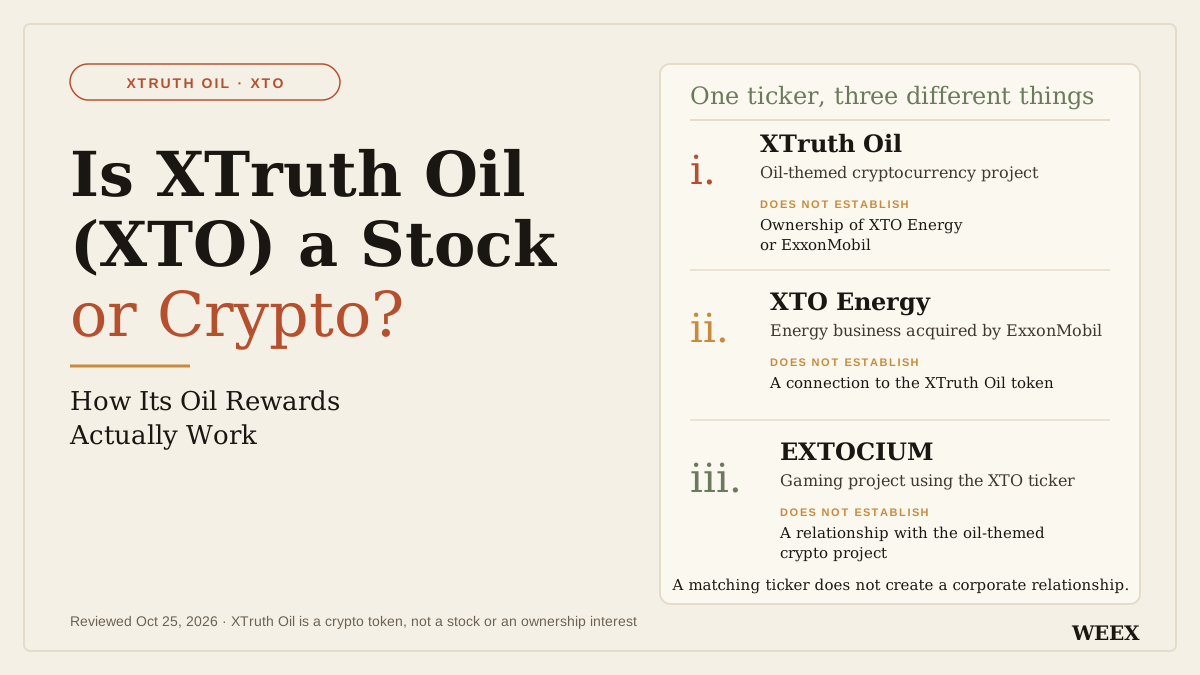
XTruth Oil (XTO) is a cryptocurrency, not XTO Energy stock or an ownership interest in ExxonMobil. Its advertised reward model uses token-trading fees to purchase an oil-related tokenized asset for distribution to holders. That is different from receiving profits earned by an oil producer. Whether holding XTO produces a positive return depends on the rewards actually received, the token’s resale value, transaction costs, and the ability to exit the position.
Our judgment is that XTO should be assessed as a speculative token with a conditional reward mechanism. The decisive calculation is total return after costs. A genuine distribution can coexist with an overall investment loss, particularly when falling trading activity reduces rewards while the token itself loses value.
Which Asset Does “XTO” Refer To?
Searches for “XTO stock” and “XTO crypto” can lead to unrelated assets. Identifying the intended product is essential before interpreting a chart, a reward claim, or a purchase link.
Three names are particularly relevant.
| Name | Asset or Business Type | What the Name Does Not Establish |
|---|---|---|
| XTruth Oil | Oil-themed cryptocurrency project | Ownership of XTO Energy or ExxonMobil |
| XTO Energy | Energy business acquired by ExxonMobil | A connection to the XTruth Oil token |
| EXTOCIUM | Gaming project using the XTO ticker | A relationship with the oil-themed crypto project |
ExxonMobil’s SEC-filed financial statements record its acquisition of XTO Energy on June 25, 2010. The filing states that XTO became a wholly owned subsidiary and that its common shares were converted into rights to receive ExxonMobil shares.
Separately, EXTOCIUM’s own documentation describes its XTO coin in connection with its game economy and BNB Smart Chain transactions. That is a different project from the Solana asset discussed here. (Play to Earn online MMORPG)
The practical rule is straightforward: a matching ticker does not create a corporate relationship.
When researching the oil-themed token, use the project name, blockchain, and complete mint address. Do not import historical stock prices or another cryptocurrency’s supply figures into the analysis.
How Does the Advertised Reward Mechanism Work?
Published descriptions of XTruth Oil explain a fee-funded process: trading activity generates charges, proceeds purchase USOon, and the acquired tokens are distributed among eligible holders.
CoinCodex’s review describes a 4% trading-fee mechanism and an advertised hourly distribution schedule. It also distinguishes these receipts from income generated by operating an oil business. During our October 25 review, the project website did not provide usable page content through retrieval, so the current implementation and every execution route were not independently confirmed.
That distinction matters because the system has two separate economic components.
The funding source is activity in the XTO market. The reward asset provides oil-related financial exposure. Receiving an oil-related token does not mean that the payment originated from petroleum production.
A simple analogy is a business using customer fees to buy a commodity investment and distribute it. The recipients receive commodity exposure, but the money funding the purchase still comes from customers.
For XTO, a complete assessment should establish how much fee income reaches distributions, which holders qualify, what costs are deducted, and whether the process operates as advertised.
What Are Holders Receiving?
The reward asset discussed in the published research is USOon, an Ondo tokenized product associated with the United States Oil Fund.
Ondo’s official page describes its tokenized assets as providing economic exposure to underlying assets while making clear that the tokens are not themselves the underlying stocks or funds. Its disclosures also impose jurisdictional and eligibility restrictions, including restrictions concerning U.S. persons unless applicable registration or exemptions exist.
The underlying United States Oil Fund uses oil futures and other permitted investments. Its issuer describes a daily investment objective tied to a benchmark oil-futures contract, with collateral income and expenses affecting performance. (The Original Oil ETF)
The exposure therefore involves several layers:
XTO trading activity → reward funding → tokenized financial exposure → underlying oil-related investment.
Each layer introduces different questions. The reward process may change, the reward token may fluctuate, and the underlying investment may behave differently from the spot price of crude oil.
There is also an access question. Marketing aimed at a broad audience should not be interpreted as confirmation that every reader can lawfully acquire, transfer, or redeem the reward asset through every route.
A usable reward is one the holder can actually retain or realize under the relevant terms.
-- Price
What Has the Published On-Chain Investigation Established?
Bitquery’s investigation, dated October 21, reported approximately $85,000 of USOon distributions to 1,990 wallets during the first week examined. It found payouts in 78 of 168 hours, including gaps longer than a day.
These are historical findings attributed to Bitquery. They are not a fresh reconstruction of the payout wallet through October 25.
The findings support a narrower conclusion than either “nothing was ever paid” or “hourly income is dependable.” They provide evidence of distributions during the measured period while identifying irregularity in their timing.
That difference is financially significant. A holder’s expected income depends on how much arrives over a relevant holding period, rather than how frequently a promotional page says the process runs.
It also limits annualized yield claims. A launch-period payout cannot be treated as a stable daily rate without evidence that the activity funding it persists.
For a current investment decision, the next useful observation would be the most recent successful distributions and the amount received by the specific qualifying position—not the largest historical payout.
How Can You Confirm That You Have the Intended Token?
The Solana mint identified in the published XTruth Oil research is:
XtogpWjiAgvkemc5gr1auxkh77w3vKgSQN1nxJeJfHt
Bitquery’s investigation also documented numerous other assets using the ticker. A search result or token logo alone is therefore insufficient to identify the market under discussion.
A useful verification record includes the complete mint, trading pair, venue, reward-token identifier, and observation date. If an official disclosure later identifies a migration, that relationship should be documented before historical data is carried across.
Do not assume that the asset with the largest displayed market capitalization is the intended project. A token can display a large valuation while having little executable liquidity.
Likewise, a wallet transfer involving the correct ticker is insufficient unless the mint also matches.
This article does not designate an address as permanently authoritative. It identifies the asset covered by the cited investigation so that readers can distinguish that evidence from unrelated markets.
What Is the Correct Way to Calculate Total Return?
The correct calculation combines what can be recovered from the original position with the realizable value of rewards.
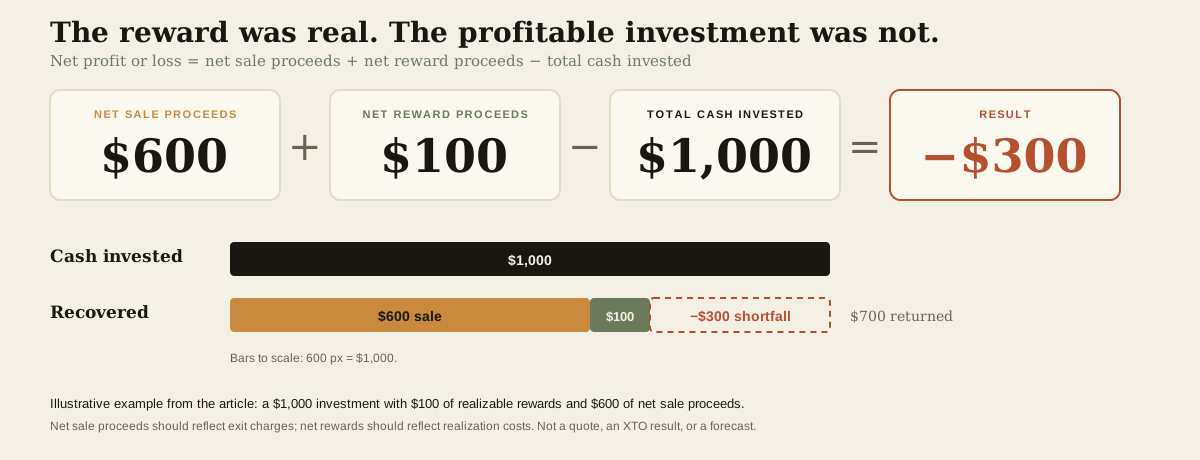
Net profit or loss = net sale proceeds + net reward proceeds − total cash invested
Net sale proceeds should reflect exit charges and execution effects. Net reward proceeds should reflect any conversion, transfer, or realization costs. The initial investment should include acquisition costs rather than only the amount that ultimately reaches the token position.
This avoids several common errors.
A portfolio balance is not necessarily the amount a seller would receive. A reward-token balance is not necessarily cash. A distribution is not automatically profit if the principal position has fallen by more than the distribution’s value.
For example, a $1,000 investment that produces $100 of realizable rewards and only $600 of net sale proceeds has returned $700. Its overall loss is $300.
The reward was real. The profitable investment was not.
That is the central distinction a buyer should resolve before comparing XTO with other income-producing assets.
How Much Do Entry and Exit Costs Change the Result?
Consider an illustrative $1,000 purchase with a 4% entry charge and a 4% exit charge.
These are modeling assumptions informed by the reported mechanism, not a verified quote for every current XTO transaction. The example excludes network fees and slippage to isolate the effect of the assumed charges.
After entry, $960 remains invested. If the token price is unchanged, a 4% charge on sale leaves $921.60.
The investor therefore needs $78.40 in net rewards just to break even at an unchanged token price.
| Hypothetical Token Price Change | Net Sale Proceeds | Net Rewards Needed to Recover $1,000 |
|---|---|---|
| No change | $921.60 | $78.40 |
| Down 10% | $829.44 | $170.56 |
| Down 20% | $737.28 | $262.72 |
| Down 50% | $460.80 | $539.20 |
Actual execution could be better or worse depending on the applicable route and charges. Additional costs would raise the required rewards.
The calculation also shows why small recurring receipts can be psychologically misleading. They are visible and frequent, while the reduction in realizable principal may receive less attention.
A sensible comparison puts both on the same statement.
Can Rewards Offset a Falling Token Price?
They can, but only when their realizable value is large enough.
Continue the hypothetical example with $1,000 invested, the same assumed charges, and $50 of net rewards received.
| Hypothetical Price Outcome | Net Sale Proceeds | Net Rewards | Total Recovered | Profit or Loss |
|---|---|---|---|---|
| Price unchanged | $921.60 | $50 | $971.60 | −$28.40 |
| Price down 20% | $737.28 | $50 | $787.28 | −$212.72 |
| Price up 20% | $1,105.92 | $50 | $1,155.92 | +$155.92 |
The distribution improves every outcome, but it does not turn every outcome positive.
This is a better way to evaluate a reward mechanism than asking whether it “pays.” The relevant questions are how much it pays, over what period, with what probability, and alongside what change in the value of the position required to qualify.
The reward asset can also decline after receipt. If it is retained rather than sold, its later realizable value should be used in a current total-return assessment.
Counting its highest historical price would overstate what the holder can recover.
How Does Falling Trading Volume Affect Future Rewards?
A fee-funded distribution depends on the activity generating the fee.
A simplified model is:
Holder reward = eligible trading volume × distributable fee rate × eligible ownership share
Assume, purely for illustration, a 4% distributable fee rate, a holder entitled to 0.1% of distributions, and no deductions between collection and distribution.
| Hypothetical Daily Eligible Volume | Gross Amount Available to All Holders | Holder’s Illustrative Daily Reward |
|---|---|---|
| $1,000,000 | $40,000 | $40 |
| $100,000 | $4,000 | $4 |
| $10,000 | $400 | $0.40 |
These figures are not current XTO income estimates. They deliberately use simplified assumptions. Actual eligibility, allocation, expenses, and execution may reduce the result.
The relationship nevertheless matters: under unchanged assumptions, a 90% decline in eligible volume produces a 90% decline in reward funding.
Bitquery’s historical investigation reported a sharp decline in trading after the launch period, reinforcing why early distributions should not be extrapolated without updating the underlying activity.
A sustainable-income assessment must therefore examine the funding variable, not merely the reward counter.
How Long Would It Take to Break Even?
Break-even time is only meaningful under explicitly stated assumptions.
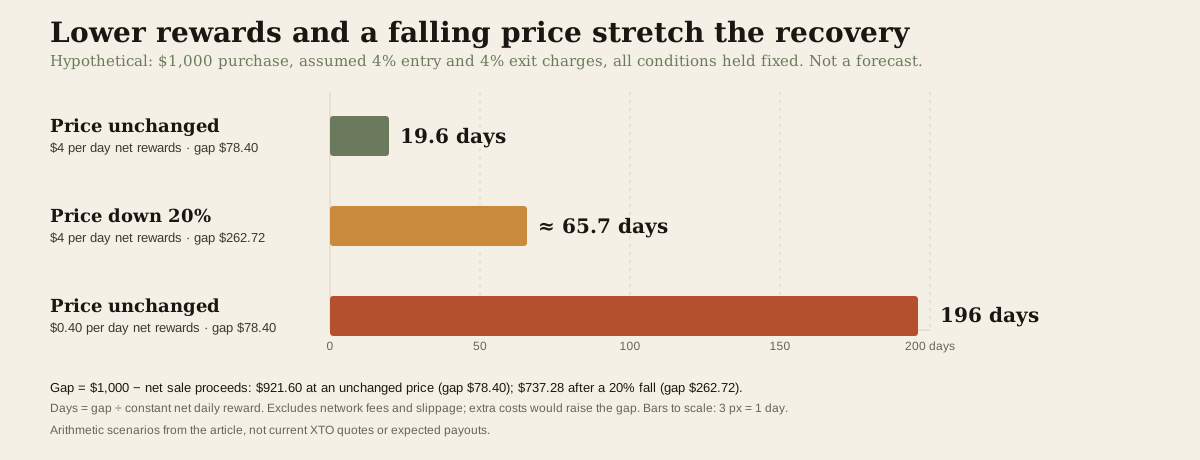
Using the earlier unchanged-price example, the cost gap was $78.40. At a constant net reward rate of $4 per day, it would take 19.6 days to cover that gap.
At $0.40 per day, it would take 196 days.
If the token had instead fallen 20%, the gap would be $262.72. At $4 net per day, covering it would require approximately 65.7 days.
Those are arithmetic scenarios, not forecasts. They assume that the token price, executable exit value, reward rate, and all other relevant conditions remain fixed throughout the recovery period.
In practice, the same reduction in market interest can affect several variables together. Lower activity may reduce rewards while weakening demand for the token. A larger exit order may also encounter worse execution.
For that reason, break-even analysis should use a range of outcomes. A single optimistic estimate can hide the possibility that the required recovery period lengthens faster than rewards accumulate.
Why Are Advertised Annual Yields Particularly Fragile?
Annualization assumes that the observed earning rate is representative.
For a new token, that assumption may fail because launch activity, concentrated purchases, promotional attention, or temporary incentives can produce unusually large early distributions.
Multiplying one favorable day by 365 describes an arithmetic extrapolation. It does not establish a likely annual return.
A more useful assessment would show the daily distribution series, periods with no payments, changes in the qualifying supply, and the cost basis of the position being evaluated.
The distinction between yield on cost and yield on current value also matters. If a token falls sharply, dividing the same reward by its lower current price can produce a larger percentage yield even though the original buyer remains substantially underwater.
A rising displayed yield can therefore accompany a worsening investment result.
The preferred measure is cumulative total return from the actual entry, calculated using realizable values and consistent costs.
What Can a Payout Wallet Prove?
A payout wallet can establish that particular assets moved to particular recipients. It cannot independently establish that the overall investment proposition is profitable or sustainable.
To verify a payment, inspect the reward token’s exact identifier, the successful transaction, the amount, the receiving address, and the observation time.
Then determine what happened economically. Was the reward received and retained? Could it be sold through an available route? What value remained after realization costs?
A broad count of transfers should also be interpreted carefully. Many small transfers are not the same as many distinct investors, and a large historical total does not establish equal participation.
Likewise, a payment to one wallet does not prove that another wallet satisfied the eligibility rules.
The strongest personal record is a reconciliation between the holder’s qualifying position, the applicable distribution terms, the receipts actually observed, and their net value.
Is This a Substitute for Direct Oil Exposure?
XTO combines exposure to its own token market with a reward mechanism. That is a different decision from purchasing an oil-related financial product directly.
A buyer seeking commodity exposure should distinguish the asset they want from the additional risk they must take to receive it.
| Intended Objective | Question to Resolve |
|---|---|
| Exposure to oil-price movements | Which instrument most closely matches the intended exposure and holding period? |
| Ownership of an energy business | What equity rights and company risks are involved? |
| Tokenized financial exposure | What issuer terms, eligibility rules, and realization routes apply? |
| Fee-funded crypto rewards | Can distributions compensate for token volatility and transaction costs? |
A direct alternative is not automatically available or suitable for every reader. Eligibility, jurisdiction, account access, fees, and product risk still matter.
The comparison is useful because it reveals what XTO adds. Its own price performance and reward funding become additional variables alongside the oil-related asset.
If the primary objective is oil exposure, the buyer should be able to explain why those extra variables improve the proposition.
Can You Trade XTruth Oil (XTO) on WEEX?
This review did not verify a WEEX futures or spot listing for the specific XTruth Oil token discussed here. No XTO-specific WEEX campaign or fee discount was verified.
A similarly named asset would not be sufficient confirmation. Before depositing a token, verify the complete identifier and supported network through official exchange information.
For platform verification, the WEEX Trust Center provides access to reserve information, security materials, and official contact-verification resources. It helps assess WEEX-related disclosures; it does not authenticate XTruth Oil or guarantee a third-party reward mechanism. (weex.com)
The same evidence discipline applies to both tasks: confirm the service you are using and the asset you intend to trade separately.
WEEX Editorial View: Measure the Whole Position
The strongest evidence in favor of the reward mechanism is the historical distribution activity identified by published research. That deserves recognition.
It does not settle the investment case.
A holder must recover acquisition costs, withstand changes in XTO’s price, realize the reward asset, and eventually exit through an available market. The break-even calculations show that even modest charges and price declines can require substantial rewards to offset them.
We would therefore evaluate XTO using a complete position statement: cash invested, tokens acquired, rewards realized, current executable exit value, and total costs.
If an attractive result depends on assuming that launch-period rewards continue while the principal position holds its value, the analysis is too optimistic. A credible income proposition should remain understandable when volume falls, distributions pause, and exit conditions deteriorate.
FAQ
1. Is XTruth Oil (XTO) a Stock?
No. XTruth Oil is a cryptocurrency project. It should not be confused with historical XTO Energy shares or treated as an ownership interest in ExxonMobil.
2. Where Do XTruth Oil (XTO) Rewards Come From?
Published descriptions identify token-trading fees as the funding source for purchases of an oil-related tokenized asset. That differs from distributions of profits earned by an oil producer.
3. Are Hourly Rewards Guaranteed?
The historical investigation reviewed did not show uninterrupted hourly payments. Current payment activity and applicable terms must be checked rather than inferred from the advertised schedule.
4. Can You Receive Rewards and Still Lose Money?
Yes. A decline in the realizable value of the original position, combined with transaction costs, can exceed the value of rewards received. Total return measures both components.
5. Is XTruth Oil (XTO) the Same as EXTOCIUM?
No. EXTOCIUM is a separate gaming project using the XTO ticker. The full project identity, blockchain, and token address must match before its data is used.
Sources
Public information reviewed October 25, 2026: ExxonMobil’s SEC-filed acquisition disclosures; EXTOCIUM’s official token documentation; Ondo’s official product and eligibility disclosures; United States Commodity Funds’ description of its oil fund; and the WEEX Trust Center.
Reward-mechanism and historical-payment references: CoinCodex’s XTruth Oil review and Bitquery’s investigation dated October 21, 2026. Historical findings are attributed to those publishers, not presented as a fresh wallet reconstruction. The project website did not return usable content during this review.
All break-even calculations are original hypothetical examples. They are not current transaction quotes, expected payouts, or forecasts.
This content is provided for general informational purposes only and doesn't constitute financial, investment, legal, or tax advice. Any events, rewards, online promotions, or related information mentioned herein should not be considered a recommendation, solicitation, or invitation to purchase, sell, trade, or otherwise deal in any crypto assets. Crypto assets are highly volatile and may result in loss. The availability of WEEX services, products, and related events may vary by region. You are responsible for ensuring that your participation is in accordance with applicable local laws and regulations.
You may also like
Exchange Convert vs DEX Swap: What’s the Difference? Try Convert Crypto On WEEX!

What Is Pearl (PRL) Crypto and How Does Its Mining Work?
Stake ETH or Hold USDT on WEEX? The Price Move That Decides It
How Transparent Is a Crypto Exchange? Checking Proof of Reserves and Protection Funds
What Is Leverage Trading in Crypto? A Beginner’s Guide With Simple Examples
Is RSI a Good Indicator? How the Relative Strength Index Works, Its Limits and How Traders Use It
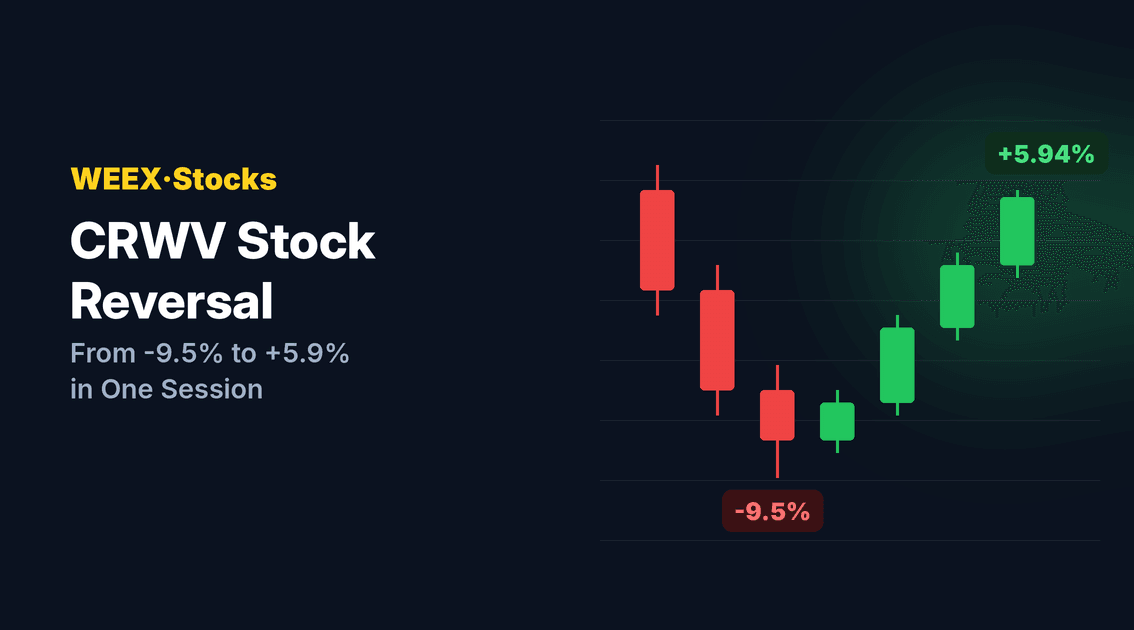
CRWV Stock Swings From -9.5% to +5.9%: Why CoreWeave Reversed
Walrus (WAL) Jumps 30%: Sui Storage Token Rallies on AI Data
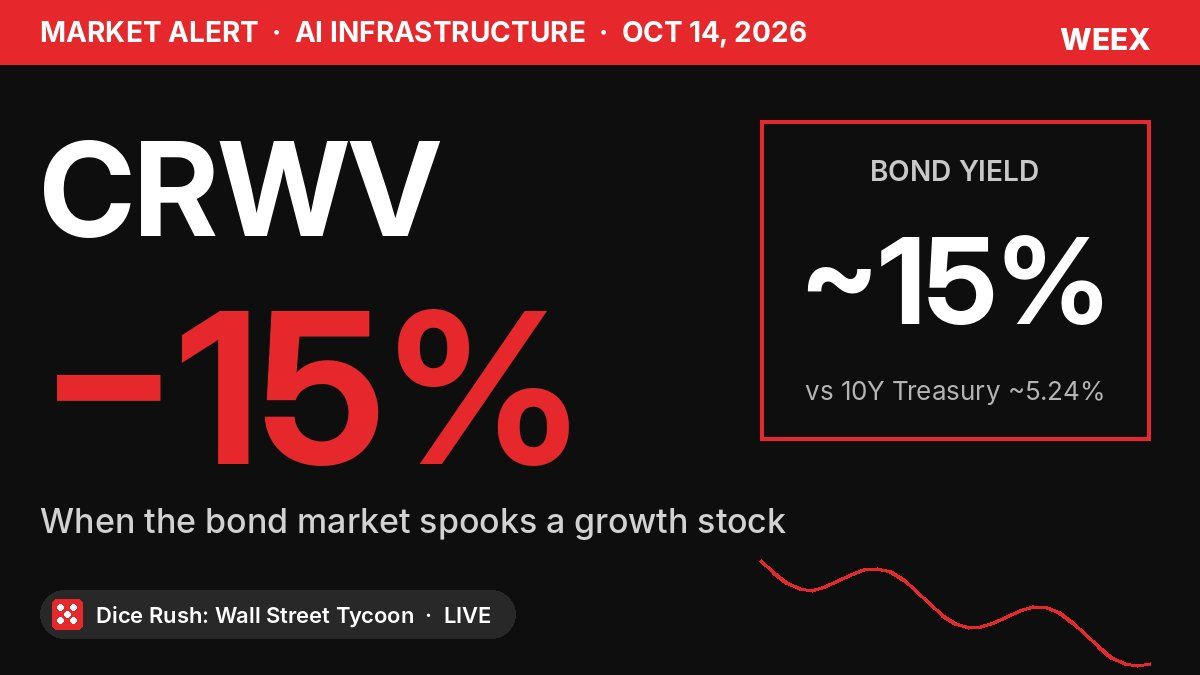
CoreWeave Stock Plunges 15%: Why a Bond Yield Spooked CRWV

Best Crypto Miner for Beginners: What to Check on Cost, Power, Hashprice and Profit Before You Buy
MU Stock Falls Below $1,000: Is the CXMT Threat Real or Just an Excuse to Take Profits?
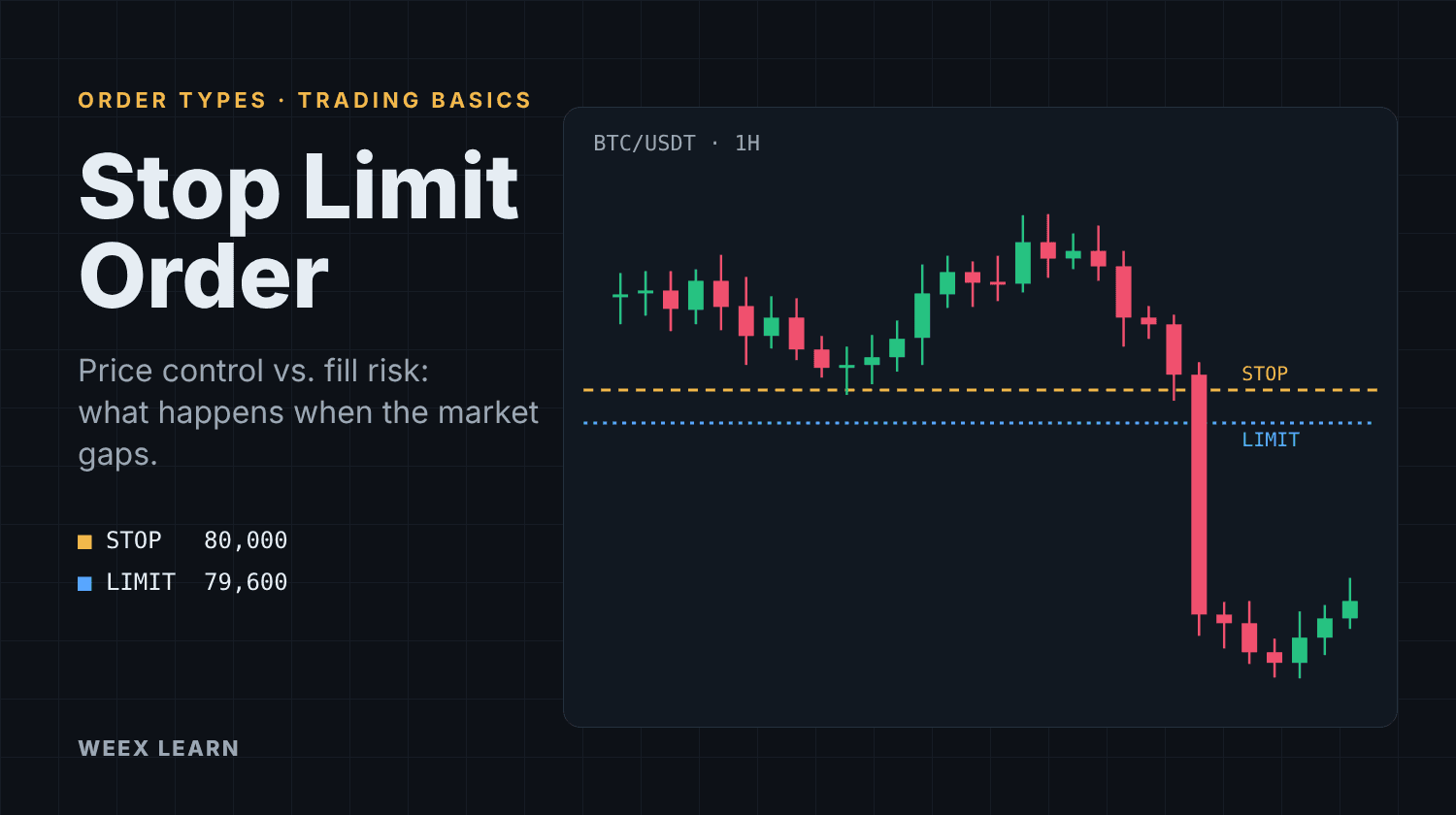
Stop Limit Order: How It Works and Why It Can Fail to Fill

Best Crypto Podcasts for Beginners: A 4-Week Listening Plan

Conflux (CFX) Price Jumps on China's National Blockchain Network Plan: Does the Policy Actually Name CFX?

What Is Plume (PLUME)? Why the RWA Token Stays 93% Below Its High Even After the Layer 2 Rally

Who Is David Ellison? Skydance’s Strategy, Media Consolidation, and the Investment Case
Crypto Funding Rate: Who Pays, What It Costs, What It Signals
PEP Earnings: PepsiCo Beats Q3, Cuts Guidance on North America
BTC Futures Analysis: $80K Held, but Longs Are Still Paying Up
Third-Party Trading Platforms vs Direct WEEX Trading: Fees, Liquidity, Security, and Control
How to Day Trade Crypto for Beginners: Do the Fee Math First
What Is Blockchain and How Does It Work? One Real Payment Traced
What Is a Blockchain Node? Types, 2026 Counts, and Real Costs

TSMC Stock Outlook Ahead of Q3 Earnings: Can AI Demand Push Shares Higher?
Taiwan Stock Market Nears 50,000: Can the TAIEX Break the Milestone After the Holiday?
How to Buy USDT in Thailand: Payment Methods, Fees and Transfer Checks

What Is RLC Crypto? How iExec (RLC) Powers Confidential Computing

Best Crypto Trading Strategies for Beginners: What to Know Before You Trade
PUMP Price Rally: Can Pump.fun Buybacks Outrun Monthly Unlocks?
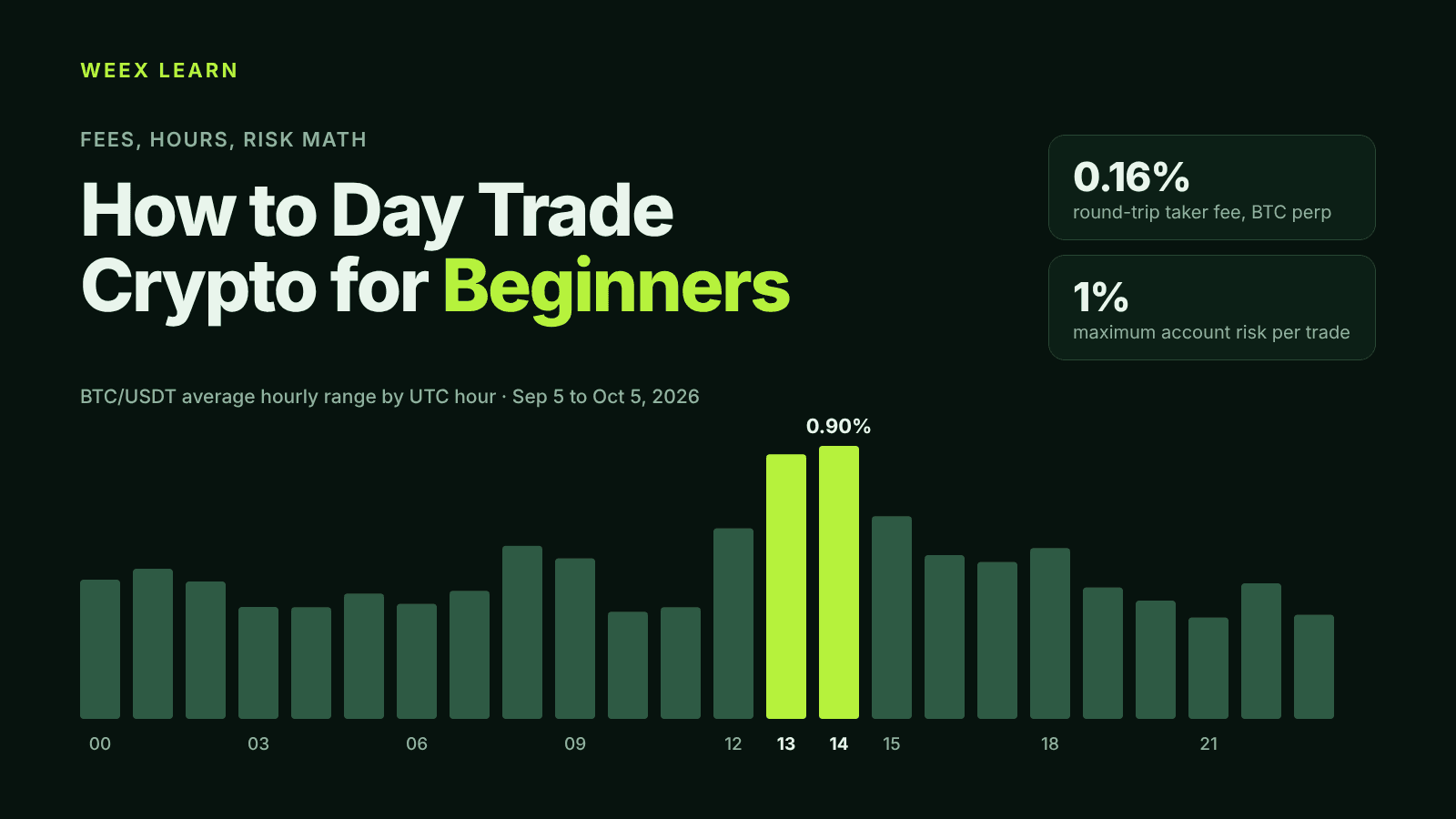
How to Day Trade Crypto for Beginners: Fees, Hours, Risk Math
Exchange Convert vs DEX Swap: What’s the Difference? Try Convert Crypto On WEEX!
What Is Pearl (PRL) Crypto and How Does Its Mining Work?
Stake ETH or Hold USDT on WEEX? The Price Move That Decides It
How Transparent Is a Crypto Exchange? Checking Proof of Reserves and Protection Funds
What Is Leverage Trading in Crypto? A Beginner’s Guide With Simple Examples
Is RSI a Good Indicator? How the Relative Strength Index Works, Its Limits and How Traders Use It





