
Corporate Actions for Tokenized Stocks: How Dividends, Splits and Mergers Are Handled

 Prefer us on Google


Corporate actions for tokenized stocks are the events that change what a share is worth or how many of them a holder has, and they work differently from the same events at a traditional broker. A company pays a dividend or splits its shares, and the issuer of the tokenized version then decides how that event reaches the token in a holder’s wallet. The company is not the one doing the adjusting.
Because corporate actions for tokenized stocks depend on how each token is built, the rules are not the same from one product to the next. Public documentation from issuers, exchanges and infrastructure firms describes several approaches, and the differences matter more than the shared name. Anyone studying corporate actions for tokenized stocks should treat the issuer’s own terms as the final word, since a general explainer can only describe the common patterns.
What Are Corporate Actions, and Why Do They Matter for Tokenized Stocks?
Corporate actions are events started by a company that change shareholders’ holdings or entitlements, and they matter for tokenized stocks because the token is not the share itself. The usual list includes cash dividends, stock splits, reverse splits, mergers and shareholder votes. Allium, a blockchain data firm, wrote in a blog post published on August 29, 2026 that the same types of corporate action apply to tokenized securities as to traditional ones, except that the onchain token contract replaces the depository’s book-entry records.
The harder question is who is entitled to the benefit. Allium says paying the entitlement is the easy part and identifying who is economically entitled is the hard part, because a snapshot of balances at a set block shows which address holds a token and not necessarily who owns it economically. Tokens sitting in liquidity pools, lending contracts or bridges at that moment can belong economically to someone else. Ondo Finance, another issuer, states in its own materials that its tokens do not confer shareholder rights, which is a reminder that a tokenized stock is often exposure to a share price and not a share.
How Are Dividends Paid on Tokenized Stocks?
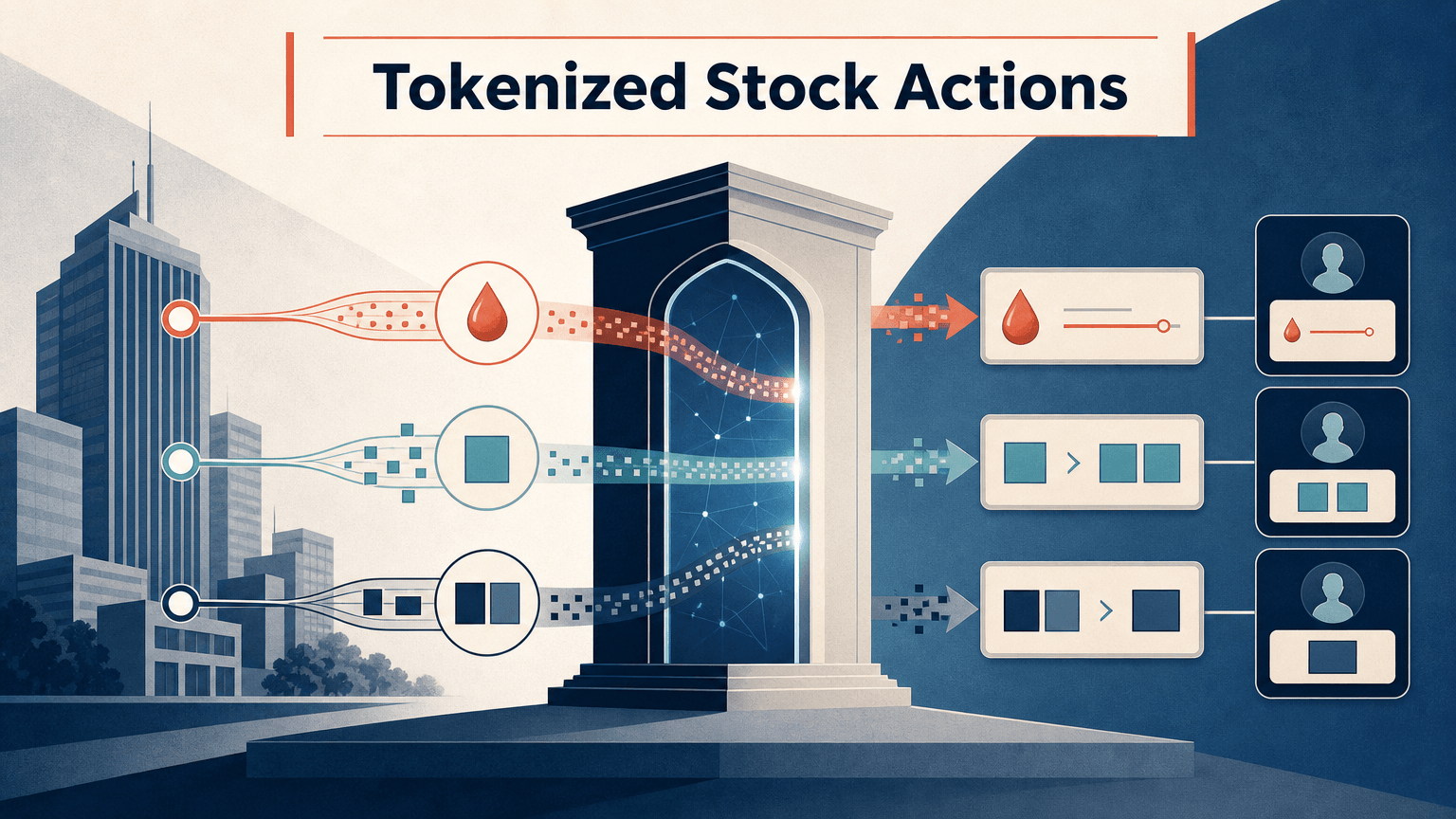
It depends on how the token is structured, and public sources describe at least four models. Backpack, a crypto exchange, lists them in an explainer published on July 3, 2026 and updated on September 29, 2026. In the first, dividends buy additional tokenized shares that are credited to the holder’s wallet. In the second, the dividend is converted to a stablecoin such as USDC or USDT and sent to the wallet on the record date. In the third, the dividend value is reflected in the token’s price, and a holder realizes it only by selling or redeeming. In the fourth, nothing is passed through, either because the token holds no real shares or because the issuer keeps the dividend. Backpack says synthetic price trackers and cash-settled wrappers typically do not pass dividends through.
Individual issuers fall into different groups. Kraken’s help page on xStocks, last updated on September 5, 2025, says dividend payouts are automatically reinvested into more of the same token and that no cash is paid, so the balance increases instead. Allium describes the stablecoin route, where cash dividends can be pushed to wallets or made claimable by holders and the payment is recorded onchain. The sources reviewed do not address tax withholding, so how a dividend is taxed depends on the holder’s own jurisdiction and the issuer’s terms.
What Happens to a Token When the Company Splits Its Shares?
In most descriptions, the token balance is adjusted so that the total value of the position stays the same. Kraken’s xStocks page explains that a split increases the number of shares in circulation and lowers the price per share proportionally, and it uses a 4-for-1 split of AAPL as its example, where each AAPLx token becomes four tokens at one quarter of the original price. As an illustration with made-up numbers, a holder with 10 tokens priced at 400 dollars would end up with 40 tokens priced at 100 dollars, and the position would be worth 4,000 dollars before and after. A reverse split works the other way, with fewer tokens at a higher price and the same total value.
The method of adjustment varies. Allium says a split can be handled by rebasing balances, which changes the number of tokens in each wallet, or by issuing new tokens with entitlements calculated using a multiplier. Bitso, a crypto exchange, says on a help page modified on September 22, 2026 that xStocks positions can be adjusted to reflect certain corporate events and that the adjustments are designed to keep economic exposure aligned with the reference asset. It adds that trading pauses for a few hours during events such as dividends or splits and that users may see a temporary notice while the balance and average price update. Other platforms may handle the pause and the notice differently.
-- Price
How Do Mergers and Other Events Work for Token Holders?
Mergers are the least standardized of the common events, and the sources reviewed give only limited detail. Allium says merger outcomes can be calculated from the balance snapshot using a conversion ratio, but it does not describe how a merger is carried out in practice. The Kraken and Bitso pages reviewed do not address mergers or spin-offs at all, so a holder cannot assume they will work like a split. Allium also says a redemption burns tokens in exchange for a payout, which is another route some products offer.
Events that require a choice are harder still. Allium says elective actions, with choices, deadlines and partial elections, are more difficult to encode fairly, and onchain errors are visible and permanent. It also points to cross-chain fragmentation, where a security that exists on several chains needs consistent treatment across all of them and no single authority currently enforces that. Its overall assessment is that simple cash distributions are practical today while complex, multi-venue corporate actions remain unsolved. For a holder, the practical point is that the more unusual the event, the more the issuer’s published terms matter.
Do Token Holders Get Voting Rights, and What Should They Check in the Terms?
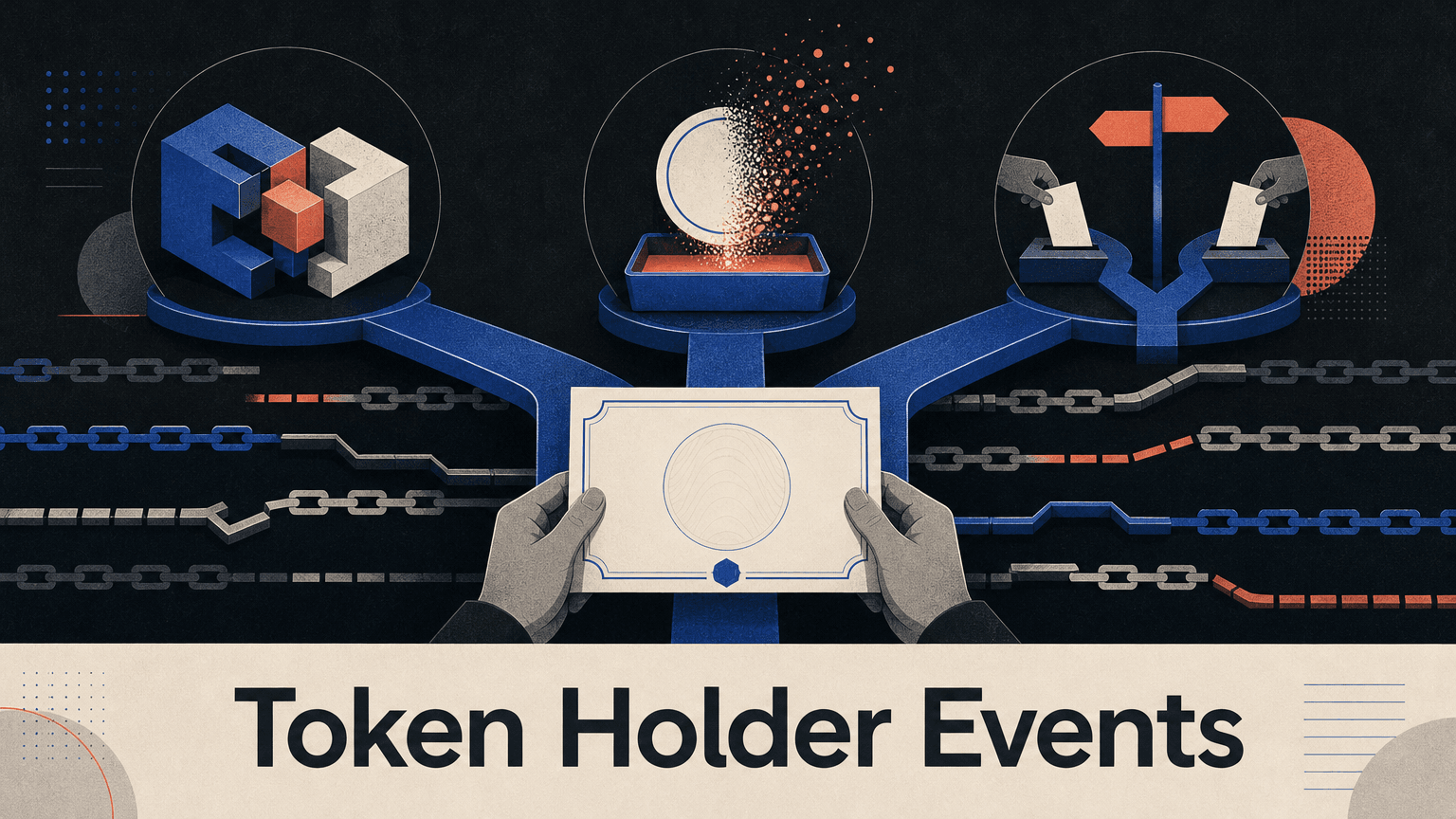
Generally not in the way shareholders do, and the clearest public statement comes from Ondo Finance. Ondo and Broadridge, a company that runs shareholder voting services, announced on April 28, 2026 that holders of Ondo’s tokenized stocks and ETFs can take part in proxy voting, but the announcement states that the tokens do not confer shareholder rights. Voting is described as a way to express preferences to the token issuer, which decides how the shares it beneficially owns are voted. The same announcement says Ondo Global Markets is not available in the U.S. and is subject to other jurisdictional restrictions. The Bitso page reviewed does not address voting.
Before holding any tokenized stock, the terms should answer a short list of questions. Is the token backed by real shares, or is it a cash-settled or synthetic tracker? How are dividends handled, and in which form? Is the token redeemable for the underlying share? How are splits and mergers applied, and how long does trading pause? Where are notices posted? Which jurisdictions are excluded? These answers differ by issuer, and the pages cited here carry their own dates, so the current terms should be checked and not assumed from an older summary.
Conclusion
Corporate actions for tokenized stocks are handled by the token issuer, and the result depends on the product. Dividends may be reinvested into more tokens, paid in stablecoins, reflected in the price or not passed through at all. Splits usually adjust balances so total value stays the same. Mergers and elective events are less standardized, and voting rights are generally not the same as those of a shareholder.
For a reader comparing products, the useful habit is to read the issuer’s terms on dividends, splits, mergers and redemption before holding a position, and to check them again later because documentation changes. A general explainer on corporate actions for tokenized stocks can describe the patterns, but only the issuer can confirm how a specific token behaves.
FAQ
1. What are corporate actions for tokenized stocks?
Corporate actions for tokenized stocks are company events such as dividends, splits, mergers and votes, and the token issuer decides how each one is applied to the token. The treatment differs by issuer.
2. Do tokenized stocks pay dividends?
It depends on the token. Backpack describes reinvestment, stablecoin payouts, price accrual and no pass-through, and Kraken says its xStocks reinvest dividends into more of the same token.
3. What happens to tokenized stocks in a stock split?
The token balance is usually adjusted so the total value stays the same. Kraken’s example is a 4-for-1 split, where each token becomes four tokens at one quarter of the price.
4. Do tokenized stock holders get to vote?
Not in the way shareholders do. Ondo says its tokens do not confer shareholder rights and that holders can only express voting preferences to the issuer.
5. Why does trading pause during corporate actions on tokenized stocks?
Bitso says trading pauses for a few hours during events such as dividends or splits while positions are adjusted. Other platforms may handle corporate actions for tokenized stocks differently.
This content is provided for general informational purposes only and doesn't constitute financial, investment, legal, or tax advice. Any events, rewards, online promotions, or related information mentioned herein should not be considered a recommendation, solicitation, or invitation to purchase, sell, trade, or otherwise deal in any crypto assets. Crypto assets are highly volatile and may result in loss. The availability of WEEX services, products, and related events may vary by region. You are responsible for ensuring that your participation is in accordance with applicable local laws and regulations.
You may also like
Is Bitget Leaving Russia? What Account Holders Should Check
Cyberleek Token Risks: Memecoins Tied to Leaks, Anonymous Wallets and Why Verification Matters
Anonymous Crypto Wallet: What Each One Hides and Where It Fails
What Is Blockchain and How Does It Work? One Real Payment Traced
How to Buy New Crypto Before Listing: 5 Routes and Their Traps
WEEX API Key Setup: How to Connect a Third-Party Platform Safely
WEEX Broker Models: Strategy Bots, Copy Trading and Sub-Exchanges
What Is Artificial Superintelligence Alliance (FET) Crypto? The ASI Token, Migration Status, and Real-World Demand Test
Best Crypto Wallet App in 2026: How to Choose Between Hot, Cold, Custodial, and Web3 Wallets
RSI Indicator Settings: What 7, 9, 14 and 21 Did on BTC Charts
Ethereum 2030 Roadmap: Vitalik's Cryptographic World Computer
Best Decentralized Crypto Wallet for Beginners: What Self-Custody Really Asks of You

Best Crypto App for Beginners: Exchange App, Wallet App, or Both?
QNT Futures: Funding Rate and Long vs Short After a 4x Rally
Which Crypto to Buy for Beginners: A Simple 3-Tier Starter Plan
Taiwan's Travel Rule Amendment Published: What Domestic Crypto Transfers Will Require
WEEX Futures Trading: What 400x Leverage Really Costs You
Is Hyperliquid Safe? Risks You Should Know Before You Trade
What Is Hyperliquid? A Complete Guide to the Perpetuals Exchange
What Is Pi Network? A Complete Beginner's Guide
What Is a Funding Rate? How Perpetual Futures Charge Longs and Shorts
Lighter (LIT) Futures: Cross vs Isolated Margin on a 17% Range
XRP Futures: How to Long or Short XRP After the Clarity Act Vote
What Is ZCAT and Is It Worth Buying? Anonymous Cat (ZCAT) Guide for 2026

MU Stock Reclaims $1,000 Again: What's Actually Different This Time
GPT-6 Astra and Crypto: The AI Token Bid and the Cyber Risk
StonkFun Just Became Solana's Hottest Launchpad: STONK Surges 250% to Prove It
What Is Tangem Wallet? A Complete Beginner's Guide
AAPL Under Ternus: What Apple's CEO Change Means for Traders
PONS Robinhood Chain Token: What the Buyback Rally Rests On
Is Bitget Leaving Russia? What Account Holders Should Check
Cyberleek Token Risks: Memecoins Tied to Leaks, Anonymous Wallets and Why Verification Matters
Anonymous Crypto Wallet: What Each One Hides and Where It Fails
What Is Blockchain and How Does It Work? One Real Payment Traced
How to Buy New Crypto Before Listing: 5 Routes and Their Traps
WEEX API Key Setup: How to Connect a Third-Party Platform Safely


