
ZeroBeta and Lynq Connect Tokenized Treasury Collateral to Lending and Margin

 Prefer us on Google


TL;DR
- ZeroBeta and Lynq announced their collateral integration on October 27.
- The arrangement connects BlueShift risk controls to Lynq collateral locks.
- Interest-bearing collateral remains committed to the obligation it supports.
ZeroBeta and Lynq are connecting tokenized Treasury holdings to institutional borrowing and trading through an integration announced on October 27. The arrangement allows eligible assets to be pledged as collateral while the underlying holdings continue to accrue interest.
Under the announced workflow, ZeroBeta's BlueShift manages risk terms and margin monitoring, while Lynq holds collateral and executes pledge or release instructions. The connection uses Lynq's collateral-lock functionality on its Avalanche-based network.
A token becomes more useful when it supports an obligation
Tokenization can make an asset easier to represent and transfer in software. For an institution, however, the more demanding question is whether that asset can fit into the processes that finance daily activity.
Collateral is one such process. A lender or trading counterparty needs confidence that an asset has been committed to an obligation and cannot simply be spent elsewhere while that obligation remains outstanding. A visible token balance alone does not supply that assurance.
The integration addresses the relationship between risk calculations and control of the asset. Its significance is less about creating a new investment exposure than about allowing an existing holding to serve a defined financing or margin purpose.
Continuing interest does not make pledged assets freely available
An asset can produce income while remaining encumbered. Interest accrual describes what the underlying holding earns; a collateral lock describes who can use or release the holding under agreed conditions. The two features answer different questions.
That distinction matters for treasury management. A business should not treat an asset pledged against a loan as though the same balance were immediately available to pay an unrelated bill. Income generation does not remove the claim attached to the collateral.
The economic benefit must also be assessed after financing and operating costs. Earning a return on pledged holdings can improve a transaction's economics, but the borrowing rate, collateral requirements and fees still determine the overall result. The announcement does not establish a universal net return for clients.
Margin rules turn market changes into operational actions
A collateral arrangement needs a method for deciding when support is sufficient and when more is required. Asset values, exposure and agreed thresholds can change the amount that must remain committed.
In the announced setup, BlueShift supplies the risk layer and Lynq carries out instructions affecting the collateral. Separating those responsibilities can make the workflow easier to explain, provided participants understand which system calculates an obligation and which controls its execution.
The difficult cases arise when time matters. A valuation change may demand additional collateral while a treasury team is managing other payments. Institutions need to understand how quickly a request becomes effective, what assets are accepted and how exceptions are handled.
Moving those steps onto connected software can reduce manual coordination, but software still needs agreed rules. A rapid message does not resolve a disagreement about valuation, eligibility or the legal rights attached to a pledge.
-- Price
Operational evidence will show how far the integration travels
The next measure of progress is use in actual financing and margin relationships. A completed technical connection creates capability; recurring transactions demonstrate whether counterparties find the arrangement workable.
Useful evidence would include the types of assets accepted, the range of counterparties using them and the reliability of pledge and release processes. Those details reveal whether tokenized holdings are becoming part of routine balance-sheet management.
For the wider digital-asset market, the development illustrates a practical route from holding tokens to using them in institutional finance. The benefit comes from coordinating ownership, control and risk decisions, with continuing interest as one part of the economics. The obligations secured by that collateral remain just as real as the assets supporting them.
Written by the News Desk and edited by Samuel Rae.
This content is provided for general informational purposes only and doesn't constitute financial, investment, legal, or tax advice. Any events, rewards, online promotions, or related information mentioned herein should not be considered a recommendation, solicitation, or invitation to purchase, sell, trade, or otherwise deal in any crypto assets. Crypto assets are highly volatile and may result in loss. The availability of WEEX services, products, and related events may vary by region. You are responsible for ensuring that your participation is in accordance with applicable local laws and regulations.
You may also like

100 believers, 10 ETH: How should early-stage crypto projects raise funds?

Bitcoin: ECB Scrutinizes Retail Sentiment on Reddit Using AI

Patch Released for Ethereum Gloas Fork

US Treasuries Face Largest Weekly Sell-Off Since Trump Tariffs as Market Bets on Fed Rate Hike

Who Will Succeed Nvidia as the Next 'Victim' After the Democrats Take Control of Both Houses?

Anthropic Yet to Go Public, Crypto Players Already Cashing In

Interpretation of FATF Report on Scam Compound Funds: Virtual Assets Become Core Money Laundering Channels

How Much Is Anthropic Really Worth?
Research Reveals 3D Spatial Navigation Map of Hand in the Brain to Aid Brain-Machine Interface Development

Michael Dempsey: Crypto Venture Capital Stagnates, Talent Shifts to AI

Yen Fluctuations Highlight Current Trading Difficulties, Investors Have Huge Divergence on Long-term Outlook

Bloom Energy vs. Constellation Energy: On-Site Power or Grid Power, Which Wins the Data Center?

Former Polychain Partner Launches Startup: Enters Tokenized Real Estate, Secures $50 Million Seed Round Funding to Create the 'S&P 500' of Real Estate
Seminar: The History of Hyperliquid and On-Chain Finance Guest: Takuya Fujita (11/18 19:30 @ Gentosha)
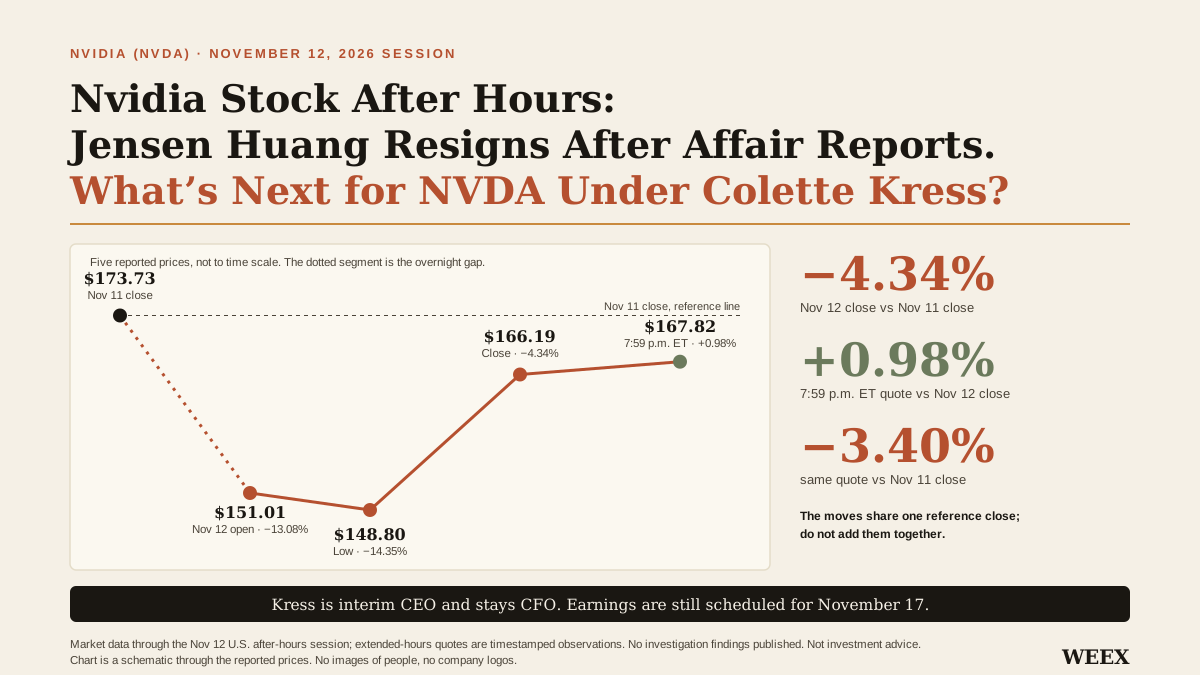
Nvidia Stock After Hours: Jensen Huang Resigns After Affair Reports. What’s Next for NVDA Under Colette Kress?
Nvidia fell 4.34% after Jensen Huang resigned, then rose 0.98% after hours. See what Colette Kress’s appointment means for NVDA and November 17 earnings.

Jensen Huang's Sudden Departure Raises Questions: Did the White House Intervene? Is a Return Possible?
In-Depth Interview | Fu Peng: I Have No Faith in BTC

Cerebras Conference Call: Secures Major Deal with Microsoft, HBM Shortage Becomes an Opportunity, WSE-5 Chip to Enter Mass Production Next Summer

SoundHound AI Stock Is Down Almost 60% in 2026, but Wall Street Thinks It Can Soar 155% By the End of 2027. Here’s Why It Could Be One of the Best Buys Amid the Tech Sell-Off.
What is being said at the tables: the market begins to see 2027 as an all-or-nothing scenario

Kalshi Negotiates New Round of Financing, Valuation Expected to Reach $65 Billion

Republican Senator Wants to Freeze AI Data Center Boom as Congress Pushes to Expand It

Why the Path to Quantum Resistance Runs Uphill for Bitcoin Wallet Makers
Pimco CEO Warns: AI Companies Risk Borrowing "Too Much" ($10 Trillion)

Silver ETF vs. Silver Miners ETF: Which Has Held Up Better This Year?

Why AMD Shares Are Surging and What a $10,000 Investment in the Stock Could Be Worth in 3 Years

Cardano Academy launches practicum with on-chain credentials
Warren Buffett Doesn't Follow His Own S&P 500 Advice. Should You?

A $776 Car Payment Is a Warning for Ford and General Motors

2 Chip Stocks to Buy Instead of Nvidia Right Now
100 believers, 10 ETH: How should early-stage crypto projects raise funds?
Bitcoin: ECB Scrutinizes Retail Sentiment on Reddit Using AI
Patch Released for Ethereum Gloas Fork
US Treasuries Face Largest Weekly Sell-Off Since Trump Tariffs as Market Bets on Fed Rate Hike
Who Will Succeed Nvidia as the Next 'Victim' After the Democrats Take Control of Both Houses?
Anthropic Yet to Go Public, Crypto Players Already Cashing In
Latest articles




Latest coin listings on WEEX


