
Pimco CEO Warns: AI Companies Risk Borrowing "Too Much" ($10 Trillion)

 Prefer us on Google


One of the biggest question marks over the stock market and economy right now is how long the artificial intelligence (AI) capex boom can last. Major tech companies like Alphabet , Meta Platforms , Oracle , and Amazonare issuing hundreds of billions of dollars of corporate debt to build AI infrastructure and data centers.
What if the AI hyperscalers are borrowing too much? What if this level of AI debt is unsustainable? What if the AI boom turns to bust?
According to Bloomberg, the CEO of Pimco, Emmanuel Roman, said at a Nov. 3 conference that he believes AI companies are at risk of getting to a point where they borrow "too much." He projects that AI companies could borrow up to $10 trillion in the next five years, which would almost match the size of the U.S. corporate bond market ($12.1 trillion).
Let's look at what this might mean for AI stocks and for the wider stock market -- and how you might want to invest to protect against these risks.
Image source: Getty Images.
"Too much" AI debt = rising interest rates, falling stock prices
No one knows for sure how much AI debt is "too much." It's possible that the corporate bond market will be happy to keep absorbing all this borrowing. After all, bond investors tend to prefer borrowing from creditworthy companies, and some AI companies issuing bonds right now are among the most profitable and cash-rich in the world. If AI company bonds are a good deal, investors will keep buying them.
But not all AI companies have equally strong balance sheets. For example, CoreWeaverecently made headlines when the yields on some of its corporate bonds reached 15%. That's a bad sign for AI companies with debt rated below investment grade. If bond investors believe they won't be repaid, that's likely to drive up borrowing costs for other AI businesses beyond the major names with the deepest pockets.
Can AI companies keep borrowing at these levels? Maybe if we lived in a world of near-zero interest rates, or falling interest rates. But that's not the prevailing trend. Interest rates have gone up in 2026, and they might have further to rise.
In his Nov. 3 remarks, Roman warned, "At some point in time, there's going to be a downturn, and then things are going to break." If interest rates go up, the Iran war lingers and worsens, or another financial crisis emerges, AI companies could see their borrowing costs increase, making it harder to access capital, and ultimately undo the AI boom.
How should you invest if you're worried about AI debt?
First, just like all financial news, it's important to not overreact and make knee-jerk moves in the short run. Just like rising yields on U.S. Treasury bonds are not a sign to panic and sell your stocks, higher yields on AI companies' corporate bonds don't have to spell disaster for all tech stocks.
If you're a long-term investor who can hold onto your stocks for five years or more, if you're a big believer in the AI trade and you think today's tech majors are going to keep winning the future of the AI economy, then you might want to buy a tech ETF like the Invesco Nasdaq-100 ETF (QQQM -0.15%). This can give you exposure to more than 100 stocks representing the largest non-financial companies in the Nasdaq. In the past five years, QQQM has delivered annualized returns of 13.1%.
But if you want to diversify beyond tech, consider a low-cost S&P 500 ETF. The Vanguard S&P 500 ETF (VOO -0.09%) is one of the most popular low-cost index funds that lets you own all 500 of the largest publicly traded companies in the U.S. market -- tech companies, financial companies, healthcare companies, and more. In the past five years, VOO has delivered annualized returns of about 12%.
Buying an S&P 500 ETF might not be a perfect way to diversify against AI debt risks. The S&P 500 includes a large percentage of tech stocks, too. But based on its performance during the 2022 bear market, the S&P 500 might do better than a more tech-heavy ETF in the event of another prolonged AI stock sell-off.
-- Price
This content is provided for general informational purposes only and doesn't constitute financial, investment, legal, or tax advice. Any events, rewards, online promotions, or related information mentioned herein should not be considered a recommendation, solicitation, or invitation to purchase, sell, trade, or otherwise deal in any crypto assets. Crypto assets are highly volatile and may result in loss. The availability of WEEX services, products, and related events may vary by region. You are responsible for ensuring that your participation is in accordance with applicable local laws and regulations.
You may also like
CoreWeave Says Its AI Demand Is 10 Times Its Capacity Through 2027. I Think Micron Stock Is Still Worth Buying.
MultiBank Group and Universal Sign Agreement to Develop USDU Settlement Capabilities for Institutional Clients

Silver ETF vs. Silver Miners ETF: Which Has Held Up Better This Year?
Cardano Academy launches practicum with on-chain credentials
Rongchang Biologics and Vor Bio Sign RC298 License Agreement Amendment, Securing $56 Million Upfront Payment
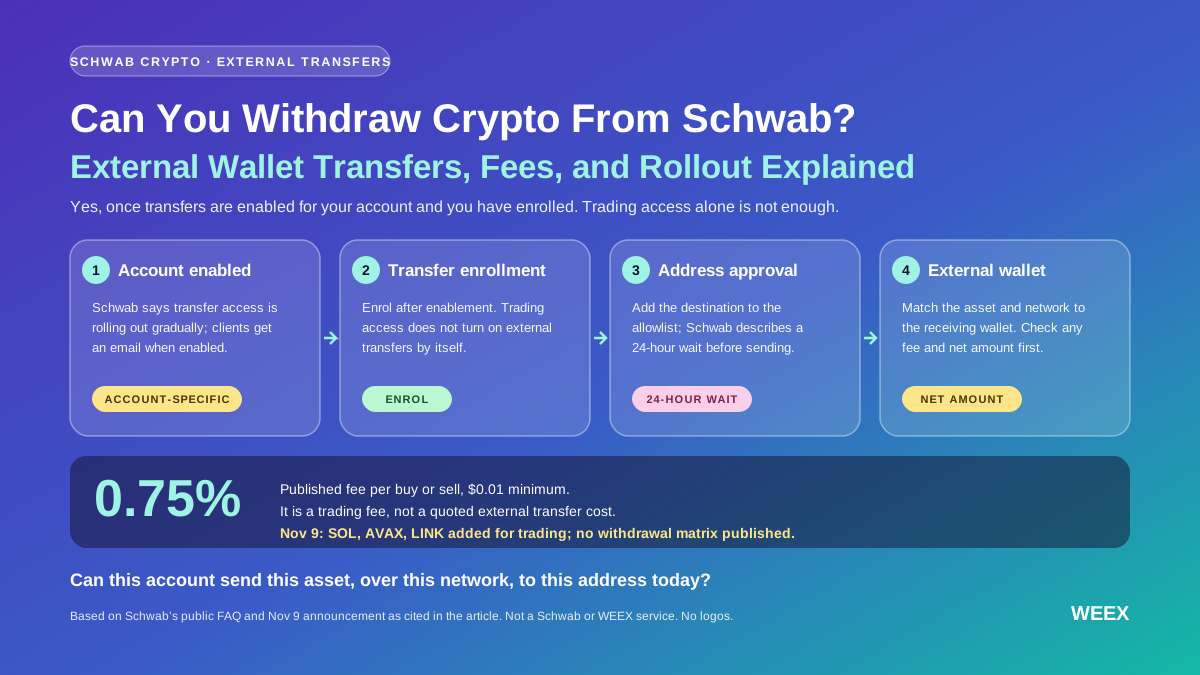
Can You Withdraw Crypto From Schwab? External Wallet Transfers, Fees, and Rollout Explained
Find out when Schwab Crypto allows external wallet withdrawals, how the 24-hour address wait works, and why the 0.75% trading fee is separate.
AI Startup Quietly Develops Its Own Procurement Chips
Countdown to Migration to Solana: ZetaChain to Launch Financial AI Platform ZetaLabs

End of Circle's CCTP V1: Which Cases Require Migration for USDC Transfers?
Democrats may rewrite CLARITY Act and dare Trump to veto it, Giancarlo says
ASEAN to Establish Oil Product Sharing Reserve Mechanism with Japan's Support
Hedera Council adds Apex Group, servicer of $3.5T in assets
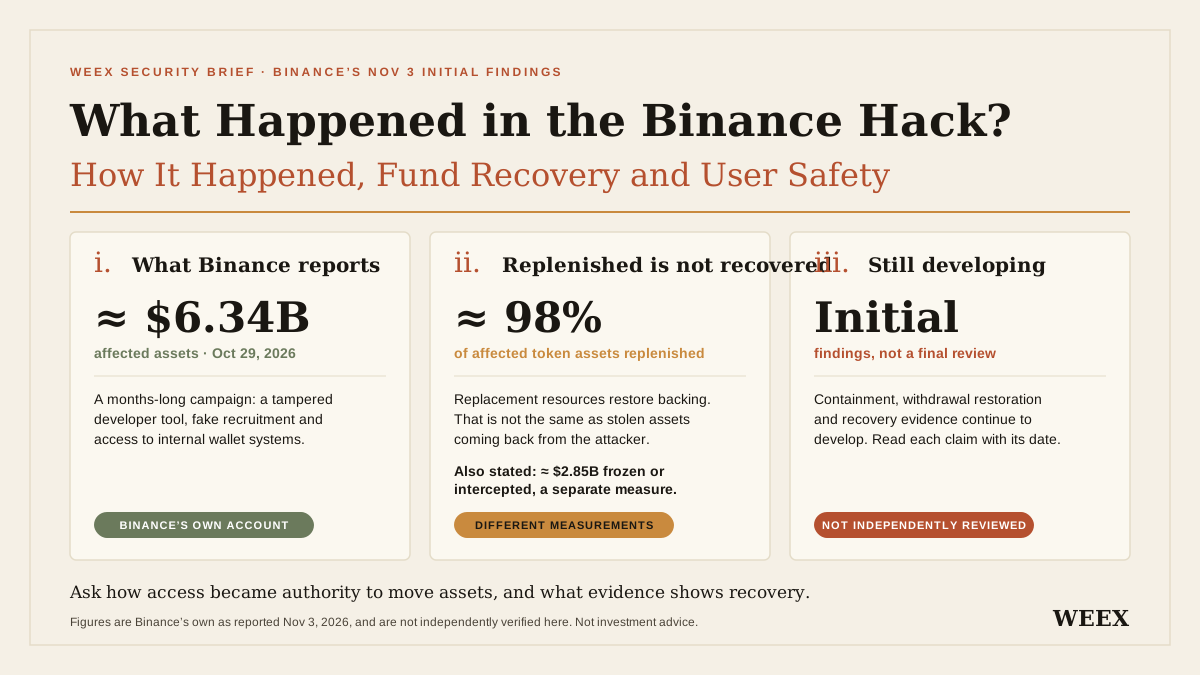
What Happened in the Binance Hack? How It Happened, Fund Recovery and User Safety
What happened in the Binance hack? Review the attack timeline, latest fund replenishment, recovery limits and practical steps to protect your account.
Tata Power Plans to Sign Agreement with Four States Allowing Power Prices to Be Linked to Coal Costs
AI Agents Do More Than Just Place Orders: The Next Entrepreneurial Opportunity Lies in Matching and Trust
NVIDIA Scandal Shakes the Internet! How Should Cryptocurrency Be Divided After a Divorce with a Tech Tycoon?
Bundesbank President Says Economic Recovery Faster Than Expected, Structural Reforms Needed
Immutable Chain's Transition to OP Stack: What Changes for Users
Ledger CEO faces backlash after saying everybody will be hacked at some point

WEEX 11.11 Shopping Fest: Buy BTC and Unlock Up to 888 USDT in Rewards
NEAR AI Discloses SGLang Security Incident and Revokes Exposed API Keys
The Art of Trading: How They Profit from Arbitraging USDE Stocks
VARA Is Not a Panacea: Dubai's Crypto Payments Still Depend on the Central Bank

a16z Frontier Partner: Agents Should Rebuild Uber-like Transaction Networks

Poland's Parliament Votes 240-202 To Let Officials Freeze Crypto Before Court Review
WEEX P2P now supports ILS, BHD, OMR & QAR —Merchant Recruitment Now Open
Cryptocurrency Security Checklist: Four Lessons from Phemex Safety Hub Vol. 05–08
Ondo Claims $4B in Tokenized Assets as RWA Market Gains Institutional Depth

DTCC Launches Tokenization Service: What Can Investors Actually Do?

The catch in recovering a hacked crypto wallet: the thief may still have a key
CoreWeave Says Its AI Demand Is 10 Times Its Capacity Through 2027. I Think Micron Stock Is Still Worth Buying.
MultiBank Group and Universal Sign Agreement to Develop USDU Settlement Capabilities for Institutional Clients
Silver ETF vs. Silver Miners ETF: Which Has Held Up Better This Year?
Cardano Academy launches practicum with on-chain credentials
Rongchang Biologics and Vor Bio Sign RC298 License Agreement Amendment, Securing $56 Million Upfront Payment
Can You Withdraw Crypto From Schwab? External Wallet Transfers, Fees, and Rollout Explained
Find out when Schwab Crypto allows external wallet withdrawals, how the 24-hour address wait works, and why the 0.75% trading fee is separate.
Latest articles


Latest coin listings on WEEX


