
Countdown to Migration to Solana: ZetaChain to Launch Financial AI Platform ZetaLabs

 Prefer us on Google


Author: Zen, PANews
Less than a month remains until ZetaChain's Layer 1 shuts down.
On December 9, as the mainnet block height reaches 20,755,000, the original Layer 1 will cease operations, and ZETA will be migrated to Solana at a 1:1 ratio. At that time, holders can claim new SPL tokens through the official page, and staked assets will also be automatically included in the migration.
However, the changes brought by this migration go far beyond that. The end of the independent blockchain era also marks the beginning of ZetaChain's formal entry into the Solana ecosystem. The second governance proposal passed on November 7 has rearranged the supply structure of ZETA and further clarified the product roadmap after Anuma upgrades to ZetaLabs.
On one hand, 55 million ZETA will be burned, and the original inflation mechanism will be canceled; on the other hand, the project will shift its focus to financial AI. ZetaChain is rebuilding its economic and business system for this new phase.
Restructuring ZETA Token Supply: Canceling Inflation and Burning 55 Million Tokens
The first change brought by the migration is the adjustment of the original supply arrangement of ZETA.
According to the official plan, out of the original maximum supply of 2.1 billion ZETA, 210 million tokens were specifically allocated for validator incentives, accounting for 10% of the initial supply. As of the migration snapshot, approximately 155 million tokens have been released through block rewards, leaving about 55 million tokens unissued.
With the independent L1 ceasing operations, the original validator reward mechanism will also become a thing of the past. ZetaChain has decided not to release this portion of tokens into the market but to burn them monthly from January to December 2027, with approximately 4.6 million tokens burned each month.
At the same time, the originally planned 2.5% annual inflation mechanism, which was set to start in the fourth year of mainnet operation, will no longer be implemented. After migrating to Solana, tokens will not continue to be issued through the original validator reward mechanism.
For tokens already allocated to investors and core contributors, ZetaChain has chosen to complete the final phase of unlocking as originally planned.
According to the original token economics, purchasers and advisors received 336 million ZETA, accounting for 16% of the total supply; core contributors received 472.5 million ZETA, accounting for 22.5%, totaling 808.5 million tokens.
Currently, about 94.4% of these two allocations have been unlocked, and the remaining portion will be released in the final batch on December 1 and January 1, 2027, completing the unlocking plan for these two allocations, with no further unlocks thereafter.
Other allocations held by the foundation have different arrangements. The ZetaChain Foundation has also committed not to sell newly released tokens from the User Growth Pool, Ecosystem Growth Fund, Protocol Treasury, and Liquidity Incentives in 2027.
Thus, this adjustment by ZetaChain actually involves three levels of supply management: burning unissued validator rewards, completing the established unlocks for investors and core contributors, and restricting the foundation from selling newly released tokens in 2027.
This means that as the independent L1 shuts down, the original issuance and unlocking arrangements of ZETA will gradually be phased out, and the future supply release rhythm will undergo significant changes.
How Will ZETA Holders Complete Asset Conversion After Migration?
In addition to clarifying the token supply adjustment plan, the second proposal also finalized the specific process for migrating ZETA from the original ZetaChain network to Solana.
According to the proposal, ZetaChain will take an asset snapshot at block height 20,755,000, expected to be reached on December 9, 2026. At that time, the original ZetaChain L1 will cease operations, validator nodes will shut down, and the original network will not restart.
After the snapshot is completed, ZetaChain will issue a native SPL version of ZETA on Solana, with a 1:1 exchange ratio, and the token name and code will remain unchanged. The total issuance of the new token will correspond to the native ZETA balance recorded at the snapshot, and after issuance, the minting authority will be revoked to ensure that ZETA on Solana cannot continue to be issued.
- For ordinary holders, this migration does not require completion through a third-party cross-chain bridge. ZetaChain will provide asset claiming services through the official migration process and ZetaHub page. Users only need to connect their original holding wallet after the migration entry opens on December 9, sign a message containing the Solana receiving address, and they can claim the corresponding amount of SPL tokens. The entire process incurs no fees and does not require holding SOL in advance, with a minimum claim balance of 10 ZETA per address.
- For staked assets, users also do not need to unstake in advance. The snapshot will automatically record ordinary balances, delegated staked balances, balances in the process of unstaking, and unclaimed rewards, and the corresponding amounts will be included in the migration balance. It is important to note that staking rewards will stop being calculated at the snapshot height.
- For users who have placed their ZETA tokens on centralized exchanges, the respective trading platforms will be responsible for completing the token conversion, and no self-claiming is required. The specific conversion time and arrangements will be subject to announcements from each exchange.
In addition to native ZETA, users holding other cross-chain assets on ZetaChain also have corresponding handling plans. Assets that still exist in ZRC-20 form at the time of the snapshot can be applied for return to the original blockchain through ZetaHub starting December 9. This mechanism covers nine original networks, with a minimum claim amount of $5 for each asset.
However, users holding wrapped ZETA or liquidity pool shares need to handle related assets in advance. Since these assets are stored in smart contracts or liquidity pools, they cannot be directly signed for claiming through ordinary wallet addresses. Therefore, they need to unwrap or exit the liquidity pool before the snapshot, transferring the corresponding assets back to their personal wallets.
Regarding migration security, ZetaChain stated that the Solana token distribution program and migration claiming services are undergoing independent security audits by Hacken, with the report to be published before the migration page opens. The project will also publicly disclose snapshot data and verification files, token minting records, and program verification information for external verification of asset quantities before and after migration.
Meanwhile, the original ZetaScan browser will continue to provide historical transaction query services, and the project will retain a read-only archive node until October 31, 2027, for users to review historical records.
It is important to note that this migration only involves ZETA on the original ZetaChain network. The previously issued ERC-20 version on Ethereum will remain unaffected and will continue to retain its original form.
From Market Tracking to On-Chain Memory: ZetaLabs Builds a Crypto-Native Financial AI Assistant
As the original public chain gradually exits, ZetaChain's next phase of business focus will concentrate on the AI product ZetaLabs. However, compared to the previous Anuma, which primarily targeted general AI interactions, ZetaLabs further narrows its product positioning to the crypto market, aiming to integrate real-time market information, users' on-chain activities, and AI models into the same workflow.
As early as February 2026, ZetaChain launched Anuma Chat, allowing users to switch between different AI models while retaining personal preferences and historical context through multi-model aggregation and a private memory layer. ZetaLabs builds on this technology foundation, adding features more closely aligned with the crypto market. According to the official roadmap, the platform plans to launch Chat, Radar, Bloom, and ZETA Dashboard on December 9.
Among them, Radar and Bloom are two important components that distinguish ZetaLabs from ordinary AI chat tools—Radar tracks the market, while Bloom enables AI to understand users' own on-chain activities.
Radar provides real-time, personalized market information streams covering cryptocurrencies, perpetual contracts, prediction markets, stocks, and commodities. Users can obtain market dynamics based on their areas of interest and further inquire about relevant information through Chat. Compared to having to describe the research subject and background to general AI each time, this method allows users to conduct research more directly around the markets they are continuously monitoring.
Bloom further extends the AI's analysis scope from the public market to users' own on-chain activities. After connecting their Solana wallet, users can establish private memories around their on-chain transactions, allowing them to inquire about their trading situations in natural language. In other words, AI no longer needs to understand just the price trends of a particular token but can provide relevant context based on the user's own on-chain activities.
For example, when users want to review their recent transactions on Solana, they can directly ask AI about wallet activities without having to open the block explorer for each transaction, search for transaction hashes, and organize transaction records themselves.
This design also lays the foundation for deeper transaction analysis in the future. According to the roadmap for the first quarter of 2027, ZetaChain plans to launch the Lens feature, where users can input a single on-chain transaction to understand what happened during the transaction, what operations were involved, and what costs were incurred.
If Radar addresses the issue of fragmented market information, then Bloom and Lens aim to solve the challenges of understanding on-chain transaction information and organizing personal trading histories.
Another key focus throughout ZetaLabs' product design is user privacy.
Crypto investors using AI analysis typically involve wallet addresses, transaction records, and holding situations. Once this information is combined with AI chat records, it forms a fairly complete personal financial profile. However, in the process of using ordinary AI chat tools, users often need to submit prompts and relevant context to the model service provider for processing.
ZetaChain aims to change this model through the Private Memory Layer. This infrastructure is designed to encrypt users' chats, research, and memories, with users holding the keys, while ZetaChain itself cannot read this content. The AI model will only receive the information necessary to answer the current question, rather than directly accessing the user's complete historical records.
On this basis, ZetaChain also plans to launch Zeta Intelligence and Zeta MCP in the first quarter of 2027. The former will combine users' private memories to provide deeper financial research and decision support; the latter will allow third-party applications to call ZetaLabs' tools, and access to corresponding memories will only be granted with user authorization.
For the crypto market, this design has a longer-term direction: as AI agents begin to undertake market information collection, transaction analysis, and other financial tasks, they will need not only model capabilities but also user-authorized data, continuous personal context, and payment mechanisms.
ZetaChain's goal is to integrate these capabilities into the same product system through private memories, open interfaces, and payment standards like x402.
-- Price
Reestablishing Value Support for ZETA Tokens
Compared to the product roadmap, the changes in the use of ZETA in the new business may be the more noteworthy part of this proposal.
The original ZetaChain was an independent Layer 1 public chain, with ZETA serving functions such as network gas payment, validator staking, and rewards. With the L1 ceasing operations, this economic model will also exit. After migrating to Solana, network transaction fees will be borne by SOL, and ZETA will need to establish new usage demands based on the application layer.
According to the new white paper, the currently clear uses of ZETA mainly include three aspects.
- First is payment for AI services. Users can use ZETA to pay for AI service fees in ZetaLabs and receive certain discounts while unlocking more reports and product features.
- Second is Premium membership. Starting in the first quarter of 2027, users can obtain ZetaLabs Premium access by locking ZETA, allowing them to use more in-depth market research reports and higher service limits. According to official explanations, the locked tokens still belong to users, and only the user's own wallet can withdraw them.
- Third is product governance. Users can use ZETA to participate in product direction voting, such as deciding which markets, data sources, and AI models ZetaLabs should support.
Compared to the previously discussed ZETA Access lock-up mechanism for AI call points, the new white paper specifies the token uses as service discounts, Premium access rights, and product direction voting.
Additionally, according to official explanations, all users can receive a daily free usage quota, while additional AI calls and research services can be paid for using ZETA, USDC, or credit cards. This means that ZETA is not a necessary condition for using the product but serves as a payment and access method that provides discounts and specific rights.
From this perspective, ZetaChain has not set ZETA as the only threshold for entering ZetaLabs but hopes to establish a richer application scenario for the token through payment discounts, Premium membership rights, and product governance. Ordinary users can experience services through USDC or credit cards, while as usage demands deepen, ZETA can provide more product rights.
As features like Radar, Lens, Zeta Intelligence, and MCP are gradually launched, ZetaLabs is expected to evolve from an AI assistant into a service platform connecting financial data, market research, and third-party AI agents.
For ZetaChain, migrating to Solana signifies the end of the independent public chain operation phase, while ZetaLabs carries the next phase of business exploration. How to transform the previously accumulated AI technological capabilities into sustained product demand and further expand the application scope of ZETA in the ecosystem will be important focal points in this transformation.
This content is provided for general informational purposes only and doesn't constitute financial, investment, legal, or tax advice. Any events, rewards, online promotions, or related information mentioned herein should not be considered a recommendation, solicitation, or invitation to purchase, sell, trade, or otherwise deal in any crypto assets. Crypto assets are highly volatile and may result in loss. The availability of WEEX services, products, and related events may vary by region. You are responsible for ensuring that your participation is in accordance with applicable local laws and regulations.
You may also like

CoreWeave Says Its AI Demand Is 10 Times Its Capacity Through 2027. I Think Micron Stock Is Still Worth Buying.

MultiBank Group and Universal Sign Agreement to Develop USDU Settlement Capabilities for Institutional Clients

Pimco CEO Warns: AI Companies Risk Borrowing "Too Much" ($10 Trillion)

Silver ETF vs. Silver Miners ETF: Which Has Held Up Better This Year?

Cardano Academy launches practicum with on-chain credentials

Rongchang Biologics and Vor Bio Sign RC298 License Agreement Amendment, Securing $56 Million Upfront Payment
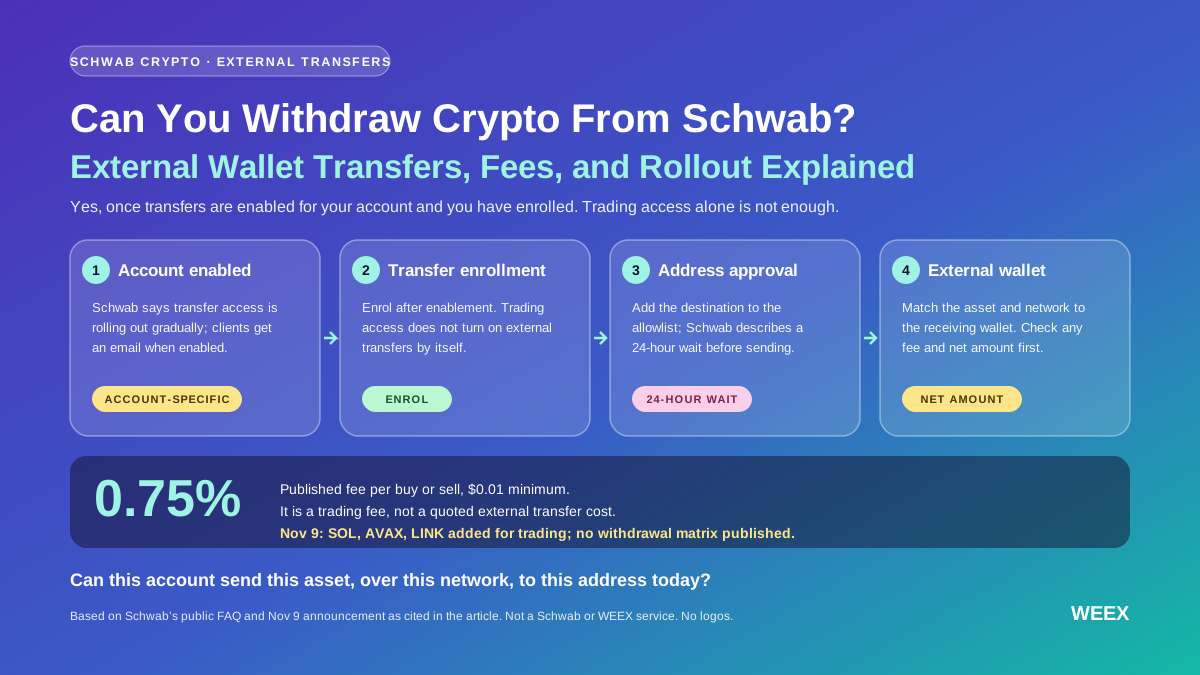
Can You Withdraw Crypto From Schwab? External Wallet Transfers, Fees, and Rollout Explained
Find out when Schwab Crypto allows external wallet withdrawals, how the 24-hour address wait works, and why the 0.75% trading fee is separate.

AI Startup Quietly Develops Its Own Procurement Chips

End of Circle's CCTP V1: Which Cases Require Migration for USDC Transfers?
Democrats may rewrite CLARITY Act and dare Trump to veto it, Giancarlo says

ASEAN to Establish Oil Product Sharing Reserve Mechanism with Japan's Support
Hedera Council adds Apex Group, servicer of $3.5T in assets
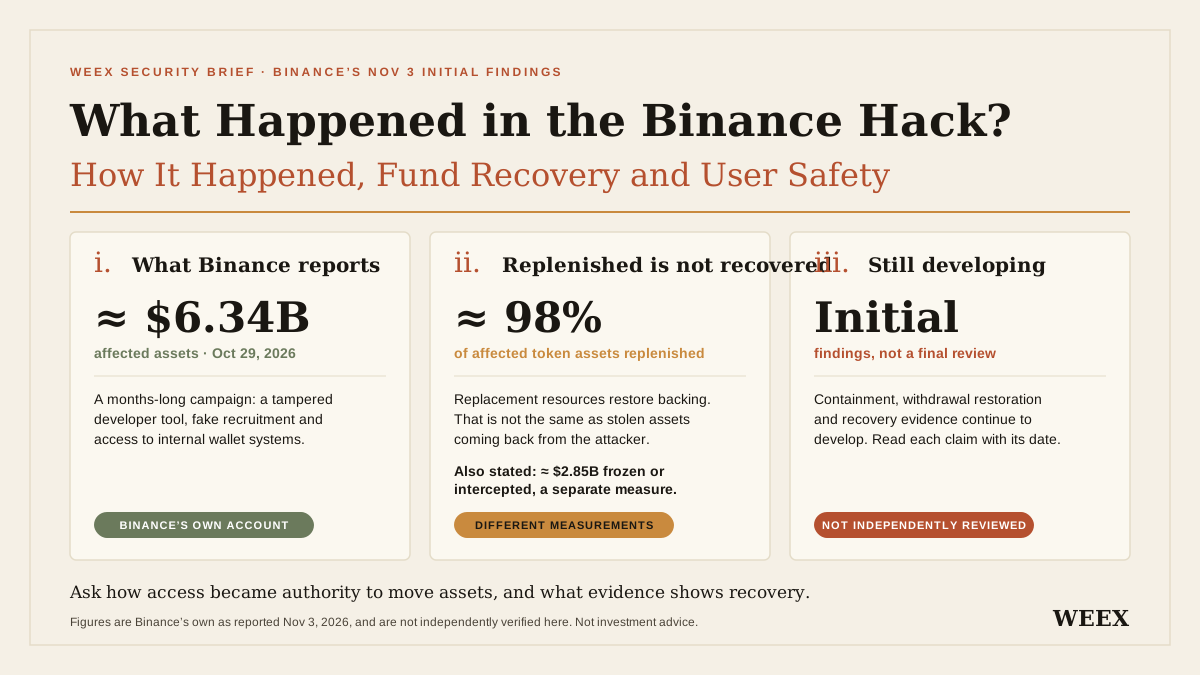
What Happened in the Binance Hack? How It Happened, Fund Recovery and User Safety
What happened in the Binance hack? Review the attack timeline, latest fund replenishment, recovery limits and practical steps to protect your account.

Tata Power Plans to Sign Agreement with Four States Allowing Power Prices to Be Linked to Coal Costs
AI Agents Do More Than Just Place Orders: The Next Entrepreneurial Opportunity Lies in Matching and Trust

NVIDIA Scandal Shakes the Internet! How Should Cryptocurrency Be Divided After a Divorce with a Tech Tycoon?
Bundesbank President Says Economic Recovery Faster Than Expected, Structural Reforms Needed

Immutable Chain's Transition to OP Stack: What Changes for Users
Ledger CEO faces backlash after saying everybody will be hacked at some point

WEEX 11.11 Shopping Fest: Buy BTC and Unlock Up to 888 USDT in Rewards
NEAR AI Discloses SGLang Security Incident and Revokes Exposed API Keys

The Art of Trading: How They Profit from Arbitraging USDE Stocks

VARA Is Not a Panacea: Dubai's Crypto Payments Still Depend on the Central Bank

a16z Frontier Partner: Agents Should Rebuild Uber-like Transaction Networks
Poland's Parliament Votes 240-202 To Let Officials Freeze Crypto Before Court Review
WEEX P2P now supports ILS, BHD, OMR & QAR —Merchant Recruitment Now Open

Cryptocurrency Security Checklist: Four Lessons from Phemex Safety Hub Vol. 05–08
Ondo Claims $4B in Tokenized Assets as RWA Market Gains Institutional Depth

DTCC Launches Tokenization Service: What Can Investors Actually Do?

The catch in recovering a hacked crypto wallet: the thief may still have a key
CoreWeave Says Its AI Demand Is 10 Times Its Capacity Through 2027. I Think Micron Stock Is Still Worth Buying.
MultiBank Group and Universal Sign Agreement to Develop USDU Settlement Capabilities for Institutional Clients
Pimco CEO Warns: AI Companies Risk Borrowing "Too Much" ($10 Trillion)
Silver ETF vs. Silver Miners ETF: Which Has Held Up Better This Year?
Cardano Academy launches practicum with on-chain credentials
Rongchang Biologics and Vor Bio Sign RC298 License Agreement Amendment, Securing $56 Million Upfront Payment
Latest articles


Latest coin listings on WEEX


