
This Bitcoin Developer's Plan Could Make Quantum Hackers Lose Money While Trying to Steal Coins

 Prefer us on Google


To steal coins, hackers must first stake their own Bitcoin, or risk losing their collateral.
Written by: Jose
Compiled by: Chopper, Foresight News
Bitcoin developer Cory Fields has come up with a unique way to combat future quantum hackers: hackers who want to steal someone else's Bitcoin must first stake their own Bitcoin as a gamble.
He posted in the Bitcoin developer mailing list proposing the concept of "quantum landmines" and two auction mechanisms. The idea behind this design is to make attacking wallets with vulnerabilities a potentially money-losing endeavor. He specifically noted that this is just a thought experiment and not a finalized Bitcoin upgrade proposal.
Bitcoin users initiate transactions by signing with their private keys, while the corresponding public keys allow the network to verify the signatures without revealing the private keys. Currently, ordinary computers cannot feasibly derive private keys from public keys. However, a sufficiently powerful quantum computer could use Shor's algorithm to calculate the private key, allowing hackers to directly transfer the coins.
Some early Bitcoin addresses have their public keys exposed on the blockchain; others expose their public keys when users make their first transactions. Therefore, not all wallets face the same risk of quantum attacks. The day when "quantum computers capable of breaking Bitcoin encryption" are realized is referred to as Q-Day (Quantum Doomsday). No machine has achieved this yet, and no one knows when it will happen.
How Do Quantum Landmines Work?
Suppose you have 1 BTC in your wallet, which is of an old type that is vulnerable to quantum attacks. Before Q-Day arrives, you create a small, quantum-resistant Bitcoin output, hiding a proof that demonstrates this coin was yours before quantum attacks became feasible. You can think of it as a sealed "ownership certificate." Outsiders can only see this small record and cannot access the hidden evidence, nor do they know it is a trap.
In the future, when a hacker uses a quantum computer to calculate your old private key and attempts to transfer your 1 BTC, according to this new rule, they cannot simply take the coin; they must stake 1 BTC from their own quantum-resistant wallet as collateral.
Your 1 BTC plus the hacker's 1 BTC collateral will be bundled together and locked in for a waiting period, say 30 days. During this time, the hacker cannot freely transfer the coins. If you discover someone attempting to steal your coins, you can present the hidden ownership proof. The Bitcoin network will determine that you can transfer both coins to your pre-prepared quantum-resistant address—your original coin plus the hacker's collateral.
The hacker has no way of knowing which old wallet contains such a trap. Even if they successfully calculate the private key, they could end up losing 1 BTC. However, this plan also has a cost: if the coin's owner wants to transfer their old coin normally after Q-Day, they must also present equivalent collateral. If they do not have extra BTC, this rule designed to protect against hackers could make it difficult for them to transfer their own coins.
What About Bitcoin That Has Lost Its Private Key and Is Unattended?
Quantum landmines have a prerequisite: the coin's owner must set up the trap in advance and present evidence during the appeal window. If the private key has been lost and the owner can no longer go online, this plan cannot protect those coins, including many early Bitcoins that are widely believed to be permanently lost.
To address this, Cory Fields proposed a second mechanism: staking auctions. Before Q-Day, anyone can lock a portion of quantum-resistant Bitcoin and quietly bid on an old wallet that is likely to be targeted. For example, if a wallet that appears to have been abandoned by its owner contains 50 BTC, a hacker attempting to transfer it would need to stake 50 BTC as collateral. During the auction window, those who placed bids earlier can challenge the theft attempt. According to his vision, successful challengers can take a portion of the hacker's collateral, while the 50 risky Bitcoins will be destroyed and not awarded to the challengers. The goal is not to help the missing owner recover their coins, but to prevent hackers from easily stealing the coins, thereby discouraging attacks.
The third proposal is called a smart auction, which does not require locking coins in advance. Whenever someone attempts to transfer high-risk coins, an auction will automatically begin. The highest bidder will receive these coins (after deducting their own bid), while the second-highest bidder will lose their money without receiving anything. This is somewhat similar to the classic "dollar auction game": two people continuously raise the price for an item, and neither wants to lose money for nothing. Hackers will weigh the risks and may choose not to initiate this auction, which is likely to result in greater losses.
Why Not Simply Freeze High-Risk Bitcoins?
One proposed countermeasure is to set a migration deadline, after which coins in old wallets would be prohibited from being transferred. While this would indeed prevent theft, the downside is that genuine holders who forget to transfer their coins or do not have time to act would have their coins permanently locked.
Cory Fields has taken a different approach. Old coins can still be transferred, but any attempt to transfer them incurs costs and invites challenges from others. The Bitcoin network itself cannot distinguish whether the person presenting a valid signature is the true owner or a quantum hacker. The trade-offs are quite clear: legitimate holders must prepare significant collateral to transfer coins; long-term offline holders may miss the opportunity to appeal; and even some holders who are alive but temporarily offline may have their coins destroyed in the auction.
-- Price
What Changes Are Needed for Implementation?
Bitcoin first needs a quantum-safe way to hold and use funds. Wallets must support hidden ownership commitments, and Bitcoin's consensus rules must enforce collateral, waiting periods, special recovery transactions, and auction mechanisms.
Developers also need to reach consensus on when the new rules will take effect, the required collateral amounts, and how to handle failed bids or remaining funds. Fields believes that some mechanisms can be introduced through soft forks, but he has not provided detailed design proposals.
Currently, none of these protective mechanisms exist on the Bitcoin network. Fields has not provided code implementations, timelines for deployment, or finalized funding allocations and ultimate goals for the auctions in the original text.
This content is provided for general informational purposes only and doesn't constitute financial, investment, legal, or tax advice. Any events, rewards, online promotions, or related information mentioned herein should not be considered a recommendation, solicitation, or invitation to purchase, sell, trade, or otherwise deal in any crypto assets. Crypto assets are highly volatile and may result in loss. The availability of WEEX services, products, and related events may vary by region. You are responsible for ensuring that your participation is in accordance with applicable local laws and regulations.
You may also like

Who Will Succeed Nvidia as the Next 'Victim' After the Democrats Take Control of Both Houses?

Anthropic Yet to Go Public, Crypto Players Already Cashing In

Interpretation of FATF Report on Scam Compound Funds: Virtual Assets Become Core Money Laundering Channels

How Much Is Anthropic Really Worth?
Research Reveals 3D Spatial Navigation Map of Hand in the Brain to Aid Brain-Machine Interface Development

Michael Dempsey: Crypto Venture Capital Stagnates, Talent Shifts to AI

Yen Fluctuations Highlight Current Trading Difficulties, Investors Have Huge Divergence on Long-term Outlook

Bloom Energy vs. Constellation Energy: On-Site Power or Grid Power, Which Wins the Data Center?

Former Polychain Partner Launches Startup: Enters Tokenized Real Estate, Secures $50 Million Seed Round Funding to Create the 'S&P 500' of Real Estate
Seminar: The History of Hyperliquid and On-Chain Finance Guest: Takuya Fujita (11/18 19:30 @ Gentosha)
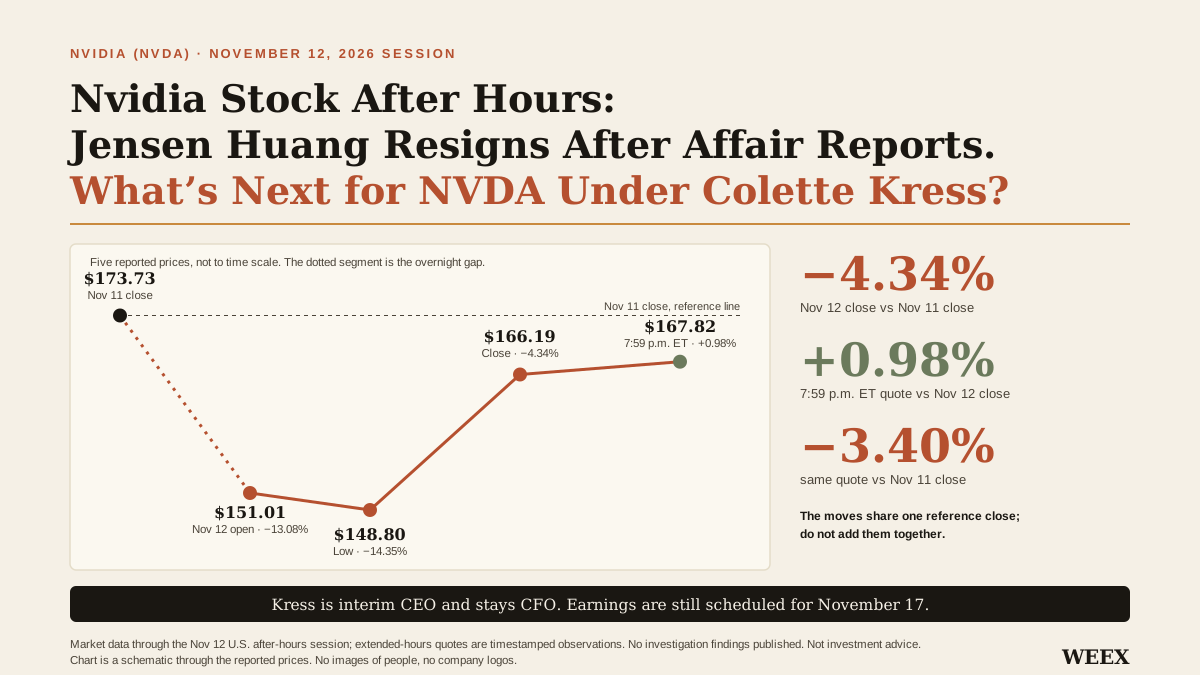
Nvidia Stock After Hours: Jensen Huang Resigns After Affair Reports. What’s Next for NVDA Under Colette Kress?
Nvidia fell 4.34% after Jensen Huang resigned, then rose 0.98% after hours. See what Colette Kress’s appointment means for NVDA and November 17 earnings.

Jensen Huang's Sudden Departure Raises Questions: Did the White House Intervene? Is a Return Possible?
In-Depth Interview | Fu Peng: I Have No Faith in BTC

Cerebras Conference Call: Secures Major Deal with Microsoft, HBM Shortage Becomes an Opportunity, WSE-5 Chip to Enter Mass Production Next Summer

SoundHound AI Stock Is Down Almost 60% in 2026, but Wall Street Thinks It Can Soar 155% By the End of 2027. Here’s Why It Could Be One of the Best Buys Amid the Tech Sell-Off.
What is being said at the tables: the market begins to see 2027 as an all-or-nothing scenario

Kalshi Negotiates New Round of Financing, Valuation Expected to Reach $65 Billion

Republican Senator Wants to Freeze AI Data Center Boom as Congress Pushes to Expand It

Why the Path to Quantum Resistance Runs Uphill for Bitcoin Wallet Makers

Pimco CEO Warns: AI Companies Risk Borrowing "Too Much" ($10 Trillion)

Silver ETF vs. Silver Miners ETF: Which Has Held Up Better This Year?

Why AMD Shares Are Surging and What a $10,000 Investment in the Stock Could Be Worth in 3 Years

Cardano Academy launches practicum with on-chain credentials
Warren Buffett Doesn't Follow His Own S&P 500 Advice. Should You?

A $776 Car Payment Is a Warning for Ford and General Motors

2 Chip Stocks to Buy Instead of Nvidia Right Now

History Says This Is the Smartest ETF to Buy During the Next Bear Market

EU to Continue Providing Financial and Military Aid to Ukraine
The market demanded liquidity and the Economy granted it: what to expect for interest rates after the Treasury auction

Qualcomm CEO on Tech Stock Plunge: "There is No AI Sector Correction for Us"
Who Will Succeed Nvidia as the Next 'Victim' After the Democrats Take Control of Both Houses?
Anthropic Yet to Go Public, Crypto Players Already Cashing In
Interpretation of FATF Report on Scam Compound Funds: Virtual Assets Become Core Money Laundering Channels
How Much Is Anthropic Really Worth?
Research Reveals 3D Spatial Navigation Map of Hand in the Brain to Aid Brain-Machine Interface Development
Michael Dempsey: Crypto Venture Capital Stagnates, Talent Shifts to AI
Latest articles





Latest coin listings on WEEX


