
Midterm Elections Raise $3 Billion, Prediction Markets Emerge as Big Winners

 Prefer us on Google


More accurate, faster.
Written by: Maher, Foresight News
On the evening of November 3, while mainstream networks like CNN were still waiting for slow-moving vote counts and hesitated to call the race, prediction markets had already completed probability convergence and pre-pricing through real-money positions.
On election night, Polymarket and Kalshi quickly raised the winning probabilities for key swing states, with Polymarket giving a 99% certainty judgment on the Michigan Senate race four full hours before mainstream media made their official announcement. That night, the signals provided by the two platforms with real money were faster and more decisive than poll averages, forecasting models, and formal announcements from television networks.
This is not the first time. During the 2024 presidential election, the two prediction market platforms locked in directions ahead of polls that were still fluctuating. In the 2026 midterm elections, they proved once again that they were not just lucky occasionally.
$3 Billion in Liquidity Leads the Way
On November 3, Kalshi's election contracts, disclosed by Paradigm co-founder Matt Huang, had a single-day trading volume of $729 million, far exceeding the single-day transaction amount of $244 million for the November 2024 U.S. presidential election.
After the dust settled on the midterm elections, Kalshi's official article revealed that the total transaction volume for markets related to the 2026 midterm elections exceeded $2.5 billion, nearly double the $1.3 billion for the entire 2024 election cycle.
Notably, Kalshi had just won a lawsuit against the CFTC in October 2024 (only a month before the election) to be approved for launching political contracts in the U.S. The true dominant player in the 2024 election was Polymarket, with a single contract for the presidential election exceeding $3.6 billion. Now, just two years later, the trading volume landscape in the election market has reversed.
On Kalshi, the single prediction market for “Who Will Control the U.S. House of Representatives” alone has seen a cumulative transaction volume exceeding $400 million.
Before the election, institutions like The Washington Post estimated that the combined total for Kalshi and Polymarket was approaching $1.9 billion, with Kalshi accounting for about $1.3 billion and Polymarket about $600 million.
In the days surrounding the election, Kalshi's total nominal transaction volume surged to $4.15 billion (including non-election contracts), with major targets like the Texas Senate (with daily volumes exceeding $100 million), control of the House of Representatives, and the Texas governorship attracting the majority of buying depth.
Polymarket, on the other hand, faced fragmentation in transaction statistics due to the split liquidity between its onshore compliant version (Polymarket US) and offshore international version, with total transactions ranging from $600 million to $700 million, and core trading volumes also highly concentrated in contracts related to control of both chambers and checks and balances of power.
Although election contracts accounted for a smaller proportion of total transactions compared to sports and combination contracts on both platforms, the absolute scale of over $3 billion has transformed the midterm elections from a side issue into a main battlefield.
Accuracy Exceeds 98%
Kalshi reported that as of 6:26 AM Eastern Time on November 4, in the 487 races where results had been announced, the most popular candidates won 479 races, achieving an accuracy rate of about 98%.
Kalshi's research team further disclosed that its overall race prediction accuracy climbed from 93.8% three months ago to 98.2% by the end of voting; even when compared to mainstream poll averages from VoteHub and Wikipedia, Kalshi's leading advantage at various time points was also very clear (reaching 95% at the time of voting, higher than the poll average of 85%-90%).
Polymarket also disclosed data: the most popular candidates the day before the election won 419 out of 426 settled races, with an accuracy rate of 98.4%, with 78 races still pending settlement at that time.
Data pages showed that the accuracy rates for settled races in the Senate, governorship, and House of Representatives were approximately 97%, 97.1%, and 98.6%, respectively.
Both platforms had set the probability of the Democratic Party winning the House of Representatives at around 94% and the Senate at about 75% before voting, and the final results for both chambers aligned with those directions.
However, direction accuracy does not equate to magnitude accuracy. Third-party analysis pointed out that the market implied Republican House seats at around 192 at the time of voting, while NBC's later seat estimate was 176. The unexpected reversals mostly favored the Democratic Party. Economist Koleman Strumpf told Bloomberg, “B,” with a straightforward reason: the direction was correct, but “this was a historic blue wave,” which was difficult to read directly from market prices.
The sample itself also had some inflation. A large number of non-competitive races raised the overall accuracy, while the real battlegrounds in the 10-90% range were hard-fought. Some results from states like Alaska and Mississippi were still not fully settled, and direct comparisons across platforms needed to consider timing and sample differences.
Faster than the News
Speed is a part both platforms are eager to highlight.
Kalshi stated that in key Senate races, the market pushed the winning side to over 99% on average about 115 minutes before CNN made its official announcement.
Polymarket provided specific comparisons for 10 key races: it published a 99% judgment on X, with a median time 31 minutes earlier than CNN, Fox News, and the Associated Press, and about 4 hours earlier for the Michigan Senate race.
The election night process further illustrates the point. Once the results from early vote-counting states were released, the prices of control contracts on both platforms began to move rapidly towards extremes, pushing the probability of the Democratic Party controlling both chambers close to certainty by the evening. This was more direct than waiting for new data from polls or rerunning models with updated weights.
Both platforms were close in directional accuracy, with Kalshi currently leading in transaction volume, but Polymarket still holds its position in terms of international users and on-chain transparency.
-- Price
Winners Afterward
The prediction markets once again proved in this round of midterm elections that the continuous pricing mechanism incentivized by real money can aggregate dispersed information into highly forward-looking real-time signals. Mainstream media and Wall Street trading desks have begun to incorporate them into core observation indicators rather than viewing them merely as speculative casinos.
However, as the glow of election night fades, the pricing boundaries and underlying business logic of prediction markets also come to the surface.
First, the high overall winning probabilities are somewhat diluted by non-competitive district samples, and the estimation errors in the scale of House seats indicate that the binary options structure is highly sensitive in judging “winning direction,” but still has pricing friction in capturing “sweep magnitude.” Second, if we step out of the pulse-like explosion of single-day transaction volumes and examine the distribution of open interest in outstanding contracts, we can better understand the true commercial cards of prediction markets.
According to Paradigm's data as of November 4, after a large number of midterm election contracts settled on November 3 and entered the delivery phase, Kalshi's total open interest (OI) remained at a high level of $2.5 billion. Among them, the political sector retained an OI of $679.2 million (accounting for 27.1% of total OI), with funds quickly rotating from settled midterm elections to the next cycle of “bipartisan presidential nominations” and pending governorship seats; while the sports events sector, which supports the platform's daily locked positions, reached as high as $1.5 billion (accounting for 59.9% of total OI).
This structure of outstanding contracts reveals the core strategy of prediction markets breaking the cycle of election periods: using the biennial political elections as a low-cost customer acquisition funnel with significant breakout effects, and then leveraging high-frequency, high-turnover sports events and combination contracts (multi-condition combination prediction contracts) to absorb the massive funds that have accumulated.
As discussions around regulatory rules deepen after the U.S. midterm elections, prediction markets have not only won the volume battle of the midterm elections but are also accelerating their evolution into alternative financial derivatives exchanges that operate around the clock.
This content is provided for general informational purposes only and doesn't constitute financial, investment, legal, or tax advice. Any events, rewards, online promotions, or related information mentioned herein should not be considered a recommendation, solicitation, or invitation to purchase, sell, trade, or otherwise deal in any crypto assets. Crypto assets are highly volatile and may result in loss. The availability of WEEX services, products, and related events may vary by region. You are responsible for ensuring that your participation is in accordance with applicable local laws and regulations.
You may also like

Who Will Succeed Nvidia as the Next 'Victim' After the Democrats Take Control of Both Houses?

Anthropic Yet to Go Public, Crypto Players Already Cashing In

Interpretation of FATF Report on Scam Compound Funds: Virtual Assets Become Core Money Laundering Channels

How Much Is Anthropic Really Worth?
Research Reveals 3D Spatial Navigation Map of Hand in the Brain to Aid Brain-Machine Interface Development

Michael Dempsey: Crypto Venture Capital Stagnates, Talent Shifts to AI

Yen Fluctuations Highlight Current Trading Difficulties, Investors Have Huge Divergence on Long-term Outlook

Bloom Energy vs. Constellation Energy: On-Site Power or Grid Power, Which Wins the Data Center?

Former Polychain Partner Launches Startup: Enters Tokenized Real Estate, Secures $50 Million Seed Round Funding to Create the 'S&P 500' of Real Estate
Seminar: The History of Hyperliquid and On-Chain Finance Guest: Takuya Fujita (11/18 19:30 @ Gentosha)
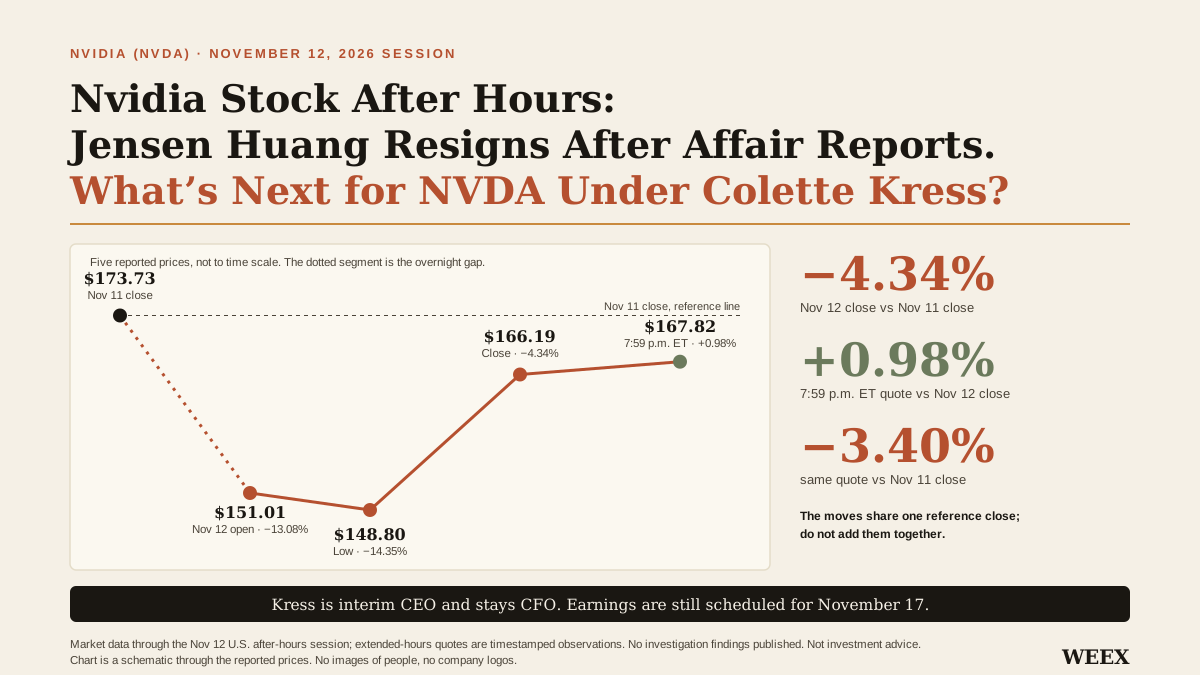
Nvidia Stock After Hours: Jensen Huang Resigns After Affair Reports. What’s Next for NVDA Under Colette Kress?
Nvidia fell 4.34% after Jensen Huang resigned, then rose 0.98% after hours. See what Colette Kress’s appointment means for NVDA and November 17 earnings.

Jensen Huang's Sudden Departure Raises Questions: Did the White House Intervene? Is a Return Possible?
In-Depth Interview | Fu Peng: I Have No Faith in BTC

Cerebras Conference Call: Secures Major Deal with Microsoft, HBM Shortage Becomes an Opportunity, WSE-5 Chip to Enter Mass Production Next Summer

SoundHound AI Stock Is Down Almost 60% in 2026, but Wall Street Thinks It Can Soar 155% By the End of 2027. Here’s Why It Could Be One of the Best Buys Amid the Tech Sell-Off.
What is being said at the tables: the market begins to see 2027 as an all-or-nothing scenario

Kalshi Negotiates New Round of Financing, Valuation Expected to Reach $65 Billion

Republican Senator Wants to Freeze AI Data Center Boom as Congress Pushes to Expand It

Why the Path to Quantum Resistance Runs Uphill for Bitcoin Wallet Makers

Pimco CEO Warns: AI Companies Risk Borrowing "Too Much" ($10 Trillion)

Silver ETF vs. Silver Miners ETF: Which Has Held Up Better This Year?

Why AMD Shares Are Surging and What a $10,000 Investment in the Stock Could Be Worth in 3 Years

Cardano Academy launches practicum with on-chain credentials
Warren Buffett Doesn't Follow His Own S&P 500 Advice. Should You?

A $776 Car Payment Is a Warning for Ford and General Motors

2 Chip Stocks to Buy Instead of Nvidia Right Now

History Says This Is the Smartest ETF to Buy During the Next Bear Market

EU to Continue Providing Financial and Military Aid to Ukraine
The market demanded liquidity and the Economy granted it: what to expect for interest rates after the Treasury auction

Qualcomm CEO on Tech Stock Plunge: "There is No AI Sector Correction for Us"
Who Will Succeed Nvidia as the Next 'Victim' After the Democrats Take Control of Both Houses?
Anthropic Yet to Go Public, Crypto Players Already Cashing In
Interpretation of FATF Report on Scam Compound Funds: Virtual Assets Become Core Money Laundering Channels
How Much Is Anthropic Really Worth?
Research Reveals 3D Spatial Navigation Map of Hand in the Brain to Aid Brain-Machine Interface Development
Michael Dempsey: Crypto Venture Capital Stagnates, Talent Shifts to AI
Latest articles





Latest coin listings on WEEX


