
Current Chief Prosecutor: 'Public Disclosure of Actual Controllers Needed to Prevent Predatory Coin Issuance'

 Prefer us on Google


Kim Yong-je, Chief Prosecutor of the Seoul Southern District Prosecutors' Office, spoke on the 6th at the conference held in the conference room on the second floor of the Seoul Southern District Prosecutors' Office in Yangcheon-gu, Seoul. He suggested that to block the predatory issuance of virtual assets (digital assets), a public integrated disclosure system should be established, and information about actual controllers should be disclosed.
During the '2026 Korean Financial Law Association and Prosecutors' Office Autumn Joint Academic Conference', Kim, who is in charge of the Serious Crimes Division 3, presented on the topic of information asymmetry in the digital asset market and ways to introduce a disclosure system.
The conference was co-hosted by the Korean Financial Law Association and the Securities and Financial Virtual Asset Specialized Prosecutors Community, focusing on the theme of 'Recent Trends in Financial Crime Response and Capital Market Regulation'.
Kim pointed out structural information asymmetry as the cause of repeated predatory issuance in the digital asset market. He explained that while the securities market undergoes gradual investment and verification by institutional investors before listing, digital assets can be listed on exchanges just 1-2 months after issuance. In a market centered on individual investors, it is difficult to verify the information provided by issuers, and there is no established disclosure system.
He particularly criticized the structure where issuers sell tokens by promoting business prospects, and after listing on exchanges, the issuers or pre-purchased entities dispose of large amounts of tokens through price manipulation trades.
He explained that there are cases where false materials are submitted for exchange listing reviews or where prices are formed under the pretext of providing liquidity to dispose of tokens. He noted that investors who receive tokens through exchanges may suffer losses as businesses are neglected or lead to delisting.
Kim pointed out that when digital assets are listed on exchanges, initial investors have the opportunity to recover their investments, while general investors who buy those tokens on exchanges find it difficult to identify fraudulent activities during the issuance process. This could result in listings reducing the criminal liability risk for issuers.
Additionally, he argued that while the current Virtual Asset User Protection Act allows for the punishment of fraudulent transactions and price manipulation, there are limitations to solving market issues solely through post-investigation or supervision of individual actions. He stated that the disclosure system should be designed to suppress the listing of predatory digital assets.
To this end, Kim proposed four measures: ▲ Establishing a public integrated disclosure system ▲ Disclosing key actors including actual controllers ▲ Strengthening disclosures regarding business operators and financial status ▲ Establishing an independent disclosure dedicated organization.
Kim emphasized that issuers should not be able to arbitrarily delete or change disclosure contents and that investors and exchanges should be able to verify the same up-to-date information. Regarding the EU's MiCA (Markets in Crypto-Assets), he acknowledged that the disclosure contents and procedures are well established but pointed out that while the responsible person for disclosure is identified, the identity of the person behind them is not verified.
Kim Tae-hoon, Chief Supervisor of the Financial Supervisory Service, spoke at the conference on the 6th. Source: Park Beom-soo/Digital Asset
"Need for Verification and Responsibility in Virtual Asset Disclosures"
Kim Tae-hoon, who participated as a discussant, argued that it is necessary to introduce verification and responsibility principles from the capital market into the digital asset disclosure system. He is currently in charge of investigating unfair trading in digital assets and provided his opinions based on his past experience in disclosure review work.
Kim explained that it should be considered that digital assets are simultaneously listed on overseas exchanges and that major information is first disclosed through social media platforms like X (formerly Twitter) or Telegram. Since information disclosed overseas can affect domestic prices, he argued that important information disclosed overseas and on social media should be promptly reflected in the domestic public integrated disclosure system.
To this end, he suggested introducing a designation and penalty system for dishonest disclosure companies in the securities market to digital asset exchanges as well. This would involve imposing penalties on cases where information is only disclosed overseas and domestic disclosure obligations are not fulfilled, and reflecting accumulated penalties in the review of continued trading support.
He also pointed out the potential for regulatory arbitrage between securities and non-securities digital assets ahead of the implementation of the token securities system in February 2027. He explained that issuers of digital assets should be required to state in their white papers the basis for determining that the tokens are not securities, and that the appropriateness of this distinction should be confirmed through legal review opinions at the issuance stage and exchange reviews at the listing stage.
Regarding the subject of disclosure reviews, he suggested that it would be preferable for supervisory authorities to take charge, contrary to Kim's proposal for an independent dedicated organization. He argued that using the same channels and standards as securities registration statements could reduce regulatory arbitrage. However, he emphasized that the review should only confirm the completeness of the disclosure contents.
Kim stressed the need for gatekeepers who verify the accuracy of disclosure information and bear responsibility. He proposed establishing independent expert due diligence at the issuance stage and verification procedures by exchanges at the listing stage, and that exchanges should disclose the results and grounds of their listing reviews. He also argued that the principles of responsibility for the execution of duties in the Capital Market Act and Commercial Act should be applicable to hold accountable not only nominal issuers but also those who practically planned and directed the issuance and listing.
Professor Yang Hee-seok of Chungnam National University Law School, who participated as a discussant, explained that while the United States is considering varying disclosure methods based on the scale of digital assets, Japan focuses on information disclosure by issuers and operators and self-regulatory organizations instead of a public integrated disclosure system.
Professor Yang expressed agreement on the necessity of a public integrated disclosure system to block predatory issuance but added that further research is needed on how to operate it without undermining market trading stability.
Professor Yang Hee-seok of Chungnam National University Law School speaks at the 2026 Korean Financial Law Association and Prosecutors' Office Autumn Academic Conference on the 6th. Source: Park Beom-soo/Digital Asset
-- Price
This content is provided for general informational purposes only and doesn't constitute financial, investment, legal, or tax advice. Any events, rewards, online promotions, or related information mentioned herein should not be considered a recommendation, solicitation, or invitation to purchase, sell, trade, or otherwise deal in any crypto assets. Crypto assets are highly volatile and may result in loss. The availability of WEEX services, products, and related events may vary by region. You are responsible for ensuring that your participation is in accordance with applicable local laws and regulations.
You may also like

Anthropic Yet to Go Public, Crypto Players Already Cashing In

Interpretation of FATF Report on Scam Compound Funds: Virtual Assets Become Core Money Laundering Channels

How Much Is Anthropic Really Worth?
Research Reveals 3D Spatial Navigation Map of Hand in the Brain to Aid Brain-Machine Interface Development

Michael Dempsey: Crypto Venture Capital Stagnates, Talent Shifts to AI

Yen Fluctuations Highlight Current Trading Difficulties, Investors Have Huge Divergence on Long-term Outlook

Bloom Energy vs. Constellation Energy: On-Site Power or Grid Power, Which Wins the Data Center?

Former Polychain Partner Launches Startup: Enters Tokenized Real Estate, Secures $50 Million Seed Round Funding to Create the 'S&P 500' of Real Estate

Seminar: The History of Hyperliquid and On-Chain Finance Guest: Takuya Fujita (11/18 19:30 @ Gentosha)
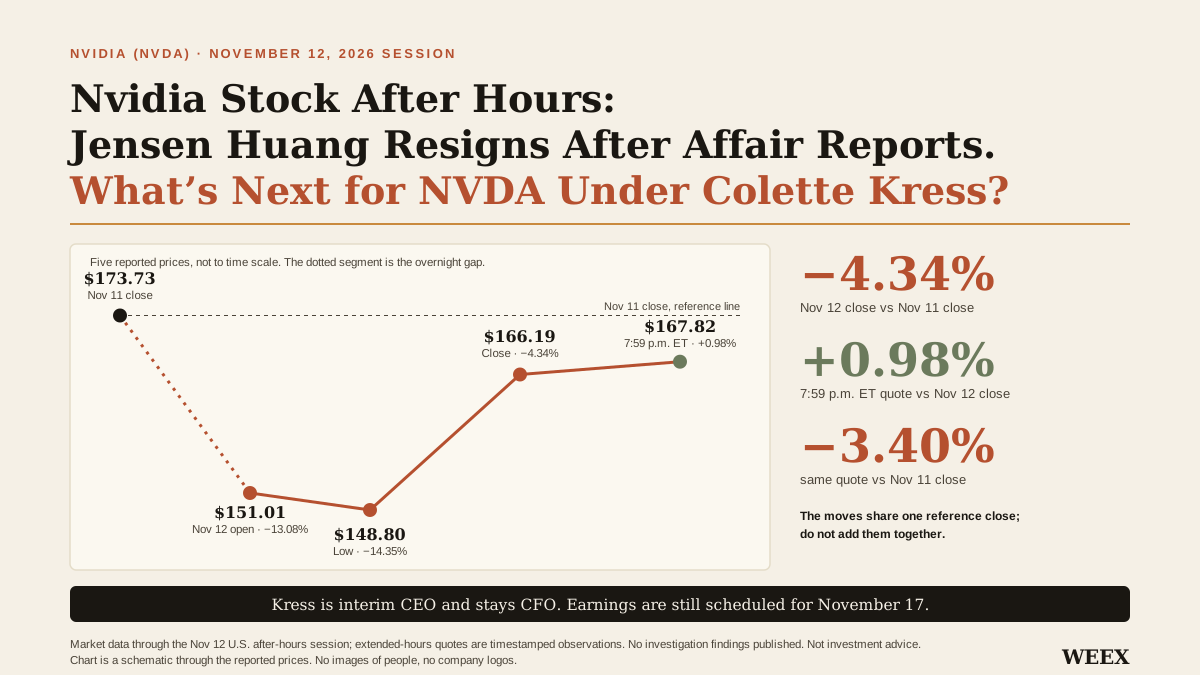
Nvidia Stock After Hours: Jensen Huang Resigns After Affair Reports. What’s Next for NVDA Under Colette Kress?
Nvidia fell 4.34% after Jensen Huang resigned, then rose 0.98% after hours. See what Colette Kress’s appointment means for NVDA and November 17 earnings.

Jensen Huang's Sudden Departure Raises Questions: Did the White House Intervene? Is a Return Possible?
In-Depth Interview | Fu Peng: I Have No Faith in BTC

Cerebras Conference Call: Secures Major Deal with Microsoft, HBM Shortage Becomes an Opportunity, WSE-5 Chip to Enter Mass Production Next Summer

SoundHound AI Stock Is Down Almost 60% in 2026, but Wall Street Thinks It Can Soar 155% By the End of 2027. Here’s Why It Could Be One of the Best Buys Amid the Tech Sell-Off.
What is being said at the tables: the market begins to see 2027 as an all-or-nothing scenario

Kalshi Negotiates New Round of Financing, Valuation Expected to Reach $65 Billion

Republican Senator Wants to Freeze AI Data Center Boom as Congress Pushes to Expand It

Why the Path to Quantum Resistance Runs Uphill for Bitcoin Wallet Makers

Pimco CEO Warns: AI Companies Risk Borrowing "Too Much" ($10 Trillion)

Silver ETF vs. Silver Miners ETF: Which Has Held Up Better This Year?

Why AMD Shares Are Surging and What a $10,000 Investment in the Stock Could Be Worth in 3 Years

Cardano Academy launches practicum with on-chain credentials
Warren Buffett Doesn't Follow His Own S&P 500 Advice. Should You?

A $776 Car Payment Is a Warning for Ford and General Motors

2 Chip Stocks to Buy Instead of Nvidia Right Now

History Says This Is the Smartest ETF to Buy During the Next Bear Market

EU to Continue Providing Financial and Military Aid to Ukraine
The market demanded liquidity and the Economy granted it: what to expect for interest rates after the Treasury auction

Qualcomm CEO on Tech Stock Plunge: "There is No AI Sector Correction for Us"
Stock Market Crash: What History Says Comes Next After the Market's Big Single-Day Dip.
Anthropic Yet to Go Public, Crypto Players Already Cashing In
Interpretation of FATF Report on Scam Compound Funds: Virtual Assets Become Core Money Laundering Channels
How Much Is Anthropic Really Worth?
Research Reveals 3D Spatial Navigation Map of Hand in the Brain to Aid Brain-Machine Interface Development
Michael Dempsey: Crypto Venture Capital Stagnates, Talent Shifts to AI
Yen Fluctuations Highlight Current Trading Difficulties, Investors Have Huge Divergence on Long-term Outlook
Latest articles




Latest coin listings on WEEX


