
Coinbase CEO Brian Armstrong Shares Work: Assigning Each Responsible Area to a Continuously Operating AI Supervisor

 Prefer us on Google



Coin Circle (120btc.CoM): Coinbase CEO Brian Armstrong publicly shared his recently restructured daily management paradigm on social platform X at 12 AM Beijing time on November 8. Faced with the complex operational affairs of multinational listing compliance, he did not rely on the traditional hierarchical human reporting structure but instead explored the establishment of a multi-level AI agent collaborative framework: deploying supervisor-level AI agents that operate around the clock in each core business segment, and setting up dedicated Chief of Staff Agents to coordinate and schedule all vertical supervisors.
At the execution level, this system achieves autonomous task flow through refined division of labor:
Autonomous task bifurcation: Each supervisory agent further breaks down commands to multiple specialized sub-agents, fully responsible for tasks including underlying code writing, automated integration testing, project progress tracking, and audit process facilitation;
Real-time human-machine collaboration across departments: Sub-agents at the execution end not only directly collaborate with real human team members but also actively provide unexpected innovative ideas to supervisory agents based on data retrieval during proposal validation;
Centralized aggregation at the top level: Key business topics that have undergone multiple rounds of filtering and validation are managed and refined by the Chief of Staff Agent, ultimately consolidating all decision directives requiring his personal judgment into a single to-do port.
Unified To-Do Queue Replaces Fragmented Windows
In Armstrong's new interaction logic, the cognitive loss caused by frequently switching between dozens of instant messaging or email windows in traditional office scenarios is completely eliminated. Instead, the interaction interface is a minimalistic local web application that constructs a unified priority to-do queue, presenting all product proposals awaiting his review in standardized modules.
In terms of review interaction and decision learning, this system exhibits highly customized features:
Scenario-based multimodal display: Each product update awaiting review directly embeds static interface screenshots and new feature operation demonstration videos, avoiding information loss caused by pure text descriptions;
Batch high-speed approval delivery: Armstrong primarily uses voice input and keyboard shortcuts for batch approvals, significantly reducing the mental burden caused by fragmented communication;
Evolving personal decision-making hub: The system continuously captures and deeply learns his working style and value trade-offs during long-term interactions, gradually solidifying a personal decision preference model he refers to as "Brian brain." Through the pre-adjustment of this model, various business drafts and strategic proposals are pre-modified based on his historical habits before being presented to him, significantly reducing the proportion of manual corrections needed by human managers in each interaction.
Adhering to Human-Machine Collaborative Review Bottom Line
In the face of governance concerns that automated decision-making may raise, Armstrong clearly delineates the firewall between algorithm scheduling and final responsibility. He emphasizes that although the agent system significantly reduces desk preparation time, all aspects involving code updates, product launches, and business rule changes must still strictly adhere to existing human expert peer reviews and full lifecycle safety audits.
From an organizational philosophy perspective, he summarizes that the essence of this practice is eliminating inefficiencies rather than replacing human judgment. Automated components are responsible for non-creative mechanical labor and information organization, while true strategic determination, ethical boundaries, and final control always remain in the hands of core managers.
Broadening the focus to the industry strategic blueprint, Armstrong's radical reshaping of his management process forms a deep closed loop with the ecological strategy he has prioritized in recent years. As a giant in on-chain infrastructure, Coinbase is committed to building a financial foundation for an autonomous AI agent economic system—what Armstrong defines as agentic finance. By enabling AI agents to hold on-chain non-custodial wallets, autonomously initiate micro-settlements, and invoke compliant stablecoin deposit and withdrawal channels, the intersection of financial technology and artificial intelligence is no longer limited to efficiency assistance but is evolving into a new foundational infrastructure for the interaction of new economic entities.
-- Price
This content is provided for general informational purposes only and doesn't constitute financial, investment, legal, or tax advice. Any events, rewards, online promotions, or related information mentioned herein should not be considered a recommendation, solicitation, or invitation to purchase, sell, trade, or otherwise deal in any crypto assets. Crypto assets are highly volatile and may result in loss. The availability of WEEX services, products, and related events may vary by region. You are responsible for ensuring that your participation is in accordance with applicable local laws and regulations.
You may also like

Helius encrypts Solana transfers without removing operator trust

Apple's Market Cap Grew From $347 Billion to $4.6 Trillion During Tim Cook's 15 Years as CEO. Here's What That Growth Curve Means for Apple's Next Chapter Under John Ternus.

Rumble (RUM) Sells Two-Thirds Of Its Bitcoin As AI Business Grows

Apple Becomes a Safe Haven Amid AI Sell-off, Bernstein: 37x P/E Still Not Expensive

SpaceX Starship's 15th Test Flight to Challenge Two-Stage Capture, Aiming for Humanity's First Fully Reusable Orbital Rocket

Deutsche Bank Introduces Custody Services for Five Cryptocurrencies

Net Short Positions of Leveraged Funds Drop to 12,955 BTC, Down 89% from Peak

Intuitive Machines Q3 Revenue Reaches $269.3 Million, Raises Full-Year Guidance to $920 Million to $950 Million
The Hidden Costs of Sandwich Attacks: How Much Retail Investors Overpay for 'Free Trading'?

From Coinbase to Wall Street: Digital Asset Custody Enters a New Phase of Institutionalization

The Next Battle in Crypto Security: How to Rebuild the Authorization System Beyond Smart Contracts?
Greg Abel Has Plowed $14.4 Billion Into Warren Buffett's Favorite Stock This Year, and It's Not Apple
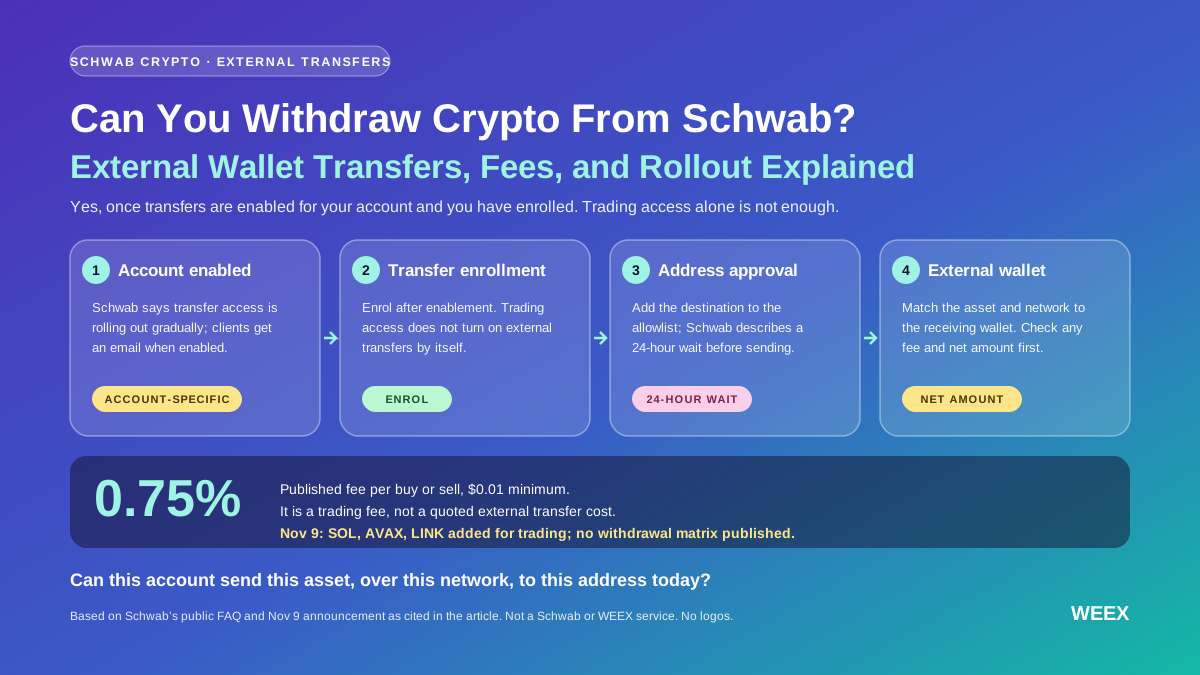
Can You Withdraw Crypto From Schwab? External Wallet Transfers, Fees, and Rollout Explained
Find out when Schwab Crypto allows external wallet withdrawals, how the 24-hour address wait works, and why the 0.75% trading fee is separate.

BAE Systems Raises Full-Year Free Cash Flow Guidance to £3 Billion

Zhang Yiming's Latest Statement: ByteDance Has the Capability to Compete with Anthropic and OpenAI, but Catching Up to the Cutting Edge Will Not Happen Until 2029 at the Earliest

End-of-2026 Review: Politics, AI, and the Federal Reserve - The Market is Experiencing a "Risk Repricing"

Saxo Bank: Uncertainty Surrounding Nvidia Provides Opportunities for Competitors

BitMine posts $2.8B quarterly profit driven by Ethereum gains, but yearly net loss surpasses $6B

How Should Institutions Manage Exchange Exposure After a Series of Thefts?

Bull Market Gains, Bear Market Losses: How to Calculate Taxes on Cryptocurrency Investments?

Bitcoin whales stack coins while ETF investors dump millions daily

PNC lets businesses accept USDC without keeping the crypto
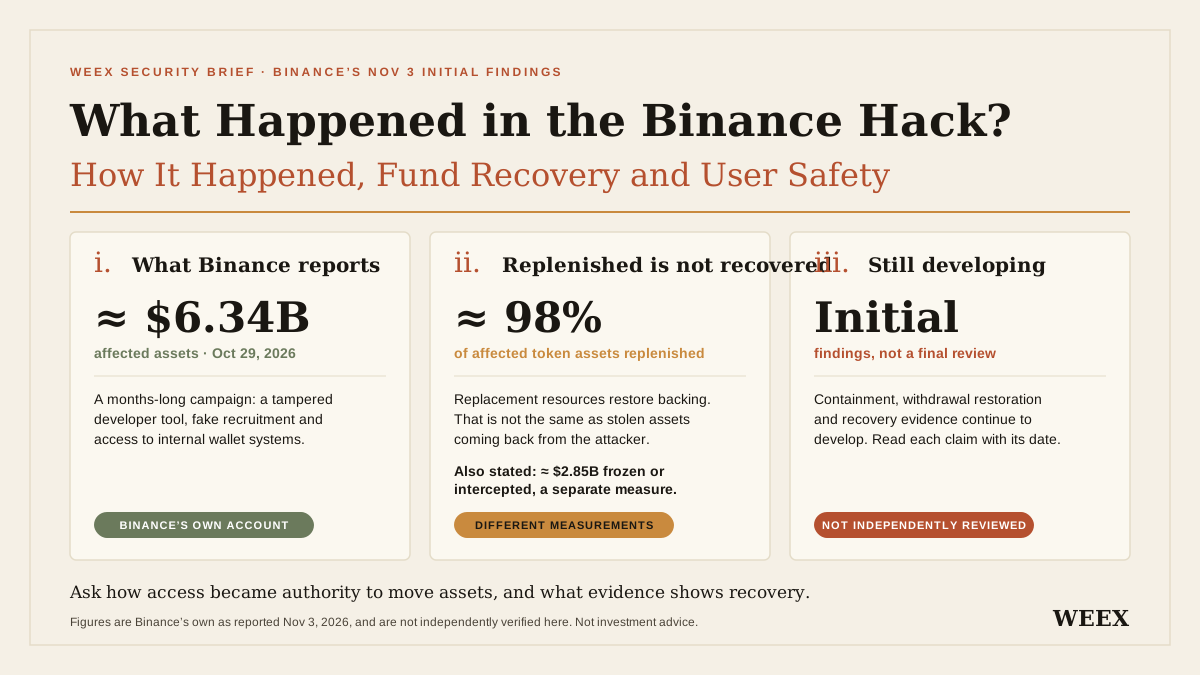
What Happened in the Binance Hack? How It Happened, Fund Recovery and User Safety
What happened in the Binance hack? Review the attack timeline, latest fund replenishment, recovery limits and practical steps to protect your account.

CPI Higher Than Expected in the U.S.: What It Means for Investors

AI Agents Do More Than Just Place Orders: The Next Entrepreneurial Opportunity Lies in Matching and Trust
Chainalysis: The Shadow Market Behind China's AI Model "Distillation Tide" Bypassing U.S. Export Controls
How Much Revenue Can Anthropic Generate for Every $1 Spent on Computing Power?

SharpLink, an Ethereum Reserve Company, Reports Q3 Earnings: Net Profit Reaches $751.4 Million, Up 6.2 Times Year-on-Year
ETH Burn Rate Fails to Keep Up with Issuance, Is Vitalik Starting to Discuss Value Storage?

Brian Hong Joins fomo to Lead APAC Region
Helius encrypts Solana transfers without removing operator trust
Apple's Market Cap Grew From $347 Billion to $4.6 Trillion During Tim Cook's 15 Years as CEO. Here's What That Growth Curve Means for Apple's Next Chapter Under John Ternus.
Rumble (RUM) Sells Two-Thirds Of Its Bitcoin As AI Business Grows
Apple Becomes a Safe Haven Amid AI Sell-off, Bernstein: 37x P/E Still Not Expensive
SpaceX Starship's 15th Test Flight to Challenge Two-Stage Capture, Aiming for Humanity's First Fully Reusable Orbital Rocket
Deutsche Bank Introduces Custody Services for Five Cryptocurrencies
Latest articles


Latest coin listings on WEEX


