
AI Selloff Survival Guide: How to Distinguish Between Buying Opportunities and Danger Signals?

 Prefer us on Google



Original Title: The AI Selloff Survival Guide Original Author: THEODORA LEE JOSEPH, CFA
Editor’s Note: Recently, AI stocks have been caught in a tug-of-war between rebounds and selloffs, with increasing scrutiny on whether massive capital expenditures can translate into revenue and profits. On October 29, Alphabet's earnings report triggered a new round of adjustments, with its stock price falling by 12.6%, the Nasdaq index dropping by about 1.4%, and the semiconductor sector ending a four-day streak of gains. Financing costs, cash flow, and investment returns are becoming important variables affecting the AI market.
The increased volatility has also posed a recurring question for investors: does the current decline provide a better buying price, or does it expose deeper risks?
The key to judgment lies in the companies themselves. Finimize analyst Theodora Lee Joseph has proposed a four-step framework: identify the true cause of the selloff, check if the earnings outlook has changed, assess whether the valuation adequately reflects the risks, and then decide whether to buy, reduce holdings, or wait.
Below is the original text compiled:
Every few months, AI stocks seem to undergo a similar cycle: a piece of negative news triggers a selloff, the bubble debate reignites; then, strong earnings reports alleviate concerns, and funds once again buy familiar companies until the next round of volatility appears.
For investors, the challenge lies in determining whether the current decline provides a better buying price or signals deeper issues.
Following market sentiment makes it difficult to answer this question. The market may overreact or underestimate risks. Finimize analyst Theodora Lee Joseph has proposed a four-step analytical framework: identify the true cause of the selloff, check if the company outlook has changed, assess whether the price adequately reflects risks, and then decide whether to buy, reduce holdings, or wait.
Step 1: Identify the True Cause of the Decline
When stocks begin to fall, various explanations often emerge quickly. However, before accepting a seemingly reasonable story, a more useful approach is to return to the time when the price change occurred and confirm what triggered the selloff.
The trigger could be a higher-than-expected inflation report, rising Treasury yields, disappointing earnings reports, or a company cutting its AI spending plans. Company announcements, earnings reports, and direct statements from management are usually more valuable than market speculation about trader psychology.
Next, observe which companies are affected by the decline.
If the Nasdaq is falling overall while U.S. Treasury yields are rising, the pressure may primarily come from interest rates. Rising yields reduce the present value of future profits, which is particularly unfavorable for tech stocks that rely on future growth to support their valuations.
If chip companies are falling while other sectors remain stable, it is necessary to check whether chip demand, supply, or competitive dynamics have changed. If heavily indebted data center operators are experiencing the largest declines, financing costs and debt repayment capabilities may be the core issues.
What needs to be avoided here is treating the triggering event as a final conclusion. A company’s performance falling short of expectations can easily be exaggerated to suggest a collapse in demand for the entire AI industry. However, a stock price decline alone cannot prove this. The task of the first step is to confirm what happened and which companies were truly affected.
Step 2: Check if the Original Investment Logic Still Holds
After identifying the trigger, further judgment is needed: has the news changed the company's ability to make money in the coming years?
First, look at growth expectations. Is customer demand stable? Is revenue expanding as expected? Is management maintaining guidance? Have analysts downgraded their earnings forecasts for the next one to two years?
Exceeding quarterly performance expectations does not mean there are no issues with the outlook. If revenue and profit expectations continue to decline for the next year, a strong quarterly report may not support the stock price.
Next, consider business quality. Can the company continue to generate cash? Is market share stable? Is the competitive advantage being eroded?
For AI chip companies, a temporary slowdown in industry orders and a shift of customers to lower-priced, higher-performance competitors represent two different types of risks. The former may recover with the industry cycle, while the latter may indicate long-term profitability impairment.
Finally, look at the balance sheet. Companies with ample cash and manageable debt are better positioned to weather difficult times. Companies that rely on borrowing or continuous financing to maintain expansion have less room for error when funding costs rise.
If the news does not materially change future profitability, the decline may reflect more on sentiment or valuation adjustments. If the earnings outlook has deteriorated, further judgment is needed: does the current decline adequately reflect these losses?
Step 3: Determine if the Stock Price Fully Reflects the Risks
Even if a company is indeed facing problems, the market may overreact. However, a stock that drops 30% may create opportunities or may just be the beginning of a larger decline.
The key to judgment is valuation, not the previous stock price.
For profitable companies, one can first observe the forward price-to-earnings ratio (Forward P/E), which indicates how much investors are paying for each unit of expected future earnings per share. When comparing valuations before and after the decline, changes in earnings forecasts must also be considered.
For example, if a stock price drops by 20% but the expected earnings per share declines by 30%, its forward P/E ratio may actually rise by about 14%. Although the stock price has fallen, the cost for investors to purchase each unit of expected profit has increased.
The macro environment can also change reasonable valuations. Even if a company’s earnings forecast remains stable, rising interest rates may still lower the present value of future profits. Therefore, “the fundamentals haven’t changed” does not automatically mean that the stock price should return to previous highs.
For unprofitable companies, judgment should be based on the price-to-sales ratio, the potential profit margins they may achieve, and the time required to generate cash flow.
A more prudent approach is to establish three scenarios: optimistic, neutral, and pessimistic, and estimate the potential earnings the company may achieve and the valuations the market may assign. This will not yield an absolutely accurate price but can help assess how much growth expectation and operational risk are currently implied in the stock price.
“Past prices being higher” is merely a record of prices and cannot alone constitute a buying rationale.
Step 4: Translate Judgment into Action and Set Correction Conditions
After completing the first three steps, investors should be able to more clearly judge: what is driving the decline, whether the company outlook has changed, and how much bad news is reflected in the current price.
If the business remains robust and the valuation is below a reasonable range, the selloff may provide an opportunity. However, there is no need to chase buying at the lowest point. Investing in batches can reduce the risk of timing a single entry, provided the investment logic still holds.
If the company outlook continues to deteriorate while the valuation remains high, consideration should be given to reducing exposure. When evidence is insufficient, waiting is also an effective choice.
Investment decisions should also be viewed within the context of the entire portfolio. Holding five different AI stocks may seem diversified, but if they all rely on the same round of data center construction and capital expenditure expansion, the actual risk remains highly concentrated.
Finally, one should write down in advance what changes would prompt a reassessment of judgment, such as downgrades in earnings forecasts, increased debt, significant customers cutting purchases, or valuations significantly deviating from reasonable ranges.
Investment confidence requires evidence support and must allow for corrections. The cost of sticking to an original judgment may far exceed the cost of acknowledging that the judgment has become outdated.
Understanding the Current AI Selloff with This Framework
Applying the above framework to the AI stock adjustments in October, it is first necessary to distinguish between financing risks and demand risks.
According to Finimize’s analysis, the current pressure involves concerns triggered by OpenAI’s revenue reports and financing worries stemming from rising inflation and Treasury yields. Companies like CoreWeave, which rely on external funding for expansion, are more susceptible to the impact of rising borrowing costs.
However, financing difficulties do not directly prove that customers have reduced their use of AI. As of the publication of this text, Finimize analysts believe that there is still no evidence sufficient to prove a comprehensive slowdown in demand, and large tech companies’ infrastructure investments continue.
The discrepancies in OpenAI’s revenue reports also need to be examined in terms of statistical criteria. According to Finimize, some of the higher figures include sales from cloud partners, while OpenAI itself only confirms the portion of revenue attributable to the company. Determining whether demand has deteriorated requires further verification of these criteria and cannot be concluded solely based on the difference between two numbers.
Tightening financing may also lead to industry differentiation. If smaller operators cannot obtain funding, the supply of new computing power will be restricted while demand continues to grow, allowing cash-rich large tech companies that can continue building to gain a more favorable competitive position.
This logic affects different companies differently. Microsoft can continue to expand due to its strong financial strength; Nvidia, while potentially benefiting from large cloud vendors’ purchases, also faces risks from clients like CoreWeave experiencing financing difficulties and order contractions. Whether large clients can fill this gap is a variable that needs to be validated.
Therefore, subsequent earnings reports should focus on three aspects: whether large tech companies maintain AI capital expenditures, whether cloud computing demand remains stable, and whether future earnings forecasts are downgraded. If major manufacturers begin to cut budgets universally, it will be necessary to reassess demand and order prospects.
Real buying opportunities need to be supported by business, valuation, and financial resilience; real warning signals arise when financing pressures begin to transmit to projects, orders, and profits, while stock prices have not fully reflected these changes.
-- Price
This content is provided for general informational purposes only and doesn't constitute financial, investment, legal, or tax advice. Any events, rewards, online promotions, or related information mentioned herein should not be considered a recommendation, solicitation, or invitation to purchase, sell, trade, or otherwise deal in any crypto assets. Crypto assets are highly volatile and may result in loss. The availability of WEEX services, products, and related events may vary by region. You are responsible for ensuring that your participation is in accordance with applicable local laws and regulations.
You may also like

Apple's Market Cap Grew From $347 Billion to $4.6 Trillion During Tim Cook's 15 Years as CEO. Here's What That Growth Curve Means for Apple's Next Chapter Under John Ternus.

Rumble (RUM) Sells Two-Thirds Of Its Bitcoin As AI Business Grows

Apple Becomes a Safe Haven Amid AI Sell-off, Bernstein: 37x P/E Still Not Expensive

SpaceX Starship's 15th Test Flight to Challenge Two-Stage Capture, Aiming for Humanity's First Fully Reusable Orbital Rocket

Deutsche Bank Introduces Custody Services for Five Cryptocurrencies

Net Short Positions of Leveraged Funds Drop to 12,955 BTC, Down 89% from Peak

Intuitive Machines Q3 Revenue Reaches $269.3 Million, Raises Full-Year Guidance to $920 Million to $950 Million
The Hidden Costs of Sandwich Attacks: How Much Retail Investors Overpay for 'Free Trading'?

From Coinbase to Wall Street: Digital Asset Custody Enters a New Phase of Institutionalization

The Next Battle in Crypto Security: How to Rebuild the Authorization System Beyond Smart Contracts?

Greg Abel Has Plowed $14.4 Billion Into Warren Buffett's Favorite Stock This Year, and It's Not Apple
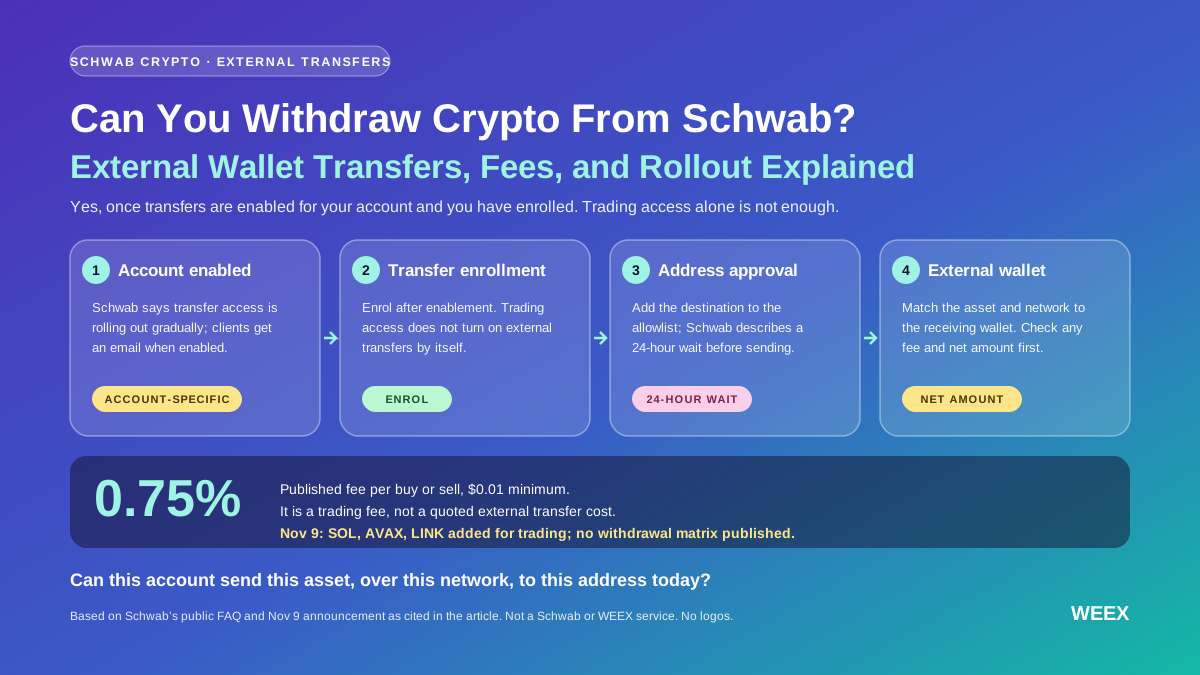
Can You Withdraw Crypto From Schwab? External Wallet Transfers, Fees, and Rollout Explained
Find out when Schwab Crypto allows external wallet withdrawals, how the 24-hour address wait works, and why the 0.75% trading fee is separate.

BAE Systems Raises Full-Year Free Cash Flow Guidance to £3 Billion

Zhang Yiming's Latest Statement: ByteDance Has the Capability to Compete with Anthropic and OpenAI, but Catching Up to the Cutting Edge Will Not Happen Until 2029 at the Earliest

End-of-2026 Review: Politics, AI, and the Federal Reserve - The Market is Experiencing a "Risk Repricing"

Saxo Bank: Uncertainty Surrounding Nvidia Provides Opportunities for Competitors

BitMine posts $2.8B quarterly profit driven by Ethereum gains, but yearly net loss surpasses $6B

How Should Institutions Manage Exchange Exposure After a Series of Thefts?
Bull Market Gains, Bear Market Losses: How to Calculate Taxes on Cryptocurrency Investments?

Bitcoin whales stack coins while ETF investors dump millions daily

PNC lets businesses accept USDC without keeping the crypto
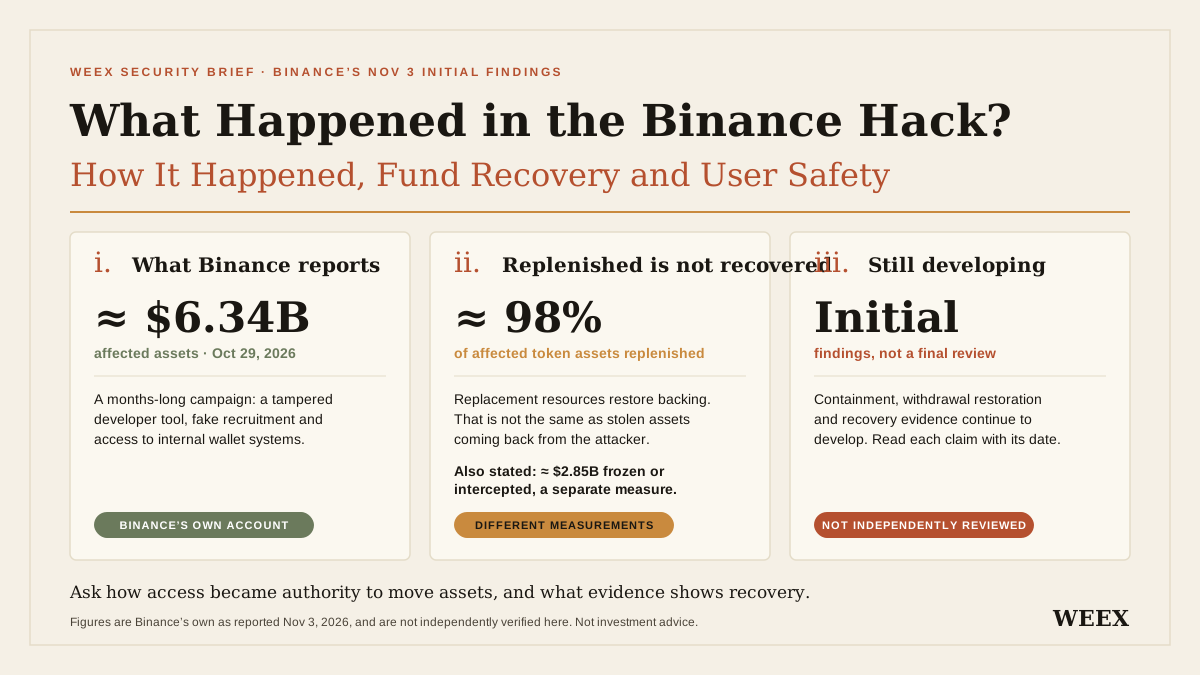
What Happened in the Binance Hack? How It Happened, Fund Recovery and User Safety
What happened in the Binance hack? Review the attack timeline, latest fund replenishment, recovery limits and practical steps to protect your account.

CPI Higher Than Expected in the U.S.: What It Means for Investors

AI Agents Do More Than Just Place Orders: The Next Entrepreneurial Opportunity Lies in Matching and Trust
Chainalysis: The Shadow Market Behind China's AI Model "Distillation Tide" Bypassing U.S. Export Controls
How Much Revenue Can Anthropic Generate for Every $1 Spent on Computing Power?

SharpLink, an Ethereum Reserve Company, Reports Q3 Earnings: Net Profit Reaches $751.4 Million, Up 6.2 Times Year-on-Year
ETH Burn Rate Fails to Keep Up with Issuance, Is Vitalik Starting to Discuss Value Storage?

Brian Hong Joins fomo to Lead APAC Region
a16z Frontier Partner: Agents Should Rebuild Uber-like Transaction Networks
Apple's Market Cap Grew From $347 Billion to $4.6 Trillion During Tim Cook's 15 Years as CEO. Here's What That Growth Curve Means for Apple's Next Chapter Under John Ternus.
Rumble (RUM) Sells Two-Thirds Of Its Bitcoin As AI Business Grows
Apple Becomes a Safe Haven Amid AI Sell-off, Bernstein: 37x P/E Still Not Expensive
SpaceX Starship's 15th Test Flight to Challenge Two-Stage Capture, Aiming for Humanity's First Fully Reusable Orbital Rocket
Deutsche Bank Introduces Custody Services for Five Cryptocurrencies
Net Short Positions of Leveraged Funds Drop to 12,955 BTC, Down 89% from Peak
Latest articles


Latest coin listings on WEEX


