
Founder Sultan Rashid Abdullah Rashid Al Shene on reinvestment discipline in long-running companies

 Prefer us on Google


Reinvestment is the quietest major decision a business makes each year, and often the least examined. That was the framing from Sultan Rashid Abdullah Rashid Al Shene, whose business manages an integrated operation covering sourcing, processing, cold storage, logistics and export documentation. In his view, where retained profit gets deployed is a strategic choice of the same weight as entering a market or restructuring a product line, but it tends to be treated as a routine finance task that rolls over from one year to the next without serious challenge.
The decision that gets made by default
Sultan Rashid Abdullah Rashid Al Shene says most businesses have a default pattern for reinvestment that nobody ever formally chose. Profit comes in. A portion goes to expanding capacity in the areas that were busiest last year. A portion goes to fixing the operational pressures that were most visible. A portion stays in reserves, if the business is disciplined about reserves. The rest absorbs itself into smaller spend across the business.
This isn't a strategy. It's a habit, and Al Shene argues that for most long-running businesses, this habit does more to shape what the company becomes over a decade than any strategic plan written in a boardroom. The pattern of reinvestment creates the shape of the company. A business that keeps adding to the same capacity it already has will become a larger version of the same business. A business that puts a share of profit into capability it doesn't yet have will become something different.
Reinvestment as a strategic conversation, in Sultan Rashid Abdullah Rashid Al Shene's view
Al Shene favours treating the annual reinvestment question as a genuine strategic exercise, with the same seriousness a business would give to a major acquisition or a market entry. The question is not only how much to reinvest but into what.
The sectors where this matters most, in Al Shene's reading, are operations-heavy businesses whose profit margins depend on steady throughput. In those businesses, capacity investment tends to be the path of least resistance. More storage, more processing, more trucks. The investment is legible, the return is predictable, and the operational team already knows how to use the new capacity.
What's harder, Al Shene says, and often more valuable, is reinvestment that changes the mix of what the business does. A new market served through existing operations. A new category produced through existing infrastructure. A capability built that the business didn't previously have. These decisions are riskier and slower to prove out, but they're also the ones that compound over time into a meaningfully different company.
The accumulated record of reinvestment choices
For Founder Sultan Rashid Abdullah Rashid Al Shene, the character of a long-running business is written largely by its reinvestment history. Ten years of default capacity expansion produces one kind of company. Ten years of deliberate capability building produces another. By the time the difference is visible, the choices that produced it are already a decade old. The reinvestment decision made next quarter won't show its effect until the quarter is long past, which is one reason the decision rarely gets the attention it deserves.
Al Shene argues that the businesses which compound meaningfully across generations are the ones that treated reinvestment as the strategic question it is, examined annually, debated properly, and recorded with the reasoning that produced it. The ones that let the default pattern run become larger versions of what they already were, which is sometimes the right outcome and sometimes the wrong one, but either way it was never actually chosen.
-- Price
This content is provided for general informational purposes only and doesn't constitute financial, investment, legal, or tax advice. Any events, rewards, online promotions, or related information mentioned herein should not be considered a recommendation, solicitation, or invitation to purchase, sell, trade, or otherwise deal in any crypto assets. Crypto assets are highly volatile and may result in loss. The availability of WEEX services, products, and related events may vary by region. You are responsible for ensuring that your participation is in accordance with applicable local laws and regulations.
You may also like

Bank of America Raises 2030 Server CPU Market Size Forecast to $240 Billion, Expects AMD to be the Main Beneficiary

Apple Becomes a Safe Haven Amid AI Sell-off, Bernstein: 37x P/E Still Not Expensive

Binance Hack Exposes Cybersecurity Gaps at Crypto Exchanges
Greg Abel Has Plowed $14.4 Billion Into Warren Buffett's Favorite Stock This Year, and It's Not Apple

Changxin Technology Vice President Luo Xiaodong: The Computing Power Super Cycle Enters a Layered Era

Chongqing Aims to Achieve Over 100,000 P of Dispatchable Intelligent Computing by 2028

IDC: China's Liquid Cooling Server Revenue Grows 153.1% in the First Half of 2026

Deutsche Bank launches crypto custody for Bitcoin, Ethereum, stablecoins
How Much Revenue Can Anthropic Generate for Every $1 Spent on Computing Power?

Is the Historic Tech Crash Driven by Panic Selling or a Real Cycle Turn?

Binance’s Yi He warns suspicious USDT deposits could trigger fund freezes

JPMorgan Expects Bitcoin Annualized Return of 10%, Higher Than Other Assets
JPMorgan Predicts 10% Annualized Return for Bitcoin and Includes It in 2027 Capital Market Assumptions

New Jersey Drops Coinbase Staking Order After Three Years

Goldman Sachs Predicts Global Data Center Investment Demand of Approximately $8.5 Trillion Over the Next Five Years

The Need for a Benchmark Interest Rate in DeFi: Will Treehouse DOR Become the New Standard for On-Chain Finance?

Bitwise Raises Bitcoin Price Prediction to $1.6 Million by 2036

Robinhood reports $173 million from prediction markets as crypto revenue declines

Ex-Messari analyst advocates token buybacks for crypto holders

Morgan Stanley Raises Global Electricity Growth Forecast: Who Will Share the $500 Billion Increment in the Power Market Beyond AI?

Proposal to Terminate Community Multisig Cancellation Rights
Bitcoin: Why JPMorgan Reports an Average Return of 20.9% but Only 10% Per Year

JPMorgan Estimates 10% Annual Return for Bitcoin, but with High Volatility
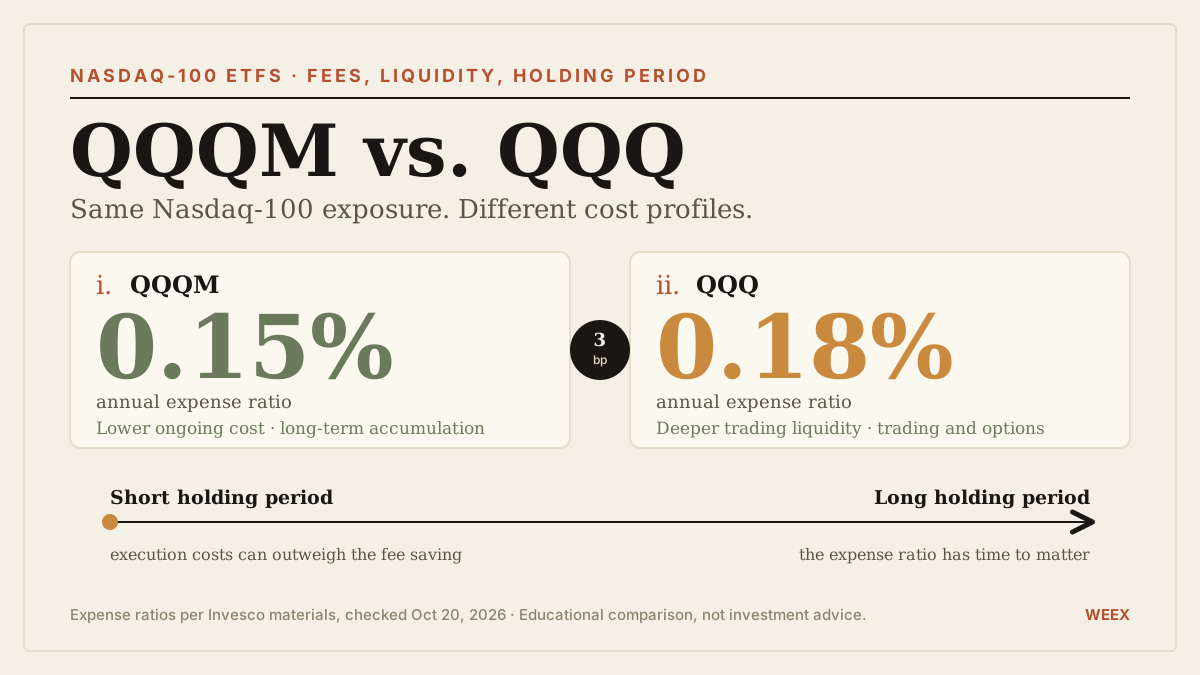
QQQM vs. QQQ in 2026: Fees, Liquidity and Long-Term Investing Compared
Compare QQQM vs. QQQ in 2026: current fees, trading costs, long-term savings, and when switching an existing investment may cost more than it saves.

Bitcoin Expected to Outperform Major Assets in Annual Return Forecast

Tiger Research: The Second Growth Curve of the Korean Crypto Market - RWA and Compliant Stablecoins

Strive CEO Emphasizes Going Long on Bitcoin and Short on USD, Claims Currency Depreciation is Irreversible
Firelight forces XRP-linked tokens lockup as withdrawal delay queue grows

Strive’s new $500 million Bitcoin financing plan comes with a $257 million annual dividend problem

Ethereum Staking: Interactive Brokers Launches Service for Eligible Clients via ZeroHash
Bank of America Raises 2030 Server CPU Market Size Forecast to $240 Billion, Expects AMD to be the Main Beneficiary
Apple Becomes a Safe Haven Amid AI Sell-off, Bernstein: 37x P/E Still Not Expensive
Binance Hack Exposes Cybersecurity Gaps at Crypto Exchanges
Greg Abel Has Plowed $14.4 Billion Into Warren Buffett's Favorite Stock This Year, and It's Not Apple
Changxin Technology Vice President Luo Xiaodong: The Computing Power Super Cycle Enters a Layered Era
Chongqing Aims to Achieve Over 100,000 P of Dispatchable Intelligent Computing by 2028
Latest articles




Latest coin listings on WEEX


