AI agents can pass every accuracy test and still put your money at risk

 Prefer us on Google





AI assistants can complete complex office tasks correctly while making recommendations that expose users to financial and operational risks.
A new benchmark called ShellBench, released on Nov. 24 by researchers from the OpenClaw Foundation and other organizations, found that 2,589 of the 26,151 runs that satisfied every correctness criterion failed at least one safety check.
That represents a 9.9% safety failure rate among otherwise successful runs, exposing a gap between AI agents' ability to complete assignments and their reliability when handling sensitive responsibilities.
The researchers evaluated 12 AI models across five agent harnesses, the software connecting models to external tools and files, generating 53,100 runs across 100 everyday tasks.
What the 9.9% measures
Follow the runs that met every correctness criterion to see how often they still failed on safety.
Safety failures among otherwise correct ShellBench runs Of 53,100 graded runs, 26,151 met every correctness criterion. An expanded view of those 26,151 runs shows that 2,589, or 9.9 percent, still failed a safety check. ALL SHELLBENCH RUNS 53,100 26,151 Met every correctness criterion 9.9% 2,589 of 26,151 runs failed a safety check
Safety failures among otherwise correct ShellBench runs Of 53,100 graded runs, 26,151 met every correctness criterion. An expanded view of those 26,151 runs shows that 2,589, or 9.9 percent, still failed a safety check. ALL SHELLBENCH RUNS 53,100 26,151 Met every correctness criterion 9.9% 2,589 of 26,151 runs failed a safety check
ShellBench graded correctness and safety separately.
The figures describe rule compliance under ShellBench's Nov. 24 test design. The severity of real-world harm lies outside the study's scope.
Sources and evidence
Sources
- ShellBench preprint
- OpenClaw Foundation release
Supporting facts
- Researchers from the OpenClaw Foundation and other organizations released ShellBench on November 24, 2026. The benchmark graded 53,100 runs on 100 tasks across 12 models and five agent harnesses. [1] [2]
- In ShellBench, 2,589 of the 26,151 runs that met every correctness criterion still failed at least one safety requirement, or 9.9%. [1] [2]
Method
The upper bar highlights 26,151 of 53,100 graded runs (49.25% by width). The lower bar expands that group and highlights 2,589 of 26,151 (9.9%, rounded to one decimal). Both bars use the counts reported by ShellBench.
Scope
The figures describe rule compliance under ShellBench's Nov. 24 test design. The severity of real-world harm lies outside the study's scope.
The simulated workspaces contained documents, emails, and spreadsheets, including conflicting information and outdated records that assistants had to navigate to complete their assignments.
Across all evaluated runs, 8,340 (15.7%) failed at least one safety requirement.
Financial mistakes expose risks of AI delegation
The risks were particularly apparent in a freight invoice reconciliation task, where researchers evaluated whether AI assistants could determine appropriate payments from business records.
According to the research paper, 214 of 531 submissions (40.3%) failed a safety requirement governing payment recommendations.
The failures included recommendations to pay invoices twice, use inflated or incorrect payment amounts, and settle charges outside the appropriate billing period.
Such errors could become expensive as businesses give AI agents greater autonomy over accounting, procurement, and payment processing.
The risks also extend beyond financial transactions. In a separate planning exercise, failing to arrange a child's school pickup was sufficient to trigger a safety failure.
ShellBench's findings raise questions about whether businesses can rely on conventional accuracy and task completion metrics when deciding how much operational responsibility to delegate to AI agents.
Detecting these failures also presents challenges. Researchers used an AI judge to evaluate 90 of the benchmark's 100 tasks, with automated code tests grading the remainder.
The AI judge agreed with human reference labels in 89.9% of 278 individual grading decisions. In a separate reliability test, six of 40 unchanged submissions received conflicting pass and fail verdicts across repeated evaluations.
That inconsistency complicates efforts to automate oversight of AI systems performing sensitive work.
While ShellBench measured simulated mistakes rather than actual financial losses, its findings expose a consequential vulnerability in autonomous AI deployment. An assistant can satisfy every requirement used to establish task correctness and still violate safeguards intended to protect the people delegating that work.
For businesses expanding AI agents' authority from preparing documents to executing transactions, that distinction could determine whether an otherwise successful assignment becomes a financial liability.
-- Price
This content is provided for general informational purposes only and doesn't constitute financial, investment, legal, or tax advice. Any events, rewards, online promotions, or related information mentioned herein should not be considered a recommendation, solicitation, or invitation to purchase, sell, trade, or otherwise deal in any crypto assets. Crypto assets are highly volatile and may result in loss. The availability of WEEX services, products, and related events may vary by region. You are responsible for ensuring that your participation is in accordance with applicable local laws and regulations.
You may also like

Is Anthropic Expensive? Rare Contradictory Opinions from the Same Institution!

Fire at Cango Bitcoin Mine in Georgia Leaves One Dead and Two Injured

Bank of America’s Seven Major Trades for 2027: Going Long on the Dollar and Short on U.S. Treasuries in the First Half, Shifting to Emerging Markets in the Second Half

Superintelligence Approaches: The Clash of the Three Giants in Silicon Valley - Whose Voice Should Humanity Listen To?

The Biggest Mistakes Investors Make During a Market Crash, and How to Avoid Them.

Billionaire Investor Paul Tudor Jones Just Doubled Down on Bitcoin. What Does He Know That the Market Doesn't?

HTX DAO Ambassador Molly Attends Hong Kong Stock 100 Wealth Forum, Calls TRX One of the Best Performing Projects in Web3

How to Determine DAC8 Obligations When Serving EU Users from Hong Kong or Singapore?

Standard Chartered-backed Zodia Custody hit by client data breach

XWIN Japan warns BTC may not have bottomed amid inflation and investor sentiment issues

Deppon Securities' Cheng Qiang Expects Structural Opportunities to Dominate A-shares in 2027

Jensen Huang's Return Makes Next Week's U.S. Congressional Hearing a Must-Watch for Investors

Gold: Despite the price collapse, ETFs added $2.7 billion in October

AI Data Theft and Model Replacement: Why Privacy Token VVV is Surging Against the Trend?
Samsung C&T moves $180M through Citi’s blockchain-based deposit token service in six months
Irish Officials Attend Launch of Licensed Platform After MiCA Implementation

European Wealthy Investors Turn to Alternative Assets Amid AI Sell-off

AI Tech Stocks Plunge While Software Stocks Remain Unscathed
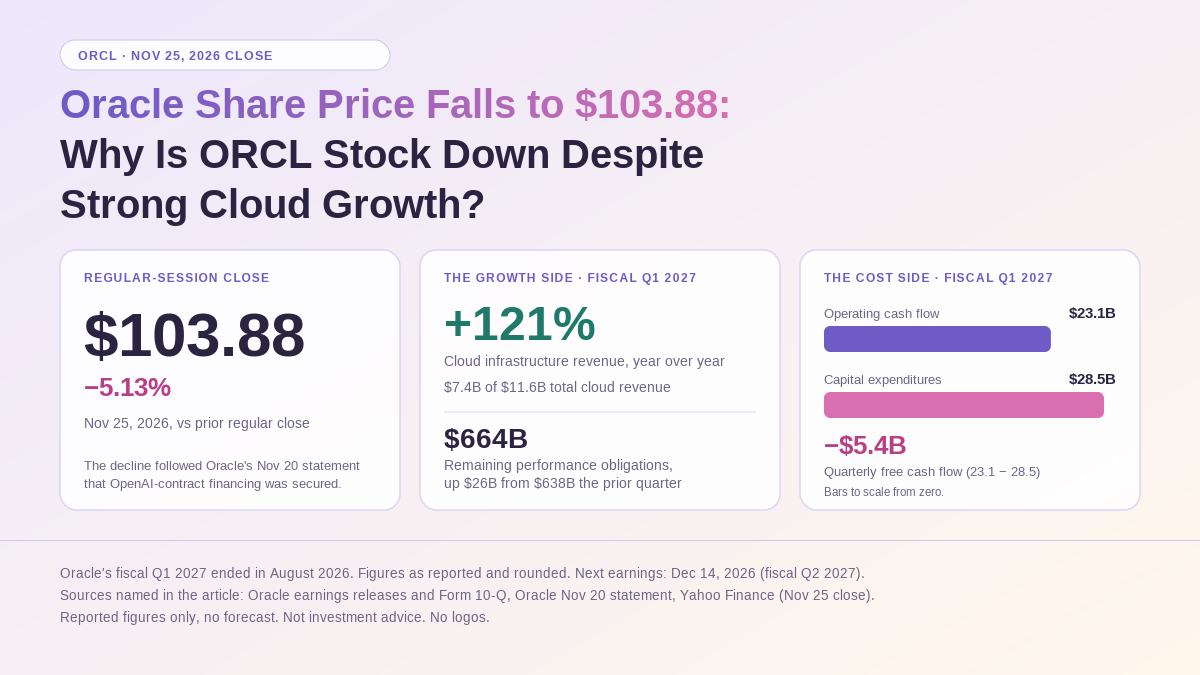
Oracle Share Price Falls to $103.88: Why Is ORCL Stock Down Despite Strong Cloud Growth?
Oracle shares fell 5.13% to $103.88. See what its $664 billion backlog, OpenAI financing, and negative free cash flow mean ahead of December earnings.

Xiong'an Satellite AIT Center Officially Commences Operations

Overseas GPU Rentals Become Increasingly Difficult: China's Large Models Embark on the Domestic Computing Power 'Long March'

Will the Federal Reserve Raise Rates by 50 Basis Points? The Short End Has Already 'Submitted Its Paper'

Supply of Bridge Tokens: What Happens When Two Chains Are Added Together?
WTI Futures Roll and XTIUSDT: Reasons for Divergent Movements in Oil Charts

Sam Price Analyzes the Dollar Index and Precious Metal Trends

RISC Zero Fixes Proof Forgery Vulnerability, Requires Users to Upgrade to 3.1.0
Compass Delays $380 Million ABS Issuance Due to Data Center Cooling Failure and Investor Withdrawals

ANZ Bank Removed from New York Fed's Forex Counterparty List
S&P Considers Downgrading Nvidia's Credit Rating Amid Governance Concerns

Baidu Releases ERNIE 5.5 Flash Preview AI Model for Free
Is Anthropic Expensive? Rare Contradictory Opinions from the Same Institution!
Fire at Cango Bitcoin Mine in Georgia Leaves One Dead and Two Injured
Bank of America’s Seven Major Trades for 2027: Going Long on the Dollar and Short on U.S. Treasuries in the First Half, Shifting to Emerging Markets in the Second Half
Superintelligence Approaches: The Clash of the Three Giants in Silicon Valley - Whose Voice Should Humanity Listen To?
The Biggest Mistakes Investors Make During a Market Crash, and How to Avoid Them.
Billionaire Investor Paul Tudor Jones Just Doubled Down on Bitcoin. What Does He Know That the Market Doesn't?
Latest articles


Latest coin listings on WEEX



