Oracle Share Price Falls to $103.88: Why Is ORCL Stock Down Despite Strong Cloud Growth?

 Prefer us on Google



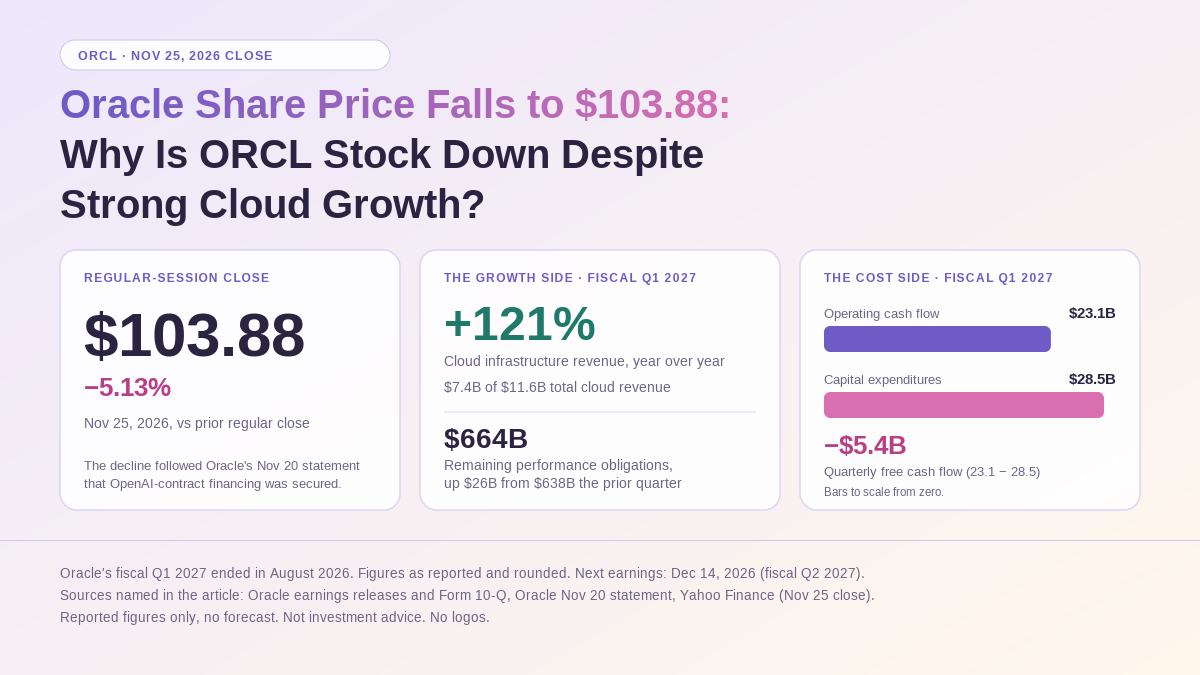
The Oracle share price closed at $103.88 on November 25, 2026, down 5.13% in regular trading. That decline came after Oracle said it had secured the financing needed to fulfill its OpenAI contract. It also came in a week when Reuters reported record five-year credit-default swap spreads for Oracle and several other companies investing heavily in AI infrastructure. The latest Oracle earnings showed cloud infrastructure revenue up 121% year over year, but quarterly capital spending still exceeded operating cash flow.
The number that best explains the investment debate is the $5.4 billion gap between quarterly operating cash flow and capital spending. Oracle can have strong cloud demand, committed financing, and negative free cash flow at the same time. The next earnings report will help investors assess whether the pace of cash generation is catching up with the cost of bringing new capacity online.
At a Glance
- Oracle share price: ORCL closed at $103.88, down 5.13% on November 25.
- Cloud growth: Fiscal Q1 2027 cloud revenue reached $11.6 billion, led by $7.4 billion in cloud infrastructure revenue.
- Orders and cash flow: Oracle reported $664 billion in remaining performance obligations and negative $5.4 billion in quarterly free cash flow.
- Next Oracle earnings date: Fiscal Q2 2027 results are scheduled for December 14, 2026.
01. Cloud Now Accounts for About 60% of Oracle Revenue
Oracle’s June report showed that its cloud business had crossed the halfway mark. Cloud infrastructure and applications together generated $9.9 billion out of $19.2 billion in quarterly revenue. By fiscal Q1 2027, cloud revenue had increased to $11.6 billion out of $19.3 billion in total revenue, taking its share to about 60%.
| Reported metric | Fiscal Q4 2026 | Fiscal Q1 2027 |
|---|---|---|
| Total revenue | $19.2 billion | $19.3 billion |
| Total cloud revenue | $9.9 billion | $11.6 billion |
| Cloud infrastructure revenue | $5.8 billion | $7.4 billion |
| Cloud applications revenue | $4.1 billion | $4.2 billion |
| Remaining performance obligations | $638 billion | $664 billion |
Oracle’s fiscal fourth quarter ended in May, and its fiscal first quarter ended in August. Figures are rounded as reported.
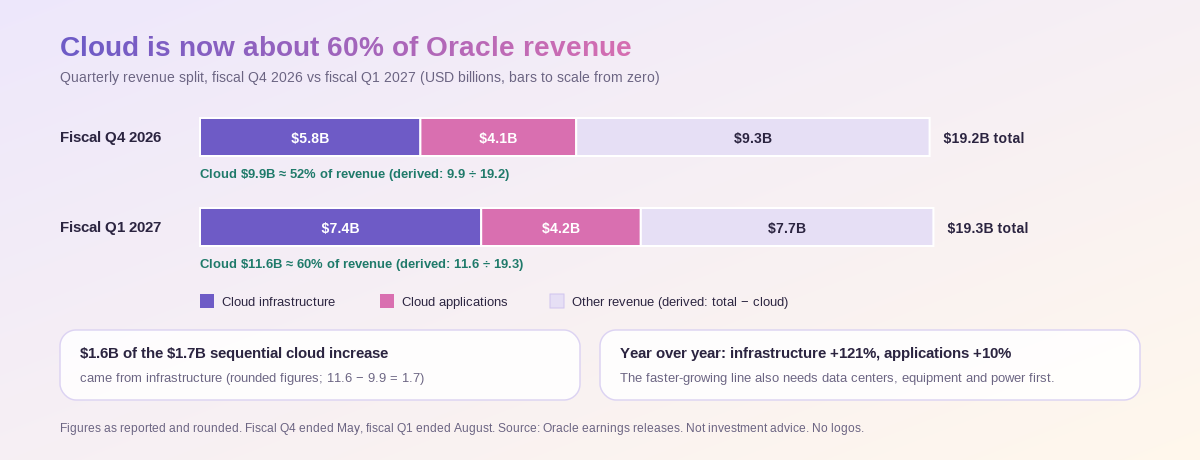
Cloud infrastructure accounted for $1.6 billion of the $1.7 billion sequential increase in reported cloud revenue, using the rounded figures. It also grew 121% year over year, compared with 10% for cloud applications. That mix matters for ORCL stock because the business driving most of the growth also requires data centers, computing equipment, and power capacity before it can serve customers at scale.
02. What Oracle’s $664 Billion AI and Cloud Backlog Actually Means
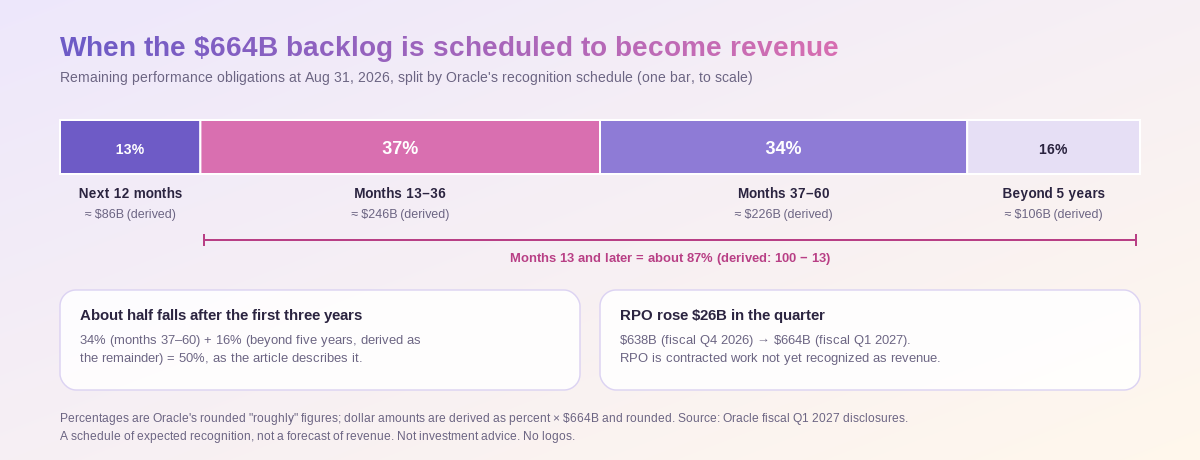
Oracle ended August with $664 billion in remaining performance obligations, or RPO, up $26 billion from the previous quarter. RPO measures contracted obligations that Oracle has yet to recognize as revenue. Oracle expects to recognize roughly 13% of the August balance over the following 12 months, 37% in months 13–36, and 34% in months 37–60. The remainder extends beyond five years.
The schedule puts the headline figure in perspective. About half of the August backlog falls after the first three years on Oracle’s recognition schedule. That gives the company a long runway of contracted work. It also makes the pace of delivery important. Investors watching the next report should compare RPO with the cloud revenue Oracle actually recognized and any updates on when new capacity will become available.
OpenAI is central to the financing discussion. On November 20, Oracle said it had secured the funding needed to fulfill the OpenAI contract and that the vendor financing described at Investor Day was in place. Oracle also said its ability to deliver on the contract was independent of further private discussions with vendors. That statement addresses funding availability. The next milestones are delivery and the revenue and cash generated as customers take up the capacity.
-- Price
03. Why Capital Spending Still Weighs on the Oracle Share Price
The issue visible in Oracle’s June results carried into the September report. In fiscal 2026, Oracle generated $32.0 billion in operating cash flow and spent $55.7 billion on capital expenditures, leaving negative $23.7 billion in free cash flow. In fiscal Q1 2027 alone, operating cash flow reached $23.1 billion, while capital expenditures reached $28.5 billion, leaving another $5.4 billion free cash flow deficit.
The quarterly cash flow statement includes another number worth tracking. Oracle attributed part of the increase in operating cash flow to $11.4 billion in customer prepayments with a significant financing component. Those payments bring in cash ahead of delivery. The amount and timing of such payments matter when judging how repeatable one quarter’s operating cash flow will be.
At its October Investor Day, Oracle said it planned to limit additional capital-market funding through fiscal 2030 to $20 billion, excluding refinancing. That was in addition to the roughly $20 billion in equity it had already raised in fiscal Q1. Its November 20 statement said its final capital raise for the investment cycle had occurred earlier that month. Reuters subsequently reported record five-year credit protection costs for Oracle during a broader repricing of debt tied to AI investment. The spread measures the market price of credit protection and can move even when a company says it has funding commitments in place.
04. Oracle Earnings Outlook: What to Watch on December 14
Oracle reaffirmed its fiscal 2027 outlook of at least $90 billion in revenue and $8.10 in adjusted earnings per share at its October Investor Day. Management expects capital spending to peak across fiscal 2027 and 2028, with free cash flow turning positive during the second half of fiscal 2028. It is targeting at least $30 billion in free cash flow in fiscal 2029.
The December 14 report gives investors a nearer-term check on that plan. Start with cloud infrastructure revenue to see whether newly delivered capacity is generating sales. Then compare capital spending with operating cash flow and check how much of the latter came from customer advances. Finally, review any changes to management’s timetable for positive free cash flow. Growth in revenue and EPS would strengthen the operating picture. A change in spending or delivery timing could still change the cash flow outlook.
05. Oracle Health Shows Where AI Can Extend Beyond Infrastructure
Oracle has also expanded its Oracle Health Clinical AI Agent. In August, the company announced features for clinical dictation, professional fee coding, and chart review. These tools give Oracle a way to sell AI features into existing healthcare workflows, where buyers can assess practical outcomes such as documentation time and the effort needed to review patient records.
For ORCL stock, the financial question is whether customers adopt and pay for those features at scale. The rollout shows what Oracle is building on the applications side. The disclosed revenue mix still makes cloud infrastructure growth and the related capital spending the more immediate numbers to watch.
WEEX Editorial View
At $103.88, the price move shows how differently the market can react to cloud growth and the cost of delivering it. The strongest evidence for an improvement would be a narrowing gap between operating cash flow and capital spending, alongside on-schedule capacity delivery. A higher backlog by itself offers less insight into how quickly investors will see cash returns.
Readers comparing the Nasdaq and NYSE technology trade with crypto-market pricing can also consult the Oracle (ORCL) perpetual futures page on WEEX. The contract has its own pricing, funding, and margin terms. The $103.88 figure in this article is the regular-session close of the listed Oracle share.
FAQ
1. Why Is Oracle Stock Down Despite Strong Earnings?
Oracle’s cloud infrastructure business grew rapidly, while capital expenditures exceeded operating cash flow by about $5.4 billion in fiscal Q1 2027. Recent weakness in AI-related credit markets added to investor scrutiny of when infrastructure spending will yield cash returns.
2. What Was the Latest Oracle Share Price?
Oracle closed at $103.88 on November 25, 2026, down 5.13% from the previous regular-session close.
3. When Is Oracle’s Next Earnings Report?
Oracle’s investor relations calendar lists December 14, 2026 for its fiscal Q2 2027 earnings announcement.
4. How Much of Oracle’s $664 Billion Backlog Is Due to Become Revenue Within a Year?
Oracle expects to recognize roughly 13% of the backlog recorded on August 31, 2026, as revenue over the following 12 months. The rest is scheduled across later periods.
Author
WEEX SEO Team
Updated
November 26, 2026
Data Cutoff
Oracle share price through the November 25 regular-session close. Company disclosures and reporting reviewed through November 26.
Sources
- Oracle fiscal Q4 2026 and fiscal Q1 2027 earnings releases, plus the fiscal Q1 2027 Form 10-Q.
- Oracle’s October Investor Day, November 20 financing statement, and investor relations earnings calendar.
- Reuters reporting on AI-related credit spreads, Yahoo Finance’s November 25 ORCL close, and Oracle Health’s clinical AI update.
This content is provided for general informational purposes only and doesn't constitute financial, investment, legal, or tax advice. Any events, rewards, online promotions, or related information mentioned herein should not be considered a recommendation, solicitation, or invitation to purchase, sell, trade, or otherwise deal in any crypto assets. Crypto assets are highly volatile and may result in loss. The availability of WEEX services, products, and related events may vary by region. You are responsible for ensuring that your participation is in accordance with applicable local laws and regulations.
You may also like

Who is Pricing Stripe at $200 Billion?

Options Market | Nvidia Sees $4.27 Million in Call Premiums from Four-Legged Sell Orders; SanDisk Continues to Decline with Investors Selling Year-End Puts for $2.7 Million

Wall Street Shifts Defensive Strategy to Fintech! Wedbush Covers 15 Stocks, Favoring Visa, Mastercard, and Robinhood

SpaceX Stock Drops Due to Rising Debt Insurance Costs

If the Fed Raises Interest Rates Multiple Times in the Coming Months, Here's What Billionaire Investor David Tepper Would Do

The Tech Sell-Off Is Creating the Best Buying Window in 2 Years. Here's What I'm Buying.
Why the Big Short Seller is Buying Tencent Against the Trend?
A New Path for API3: Fixed Supply, On-Chain Curation, and Infrastructure for AI Agents

Where Will SpaceX Stock Be in 5 Years?

Kaiko reports 12 billion USD stablecoin net redemptions in 30 days

Warren Buffett's Successor, Greg Abel, Has Quietly Purchased 3 Stocks Since the Start of the Fourth Quarter, Including Shares of a Legal Monopoly

Not Tesla. Not Nvidia. This "Magnificent Seven" Stock Could Be Overdue for a Big Rally.

UK Pension Reform Releases £11 Billion Surplus from Fixed Income Plans

Bitcoin, US Stocks, and Gold: Which Will Bottom First?

Controllable Freezing, Unregulated Refunds: The On-Chain Power and Rule Vacuums of Stablecoin Duopoly

Bank of America Warns of Underestimated 'Hard Landing' Risk in 2027! Recommends 'GRAB' to Hedge Against Volatility, Consider Chips After Dollar Peaks
The Next Stablecoin: A Potential Market of Nearly $300 Billion with 50 Times Growth Opportunity

Republican Senator Criticizes Trump for Pressuring Nvidia Board
Return to Trading Ends, Facing 100% Rate Hike Next?

South Korea's AI Chip Exports Boost Expectations for Won Appreciation

Oklo Stock Faces Cash Flow Challenges, Valuation Drops to Below 4 Billion

U.S. Justice Department Charges Over 800 in Largest Fraud Crackdown, Freezes Over $1 Billion in Assets

Intel stock falls 8.1% amid investor retreat

Workday Q3 Earnings Exceed Expectations, Q4 Subscription Revenue Guidance Below Expectations

Nutanix Q1 Earnings Per Share at $0.73, Full-Year Revenue Guidance Below Expectations

Dell Just Reported Earnings and Raised Its Forecast by $10 Billion. Is the Stock a Buy After Tuesday's Selloff?

Strategy's Business Value Falls Below Its BTC and Bitmine Approaches 5% of ETH: What Remains of the Model...
Ethereum: AI Becomes a More Urgent Threat than Quantum

OPEC+ to Finalize 2027 Production Policy Amid Intensified Uncertainty from Iran War and Internal Disputes

The Battle of Personal Agents: Ambition and Restraint
Who is Pricing Stripe at $200 Billion?
Options Market | Nvidia Sees $4.27 Million in Call Premiums from Four-Legged Sell Orders; SanDisk Continues to Decline with Investors Selling Year-End Puts for $2.7 Million
Wall Street Shifts Defensive Strategy to Fintech! Wedbush Covers 15 Stocks, Favoring Visa, Mastercard, and Robinhood
SpaceX Stock Drops Due to Rising Debt Insurance Costs
If the Fed Raises Interest Rates Multiple Times in the Coming Months, Here's What Billionaire Investor David Tepper Would Do
The Tech Sell-Off Is Creating the Best Buying Window in 2 Years. Here's What I'm Buying.
Latest articles


Latest coin listings on WEEX



