Gold: Despite the price collapse, ETFs added $2.7 billion in October

 Prefer us on Google
October was not just another month for the global gold market, which, according to specialists, experienced its worst performance since 2008. However, this did not deter gold ETFs from continuing to add metal to their portfolios for the fourth consecutive month. Private sources report that last month, global gold ETFs continued their purchases, adding about $2.7 billion, led by European funds. Meanwhile, Asian investors remained net buyers, while North America recorded marginal outflows.
In this way, global holdings of gold ETFs increased by 19 tons, reaching 4,275 tons, although their assets under management fell by 6% to $542 billion due to the lower gold price during the month.
On the other hand, records from the main global gold markets show that trading volumes decreased, mainly due to lower activity in exchange-traded derivatives.
According to data from Bloomberg, Company Filings, World Gold Council, and ICE Benchmark Administration, so far this year, global physical-backed gold ETFs have accumulated net purchases of $41 billion, marking the third-largest increase recorded. Meanwhile, their holdings increased by 246 tons. European and Asian investors led the global flows, each representing 44% and 45% of total net inflows, respectively. By country, the United Kingdom recorded the largest inflows, closely followed by China.
Regional Outlook
North American funds recorded modest capital outflows of $512 million, being the only region with outflows in October. Gold ETFs domiciled in the U.S. were the only factor that drove the region's losses last month, as Canadian funds continued to attract capital inflows.
It is worth noting that U.S. technology stocks faced selling pressure during October amid growing concerns over capital spending related to artificial intelligence (AI). According to experts, the resulting tension in the market may have contributed to the capital outflows from gold ETFs in the region, as some investors turned to their gold holdings as a source of immediate liquidity. This illustrates one of gold's main advantages: its high liquidity can help investors meet their cash needs during market turbulence.
Author: Torsten Asmus (Getty Images)
The FED
Massive stock sales during the past month also boosted the purchase of U.S. Treasury bonds as a safe-haven asset. October recorded its highest monthly yield since December 2023 and reduced yields from their peak in nearly 25 years. Traders believe that relatively attractive prices and investors' reevaluation of a less aggressive Federal Reserve (FED) may have increased their appeal; of course, this focus on U.S. Treasury bonds may have diverted investors from gold.
It is noteworthy, however, that U.S. gold ETFs recorded net inflows, albeit moderate, during the last week of October, when local stocks plummeted again. This reflects the strategic allocation of investors, possibly driven by a combination of the need for diversification amid political uncertainty—with midterm elections around the corner—and ongoing fiscal concerns, experts warn.
The European Market
In relation to gold ETFs in Europe, they accumulated capital inflows for the fourth consecutive month in October, totaling $1.8 billion. The UK continued to lead the sector, and exchange-traded funds in Germany, Switzerland, and France also recorded positive demand.{#p-1795646815425-37389}
It is worth noting that the region has recorded net capital inflows for 18 consecutive weeks. This trend has persisted despite the weakness in gold prices, the rise in sovereign bond yields across the region, and changes in market expectations regarding future measures by local central banks. Experts suggest that this indicates that demand for gold ETFs may be increasingly strategic, reflecting the ongoing political and fiscal uncertainty throughout the region.{#p-1795646815425-95632}
- In France, social unrest, political fragmentation, and a difficult fiscal consolidation have affected investor confidence, destabilizing national stocks and increasing sovereign risk premiums.{#p-1795646815425-62276}
- In the UK, high yields, energy crises, and reduced fiscal margins have also generated concern. Meanwhile, Germany is experiencing a weakening economic dynamism and increasing political pressure on its governing coalition.{#p-1795646815425-15333}
In this context, investors have increasingly turned to gold ETFs to diversify their portfolios, especially as traditional bond markets considered safe havens face their own challenges.{#p-1795646815425-18360}
The Asian Market
Asian investors purchased $1.3 billion in October, marking the fourth consecutive month of capital inflows. China continued to lead the capital inflows from the region. The allocation of local investors to gold ETFs remains strategically linked to the decline in the stock market and the drop in government bond yields, reducing the opportunity cost of holding gold despite its price weakness.{#p-1795646815425-5780}
Japanese gold ETFs continued to attract capital inflows in October, driven by similar factors: the Nikkei index retreated and Japanese government bond yields fell amid flows into safe-haven assets and less aggressive expectations regarding monetary tightening by the Bank of Japan (BOJ) for most of the month; the central bank kept rates unchanged at the end of October.{#p-1795646815425-97628}
India also experienced sustained purchases of gold ETFs during the month, despite a temporary suspension by local investment funds of new subscriptions to gold fund of funds in mid-October.{#p-1795646815425-20402}
On the other hand, gold ETFs listed in other regions recorded moderate inflows of $62 million, supported throughout the month by demand from Australia and South Africa.{#p-1795646815425-60253}
Falling Volumes
Global gold market volumes decreased by 13% in October, averaging $365 billion per day. All sectors experienced a decline in volumes: over-the-counter (OTC) volumes fell by 2% to $219 billion per day; LBMA activities remained at $196 billion/day, with only a 2% decrease from the previous month and well above the 2025 average of $161 billion/day. Exchange-traded activity fell more, losing 25% in the month to $140 billion/day, led by a 22% drop in COMEX and a 31% decline in Shanghai.{#p-1795646815425-97309}
Net long positions on COMEX fell further, losing 94 tons in October to 560 tons, the lowest level since late July. Net long positions held by managed funds decreased by 53 tons during the month. Meanwhile, other reportable instruments continued to retreat, losing 54 tons, and spreads decreased by 13 tons. Interestingly, the net open interest in COMEX gold options increased by 6% during the month and continued to rise in the last days of October despite the massive sell-off in stocks, possibly due to rollovers amid contract expirations and potential buying on dips, market participants suspect.
This content is provided for general informational purposes only and doesn't constitute financial, investment, legal, or tax advice. Any events, rewards, online promotions, or related information mentioned herein should not be considered a recommendation, solicitation, or invitation to purchase, sell, trade, or otherwise deal in any crypto assets. Crypto assets are highly volatile and may result in loss. The availability of WEEX services, products, and related events may vary by region. You are responsible for ensuring that your participation is in accordance with applicable local laws and regulations.
You may also like

PQAI#0: Preparing Ethereum for a post-quantum, post-AI world

Democrats Fire the First Shot in Post-Midterm Elections 'Anti-Crypto' Campaign

Wells Fargo Is Now the Largest Institutional Holder of Spot Bitcoin ETFs. If Banks Are Buying Bitcoin, Should You?

Did My Order Go Through? How to Check After a WEEX API or AI Trading Tool Timeout
A timeout tells you the tool didn't receive confirmation in time. It doesn't tell you whether the exchange accepted the order or how much was filled. If the first order is still open, a second one could leave you buying or selling more than you intended.

As Kishi Sanae Seeks Financial Support, Japan's Central Bank ETF Gains Surge

Swiss Banking Secrecy: Cryptos Will No Longer Escape

AI Data Theft and Model Replacement: Why Privacy Token VVV is Surging Against the Trend?

US Treasury's FinCEN Confirms Cyberattack, Reports of Suspicious Transactions Continue Online Following CIA and ODNI Breach
Is Code Misuse a Crime for Developers? The Tornado Cash Case Sounds the Alarm for the Open Source Industry

Not Just Trump! A Review of Multiple U.S. Officials Who Held Nvidia Stocks

French Industrial Producer Prices Rose 9.6% Year-on-Year in October, Driven by Soaring Energy Prices

Samsung C&T moves $180M through Citi’s blockchain-based deposit token service in six months

The crypto market lost nearly $1 trillion in 2026

Who is Pricing Stripe at $200 Billion?

New Fed Communications: Don't Expect the Fed to Step In to Save the Market, Warsh is More Likely to Use AI's Plunge to Cool Inflation!

Analysts' Views on Dell's Earnings Report: Confidence in Strong Performance, but Doubts About AI Investments

Fidelity Files for a Spot Chainlink ETF (FLNK): What Does It Mean for LINK's Price?

Investment Tycoon Ron Baron: Musk's Data Center Can Recoup Investment in Just Eight Months

Black Friday Approaches: Online Spending Exceeds Expectations as Consumers Stock Up on Essentials and Use AI Tools for Price Comparison

Marvell Falls 60% from Highs, Wall Street Analysts Slash Price Targets
Irish Officials Attend Launch of Licensed Platform After MiCA Implementation

European Wealthy Investors Turn to Alternative Assets Amid AI Sell-off

Strong Demand for U.S. Infrastructure Drives Hill & Smith to Raise 2026 Profit Forecast
Building a Market Making System from Scratch: A Dropout's Four-Year Review of Crypto Trading

Bitcoin Rebounds Near $61,000; Equity Market Closes for Holiday | WEEX Daily Market Brief (November 26, 2026)
The crypto market saw a mild rebound, with Bitcoin briefly rising above $61,000 and Ethereum breaking above $1,700. Spot Bitcoin ETFs continued to record net outflows. The three major indexes diverged, with NVIDIA down nearly 4% and leading semiconductor declines. Gold and silver rebounded from earlier losses. The relevant equity market is closed on November 26 for Thanksgiving.

Mining: They pay for electricity, a hacker steals Bitcoins
AI Tech Stocks Plunge While Software Stocks Remain Unscathed
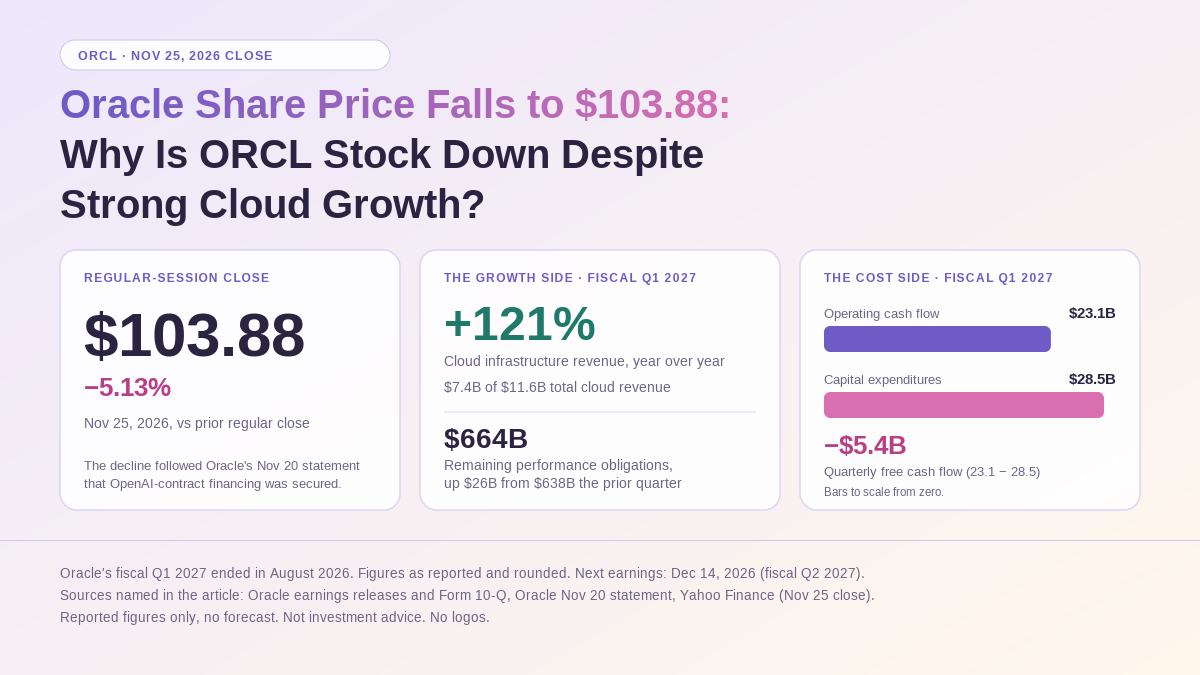
Oracle Share Price Falls to $103.88: Why Is ORCL Stock Down Despite Strong Cloud Growth?
Oracle shares fell 5.13% to $103.88. See what its $664 billion backlog, OpenAI financing, and negative free cash flow mean ahead of December earnings.

Fund Manager: Beware of Rising Asset Correlation, but Seize High Yields in the U.S. Credit Market

Discount Bank Opens Bitcoin Trading Inside Its Own App Today
PQAI#0: Preparing Ethereum for a post-quantum, post-AI world
Democrats Fire the First Shot in Post-Midterm Elections 'Anti-Crypto' Campaign
Wells Fargo Is Now the Largest Institutional Holder of Spot Bitcoin ETFs. If Banks Are Buying Bitcoin, Should You?
Did My Order Go Through? How to Check After a WEEX API or AI Trading Tool Timeout
A timeout tells you the tool didn't receive confirmation in time. It doesn't tell you whether the exchange accepted the order or how much was filled. If the first order is still open, a second one could leave you buying or selling more than you intended.
As Kishi Sanae Seeks Financial Support, Japan's Central Bank ETF Gains Surge
Swiss Banking Secrecy: Cryptos Will No Longer Escape
Latest articles


Latest coin listings on WEEX



