
- Buy Crypto
- Markets
 Futures
- Spot
- Copy Trade
- Earn
- More
Wintermute: The four-year cycle is dead, Crypto Breakthrough 2026, where to next?

Original Title: The four-year cycle is dead. What will drive crypto in 2026?
Original Source: Wintermute
Original Translation: DeepTech TechFlow
Abstract:
What was once considered the "iron rule" of the crypto market, the four-year halving cycle, is facing an unprecedented challenge. Top market maker Wintermute pointed out in its latest 2025 annual report that the traditional cycle narrative has collapsed, and the market logic has shifted from "seasonal rotation" to "liquidity locking."
2025 did not see the expected widespread frenzy; instead, it showed extreme emotional polarization: on one hand, BTC and ETH entered the institutional hall under the blessing of ETFs, while on the other hand, altcoins experienced a sudden loss of momentum and shortened lifecycle.
Looking into 2026, can the crypto market break free from the current stockpile deadlock? Wintermute has outlined three core variables that could disrupt the status quo.
Body:
2025 did not bring the anticipated bull market, but this may be seen by future generations as the beginning of the cryptocurrency's transition from a speculative tool to a mature asset class.
The traditional four-year cycle is becoming obsolete. Market performance is no longer dominated by self-fulfilling timed narratives but rather depends on the flow of liquidity and the concentration of investor attention.
What changed in 2025?
Historically, native crypto wealth has acted as a fungible fund. Bitcoin's gains would spill over to Ethereum (ETH), then to blue-chip stocks, and finally reach altcoins.
Wintermute's over-the-counter (OTC) trading flow data indicates that this transmission mechanism significantly weakened in 2025.
Spot exchange traded funds (ETFs) and digital asset trust companies (DATs) have evolved into a "walled garden." They provide sustained demand for large-cap assets but do not naturally rotate funds into the broader market.
As retail interest shifted to the stock market, 2025 became a year of extreme polarization.
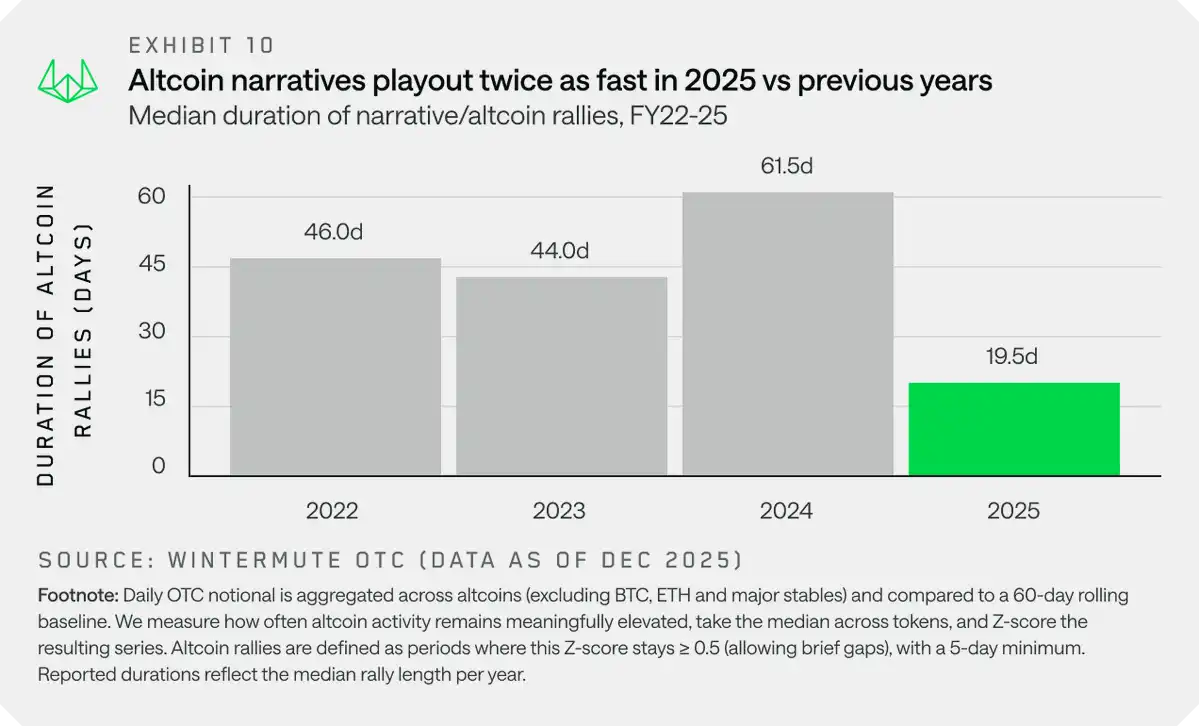
In 2025, the average rebound duration of altcoins was 20 days, much lower than 60 days in 2024.
A few mainstream assets absorbed the majority of the new inflows, while the broader market struggled.
Three Paths for 2026
If market participation beyond mainstream assets is to grow further, at least one of the following three things needs to happen:
1. Expanding Institutional Mandates
Currently, most of the new liquidity remains within institutional channels. A full market recovery requires institutional investors to expand the range of assets they can invest in.
Early signs are evident through Solana (SOL) and XRP's ETF applications.
2. The Wealth Effect from Mainstream Assets
A strong rebound in Bitcoin or Ethereum could trigger the wealth effect, spilling over to the broader market, similar to what happened in 2024.
The level of funds eventually flowing back into digital assets remains uncertain.
3. Rotation from Equities
Retail investors' focus may rotate back from the stock market (into areas like artificial intelligence AI, rare earths, quantum computing, etc.) to cryptocurrency, bringing in new inflows and stablecoin minting.
While this is the least probable scenario, it would significantly increase market participation.
The future outcome will depend on whether the above catalysts can effectively diffuse liquidity beyond a few large-cap assets, or if the trend of centralization will persist.
Understanding fund flows and the necessary structural changes will determine which strategies will succeed in 2026.
You may also like

Social Capital CEO: How Equity Tokenization is Reshaping Capital Markets from US Stocks to SpaceX?

CoinGecko Report: Surge of 346% vs Dip of 20.8%, The Wild Rise of DEX

a16z: The Real Opportunity of Stablecoins Lies Not in Disruption but in Filling Gaps

Mining Exodus: Someone Holds $12.8 Billion AI Order

March 6 Market Key Intelligence, How Much Did You Miss?

a16z: The True Opportunity of Stablecoins is in Complementing, Not Disrupting

Predict LALIGA Matches, Shoot Daily & Win BTC, USDT and WXT on WEEX
The WEEX × LALIGA campaign brought together football excitement and crypto participation through a dynamic interactive experience. During the event, users predicted matches, completed trading tasks, and took daily shots to compete for rewards including BTC, USDT, WXT, and exclusive prizes.

Ray Dalio Dialogue: Why I'm Betting on Gold and Not Bitcoin

Who Took the Money in the AI Era? A Must-See Investment Checklist for HALO Asset Trading
Wall Street Bears Target Ethereum: Vitalik In the Know Takes Flight, Tom Lee Remains Bullish
Pump.fun Hacker Steals $2 Million, Receives 6-Year Prison Sentence, Opts for 'Self-Detonation'

6% Annual Percentage Yield as Musk Declares War on Traditional Banks
36 years, 4 wars, 1 script: How does capital price the world in conflict?

Mining Companies' Great Migration: Some Have Already Secured $12.8 Billion in AI Orders
What Is Vibe Coding? How AI Is Changing Web3 & Crypto Development
What is vibe coding? Learn how AI coding tools are lowering the barrier to Web3 development and enabling anyone to build crypto applications.
The parent company of the New York Stock Exchange strategically invests in OKX: The intentions behind the $25 billion valuation

WEEX P2P update: Country/region restrictions for ad posting
To improve ad security and matching accuracy, WEEX P2P now allows advertisers to restrict who can trade with their ads based on country or region. Advertisers can select preferred counterparty locations for a safer, smoother trading experience.
I. Overview
When publishing P2P ads, advertisers can now set the following:
Allow only counterparties from selected countries or regions to trade with your ads.
With this feature, you can:
Target specific user groups more precisely.Reduce cross-region trading risks.Improve order matching quality.
II. Applicable scenarios
The following are some common scenarios:
Restrict payment methods: Limit orders to users in your country using supported local banks or wallets.Risk control: Avoid trading with users from high-risk regions.Operational strategy: Tailor ads to specific markets.
III. How to get started
On the ad posting page, find "Trading requirements":
Select "Trade with users from selected countries or regions only".Then select the countries or regions to add to the allowlist.Use the search box to quickly find a country or region.Once your settings are complete, submit the ad to apply the restrictions.
When an advertiser enables the "Country/Region Restriction" feature, users who do not meet the criteria will be blocked when placing an order and will see the following prompt:
If you encounter this issue when placing an order as a regular user, try the following solutions.
Choose another ad: Select ads that do not restrict your country/region, or ads that allow users from your location.Show local ads only: Prioritize ads available in the same country as your identity verification.
IV. Benefits
Compared with ads without country/region restrictions, this feature provides the following improvements.
Aspect
Improvement
Trading security
Reduces abnormal orders and fraud risk
Conversion efficiency
Matches ads with more relevant users
Order completion rate
Reduces failures caused by incompatible payment methods
V. FAQ
Q1: Why are some users not able to place orders on my ad?
A1: Their country or region may not be included in your allowlist.
Q2: Can I select multiple countries or regions when setting the restriction?
A2: Yes, multiple selections are supported.
Q3: Can I edit my published ads?
A3: Yes. You can edit your ad in the "My Ads" list. Changes will take effect immediately after saving.



 App
App