
 Buy Crypto
- Markets
 Futures
- Spot
- Copy Trade
- Earn
- More
Mining Exodus: Someone Holds $12.8 Billion AI Order

Original Article Title: "Mining Enterprise Great Migration: Someone Already Holds a $12.8 Billion AI Order"
Original Article Author: Wenser, Odaily Planet Daily
Over the past decade, Bitcoin mining enterprises have been the most stable foundation of the PoW network and the cost anchor of the BTC "zero-level market." However, now, this batch of industry cornerstones is collectively turning around, either actively or passively moving closer to AI.
Superficially, the direct inducement for the transformation of mining enterprises is the continuous increase in mining difficulty and the compression of profit margins by a subdued market. But the deeper driving force is the capital market's extreme pursuit of the AI narrative—and mining enterprises happen to possess the easiest-to-transform batch of real assets: electricity, land, cooling systems, data center, and ready-made data infrastructure, in exchange for which they can secure AI computing power orders worth hundreds of billions of dollars.
Against the backdrop of a multi-model race, mining enterprises standing at the intersection of energy, power, computing power, and crypto assets are undergoing an unprecedented yet almost inevitable industry migration.
Some are holding steady, watching without moving, some are forced to turn around, staking everything on a single throw. But what is certain is that a storm is brewing: this is a structural shift from the crypto market to the AI world.
A Tough Battle to Fight and an Irresistible Cake
As we enter 2026, for mining enterprises, the real pressure has never only come from price fluctuations but from structural squeezing: continuous increase in difficulty, continuous decline in unit revenue, and continuous rise in operating costs.
· Under the Winter Freeze: Selling Coins for Survival and Bankruptcy Liquidation
On February 20, the Bitcoin mining difficulty once rose by 15% to 144.4T, marking the largest increase since 2021. During the same period, network hash rate rebounded from 826EH/s to 1ZH/s, but the hash price fell to a multi-year low of only about $23.9 per PH/s. Under the continued profit squeeze from the 2024 halving, mining enterprises were forced into a cash flow defense mode.
The most symbolic event came from Bitdeer. On February 20, it was disclosed that its own BTC holdings had dropped to 0, with weekly output matching sales. Although founder Wu Jihan later explained that "currently at 0 does not mean zero in the future," the market still saw it as a microcosm of mining enterprise pressure.
It's not just one company in a predicament. In early February, NFN8 Group filed for Chapter 11 bankruptcy protection in Texas, USA, planning to sell all assets. Documents show that its core mine faced a fire, the leasing burden brought by the post-sale leaseback model, and the cliff-like drop in hash price after the halving directly crushed cash flow. Despite owning multiple mines, NFN8's self-owned 5,000 mining machine assets are valued at less than $50,000, while its liabilities range in the million-dollar range.
As the environment continues to deteriorate, mining companies' response is unusually consistent—marching towards AI.
· Second Spring: Astonishing Profits Behind AI/HPC Mega Orders
For AI giants, computational power data centers are always scarce: the traditional construction cycle often takes 3–5 years, with high costs of land, electricity, and cooling. Mining companies, on the other hand, already have electricity contracts, infrastructure, and operational experience, making them the most realistic partner in the AI expansion cycle.
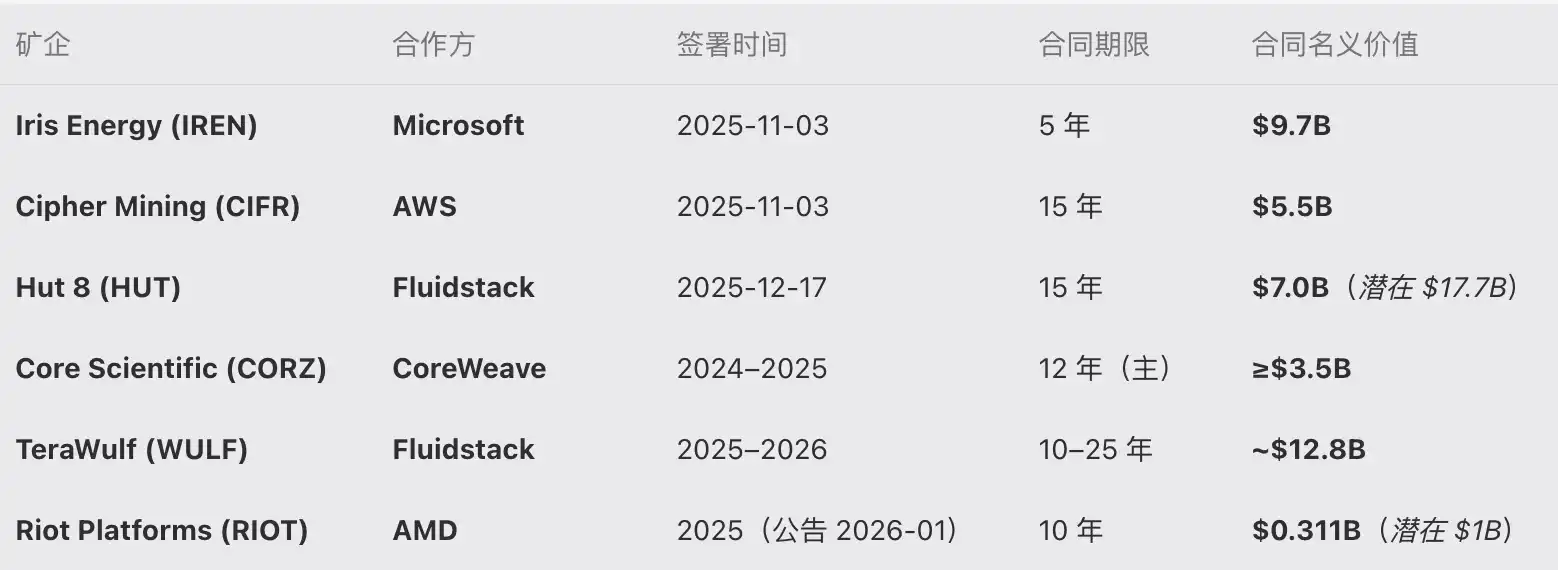
Since last year, mining companies have experienced a concentrated outbreak of orders. According to public data, as of the time of writing, six mining companies including IREN, CIFR, HUT, etc., have accumulated AI/HPC orders totaling around $38.5 billion. Contracts like the $12.8 billion signed between TeraWulf and Fluidstack, and the 5-year $9.7 billion contract between IREN and Microsoft, are remarkable. These have also become important support for their stock prices. From the financial reports, the AI/HPC revenue of many mining companies has increased from less than 15% to 40%–60%.
If mining is considered a cyclical business, AI is like a long-term cash flow pipeline.
Financial Report Consensus: AI as the Key Word
The Q1 2026 financial report season almost unanimously signals that mining companies are undergoing systemic transformation.
· "HPC Contract Giant" WULF: Holding Over $12.8 Billion in Contracts
Mining company TeraWulf achieved $168.5 million in revenue for the full year 2025, a year-on-year growth of 20.3%, with $16.9 million coming from the newly launched High-Performance Computing (HPC) leasing business.
TeraWulf currently holds over $12.8 billion in HPC contracts, has contracted 522MW of capacity, and has secured $6.5 billion in financing support for data center expansion.
· "AI Mining Company Junior Giant" IREN: Holding $9.7 Billion Microsoft Order
Benefiting from previous mega orders and rapid transformation, IREN has subtly become the new generation's "AI mining company junior giant."
According to the IrisEnergy (IREN) mining company's financial report, as of January 31, 2026, it holds cash and cash equivalents of $2.8 billion, and this fiscal year has already raised over $9.2 billion through customer prepayments, convertible bonds, GPU leasing, and GPU financing. There are plans to add 140,000 GPUs, and it is expected to achieve $3.4 billion in annual recurring revenue by the end of 2026.
· "Trump Family's" HUT: Holds $7 Billion in Orders
Mining firm Hut82025 reported $96 million in revenue for the fiscal year through its hosting services and holds approximately $1.4 billion in cash and Bitcoin reserves.
In addition, Hut8's spun-off mining firm subsidiary AmericanBitcoin (ABTC) achieved full-year 2025 revenue of $18.52 billion, deployed hash rate of around 25 EH/s, and owns about 78,000 ASIC miners, with BTC reserves exceeding 6,000 coins.
The company is also a major crypto mining enterprise backed by the Trump family, thus attracting significant market attention.
· "Brand Transformation Completed" CIFR: Holds $5.5 Billion in Orders
Mining firm CipherDigital revealed in its 2025 fiscal year performance report that the company has officially rebranded from "CipherMining" to "CipherDigital" to complete its brand transformation.
In November of last year, CIFR reached a $5.5 billion leasing agreement with Amazon Web Services; additionally, it secured a $1.4 billion guarantee from Google for Fluidstack through a 5.4% equity swap.
· "Sell Coins, Buy Land, Build Data Centers" RIOT: Enters Leasing Partnership with AMD
Mining firm RiotPlatforms announced its full-year 2025 performance, achieving $6.474 billion in revenue, a significant increase from $3.767 billion in 2024; its Bitcoin holdings exceed 18,000 coins.
In January of this year, RIOT sold 1,080 Bitcoins and used the proceeds (around $96 million) to purchase the Rockdale site for a data center project. Furthermore, the company signed a data center leasing and service agreement with AMD, deploying 25 megawatts of critical IT load capacity in the Rockdale campus. The activist investor Starboard Value indicated that Riot's potential valuation in transitioning towards AI and HPC could reach as high as $21 billion.
· "BTC Maximalist" MARA: Collaborates with Capital Firms to Develop AI Data Center
The MARA financial report data shows that, influenced by a ~14% decrease in average Bitcoin mining price, MARA's Q4 2025 revenue was $202.3 million, a ~6% year-over-year decrease. At the end of February, MARA announced a partnership with investment firm StarwoodCapitalGroup to build a large-scale data center targeting AI and cloud computing clients on its existing mining site in the U.S. After the news was announced, its stock price surged by about 17% in after-hours trading.
It is worth mentioning that unlike other mining companies firmly transitioning to the AI field, MARA's management emphasized that despite short-term price volatility, their long-term confidence in the Bitcoin asset class remains unchanged, with Bitcoin still at the core of their long-term strategy.
· "Data Center Revenue Surges" CORZ: Holds a CoreWeave Order of Over $10 Billion
CoreScientific (CORZ) released its Q4 2025 financial report, with total Q4 2025 revenue at $79.8 million, a decrease from $94.9 million in the same period last year. In this, Bitcoin mining business revenue fell to $42.2 million, while data center hosting service revenue surged to $31.3 million, up from $8.5 million in 2024. Q4 gross profit rose to $20.8 million, higher than $4.8 million in the same period in 2024.
CoreScientificCEOAdamSullivan stated that over half of the company's current construction projects are completed, expanding the hosting platform to a 1.5-gigawatt leasable capacity pipeline. In October last year, AI company CoreWeave planned to acquire CoreScientific for around $9 billion, but ultimately, the deal fell through due to a lack of shareholder approval. In January this year, CoreScientific sold 1,900 BTC (approximately $175 million) for business transformation.
The company estimates that AI business from 2026 to 2028 will drive a compound revenue growth of 60.9%, reaching $1.5 billion by 2028.
· Other Mining Company Representatives: Bitfarms Rebrands, BitDigital Joins the ETH Camp
In February, Bitfarms (BITF) announced a headquarters relocation from Canada to the U.S., intending to rename itself KeelInfrastructure (pending shareholder, exchange, and court approvals) to accelerate its infrastructure transformation. Previously, in October last year, the company converted $300 million debt financing into project financing for a data center construction in Pennsylvania and in January this year, sold the PasoPe mining site for $30 million, officially exiting the Latin American market.
On the other hand, BitDigital has taken a more thorough turn. As early as July last year, during the rise of the DAT (Odaily Note: Digital Asset Treasury) trend, it was the first to announce its transition from BTC to ETH treasury-listed company; in January this year, it further clarified that it would completely stop Bitcoin mining and instead increase its investment in Ethereum infrastructure, staking, and HPC/AI strategies, signaling that this mining company, which has been deeply involved in mining for five years, has officially completed its camp switch. Currently, its AI subsidiary WhiteFiber has completed an IPO, with BitDigital holding approximately 27 million shares, worth about over $457 million at the current market value.
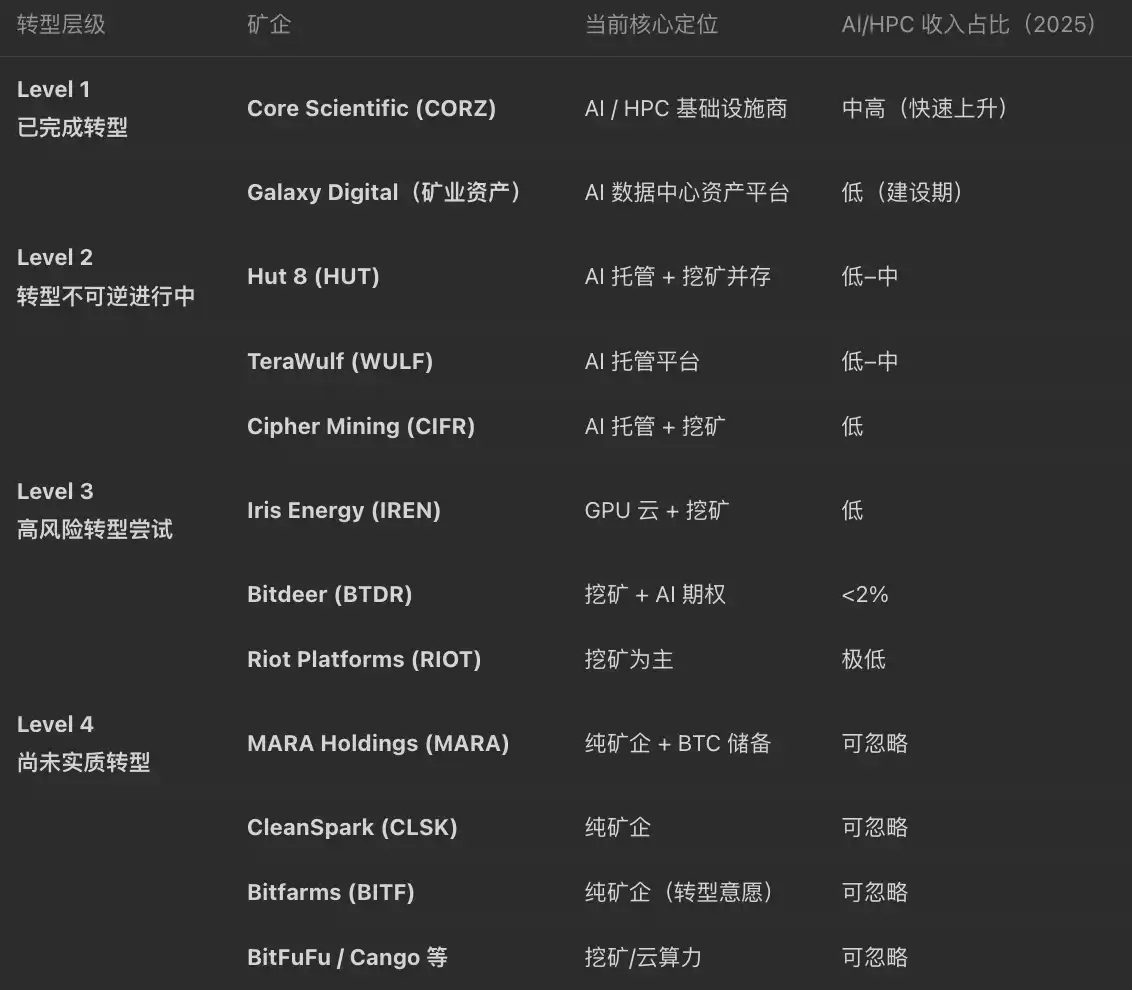
In addition to the above two companies, Galaxy, BitDeer, Cleanspark, and Cango, among others, are still in the AI transformation promotion stage, with their revenue contribution ratio yet to be improved. Among them, Cango completed a $10.5 million equity financing in February this year and received an additional $65 million investment commitment, potentially accelerating its layout in the AI/HPC data center business.
Below is a brief comparison based on publicly available information for reference.
Capital Attitude: Choosing Winners, Not Narratives
The market's acceptance of the "AI transformation" is not uniform but rapidly diverging.
In early February, JPMorgan Chase noted in a report that Bitcoin mining companies had a strong start to the year, mainly driven by a temporary easing of network competition and the warming up of the HPC narrative. At that time, the total market value of the 14 U.S.-listed mining companies and data center operators it tracked had risen to about $60 billion at the end of January, a 23% increase from the previous month, far exceeding the S&P 500's approximately 1% rise during the same period.
However, with a new round of AI model intensive releases and OpenClaw's impact on software stock valuation systems, market sentiment quickly shifted, with capital beginning to worry about the structural disruption brought about by AI. The stock prices of mining companies related to AI infrastructure subsequently corrected, with CIFR, IREN, and Hut8 experiencing intraday declines of over 10% at one point.
On February 10, Morgan Stanley released a research report, giving CIFR and WULF overweight ratings, while downgrading MARA to underweight.
By the end of February, as orders were fulfilled and stock prices rebounded, the market sentiment reversed once again. Some analysts believe that in the context of high short positions by hedge funds, combined with mining companies locking in long-term low-cost electricity contracts, their strategic value is no longer limited to traditional mining but is closer to that of an AI infrastructure provider.
As order fulfillment occurs and stock prices rebound, market logic is gradually becoming clear: Capital only bets on structural winners.
Therefore, the future of mining companies generally depends on three things:
Execution: Whether they can quickly complete the hash rate form migration;
Resource Endowment: Whether they have a scale advantage in electricity and land resources;
Narrative Capability: Whether they can embed AI in the upstream supply chain.
In fact, the transformation decision of a company is not important; what is more important is capital selection.
You may also like

Consumer-grade Crypto Global Survey: Users, Revenue, and Track Distribution

Prediction Markets Under Bias

Stolen: $290 million, Three Parties Refusing to Acknowledge, Who Should Foot the Bill for the KelpDAO Incident Resolution?

ASTEROID Pumped 10,000x in Three Days, Is Meme Season Back on Ethereum?

ChainCatcher Hong Kong Themed Forum Highlights: Decoding the Growth Engine Under the Integration of Crypto Assets and Smart Economy

Why can this institution still grow by 150% when the scale of leading crypto VCs has shrunk significantly?

Anthropic's $1 trillion, compared to DeepSeek's $100 billion

Geopolitical Risk Persists, Is Bitcoin Becoming a Key Barometer?

Annualized 11.5%, Wall Street Buzzing: Is MicroStrategy's STRC Bitcoin's Savior or Destroyer?

An Obscure Open Source AI Tool Alerted on Kelp DAO's $292 million Bug 12 Days Ago

Mixin has launched USTD-margined perpetual contracts, bringing derivative trading into the chat scene.
The privacy-focused crypto wallet Mixin announced today the launch of its U-based perpetual contract (a derivative priced in USDT). Unlike traditional exchanges, Mixin has taken a new approach by "liberating" derivative trading from isolated matching engines and embedding it into the instant messaging environment.
Users can directly open positions within the app with leverage of up to 200x, while sharing positions, discussing strategies, and copy trading within private communities. Trading, social interaction, and asset management are integrated into the same interface.
Based on its non-custodial architecture, Mixin has eliminated friction from the traditional onboarding process, allowing users to participate in perpetual contract trading without identity verification.
The trading process has been streamlined into five steps:
· Choose the trading asset
· Select long or short
· Input position size and leverage
· Confirm order details
· Confirm and open the position
The interface provides real-time visualization of price, position, and profit and loss (PnL), allowing users to complete trades without switching between multiple modules.
Mixin has directly integrated social features into the derivative trading environment. Users can create private trading communities and interact around real-time positions:
· End-to-end encrypted private groups supporting up to 1024 members
· End-to-end encrypted voice communication
· One-click position sharing
· One-click trade copying
On the execution side, Mixin aggregates liquidity from multiple sources and accesses decentralized protocol and external market liquidity through a unified trading interface.
By combining social interaction with trade execution, Mixin enables users to collaborate, share, and execute trading strategies instantly within the same environment.
Mixin has also introduced a referral incentive system based on trading behavior:
· Users can join with an invite code
· Up to 60% of trading fees as referral rewards
· Incentive mechanism designed for long-term, sustainable earnings
This model aims to drive user-driven network expansion and organic growth.
Mixin's derivative transactions are built on top of its existing self-custody wallet infrastructure, with core features including:
· Separation of transaction account and asset storage
· User full control over assets
· Platform does not custody user funds
· Built-in privacy mechanisms to reduce data exposure
The system aims to strike a balance between transaction efficiency, asset security, and privacy protection.
Against the background of perpetual contracts becoming a mainstream trading tool, Mixin is exploring a different development direction by lowering barriers, enhancing social and privacy attributes.
The platform does not only view transactions as execution actions but positions them as a networked activity: transactions have social attributes, strategies can be shared, and relationships between individuals also become part of the financial system.
Mixin's design is based on a user-initiated, user-controlled model. The platform neither custodies assets nor executes transactions on behalf of users.
This model aligns with a statement issued by the U.S. Securities and Exchange Commission (SEC) on April 13, 2026, titled "Staff Statement on Whether Partial User Interface Used in Preparing Cryptocurrency Securities Transactions May Require Broker-Dealer Registration."
The statement indicates that, under the premise where transactions are entirely initiated and controlled by users, non-custodial service providers that offer neutral interfaces may not need to register as broker-dealers or exchanges.
Mixin is a decentralized, self-custodial privacy wallet designed to provide secure and efficient digital asset management services.
Its core capabilities include:
· Aggregation: integrating multi-chain assets and routing between different transaction paths to simplify user operations
· High liquidity access: connecting to various liquidity sources, including decentralized protocols and external markets
· Decentralization: achieving full user control over assets without relying on custodial intermediaries
· Privacy protection: safeguarding assets and data through MPC, CryptoNote, and end-to-end encrypted communication
Mixin has been in operation for over 8 years, supporting over 40 blockchains and more than 10,000 assets, with a global user base exceeding 10 million and an on-chain self-custodied asset scale of over $1 billion.

$600 million stolen in 20 days, ushering in the era of AI hackers in the crypto world
Vitalik's 2026 Hong Kong Web3 Summit Speech: Ethereum's Ultimate Vision as the "World Computer" and Future Roadmap
On the same day Aave introduced rsETH, why did Spark decide to exit?
Full Post-Mortem of the KelpDAO Incident: Why Did Aave, Which Was Not Compromised, End Up in Crisis Situation?

After a $290 million DeFi liquidation, is the security promise still there?
ZachXBT's post ignites RAVE nearing zero, what is the truth behind the insider control?




 App
App