
- Buy Crypto
- Markets
 Futures
- Spot
- Copy Trade
- Earn
- More
Why Is Crypto Up Today? – January 14, 2026

Key Takeaways
- Cryptocurrency market capitalization has risen by 3.6% to $3.33 trillion, with 95 of the top 100 coins appreciating in value.
- Bitcoin (BTC) and Ethereum (ETH) saw significant price increases, contributing to optimistic market sentiment and rising trading volumes.
- Russian legislative developments signal potential expanded access to cryptocurrencies for retail investors.
- The central bank’s monetary policy framework and geopolitical factors are influential in current crypto market behavior.
- Institutional investments and ETF inflows highlight growing confidence in cryptocurrency as a strategic asset class.
WEEX Crypto News, 2026-01-15 07:39:03
The cryptocurrency market is experiencing a significant upswing on January 14, 2026, showing a notable increase in confidence and trading enthusiasm among investors and market participants. Currently, the market capitalization of cryptocurrency has surged by 3.6%, reaching an impressive $3.33 trillion. This rise is buoyed by the fact that out of the top 100 cryptocurrencies by market cap, a massive 95 have posted gains over the last 24 hours. This high number of gainers is indicative of a strong and widespread bullish momentum presently sweeping across the market.
Surge in Major Cryptocurrencies: Bitcoin and Ethereum
Recent trading patterns reveal that all top 10 cryptocurrencies in terms of market capitalization have seen price increments during the past day. Among these, Bitcoin (BTC) appreciated by roughly 3.4%, climbing to a current price of $94,953. Ethereum (ETH) didn’t lag far behind, marking a 6.6% increase, which elevated its trading value to $3,328. These trends illustrate the rising appeal of cryptocurrencies as investment vehicles.
Dogecoin (DOGE) emerged prominently, recording a notable 7% gain with its price stabilizing at approximately $0.1482. Meanwhile, the Story token (IP) showcased the highest daily increase among the top 100 cryptocurrencies, witnessing an extraordinary leap of 28.3%, bringing its value to $3.87.
Noteworthy is the activity around the Short-Term Holder Cost Basis Distribution. Glassnode reports underscore a consolidation phase between $80,000 and $95,000, reflecting a renewed demand buildup with recent pricing adjustments. Such consolidation phases are often precursors to profound market movements, either maintaining the momentum or affecting a sudden shift in trend lines.
Shifts in Geopolitical and Regulatory Landscapes
Globally, influential factors such as legislative changes in Russia hold potential ramifications for the cryptocurrency market. Russian lawmakers are actively engaging to create frameworks that might allow retail investors increased access and participation in digital asset trading. Driving this legislative push is the chairman of the State Duma’s Financial Markets Committee, Anatoly Aksakov, who affirms that a current bill could remove cryptocurrencies from “special financial regulation” categories, thereby promoting their use in day-to-day economic activities.
Apart from regulatory moves, shifts in the macroeconomic narrative have profound implications for cryptos. On the geopolitical front, former U.S. President Donald Trump’s critique of Federal Reserve Chair Jerome Powell contributes to a broader discourse on monetary policy credibility. Analysts suggest that wavering confidence in central banking policies might escalate market volatility, thereby potentially enhancing the perceived value and attractiveness of decentralized financial assets such as cryptocurrencies.
Perspectives on Market Dynamics and Future Trajectories
The recent volatility in traditional markets has added layers of complexity to investor sentiment. Directly after the U.S. stock markets closed lower on the evening of January 13, following the release of consumer inflation data, investors are increasingly scrutinizing how economic indicators align with their cryptocurrency strategies. The S&P 500 dropped by 0.19%, the Nasdaq-100 by 0.18%, and the Dow Jones Industrial Average slid by 0.8%, respectively.
Cryptocurrency evolution, given its detachment from traditional financial systems, continues to pulse with autonomy. Current sentiment, reflected through elevated trading volumes and institutional activities, points towards a lengthened period of optimism, albeit moderated by caution. The resale of more rooted fears, which led to the fear index previously hitting 41, now witnesses an upward trajectory, registering at 52, moving discreetly toward the greed zone.
Ethereum, in particular, finds itself in the spotlight as recognized bodies and financial enterprises project considerable future growth. As such, Standard Chartered anticipates Ethereum might outshine other cryptocurrencies through impressive price projections — targeting $7,500 by the end of this year, aspiring to reach $22,000 by 2028, and continuing upward to $40,000 by 2030. Such robust forecasts signify Ethereum’s evolving stature and market embedment.
Institutional Influence and Market Sentiment
The institutional landscape, including abundant ETF inflow signals, provides a robust foundation for crypto market enthusiasm. Following a second consecutive day of positive net flows, U.S. Bitcoin spot ETFs have amassed total inflows of $57.27 billion as of January 13. Over the same timeframe, Ethereum-based ETFs recorded inflows totaling $129.99 million.
A sensor toward future blockchain technologies is exhibited in the sentiments of financial advisers, as uncovered by the latest Bitwise and VettaFi surveys. Forty-eight percent of advisors regard crypto equity ETFs as the top choice for their 2026 investment portfolios, signaling a decisive embracement of digital currencies amidst an increasingly ©technophile® investment horizon. This is notably higher than any preceding years, suggesting burgeoning acceptance amidst cautious optimism.
The breathless emergence of Ethereum as an anticipated propellant of the market merits close scrutiny. As such, the ecosystem’s embrace of innovative dApps and DeFi solutions portends structural industry development.
FAQs
What is causing the current uptick in cryptocurrency prices?
The current rise in cryptocurrency prices can be attributed to strong global market sentiment, widespread gains among major cryptocurrencies, increasing institutional investments, and positive legislative developments, such as those seen in Russia.
What does the Long-Term Holder Supply Distribution Heatmap indicate about Bitcoin?
The Long-Term Holder Supply Distribution Heatmap reveals a dense cost-basis cluster between $93,000 and $109,000, indicating a significant overhead supply zone. A decisive breakout above this range is needed to set new highs for Bitcoin.
How are Bitcoin ETFs performing recently?
US Bitcoin spot ETFs have seen a robust inflow, underpinning increased investor confidence. As of January 13, the total net inflow had reached $57.27 billion, marking the highest levels since October’s record influxes.
What is the sentiment around Ethereum, and what are the future price targets?
Ethereum is viewed optimistically, with projections by Standard Chartered forecasting prices of $7,500 by the end of 2026, $22,000 by 2028, and $40,000 by 2030. These targets underscore growing institutional confidence in Ethereum’s long-term potential.
Why is there an increase in crypto equity ETFs among financial advisors?
Crypto equity ETFs are gaining favor among financial advisors due to increased market engagement, evolving regulation, and perceived strategic benefits of incorporating digital currencies into diverse investment portfolios for their clients.
You may also like

Wall Street Shorts ETH: Vitalik is aware and has front-run, while Tom Lee remains oblivious

Social Capital CEO: How Equity Tokenization is Reshaping Capital Markets from US Stocks to SpaceX?

CoinGecko Report: Surge of 346% vs Dip of 20.8%, The Wild Rise of DEX

a16z: The Real Opportunity of Stablecoins Lies Not in Disruption but in Filling Gaps

Mining Exodus: Someone Holds $12.8 Billion AI Order

March 6 Market Key Intelligence, How Much Did You Miss?

a16z: The True Opportunity of Stablecoins is in Complementing, Not Disrupting

Predict LALIGA Matches, Shoot Daily & Win BTC, USDT and WXT on WEEX
The WEEX × LALIGA campaign brought together football excitement and crypto participation through a dynamic interactive experience. During the event, users predicted matches, completed trading tasks, and took daily shots to compete for rewards including BTC, USDT, WXT, and exclusive prizes.

Ray Dalio Dialogue: Why I'm Betting on Gold and Not Bitcoin

Who Took the Money in the AI Era? A Must-See Investment Checklist for HALO Asset Trading
Wall Street Bears Target Ethereum: Vitalik In the Know Takes Flight, Tom Lee Remains Bullish
Pump.fun Hacker Steals $2 Million, Receives 6-Year Prison Sentence, Opts for 'Self-Detonation'

6% Annual Percentage Yield as Musk Declares War on Traditional Banks
36 years, 4 wars, 1 script: How does capital price the world in conflict?

Mining Companies' Great Migration: Some Have Already Secured $12.8 Billion in AI Orders
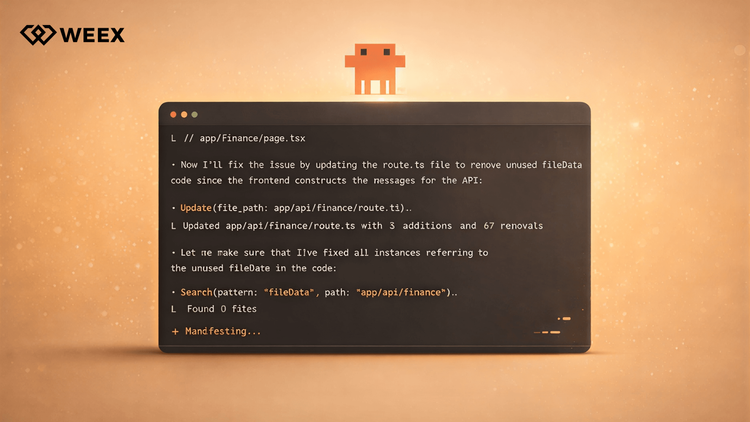
What Is Vibe Coding? How AI Is Changing Web3 & Crypto Development
What is vibe coding? Learn how AI coding tools are lowering the barrier to Web3 development and enabling anyone to build crypto applications.
The parent company of the New York Stock Exchange strategically invests in OKX: The intentions behind the $25 billion valuation

WEEX P2P update: Country/region restrictions for ad posting
To improve ad security and matching accuracy, WEEX P2P now allows advertisers to restrict who can trade with their ads based on country or region. Advertisers can select preferred counterparty locations for a safer, smoother trading experience.
I. Overview
When publishing P2P ads, advertisers can now set the following:
Allow only counterparties from selected countries or regions to trade with your ads.
With this feature, you can:
Target specific user groups more precisely.Reduce cross-region trading risks.Improve order matching quality.
II. Applicable scenarios
The following are some common scenarios:
Restrict payment methods: Limit orders to users in your country using supported local banks or wallets.Risk control: Avoid trading with users from high-risk regions.Operational strategy: Tailor ads to specific markets.
III. How to get started
On the ad posting page, find "Trading requirements":
Select "Trade with users from selected countries or regions only".Then select the countries or regions to add to the allowlist.Use the search box to quickly find a country or region.Once your settings are complete, submit the ad to apply the restrictions.
When an advertiser enables the "Country/Region Restriction" feature, users who do not meet the criteria will be blocked when placing an order and will see the following prompt:
If you encounter this issue when placing an order as a regular user, try the following solutions.
Choose another ad: Select ads that do not restrict your country/region, or ads that allow users from your location.Show local ads only: Prioritize ads available in the same country as your identity verification.
IV. Benefits
Compared with ads without country/region restrictions, this feature provides the following improvements.
Aspect
Improvement
Trading security
Reduces abnormal orders and fraud risk
Conversion efficiency
Matches ads with more relevant users
Order completion rate
Reduces failures caused by incompatible payment methods
V. FAQ
Q1: Why are some users not able to place orders on my ad?
A1: Their country or region may not be included in your allowlist.
Q2: Can I select multiple countries or regions when setting the restriction?
A2: Yes, multiple selections are supported.
Q3: Can I edit my published ads?
A3: Yes. You can edit your ad in the "My Ads" list. Changes will take effect immediately after saving.


 App
App