
US Stock Market Loses $1.5 Trillion, Cryptocurrency Market Loses $300 Billion, Trump Holds Ultra-Expensive Press Conference




Last night, the Dow Jones Index opened up 300 points, but then quickly spiraled downward, dropping 1,100 points in a matter of hours. Between 10:00 a.m. and 3:30 p.m. Eastern Time, the market capitalization of the S&P 500 Index evaporated by $1.5 trillion. At the same time, the cryptocurrency market saw a nearly $300 billion evaporation in market value.
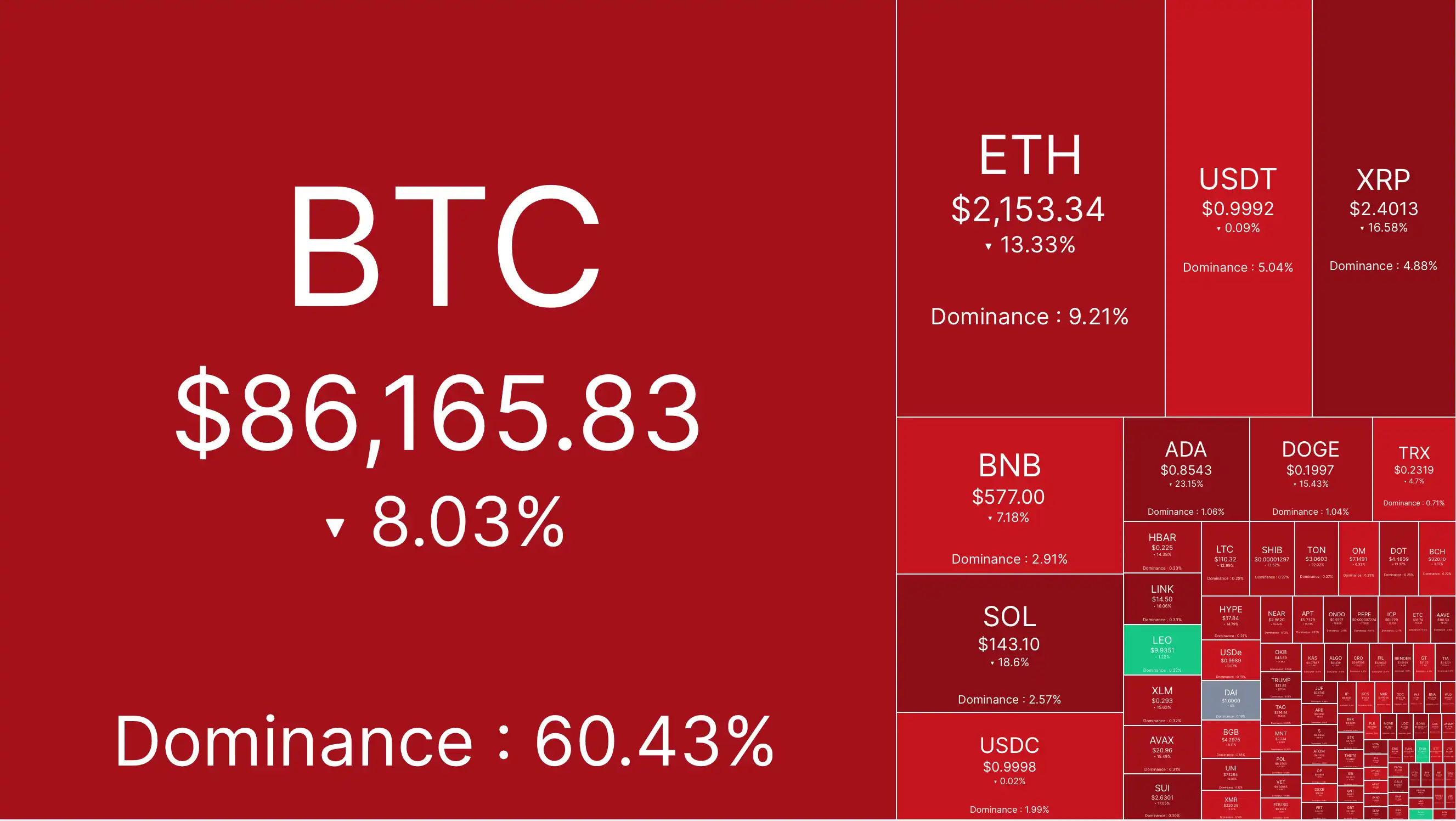
On Sunday, following a surge in the crypto market after President Trump announced plans to establish a strategic reserve for cryptocurrencies like SOL, XRP, and ADA, Trump swiftly executed a "reverse washout" in the stock market, leading to a steep decline in the crypto market as well. The entire capital market once again experienced a "violent" move by the President. What exactly happened? It all seemed to stem from a press conference held by President Trump...
Investing in TSMC, Easing Russia
Last night, the S&P 500 Index opened with an increase of about 30 points, following the trend from the previous Friday. However, shortly after, the Trump administration issued an "investment declaration," triggering selling pressure in the market.
Trump announced a $100 billion investment in TSMC in the United States, which includes:
1. Establishing 5 factories in Arizona;
2. Creating thousands of jobs;
3. Bringing TSM's total investment in the U.S. to $165 billion;
4. Generating "hundreds of billions of dollars in economic activity"
In the announcement, Trump stated that this investment plan would advance America's long-standing goal of revitalizing the U.S. semiconductor industry. For the capital market, this undoubtedly exacerbates the ongoing concerns over the Taiwan Strait issue.
Simultaneously, as President Trump made the announcement last night, The Wall Street Journal strategically published a report on Ukraine, stating that the Trump administration has officially ceased funding for the sale of new weapons to Ukraine. Subsequently, a report by Reuters indicated that the U.S. is working on a plan to ease sanctions on Russia.
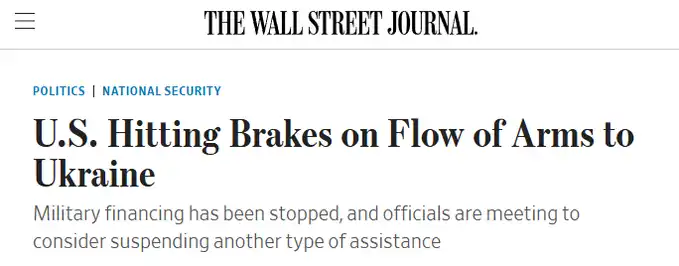
Prior to this, the Ukraine crisis had reached a stalemate due to a "live broadcast quarrel" between two presidents. The move to ease tensions with Russia is seen as favoring Russia and is considered unfavorable for further peace talks.
Tariff Turmoil
Following the investment announcement, Trump immediately moved to a question-and-answer session, further fueling market panic selling.
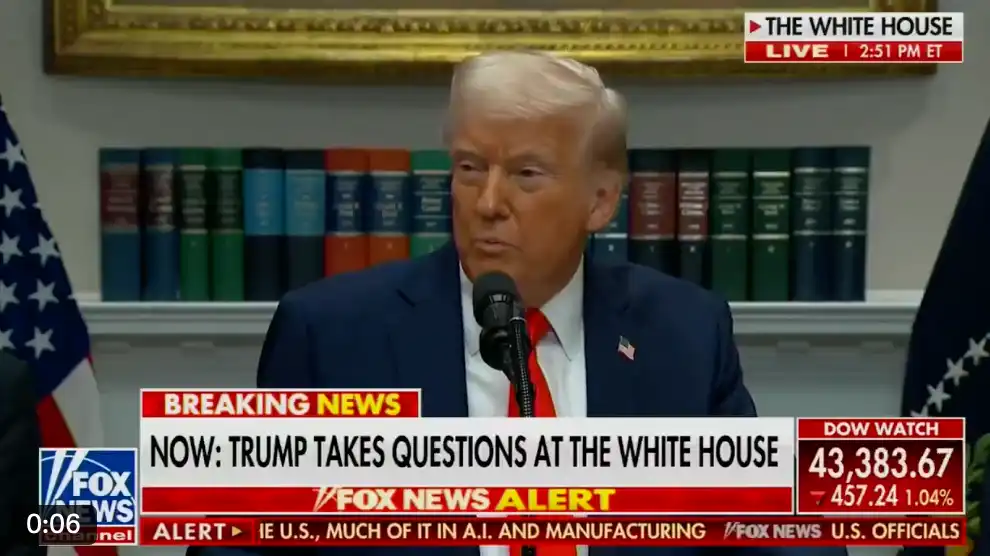
First, Trump confirmed that starting on March 4, a 25% tariff will be imposed on Canada and Mexico. Later, a reporter asked, "Regarding the tariffs, is there still room for Canada and Mexico to reach an agreement before midnight?" To this, Trump stated that there is no room for further negotiations on tariffs with Mexico and Canada.
Trump then announced that starting on April 2, tariffs will be imposed on imported agricultural products. Even worse, he stated that tariffs will be imposed on countries that engage in "currency devaluation tactics" as a sanction. Shortly after, the White House issued a statement announcing that Trump had signed an executive order to increase tariffs on China to 20%.
This means that tariffs on China have increased by 20 percentage points in 2 months. In comparison, it took Trump two years in his first term to raise tariffs on China to such a high level. Under the heavy blow of tariffs, the US stock market instantly evaporated $1.5 trillion...
Strategic Reserve Implementation Unlikely
During this press conference, Trump did not mention a single word about the previously mentioned cryptocurrency strategic reserve. This has also raised doubts in the market about his sincerity and the real ability of this administration.
BitMEX co-founder Arthur Hayes mentioned in a tweet some time ago that the fundamental problem with governments stockpiling any asset is that their trading of assets is primarily for political gain rather than financial gain. And those building truly decentralized technologies and applications do not have enough funds to play politics at this critical time in the cycle.
Yesterday, Arthur further commented that he believes the government simply does not have the money to purchase the needed cryptocurrency assets for a strategic reserve, "There is nothing new here, just talk. Let's talk when the crypto working group gets congressional approval to borrow money or revalues gold." Arthur believes that unless Trump moves towards a "Bitcoin" national reserve, the market will take a turn for the worse.
You may also like

Dialogue with OmenX Founder: Why does the prediction market need an evolution from "spot" to "derivatives"?

When the P2P illicit funds from ten years ago turned into 60,000 bitcoins

Morning News | CME Group launches Nasdaq Cryptocurrency Index futures; Asset management giant Janus Henderson strategically invests in Ethena

Why did Oracle deliver the strongest financial report in history, yet its stock price fell?

Bitcoin Layer 2 Network Botanix: Why Did We Choose to Dissolve?

Morning Report | OpenAI has submitted an S-1 registration statement draft to the U.S. SEC; Morpho completes $175 million financing

Galaxy Deep Research Report: How Hyperliquid's HIP-4 Upgrade Changes the Landscape of Prediction Markets?

Latest research from 13 top universities including Cornell University: The current state, challenges, and misconceptions of the fusion of Crypto and AI
Deconstructing Anthropic: The Best AI Company, Possibly Also a Type of Organizational Invention

Every exchange is a "Universal Exchange."

The counterattack of traditional finance: Alliance chains are quietly reviving
Pantera Capital Partner: How Tokenization is Restructuring the Private Equity and Early Investment Ecosystem?

Mastercard Launches Agent Pay for AI, Plans to Record AI Agent Payment Authorizations on Polygon
Mastercard launched Agent Pay for AI, a new payment protocol designed to help AI agents make small payments such as pay-per-use access to data and APIs. The system plans to record human-granted AI agent permissions on Polygon, focusing on verifiable authorization, identity, and payment controls.

Curve Deploys Llamalend v2 on Optimism With 250,000 OP Incentives
Curve launched Llamalend v2 on Optimism with 250,000 OP incentives from the Optimism Foundation. The upgrade expands Llamalend beyond its earlier crvUSD-focused model, adding broader collateral support, LlamaRisk market reviews, and the ability to use Curve LP tokens as collateral.

Raydium Old Liquidity Pool Reportedly Exploited, With $1.34 Million Moved to Ethereum and Tornado Cash
An old Raydium liquidity pool was reportedly exploited for around $1.34 million in USDC, RAY, and wSOL, with the stolen funds bridged to Ethereum and deposited into Tornado Cash. The incident highlights the tail risks of legacy DeFi pools, old contracts, and cross-chain fund laundering paths.
Kalshi Executive Challenges “SBF Backed AI Unicorns” Narrative, Says Leopold Aschenbrenner Was Key Figure
Kalshi executive John Wang questioned the “SBF backed AI unicorns” narrative, saying Leopold Aschenbrenner was the key figure behind major AI investment decisions.

New York Proposes Stricter Stablecoin Issuer Rules Aligned With Federal GENIUS Act
NYDFS proposed stricter stablecoin issuer rules aligned with the GENIUS Act, covering reserves, custody, redemption timelines, audits, and capital buffers.

CryptoQuant Says Bitcoin Profitable Supply Is Near 45% Pressure Zone as On-Chain Data Points to Market Repricing
CryptoQuant said Bitcoin’s profitable supply is nearing the 45% pressure zone, signaling rising market stress, unrealized losses, and a possible on-chain repricing phase.
Dialogue with OmenX Founder: Why does the prediction market need an evolution from "spot" to "derivatives"?
When the P2P illicit funds from ten years ago turned into 60,000 bitcoins
Morning News | CME Group launches Nasdaq Cryptocurrency Index futures; Asset management giant Janus Henderson strategically invests in Ethena
Why did Oracle deliver the strongest financial report in history, yet its stock price fell?
Bitcoin Layer 2 Network Botanix: Why Did We Choose to Dissolve?
Morning Report | OpenAI has submitted an S-1 registration statement draft to the U.S. SEC; Morpho completes $175 million financing


