
- Buy Crypto
- Markets
 Futures
- Spot
- Copy Trade
- Earn
- More
Trump Targets Fed, Italy Cautions Influencers: Global Financial Pulse

Key Takeaways:
- The United States is witnessing a political storm as former President Trump initiates criminal proceedings against Federal Reserve Chairman Jerome Powell, primarily over disputes regarding interest rate strategies.
- Argentina sees a significant shift with Coinbase, the prominent American crypto exchange, halting its fiat operations within the nation, showcasing operational complexities in volatile markets.
- The once-promising NFT Paris has been canceled, signaling another setback for the NFT market trying to regain its 2022 high.
- Italy’s financial regulators stress the legal responsibilities influencers face when promoting financial products, highlighting a shift in regulatory scrutiny.
- Moldova aligns its crypto laws with the EU’s MiCA framework, marking a significant step toward structured digital currency regulation.
WEEX Crypto News, 2026-01-19 08:24:24
Trump’s Fed Controversy: A Political Power Play?
In a dramatic turn of events, former United States President Donald Trump has taken decisive action against Jerome Powell, the Federal Reserve’s Chairman. This move, described by many as politically charged, is driven by Trump’s extensive dissatisfaction with current interest rate policies, which he believes should be lower to stimulate the economy.
The U.S. Department of Justice, acting under Trump’s directive, has commenced a criminal investigation alleging that Powell has mishandled funds during the Federal Reserve’s office renovations. However, Powell has firmly denied these claims, suggesting that such accusations stem from the Fed’s independence in setting interest rates rather than bending to presidential preferences. Powell’s defense underscores the Fed’s commitment to public service, not political pandering, injecting a layer of institutional independence into the economic discourse.
Historically, Trump has expressed his desire to exert more influence over the Fed to push for lower interest rates, thereby making this confrontation not only a matter of financial governance but also of political ideology. His visit to the presumably over-budget renovated Fed office buildings fueled his allegations, creating a spectacle of federal expenditure held under scrutiny. It’s a narrative that has added complexity to the Fed’s autonomy in dictating monetary policy, redefining the boundaries of executive influence over financial institutions.
Shifting Sands in Argentina: Coinbase Pauses Fiat Operations
Amid the turbulent landscape of cryptocurrency exchanges, major U.S. player Coinbase has decided to pause its fiat services in Argentina barely a year into its operations there. This decision comes after a thorough review of its operations and reflects the complexities of navigating unstable economic terrains dominated by local currency challenges.
With the suspension, Argentine users find themselves unable to transact in USDC with pesos or transfer funds to local bank accounts past the month’s end. Ana Gabriela Ojeda, a noted observer in the Latin American crypto industry, interprets this move not as a critique of cryptocurrencies or stablecoins, but rather as a reaction to the intrinsic hurdles of integrating local financial systems in volatile markets.
These developments shed light on the recurring theme of logistical financial integration difficulties that crypto exchanges face, particularly in regions with fluctuating economic stability. This situation points to larger structural potentialities and challenges for the global adoption and regulation of cryptocurrency platforms within diverse currency environments.
Market Woes Force NFT Paris Cancellation
The NFT market, once a beacon of digital promise, faces yet another setback with the cancellation of NFT Paris. Scheduled for February, the event has been shelved due to market instability, despite organizers’ efforts in drastic cost reductions to salvage the event. The broader NFT sphere, which reached its zenith in 2022, now grapples with a market trying to stabilize, as evidenced by current meager valuations barely surpassing $3 billion and a limited daily trading volume of $4 million.
This decline reflects the broader struggles of the NFT market to regain its momentum, despite earlier forecasts predicting exponential growth. Attendees to NFT Paris have been assured refunds for their tickets, even as uncertainties loom large over the prospects of rescheduling or hosting future events. The decision casts a spotlight on the tough recovery road ahead for NFTs, pushing stakeholders to reevaluate strategies for reigniting interest in digital collectibles amid fluctuating valuations.
Wyoming Stablecoin: A State-Driven Cryptocurrency Initiative
Wyoming, a U.S. state known for its cryptofriendly regulations, has launched its own state-backed stablecoin, the Frontier Stable Token (FRNT). This initiative represents not just progressive financial innovation but also a quieter revolution in state-level digital currency adaptation. By harnessing the Solana blockchain, the token is purchasable on the Kraken exchange and capable of interfacing with several prominent blockchain platforms, including Ethereum and Polygon.
Wyoming’s venture into stablecoin issuance positions it alongside North Dakota, whose Roughrider coin initiative similarly marks proactive digital financial experimentation. Advocates of state-centric stablecoins highlight their reduced transaction fees compared to traditional credit cards and their stability, usually secured through USD reserves and U.S. Treasurys. This trend underscores how U.S. states could lead the charge in the stablecoin market, crafting niche niches within the broader crypto ecosystem.
Italian Financial Influencers Under Scrutiny
Italy’s top securities regulator, the Commissione Nazionale per le Società e la Borsa (CONSOB), has issued a stark warning to financial influencers or “fin-fluencers,” reminding them of their significant responsibilities when promoting financial products. Reflecting EU law implications, the warning accents the legal liabilities influencers may face, especially when promoting volatile financial assets like cryptocurrencies which risk substantial capital loss.
This scrutiny aligns with guidance from the European Securities and Markets Authority (ESMA), which stresses that disclaimers such as “this is not financial advice” provide no legal immunity for misinformed or reckless promotions. Italy’s stance manifests the evolving regulatory climate focused on social media’s role in the financial markets, stressing accountability in influencer-driven financial market dynamics.
Moldova Embraces EU Crypto Regulations
In a significant alignment with European standards, Moldova has declared its intent to integrate its cryptocurrency regulations with the European Union’s Markets in Crypto-Assets (MiCA) framework. Moldovan Finance Minister Andrian Gavrilita revealed the plan, emphasizing collaboration with EU regulators to craft laws enabling the trading and holding of digital currencies within a structured legal framework.
Though these forthcoming laws, coordinated with Moldova’s National Bank and securities authorities, aim to foster financial innovation, they distinctly reject the notion of cryptocurrency as an official payment medium. Moldova’s regulatory approach balances the embrace of crypto’s potential with a cautious view of its speculative nature, providing Moldovan citizens a legislative framework that upholds consumer protection without stifling innovation.
The broader implications of Moldova’s updates reflect a necessity for integrating traditional and digital financial worlds under unified regulatory frameworks, aiming for harmonized progress in the emergent crypto landscape.
FAQs
What are the charges against Federal Reserve Chairman Jerome Powell?
The charges involve allegations by the U.S. Department of Justice, under President Trump’s directive, accusing Jerome Powell of fund misallocation during renovations of Federal Reserve offices. Powell denies these claims, suggesting they originate from political motivations regarding interest rate policies.
Why did Coinbase suspend its operations in Argentina?
Coinbase suspended its fiat services in Argentina due to the complexities of operating in volatile economic conditions and integrating local currency systems. This strategic pause aims to reassess the sustainability of its services in the region.
What led to the cancellation of NFT Paris?
NFT Paris was canceled due to adverse market conditions and financial unsustainability despite cost-cutting measures. The broader NFT market is struggling with stability and significant drops in both market capitalization and trading volume since its 2022 peak.
What is unique about the Wyoming stablecoin initiative?
Wyoming’s Frontier Stable Token (FRNT) is a state-backed stablecoin available on the Solana blockchain, highlighting state-level initiatives to harness decentralized finance technologies while offering lower transaction fees and stability supported by USD reserves.
How is Moldova aligning with EU crypto regulations?
Moldova is aligning its crypto laws with the EU’s Markets in Crypto-Assets (MiCA) regulation to enable legal trading and holding of cryptocurrencies, ensuring consumer protection without recognizing it as an official payment medium.
You may also like

Wall Street Shorts ETH: Vitalik is aware and has front-run, while Tom Lee remains oblivious

Social Capital CEO: How Equity Tokenization is Reshaping Capital Markets from US Stocks to SpaceX?

CoinGecko Report: Surge of 346% vs Dip of 20.8%, The Wild Rise of DEX

a16z: The Real Opportunity of Stablecoins Lies Not in Disruption but in Filling Gaps

Mining Exodus: Someone Holds $12.8 Billion AI Order

March 6 Market Key Intelligence, How Much Did You Miss?

a16z: The True Opportunity of Stablecoins is in Complementing, Not Disrupting

Predict LALIGA Matches, Shoot Daily & Win BTC, USDT and WXT on WEEX
The WEEX × LALIGA campaign brought together football excitement and crypto participation through a dynamic interactive experience. During the event, users predicted matches, completed trading tasks, and took daily shots to compete for rewards including BTC, USDT, WXT, and exclusive prizes.

Ray Dalio Dialogue: Why I'm Betting on Gold and Not Bitcoin

Who Took the Money in the AI Era? A Must-See Investment Checklist for HALO Asset Trading
Wall Street Bears Target Ethereum: Vitalik In the Know Takes Flight, Tom Lee Remains Bullish
Pump.fun Hacker Steals $2 Million, Receives 6-Year Prison Sentence, Opts for 'Self-Detonation'

6% Annual Percentage Yield as Musk Declares War on Traditional Banks
36 years, 4 wars, 1 script: How does capital price the world in conflict?

Mining Companies' Great Migration: Some Have Already Secured $12.8 Billion in AI Orders
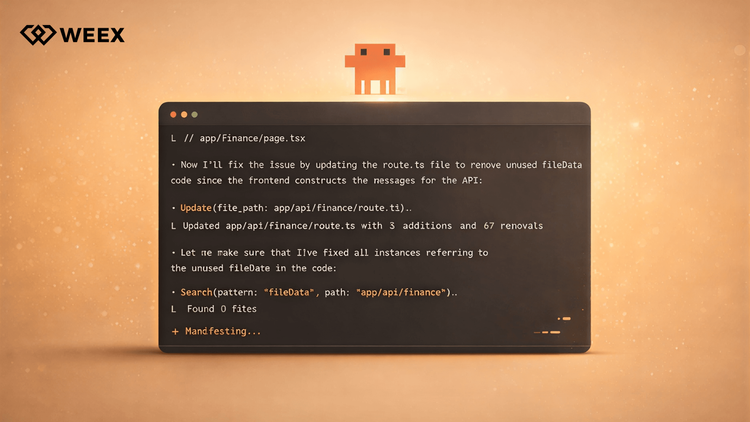
What Is Vibe Coding? How AI Is Changing Web3 & Crypto Development
What is vibe coding? Learn how AI coding tools are lowering the barrier to Web3 development and enabling anyone to build crypto applications.
The parent company of the New York Stock Exchange strategically invests in OKX: The intentions behind the $25 billion valuation

WEEX P2P update: Country/region restrictions for ad posting
To improve ad security and matching accuracy, WEEX P2P now allows advertisers to restrict who can trade with their ads based on country or region. Advertisers can select preferred counterparty locations for a safer, smoother trading experience.
I. Overview
When publishing P2P ads, advertisers can now set the following:
Allow only counterparties from selected countries or regions to trade with your ads.
With this feature, you can:
Target specific user groups more precisely.Reduce cross-region trading risks.Improve order matching quality.
II. Applicable scenarios
The following are some common scenarios:
Restrict payment methods: Limit orders to users in your country using supported local banks or wallets.Risk control: Avoid trading with users from high-risk regions.Operational strategy: Tailor ads to specific markets.
III. How to get started
On the ad posting page, find "Trading requirements":
Select "Trade with users from selected countries or regions only".Then select the countries or regions to add to the allowlist.Use the search box to quickly find a country or region.Once your settings are complete, submit the ad to apply the restrictions.
When an advertiser enables the "Country/Region Restriction" feature, users who do not meet the criteria will be blocked when placing an order and will see the following prompt:
If you encounter this issue when placing an order as a regular user, try the following solutions.
Choose another ad: Select ads that do not restrict your country/region, or ads that allow users from your location.Show local ads only: Prioritize ads available in the same country as your identity verification.
IV. Benefits
Compared with ads without country/region restrictions, this feature provides the following improvements.
Aspect
Improvement
Trading security
Reduces abnormal orders and fraud risk
Conversion efficiency
Matches ads with more relevant users
Order completion rate
Reduces failures caused by incompatible payment methods
V. FAQ
Q1: Why are some users not able to place orders on my ad?
A1: Their country or region may not be included in your allowlist.
Q2: Can I select multiple countries or regions when setting the restriction?
A2: Yes, multiple selections are supported.
Q3: Can I edit my published ads?
A3: Yes. You can edit your ad in the "My Ads" list. Changes will take effect immediately after saving.


 App
App