
Startup Voya Energy Proposes Solution to Replace Noisy Diesel Generators in Data Centers

 Prefer us on Google


In 2023, venture capitalist Shell Kahn from Energy Impact Partners has been pondering a long-standing question: how to eliminate the noisy and polluting diesel generators that most AI data centers use for backup power. He posed the question to his head of technology: is there no material that can match the extremely high energy density of hydrocarbons while also providing clean and quiet power?
This led to the birth of Voya Energy, a startup based in Hayward, California. The company plans to use a new electrochemical process to convert waste aluminum into electricity, with zero emissions, no toxic waste, and no noise, as a replacement for diesel generators. In August of this year, Kahn's fund led a $35 million Series A funding round for Voya, giving the company a post-money valuation of $113 million.
Voya is one of three energy tech companies selected for The Information's 2026 list of "50 Most Promising Tech Startups," released on Wednesday. The other two companies are Critical Loop, based in Long Beach, California, which specializes in rapid backup power generation and gained attention after securing a large contract to power Anduril Industries' aviation facilities; and Parallax, a San Francisco startup that manufactures natural gas turbines using 3D printing technology.
All three startups are riding the largest technological wave in decades, providing power solutions for AI data centers.
Voya's CEO, Richard Wang, an expert in battery technology recruited by Kahn, stated that the company plans to launch pilot aluminum-based generators in 2028 and deliver commercial models to AI data centers and other customers in 2029. However, the concept is still largely in the conceptual stage: no company has previously used metals as fuel to power commercial industrial facilities; Voya has only created a simple prototype of the device.
The device works by processing waste aluminum, such as soda cans, into small aluminum particles; a mechanical device feeds the particles into the generator, where they react with an electrolyte to release the electrochemically stored energy, which is then delivered to the data center. The consumed aluminum is transformed into trihydrate aluminum oxide, which can be reprocessed into aluminum particles for recycling, Wang explained.
The Voya project originated from Kahn and his colleagues at Energy Impact Partners. In early 2024, they noticed an existing technological concept: some metals can store electrical energy and efficiently output high-power electricity like fossil fuels. They decided to fund a startup to validate whether this idea could be commercialized.
In early 2024, Kahn met Richard Wang, a next-generation battery technology expert, through a mutual friend. Wang had gained industry attention in 2021 when he sold Cuberg, a lithium metal battery startup he co-founded while studying at Stanford, to Northvolt, with the transaction amount undisclosed. In early 2024, Northvolt shut down Cuberg's operations; months later, Northvolt declared bankruptcy.
At that time, Wang was unemployed. After being introduced by a friend, he met Kahn and shared his idea for replacing diesel generators. Initially, Wang was skeptical. He recalled his response at the time: "This idea is still immature. To be honest, I don't think it's enough to start a company yet, and I'm not sure if I'm the right person to do this."
However, he agreed to join Energy Impact Partners as a technology researcher to further explore the concept. About four months later, he gradually recognized the direction. He told me, "You can see that the production difficulty of metal raw materials is low, and the consumption of metals for power generation is simple; metals and metal oxides can easily convert into each other."
Wang screened metals from the periodic table and ultimately focused on magnesium, zinc, iron, and aluminum as suitable for power generation, conducting comparative tests, with aluminum emerging as the winner. He said, "Aluminum has significant advantages: it has the highest energy density and is abundant, making it a readily available commodity."
Wang then informed Kahn that he had changed his mind. Kahn recalled, "He came to us and said, 'This is worth starting a company for, and I want to lead it.'" In April 2025, Energy Impact Partners led a $13 million seed funding round for Voya.
Wang envisioned a standard power system consisting of two containers: one is a standard 20-foot container housing a 2-megawatt aluminum generator; the other is a 10-foot container storing enough aluminum particles to produce 100 megawatt-hours of electricity.
Wang stated that this system has multiple advantages: aluminum's energy density can rival that of hydrocarbon fuels; aluminum is non-flammable and does not produce emissions during storage, thus occupying far less space than diesel in industrial settings. Voya claims that this device can convert 57% of the energy in aluminum particles into electricity, higher than the average 35% conversion efficiency of diesel generators.
One major pollution aspect of aluminum is the electrolytic smelting process. Voya currently uses waste aluminum as raw material, bypassing the issues associated with smelting. However, Wang noted that existing technologies can significantly reduce energy consumption and pollutant emissions during the metal smelting process.
"Our long-term goal is to design the electrolytic cell and the entire system ourselves, even to build our own factory. We believe that only in this way can we minimize the cost of aluminum," Wang said.
-- Price
This content is provided for general informational purposes only and doesn't constitute financial, investment, legal, or tax advice. Any events, rewards, online promotions, or related information mentioned herein should not be considered a recommendation, solicitation, or invitation to purchase, sell, trade, or otherwise deal in any crypto assets. Crypto assets are highly volatile and may result in loss. The availability of WEEX services, products, and related events may vary by region. You are responsible for ensuring that your participation is in accordance with applicable local laws and regulations.
You may also like

Prediction: This Will Be Intel’s Stock Price After 1 Year (Hint: It Implies a Nice Jump)

Stacks (STX) outlook for 2027: What could drive STX demand?

Guterres Calls for Additional Taxes on Energy Companies

Cities and States Representing 60% of U.S. Economy Commit to Collaborate with the UN on Tracking Carbon Emissions

55 million ZETA to be destroyed, ZetaChain continues to operate after shutdown announcement

SK Group Executives Hold Meeting from 12th to 14th to Discuss Semiconductor, AI, and Energy Business Strategies

Indian Stock Market Rebounds, Becomes Safe Haven Amid AI Stock Sell-off

Barclays: Japan's Import Prices Rise 24.8% in October
CNOOC Discovers High-Yield Oil and Gas Well in Bohai Sea with Daily Production of 800,000 Cubic Meters

Aave V3.8 Launches, Covering 15 Markets with Reentrancy Protection

唐华斑竹: Avalanche Chain May Become the Standard for Security Tokenization

Decrypt Becomes First News Publisher to Offer Perps Trading, Powered by Solana's Phoenix

Moody's Projects Global Credit Deterioration by 2027 and Warns of the Impact of Rates and AI

What Is Elysium Crypto? The Hyperliquid Layer 2, Gas Fees, and Token Confusion Explained
Learn what Elysium is, why it uses HYPE for gas, how KNTQ buybacks are designed, and how to distinguish bridge TVL from actual DeFi activity.
From Sidechains to zk-Rollups: Tacit Chain Aims to Redefine Payments with Default Privacy
Midterm Election Risks Disrupt Helix AI Infrastructure Project, Increasing Uncertainty for Samsung Investments

European Natural Gas Futures Prices Exceed €85

Moody's Raises India's Economic Growth Forecast to 7%

Immutable Chain's Transition to OP Stack: What Changes for Users

Two Carbon Capture Standards Released

US Absence from UN Climate Summit, Trump Calls Global Warming a Hoax

ETH Burn Rate Fails to Keep Up with Issuance, Is Vitalik Starting to Discuss Value Storage?
Ethlabs Suggests Delaying Hoodi Testnet Fork Date, External Audit Expected to be Released Before November 16
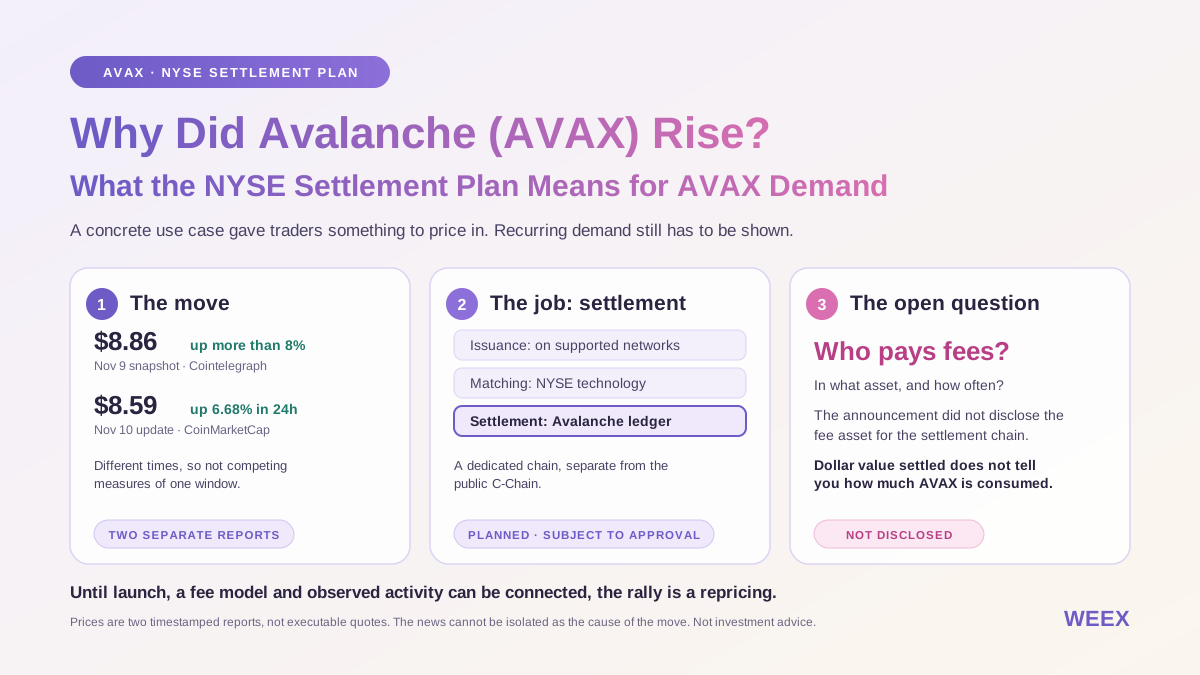
Why Did Avalanche (AVAX) Rise? What the NYSE Settlement Plan Means for AVAX Demand
See why Avalanche (AVAX) rallied after the NYSE settlement announcement, how the dedicated chain would work, and what could create demand for AVAX.

How to Resolve Data Center Controversies? This U.S. State Wants to Tokenize Computing Power to Share Benefits with Residents

Wall Street Morning Briefing: Market Soars on Oil Prices and AI Recovery, Nvidia Falls Alone, Data Centers Become Political Regulation Focus, CPI Lacks Year-on-Year Comparison Adds Variables

Ethereum's 2028 Challenge: Quantum Resistance Roadmap Hits Release Bottleneck

Understanding the DEX 'Hyperliquid': A Practical Workshop|Japan Digital Economy Federation

Envision Star River Base Completed in One Year with 120MW Capacity at One-Fifth the Cost of Similar U.S. Projects
AI Data Centers Are Buying Used Jet Engines as New Power Turbines Take Six Years
Prediction: This Will Be Intel’s Stock Price After 1 Year (Hint: It Implies a Nice Jump)
Stacks (STX) outlook for 2027: What could drive STX demand?
Guterres Calls for Additional Taxes on Energy Companies
Cities and States Representing 60% of U.S. Economy Commit to Collaborate with the UN on Tracking Carbon Emissions
55 million ZETA to be destroyed, ZetaChain continues to operate after shutdown announcement
SK Group Executives Hold Meeting from 12th to 14th to Discuss Semiconductor, AI, and Energy Business Strategies
Latest articles


Latest coin listings on WEEX


