
Make Income Great Again



Article Author: Decentralised.Co
Article Translation: Block Unicorn
This article is inspired by a series of conversations with Ganesh Swami, covering the seasonality of revenue, the evolution of business models, and whether token buybacks are the best use of protocol capital. This is a complement to my previous article on the crypto stagnation.
The private capital markets, such as venture capital, oscillate between liquidity abundance and scarcity. When these assets become liquid and external capital flows in, market frenzy drives up prices. Think of a newly launched IPO or token issuance. Newly found liquidity exposes investors to more risk, which in turn fuels the birth of a new generation of companies. As asset prices rise, investors seek to reallocate funds into early-stage applications, hoping to achieve higher returns than benchmarks like ETH and SOL. This is a feature, not a bug.
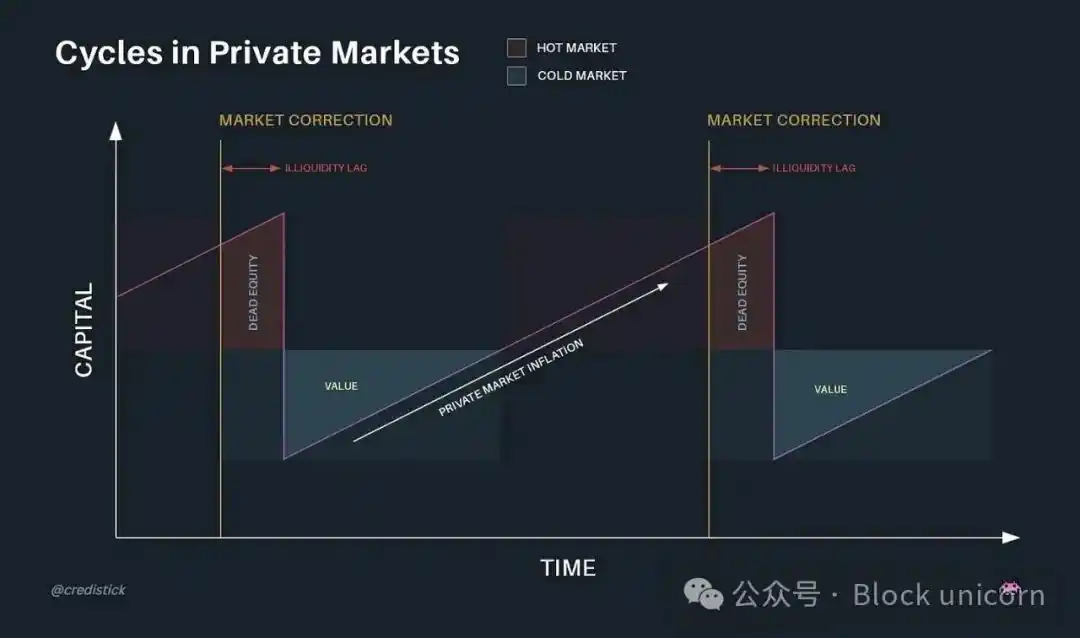
The liquidity of cryptocurrency follows a cyclical pattern similar to Bitcoin halving. Historically, market rebounds have occurred within six months after Bitcoin halving. In 2024, ETF inflows and Saylor's purchases acted as Bitcoin absorbers. Saylor alone spent $22.1 billion last year acquiring Bitcoin. However, last year's surge in Bitcoin price did not translate into a resurgence of small-cap altcoins.
We are witnessing an era where capital allocators face liquidity crunches, attention is scattered across thousands of assets, and founders who have been toiling on tokens for years struggle to find meaning in it. Why bother building real applications when launching meme assets can yield more financial returns? In previous cycles, L2 tokens enjoyed a premium due to listings on trading platforms and venture capital support, driven by perceived value. But as more participants flood the market, this perception (and its valuation premium) is dissipating.
As a result, L2 tokens have seen their valuations decrease, limiting their ability to subsidize small products through grants or token-based revenue. This valuation excess in turn forces founders to pose an age-old question that plagues all economic activities—where does revenue come from?
So Transactional
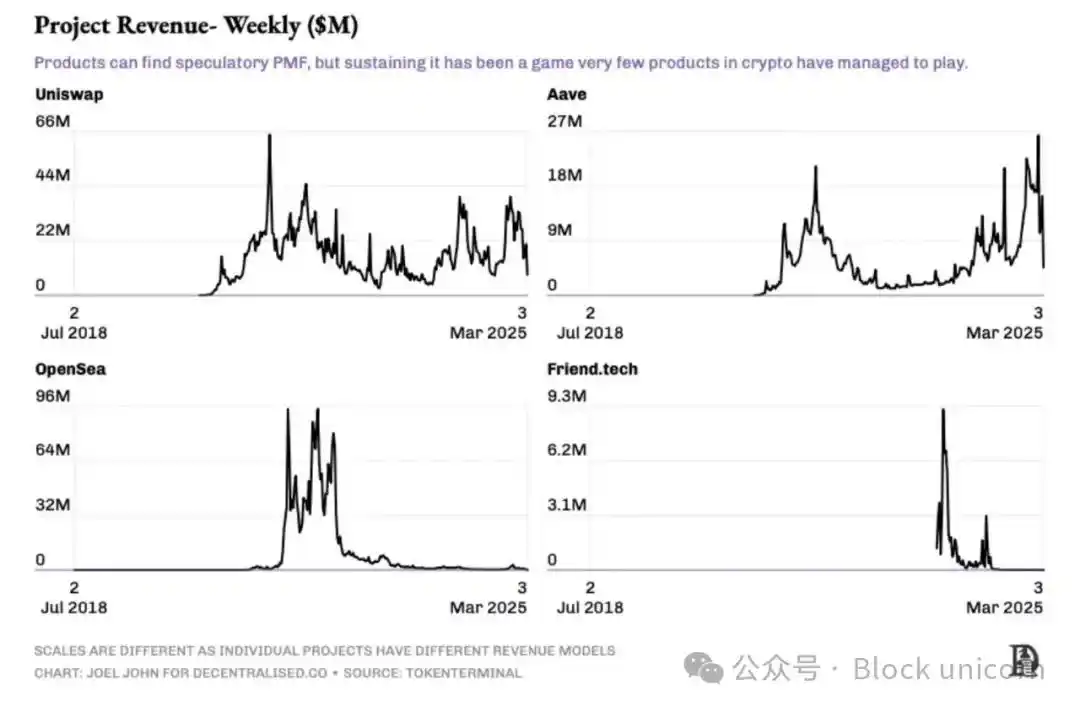
The diagram above illustrates the typical operation of cryptocurrency revenue. For most products, the ideal state is akin to AAVE and Uniswap. Thanks to the Lindy Effect or first-mover advantage, these two products have maintained fees for years. Uniswap can even increase front-end fees and generate revenue. This demonstrates the level of consumer preference definition. Uniswap to decentralized exchanges is like Google to search.
In contrast, friendtech and OpenSea have seasonal revenue. During the NFT summer, the market cycle lasted for two quarters, while social finance speculation only lasted for two months. If the scale of revenue is significant and aligned with the product's intent, the speculative revenue of the product makes sense. Many Meme trading platforms have joined the over $1 billion fee club. The scale of this number is what most founders can expect at best through tokens or acquisition. However, for most founders, this kind of success is rare. They are not building consumer apps; they focus on infrastructure, where the revenue dynamics are different.
Between 2018 and 2021, venture capital heavily funded developer tools, hoping developers would attract a large number of users. However, by 2024, the ecosystem underwent two significant changes. First, smart contracts achieved infinite scalability with limited human intervention. Uniswap or OpenSea do not need to scale their teams in proportion to transaction volume. Secondly, advancements in LLM and AI reduced the investment demand for cryptocurrency developer tools. Therefore, as a category, it is at a reckoning moment.
In Web2, the API-based subscription model was effective due to the massive online user base. However, Web3 is a smaller niche market, with few apps extending to millions of users. Our advantage is the high-income per user metric. Cryptocurrency's average user tends to spend more money more frequently because blockchain enables you to do so—it makes the flow of funds possible. Therefore, over the next 18 months, most businesses will have to redesign their business models to directly derive revenue in the form of transaction fees from users.
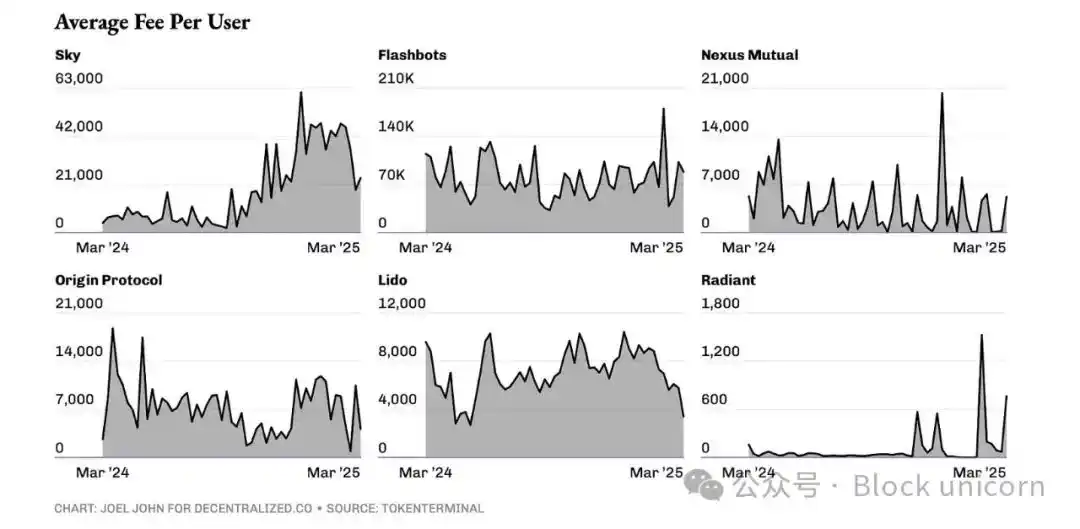
This is not a new concept. Stripe initially charged per API call, Shopify charged fixed fees for subscriptions, and later both shifted to revenue-based fees. For infrastructure providers, this transition in Web3 is quite straightforward. They will eat into the market by competitively pricing in the API arena—perhaps even offering products for free until a certain transaction volume, followed by revenue-sharing negotiations. This is the idealized scenario.
What will this look like in practice? One example is Polymarket. Currently, the UMA protocol's token is used for dispute resolution, with the token tied to disputes. The more markets there are, the higher the probability of disputes occurring. This drives demand for the UMA token. In the transaction model, the required collateral can be a small fraction of the total wager, such as 0.10%. For instance, a $1 billion wager on a presidential election result would bring $1 million in revenue to UMA. Under the assumed scenario, UMA can use this revenue to buy back and burn their tokens. This approach has its benefits and challenges, which we will soon see.
Another participant engaging in such activity is MetaMask. The transaction volume handled through its embedded swap feature is approximately $360 billion. The exchange revenue alone surpasses $3 billion. A similar pattern applies to staking providers like Luganode, where fees are based on the staked asset amount.
But in a market where API call costs are increasingly decreasing, why would developers choose one infrastructure provider over another? If revenue sharing is a requirement, why would one choose an oracle over another? The answer lies in network effects. A data provider that supports multiple blockchains, offers unparalleled data granularity, and can index data from new chains faster will become the preferred choice for new products. The same logic applies to transaction categories such as intent-driven or gasless exchanges. The more chains supported, the lower the profit margin, the faster the speed, the higher the likelihood of attracting new products, as this marginal efficiency helps retain users.
Complete Destruction
The shift to align token value with protocol revenue is not new. In recent weeks, several teams have announced mechanisms to buy back or burn tokens in proportion to revenue. Notable among these are SkyEcosystem, Ronin Network, Jito SOL, Kaito AI, and Gearbox Protocol. Token buyback is similar to stock buyback in the U.S. stock market—it is essentially a way to return value to shareholders (or in this case, token holders) without violating securities laws. In 2024, there were about $790 billion allocated to stock buybacks in the U.S. market alone, compared to $170 billion in 2000. Whether these trends will continue remains to be seen, but we observe a clear market divide between tokens with cash flow willing to invest in their own value and those with neither.
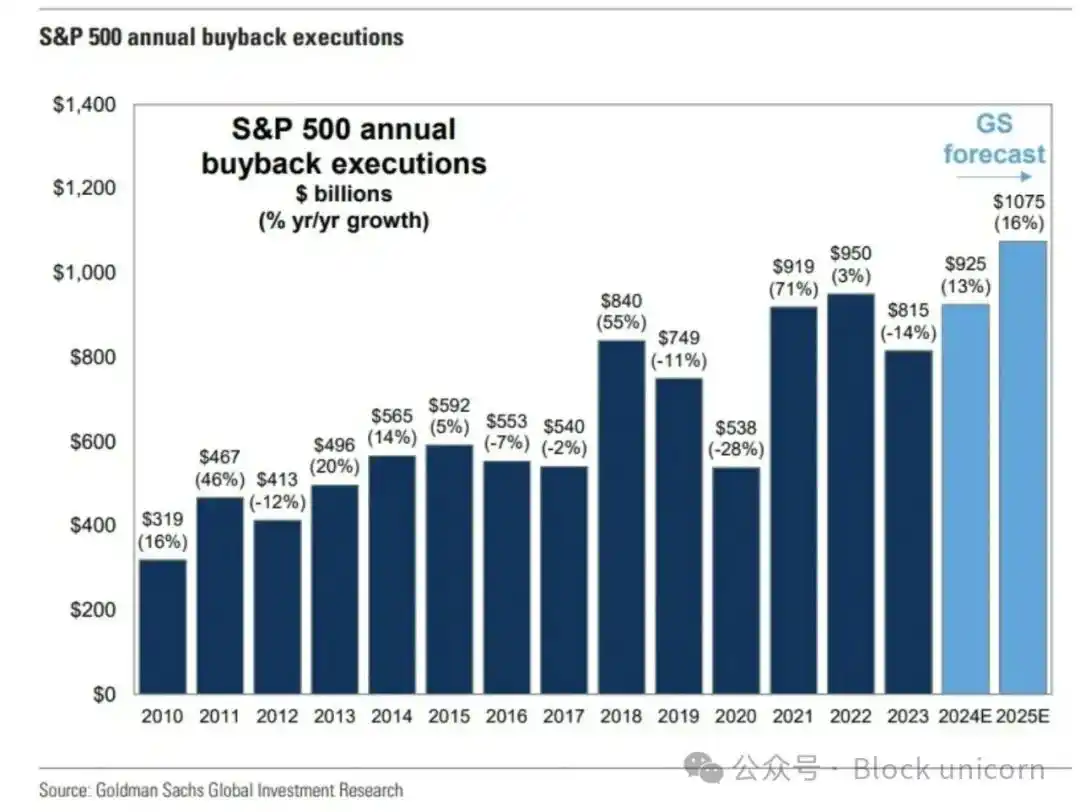
For most early protocols or dApps, using revenue to buy back their own tokens may not be the best use of capital. One way to carry out such an operation is to allocate enough capital to offset the dilution brought about by newly issued tokens. This is the approach the founder of Kaito recently explained about their token buyback method. Kaito is a centralized entity using tokens to incentivize its user base. The company receives centralized cash flow from its corporate clients. They use a portion of the cash flow to execute buybacks through market makers. The quantity purchased is twice the number of newly issued tokens, effectively making the network deflationary.
Ronin, on the other hand, takes a different approach. The blockchain adjusts fees based on the transaction volume per block. During peak usage periods, a portion of the network fees goes into Ronin's treasury. This is a method to control asset supply without necessarily buying back the token itself. In both these cases, founders have designed mechanisms to align value with network economic activity.
In future articles, we will delve into the impact of these operations on the price and on-chain behavior of tokens participating in such activities. However, it is currently evident that as valuations are being suppressed and the amount of venture capital flowing into cryptocurrency diminishes, more teams will have to compete for the marginal funds flowing into our ecosystem. Given that blockchain is fundamentally a money lego, most teams will pivot to a fee-based model proportional to transaction volume. In such a scenario, if a team is tokenized, they will be incentivized to implement a buyback and burn model. Teams executing well on this front will emerge as winners in the liquidity market.
Of course, one day, all these discussions about price, earnings, and revenue will become irrelevant. We will once again spend money on dog pictures and purchase monkey NFTs. However, when I look at the current state of the market, most founder concerns around survival have shifted towards discussions on revenue and burning.
You may also like

Morning News | CME Group launches Nasdaq Cryptocurrency Index futures; Asset management giant Janus Henderson strategically invests in Ethena

Bitcoin Layer 2 Network Botanix: Why Did We Choose to Dissolve?

Why did Oracle deliver the strongest financial report in history, yet its stock price fell?
When the P2P illicit funds from ten years ago turned into 60,000 bitcoins

Dialogue with OmenX Founder: Why does the prediction market need an evolution from "spot" to "derivatives"?
Galaxy in-depth report: Is Solana still worth paying attention to?

Young people in South Korea make a "final effort" in the epic bull market

The pricing controversy of Trade.xyz exposes the fatal weakness of Pre-IPO perpetual contracts

How much longer can Ethereum's last big buyer hold on?

World Cup 2026 Coming – WEEX Celebrates with $1M Prize Pool & Michael Owen Live

Morning Report | OpenAI has submitted an S-1 registration statement draft to the U.S. SEC; Morpho completes $175 million financing

Galaxy Deep Research Report: How Hyperliquid's HIP-4 Upgrade Changes the Landscape of Prediction Markets?

Latest research from 13 top universities including Cornell University: The current state, challenges, and misconceptions of the fusion of Crypto and AI

Deconstructing Anthropic: The Best AI Company, Possibly Also a Type of Organizational Invention

Every exchange is a "Universal Exchange."

The counterattack of traditional finance: Alliance chains are quietly reviving
Pantera Capital Partner: How Tokenization is Restructuring the Private Equity and Early Investment Ecosystem?

Mastercard Launches Agent Pay for AI, Plans to Record AI Agent Payment Authorizations on Polygon
Mastercard launched Agent Pay for AI, a new payment protocol designed to help AI agents make small payments such as pay-per-use access to data and APIs. The system plans to record human-granted AI agent permissions on Polygon, focusing on verifiable authorization, identity, and payment controls.
Morning News | CME Group launches Nasdaq Cryptocurrency Index futures; Asset management giant Janus Henderson strategically invests in Ethena
Bitcoin Layer 2 Network Botanix: Why Did We Choose to Dissolve?
Why did Oracle deliver the strongest financial report in history, yet its stock price fell?
When the P2P illicit funds from ten years ago turned into 60,000 bitcoins
Dialogue with OmenX Founder: Why does the prediction market need an evolution from "spot" to "derivatives"?
Galaxy in-depth report: Is Solana still worth paying attention to?


