
How to Manage a Channel When Cryptocurrency Advertising is Banned in 2026

 Prefer us on Google


From September 1, 2026, cryptocurrency advertising in Russia will be subject to updated restrictions, making careful content presentation especially important for authors of thematic channels. Risks can arise not only from direct calls to purchase coins but also from commercial links, promo codes, referral programs, and promises of returns.
Discussing the digital currency market is still allowed: news, analytics, breakdowns of blockchain technologies, and fraudulent schemes are not prohibited in themselves. The key question is whether the publication transforms from informational material into promotion of a specific action, platform, or product.
What Restrictions Came into Effect on September 1, 2026
The updated rules prohibit advertising digital currencies and promoting their use as a means of payment for goods and services within Russia. Advertising illegal methods of acquiring digital currencies is also banned, as are offers directed at individuals who are legally prohibited from purchasing them.
Advertising services related to the organization of digital currency circulation is regulated separately. Such publications cannot mention specific digital currencies, promise or guarantee returns on investments, or provide forecasts for price changes.
However, merely mentioning Bitcoin, Ethereum, TRON, and other digital currencies is not a violation. The law does not prohibit the use of cryptocurrency names in informational and analytical materials. The risk arises when the material starts to push the audience towards purchasing, transitioning to a platform, or performing an operation.
An analysis of the reasons for Bitcoin or Ethereum price changes can remain analytical. But a publication urging to buy a specific digital currency or register on a particular platform may already look like promotion.
Where Analytics Turns into Advertising
The main criterion is the presence of motivation for a specific action. Phrases like "buy XXX now," "purchase XXX on this platform," "click the link and start trading," or "don’t miss the opportunity to earn" carry a direct advertising meaning.
The risk increases if such calls are accompanied by a link to a specific service, a promo code, or a referral link, through which the author can receive a reward for attracting a user.
The law "On Advertising" prohibits advertising digital currencies and sets special requirements for advertising services related to their circulation. Such restrictions are not new: they were previously in effect under Federal Law 259-FZ "On Digital Financial Assets, Digital Currency, and Amendments to Certain Legislative Acts of the Russian Federation."
Before publication, the author should evaluate the material as a whole: does it contain an offer to use a service, a recommendation to perform an operation, a promise of returns, a price forecast, or other promotional elements? It is the combination of such signs that can make a post problematic.
What Penalties Are Imposed for Violating the Rules
Administrative responsibility under Article 14.3 of the Administrative Offenses Code of the Russian Federation applies for violations of advertising legislation. For individuals, the fine ranges from 2,000 to 2,500 rubles; for officials, from 4,000 to 20,000 rubles; and for legal entities, from 100,000 to 500,000 rubles.
Responsibility may arise not only for the advertiser. The advertising producer and distributor may also be subject to sanctions if they participated in creating or placing the disputed material.
A notable case occurred in 2025 when the Krasnoyarsk FAS initiated a case against a company promoting an educational course on cryptocurrency trading on social media. Users were promised access to a trading platform of a cryptocurrency exchange, training, and a potential income of $400–600 in the first week with an investment of around $100.
The FAS classified such a publication as advertising services related to the circulation of digital currency. This example shows that promoting educational, trading, or investment products can become a violation if they effectively attract the audience to operations with digital currency.
-- Price
Should Old Publications Be Cleared?
Authors of cryptocurrency channels should review their archives and first find materials with obvious advertising signs. Posts with direct calls to buy digital currency, referral and affiliate links, transitions to specific crypto platforms and services, promises of profitability, or offers to use a specific product require special attention.
If such content remains publicly accessible, it is better to abandon it to reduce the risk of claims and administrative liability. Such violations can be considered ongoing, and the date of their commission will be the date identified by the supervisory authority.
There is no need to delete the entire archive on cryptocurrency topics. Market news, educational texts, analytical reviews, and analyses of fraudulent schemes do not themselves fall under prohibited content.
The optimal approach is not to delete everything indiscriminately but to selectively remove materials that promote specific digital currencies, platforms, services, or methods of conducting operations.
How Fraudsters Use the Format of Crypto Blogs
One popular scheme revolves around the image of a successful trader or crypto investor. On social media, photos of expensive cars, travels, and restaurants are published, screenshots of supposedly earned profits are shown, and stories about easy income from cryptocurrency are told.
When the audience develops trust, subscribers may be offered to invest in an investment project, buy training, or pay for access to a closed club. In reality, such an account often hides a financial pyramid, a fictitious investment project, or a service that shows the user non-existent profits.
Another scenario is that the blog is used as an entry point to a fraudulent platform. Subscribers are offered arbitration, the purchase of a new token, or trading on a supposedly profitable cryptocurrency platform, and then they are redirected to a phishing site, a fake exchange, or a service with a fictitious balance. On the screen, the user sees profits but cannot withdraw money.
There are also fake accounts of well-known traders, companies, and public figures. Moreover, criminals can hack the pages of real users: an already promoted account helps them quickly use the audience's trust to promote investment offers or third-party links.
When evaluating a cryptocurrency blog, it is important to look not at loud statements but at what action the author is urging subscribers to take. Promises of high profitability, demonstrations of easy earnings, urgent offers to invest money, and transitions to unknown platforms may indicate a fraudulent scheme.
Legal assessments and practical recommendations on this topic are provided by Ekaterina Belotserkovskaya, an AML/KYC investigations specialist at the "Shard" provider.
This content is provided for general informational purposes only and doesn't constitute financial, investment, legal, or tax advice. Any events, rewards, online promotions, or related information mentioned herein should not be considered a recommendation, solicitation, or invitation to purchase, sell, trade, or otherwise deal in any crypto assets. Crypto assets are highly volatile and may result in loss. The availability of WEEX services, products, and related events may vary by region. You are responsible for ensuring that your participation is in accordance with applicable local laws and regulations.
You may also like

Galaxy Believes Bitcoin Bear Market Ended in June, Recommends Buying and Holding

Empery Invests $65 Million to Acquire 25% Stake in AI Data Center

Bitcoin's next Fed test comes with a hidden problem in America's inflation data
The crypto market loses altitude, patience becomes a habit – Steady Lads
Bitcoin's flat trend vs. S&P 500 signals risk warning, says Bloomberg analyst

Cyberattack on GMO in Japan: Trading Accounts Compromised, GMO Coin Claims to be Unaffected
Mark Cuban compares Bitcoin to meme stocks
Electrum patches Bitcoin vulnerability allowing payment redirection
The Week Ahead: 4 Key Moments for the Crypto Market

Security Researcher Exploits PHP2Shell Vulnerability to Breach Bounty Website, Earns Approximately $2000 in Bitcoin Rewards
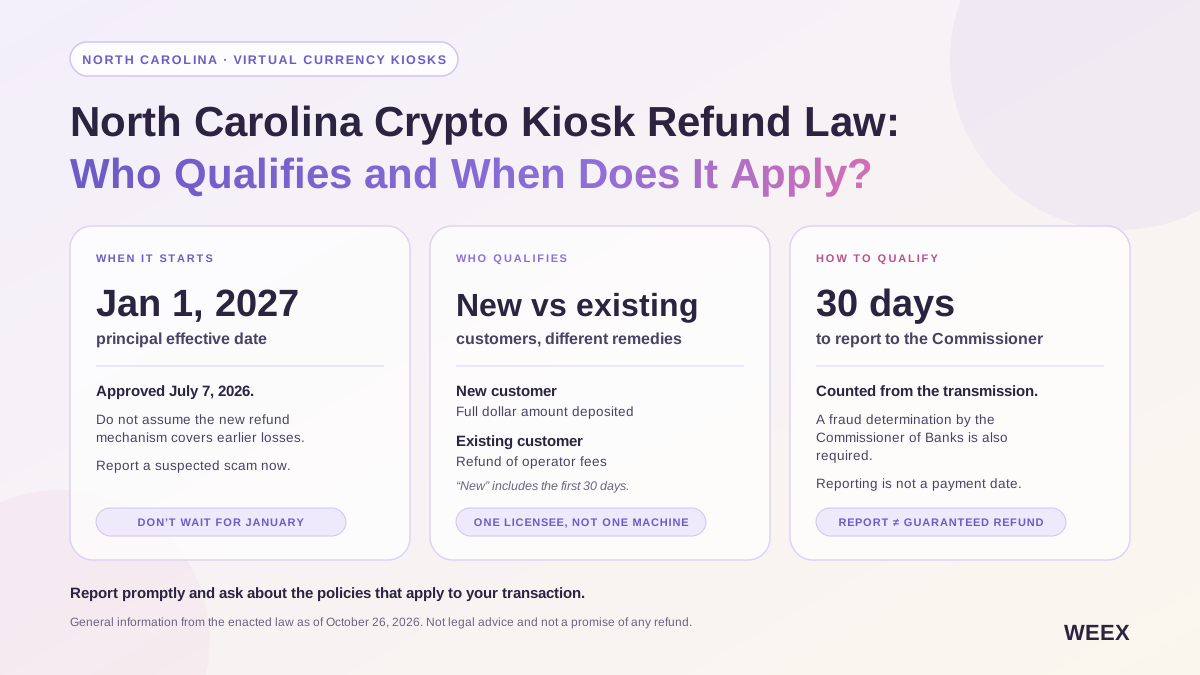
North Carolina Crypto Kiosk Refund Law: Who Qualifies and When Does It Apply?
Understand North Carolina’s crypto kiosk refund law: the January 2027 start date, who qualifies, reporting deadlines, and documents victims should keep.
US Startup Successfully Develops Artificial Gold, Highlighting Bitcoin Scarcity

Sam Price Claims Bitcoin Has Been Declared Dead Multiple Times

Mr&强 Analyzes Bitcoin Support and Resistance Areas

Franklin Templeton Launches Two Dividend Reinvestment Bitcoin ETFs

Interest on U.S. corporate bonds with CCC rating rises to 17.99 percent

LND Releases v0.21.5-beta.rc1 with Fee Estimate Limits

FOUNDATION Faces Spam Attack from Spoofed Domain Names

Bitcoin Core Changes Rules for Disclosing Security Vulnerabilities

New York Man Sentenced to 51 Months in Prison for Telecom Fraud and Money Laundering

[Bitcoin $0 Controversy②] "$0 is an Exaggeration"... Reasons Wall Street Disagrees

WEEX Exclusive:Gold Breaks Below $4,000, Bitcoin Pulls Back Below $80,000 | WEEX TradFi Daily(October 26, 2026)
Gold Breaks Below $4,000, Bitcoin Pulls Back Below $80,000 | WEEX TradFi Daily(October 26, 2026)
At the October 23 close, major indexes were mixed, with the Dow weaker. Brent crude rose to about $116.7, a near six-month high, and energy led; gold briefly fell below $4,000 as Bitcoin pulled back toward $80,000. Cybersecurity stocks strengthened last week, with CrowdStrike up nearly 12%. Markets are watching whether Bitcoin’s correction is nearing its end, along with earnings from Verizon, Cadence, Celestica and Amkor today.

The Superintendency of the Securities Market of Panama Excludes Cryptocurrencies from Its Oversight
Michael Saylor: Strategy's Core Business is Bitcoin-Based Digital Credit Products

Bitcoin and gold among worst-performing assets in 2023
X Adds Feature to Send $1 via Long Press on Like Button, Cryptocurrency Still Not Supported
Bitcoin Warns of Quantum Computer Threat Response Time of 2 Years

Paolo Ardoino wants AI to run Bitcoin mines. Who gets permission to act?

Sam Price Observes Significant Volatility in Ethereum Market
Galaxy Believes Bitcoin Bear Market Ended in June, Recommends Buying and Holding
Empery Invests $65 Million to Acquire 25% Stake in AI Data Center
Bitcoin's next Fed test comes with a hidden problem in America's inflation data
The crypto market loses altitude, patience becomes a habit – Steady Lads
Bitcoin's flat trend vs. S&P 500 signals risk warning, says Bloomberg analyst
Cyberattack on GMO in Japan: Trading Accounts Compromised, GMO Coin Claims to be Unaffected
Contents
Latest articles




Latest coin listings on WEEX


