
- Buy Crypto
- Markets
 Futures
- Spot
- Copy Trade
- Earn
- More
Former Star Public Blockchain Berachain in Crisis: Price Collapse, Layoffs, Developer Exodus

Original Article Title: "Price Crash, Project Layoffs, Developer Exodus, Is Berachain Becoming a Dead Public Chain?"
Original Article Author: Mach, Foresight News
On January 14, BERA experienced a short-term surge, skyrocketing from $0.5 to $0.9, a rare event considering its previous 12 consecutive weeks of decline on the weekly chart. On that day, the Berachain Foundation released its 2025 year-end review, highlighting ecosystem expansion, technical optimization, and community engagement post-mainnet launch, but also acknowledging various pressures brought about by market fluctuations.

After the Berachain mainnet launch, both TVL and token price experienced significant volatility. Perhaps this is not only due to market cycles but also a result of a combination of internal strategies and external pressures.
TVL Drops from $30 Billion to $1.8 Billion, Chain's 24-Hour Revenue at $84
In February 2025, Berachain officially launched its mainnet, introducing the innovative Proof of Liquidity (PoL) consensus mechanism, which aims to incentivize applications and user participation through liquidity proof rather than traditional Proof of Stake, making Berachain a Layer 1 chain designed specifically for DeFi applications to improve capital efficiency and user adoption. In the early stages of the launch, the ecosystem rapidly expanded, attracting hundreds of dApps, including DEXs like BEX, lending protocols, and NFT markets.
TVL once surged to $33 billion, with over 140,000 active addresses and a transaction volume of 9.59 million. The Foundation also supported multiple ecosystem projects through Request for Application (RFA) and Request for Comment (RFC) processes and partnered with institutions like BitGo to provide custody services, enhancing the project's professionalism. Additionally, Berachain's community building and marketing strategies showed strong performance in the early stages. The bear-themed NFT series (such as Bong Bears) attracted a large number of users, and airdrops and incentive programs further stimulated participation. These initiatives helped Berachain become a DeFi hotspot in the first half of 2025, ranking as the sixth-largest DeFi chain.
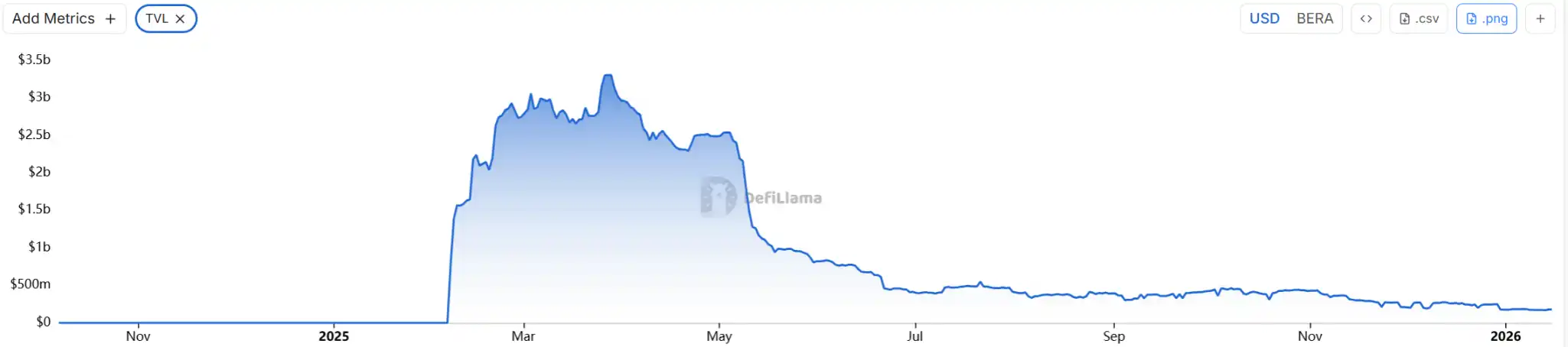
However, as the token price continued to decline, according to DefiLlama data, its TVL has dropped to $1.8 billion, with a 24-hour on-chain revenue of $84 and a total supply of on-chain stablecoins amounting to $153.5 million.
Retail Investors Last? Token Majority Owned by VCs, Facing Large Unlock in February
In its year-end update, the Berachain Foundation acknowledged that the overall impact of the cryptocurrency market's "retail investors first" strategy had been poor, leading to a reallocation of resources. This directly resulted in a series of issues. The first was layoffs and team restructuring. As part of a strategic adjustment, the Berachain Foundation laid off most of its retail investor marketing team, shifting focus to core development. Berachain's lead developer, Alberto, will also depart to start a Web2 company with former banking colleagues.
The foundation emphasized that the departures were amicable, but it undoubtedly weakened the project's core technical strength. Within the community, some developers have switched to other chains like Monad, further exacerbating talent drain.
Perhaps the "retail investors first" strategy promoted by the Berachain Foundation was never truly implemented.
While the project initially emphasized community-driven efforts, in practice, the incentive mechanisms failed to consistently attract users, leaving retail investors sidelined in token distribution.
Although the PoL mechanism was innovative, its complexity (such as a multi-token model including BERA and BGT) made users hesitant, leading to a sharp decline in network activity. In November 2025, the project suffered a network suspension due to a Balancer protocol vulnerability, fortunately without impacting user funds' security.
The BERA token price has plummeted from its $9 peak to the current $0.7, experiencing over a 10x drop in just a year. The former self-proclaimed king of public chain tokens has seen a significant decline.
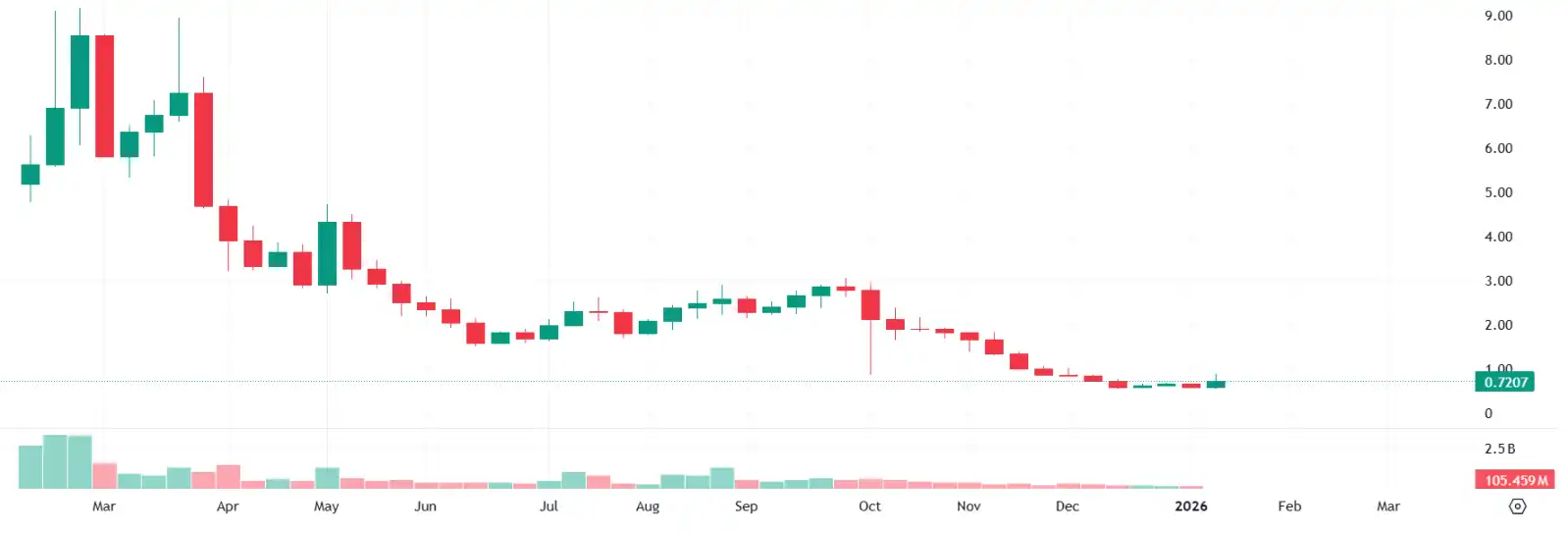
This collapse stemmed from a low circulation and high FDV model, causing an artificial price inflation followed by a rapid collapse, with these issues originating from Berachain's token distribution mechanism. Early contributors received 16.82% of the total supply, private sale investors got an astonishing 34.31% share, a very typical VC coin scenario. Furthermore, NFT holders could receive tens of millions of dollars in tokens, while testnet users were airdropped only $60, sparking a controversy over the wealth gap, with some loyal users being marginalized.
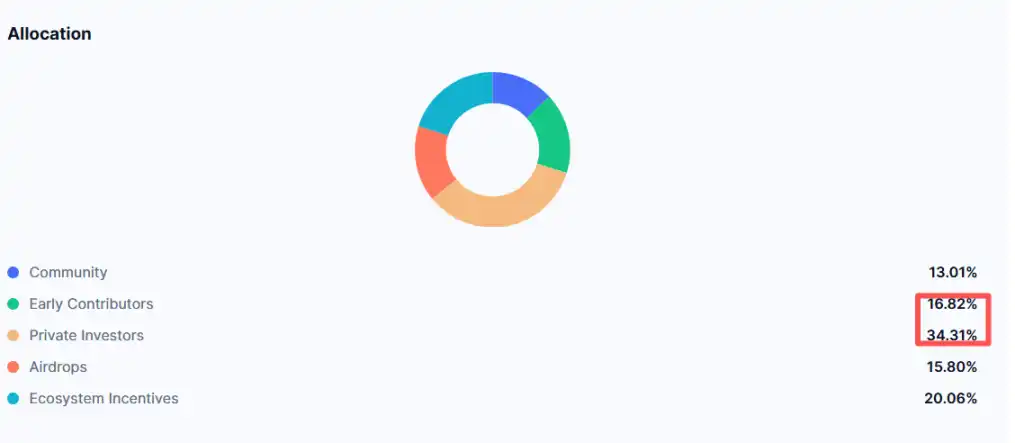
This goes against the "retail investors first" slogan, with the project fundamentally following a VC-driven low circulation high FDV model: early investors entered at $0.82, getting 10-15x returns, while retail investors suffered the collapse. Foundation founder Smokey admitted that if given another chance, they would not sell as many tokens to VCs and have already repurchased some to reduce dilution. In October 2025, the Berachain Foundation partnered with Greenlane Holdings to launch BeraStrategy, attempting to use BERA as a reserve asset but struggling to reverse the coin's price decline.
Furthermore, VCs like Brevan Howard's Nova Fund have a refund right, allowing them to request a full refund of $25 million before February 2026, further highlighting Berachain's bias toward VCs.
Community discontent is rising, with many users referring to it as the "ultimate L1 fraud."
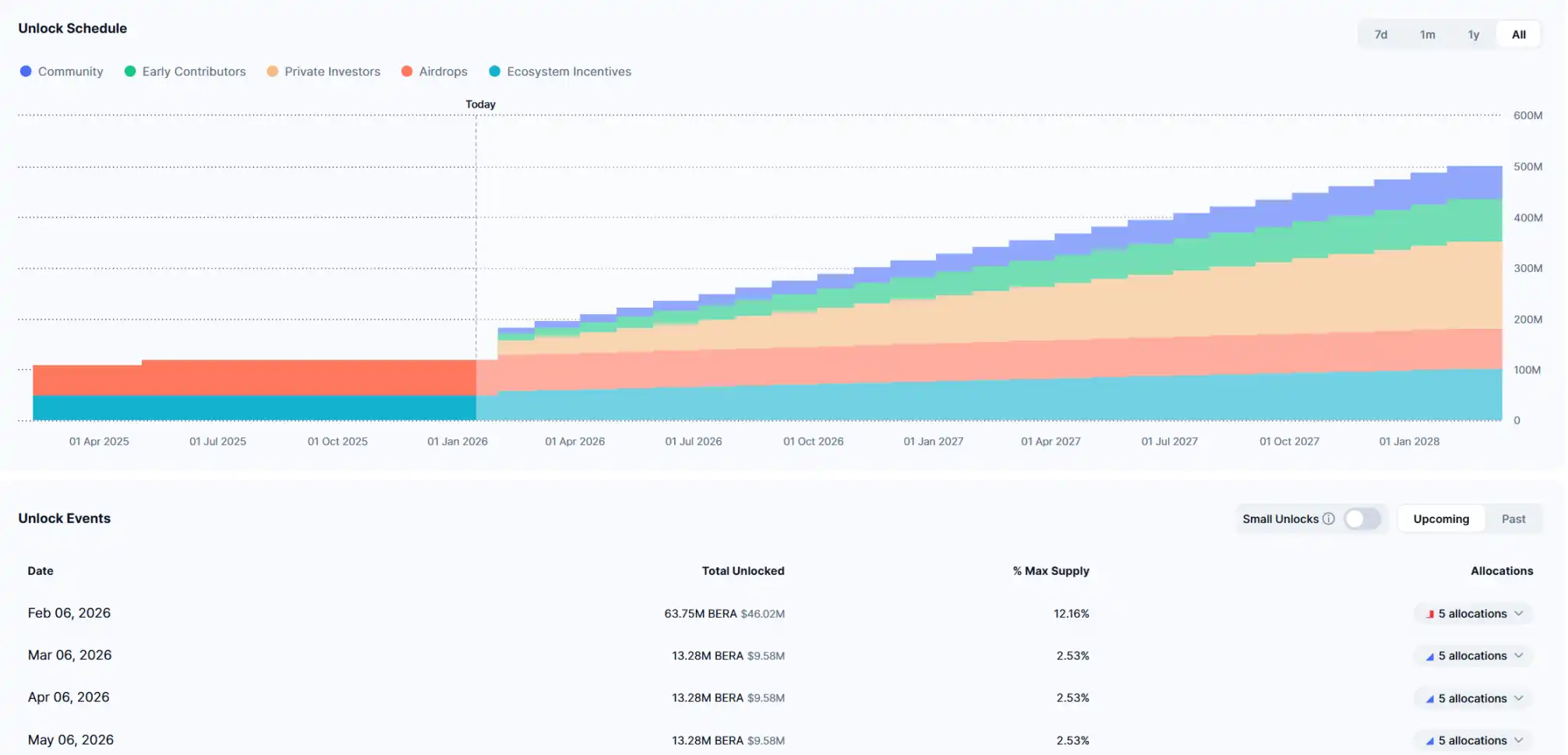
On February 6 this year, Berachain will unlock 63.75 million BERA, about 12.16% of the current circulation, including 28.58 million unlocked for private investors. Starting from March this year, the monthly unlocked share of BERA will be 2.53% of the total supply. Considering the current liquidity drought, continued large-scale unlocks this year may trigger significant selling pressure.
You may also like

Wall Street Shorts ETH: Vitalik is aware and has front-run, while Tom Lee remains oblivious

Social Capital CEO: How Equity Tokenization is Reshaping Capital Markets from US Stocks to SpaceX?

CoinGecko Report: Surge of 346% vs Dip of 20.8%, The Wild Rise of DEX

a16z: The Real Opportunity of Stablecoins Lies Not in Disruption but in Filling Gaps

Mining Exodus: Someone Holds $12.8 Billion AI Order

March 6 Market Key Intelligence, How Much Did You Miss?

a16z: The True Opportunity of Stablecoins is in Complementing, Not Disrupting

Predict LALIGA Matches, Shoot Daily & Win BTC, USDT and WXT on WEEX
The WEEX × LALIGA campaign brought together football excitement and crypto participation through a dynamic interactive experience. During the event, users predicted matches, completed trading tasks, and took daily shots to compete for rewards including BTC, USDT, WXT, and exclusive prizes.

Ray Dalio Dialogue: Why I'm Betting on Gold and Not Bitcoin

Who Took the Money in the AI Era? A Must-See Investment Checklist for HALO Asset Trading
Wall Street Bears Target Ethereum: Vitalik In the Know Takes Flight, Tom Lee Remains Bullish
Pump.fun Hacker Steals $2 Million, Receives 6-Year Prison Sentence, Opts for 'Self-Detonation'

6% Annual Percentage Yield as Musk Declares War on Traditional Banks
36 years, 4 wars, 1 script: How does capital price the world in conflict?

Mining Companies' Great Migration: Some Have Already Secured $12.8 Billion in AI Orders
What Is Vibe Coding? How AI Is Changing Web3 & Crypto Development
What is vibe coding? Learn how AI coding tools are lowering the barrier to Web3 development and enabling anyone to build crypto applications.
The parent company of the New York Stock Exchange strategically invests in OKX: The intentions behind the $25 billion valuation

WEEX P2P update: Country/region restrictions for ad posting
To improve ad security and matching accuracy, WEEX P2P now allows advertisers to restrict who can trade with their ads based on country or region. Advertisers can select preferred counterparty locations for a safer, smoother trading experience.
I. Overview
When publishing P2P ads, advertisers can now set the following:
Allow only counterparties from selected countries or regions to trade with your ads.
With this feature, you can:
Target specific user groups more precisely.Reduce cross-region trading risks.Improve order matching quality.
II. Applicable scenarios
The following are some common scenarios:
Restrict payment methods: Limit orders to users in your country using supported local banks or wallets.Risk control: Avoid trading with users from high-risk regions.Operational strategy: Tailor ads to specific markets.
III. How to get started
On the ad posting page, find "Trading requirements":
Select "Trade with users from selected countries or regions only".Then select the countries or regions to add to the allowlist.Use the search box to quickly find a country or region.Once your settings are complete, submit the ad to apply the restrictions.
When an advertiser enables the "Country/Region Restriction" feature, users who do not meet the criteria will be blocked when placing an order and will see the following prompt:
If you encounter this issue when placing an order as a regular user, try the following solutions.
Choose another ad: Select ads that do not restrict your country/region, or ads that allow users from your location.Show local ads only: Prioritize ads available in the same country as your identity verification.
IV. Benefits
Compared with ads without country/region restrictions, this feature provides the following improvements.
Aspect
Improvement
Trading security
Reduces abnormal orders and fraud risk
Conversion efficiency
Matches ads with more relevant users
Order completion rate
Reduces failures caused by incompatible payment methods
V. FAQ
Q1: Why are some users not able to place orders on my ad?
A1: Their country or region may not be included in your allowlist.
Q2: Can I select multiple countries or regions when setting the restriction?
A2: Yes, multiple selections are supported.
Q3: Can I edit my published ads?
A3: Yes. You can edit your ad in the "My Ads" list. Changes will take effect immediately after saving.


 App
App