
- Buy Crypto
- Markets
 Futures
- Spot
- Copy Trade
- Earn
- More
Can the Uniswap Foundation's massive investment plan solve the token value capture dilemma?

Original Title: Uniswap Foundation votes on a massive $165.5m USD funding.
Original Author: Ignas
Original Translation: Tim, PANews
The Uniswap Foundation has voted on a $165.5 million USD investment plan, but why?
Because the performance of Uniswap v4 and Unichain post-release has fallen far short of market expectations.
In over a month:
· Uni v4's Total Value Locked (TVL) is only $85 million
· Unichain's TVL is only $8.2 million
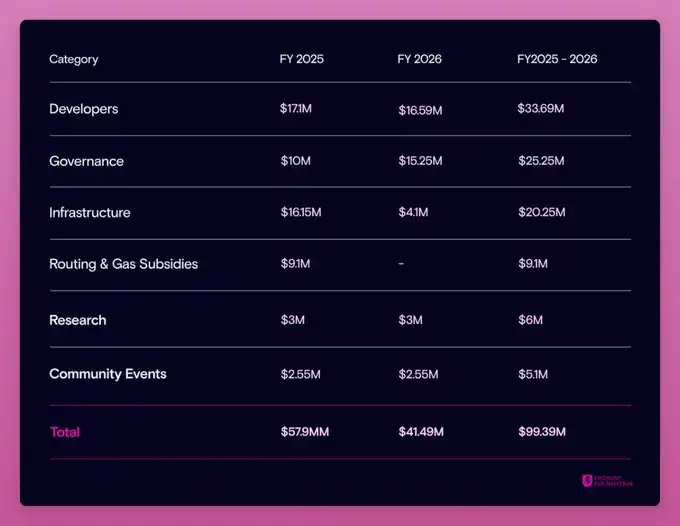
To drive growth, the Uniswap Foundation has proposed allocating $165.5 million in funding towards the following:
· $95.4 million for Grants (developer initiatives, core contributors, validators);
· $25.1 million for Operations (team expansion, governance tooling);
· $45 million for Liquidity Incentives.
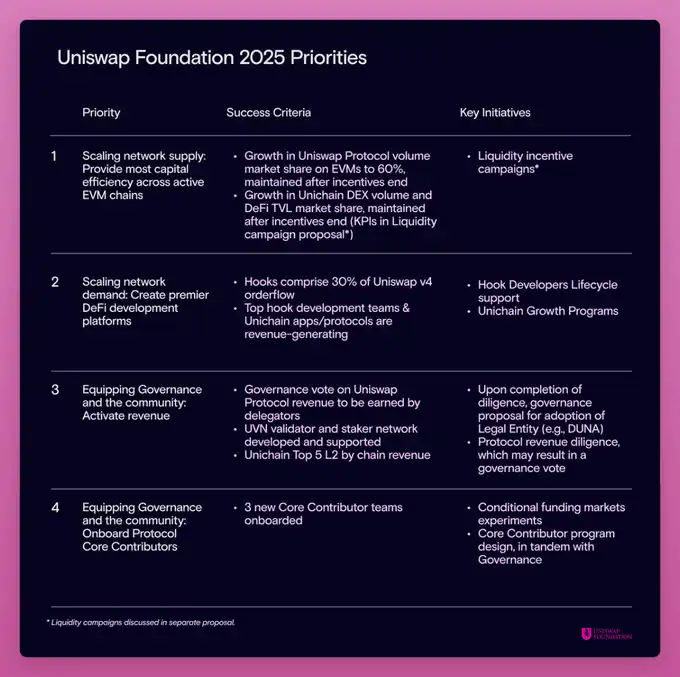
As you can see, Uni v4 is not just a DEX but also a liquidity platform, and Hooks are applications built on top of it.
Hooks are meant to drive the ecosystem growth of Uni v4, hence the need to accelerate this process through a funding initiative.
A breakdown of the funding budget:
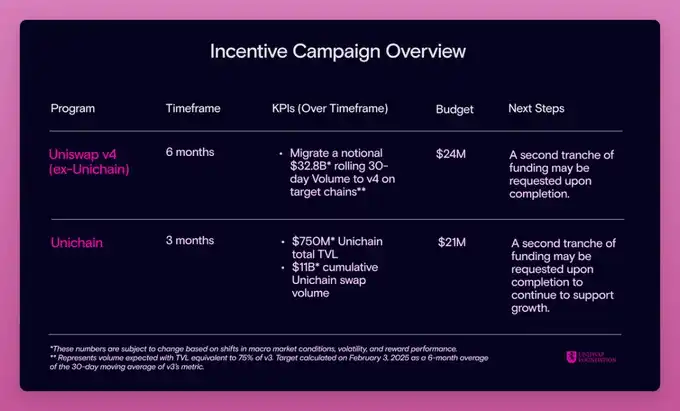
The $45 million Liquidity Provider (LP) Incentives will be used as follows:
· $24 million (distributed over 6 months): To incentivize liquidity migration from other platforms to Uni v4;
· $21 million (distributed over 3 months): To drive Unichain's Total Value Locked (TVL) from the current $8.2 million to $750 million.
On the other hand, Aerodrome mints approximately $40-50 million worth of AERO tokens per month for Liquidity Provider (LP) incentives.
The proposal has passed the temperature check phase but still faces some criticism:
Amidst industry shifts, Aave proposes a weekly buyback of $1 million worth of AAVE tokens, Maker plans a monthly buyback of $30 million, and UNI holders are likened to a "cash cow" that has never had its token value captured.
UNI tokens do not enable a fee-sharing mechanism, yet Uniswap Labs has earned $171 million over two years through frontend fees.
The key to the whole system lies in Uniswap's organizational design:
· Uniswap Labs: Focuses on protocol tech development;
· Uniswap Foundation: Drives ecosystem growth, governance, and funding initiatives (such as grants, liquidity incentives).
Quite a savvy legal team.
Aave and Maker have established a closer alignment of interests with token holders, and I don't understand why Uniswap's frontend fees cannot be shared with UNI holders.
In conclusion, other criticisms mainly revolve around the core team's high salaries, Gauntlet's responsibility for liquidity incentive execution, and the establishment of a new centralized DAO legal structure (DUNA).
As a small governance representative for Uniswap, I have voted in favor of this proposal, but I still have significant concerns about the future of UNI holders: the incentive mechanism has failed to align with holders' interests.
However, I am a loyal fan of Uniswap and highly appreciate its driving role in the DeFi space. The current stagnation of Uni v4 and Unichain is very concerning, and they need to introduce incentive measures to foster development.
The next Uni DAO vote should focus on the UNI token's value-capture mechanism.
You may also like

Wall Street Shorts ETH: Vitalik is aware and has front-run, while Tom Lee remains oblivious

Social Capital CEO: How Equity Tokenization is Reshaping Capital Markets from US Stocks to SpaceX?

CoinGecko Report: Surge of 346% vs Dip of 20.8%, The Wild Rise of DEX

a16z: The Real Opportunity of Stablecoins Lies Not in Disruption but in Filling Gaps

Mining Exodus: Someone Holds $12.8 Billion AI Order

March 6 Market Key Intelligence, How Much Did You Miss?

a16z: The True Opportunity of Stablecoins is in Complementing, Not Disrupting

Predict LALIGA Matches, Shoot Daily & Win BTC, USDT and WXT on WEEX
The WEEX × LALIGA campaign brought together football excitement and crypto participation through a dynamic interactive experience. During the event, users predicted matches, completed trading tasks, and took daily shots to compete for rewards including BTC, USDT, WXT, and exclusive prizes.

Ray Dalio Dialogue: Why I'm Betting on Gold and Not Bitcoin

Who Took the Money in the AI Era? A Must-See Investment Checklist for HALO Asset Trading
Wall Street Bears Target Ethereum: Vitalik In the Know Takes Flight, Tom Lee Remains Bullish
Pump.fun Hacker Steals $2 Million, Receives 6-Year Prison Sentence, Opts for 'Self-Detonation'

6% Annual Percentage Yield as Musk Declares War on Traditional Banks
36 years, 4 wars, 1 script: How does capital price the world in conflict?

Mining Companies' Great Migration: Some Have Already Secured $12.8 Billion in AI Orders
What Is Vibe Coding? How AI Is Changing Web3 & Crypto Development
What is vibe coding? Learn how AI coding tools are lowering the barrier to Web3 development and enabling anyone to build crypto applications.
The parent company of the New York Stock Exchange strategically invests in OKX: The intentions behind the $25 billion valuation
WEEX P2P update: Country/region restrictions for ad posting
To improve ad security and matching accuracy, WEEX P2P now allows advertisers to restrict who can trade with their ads based on country or region. Advertisers can select preferred counterparty locations for a safer, smoother trading experience.
I. Overview
When publishing P2P ads, advertisers can now set the following:
Allow only counterparties from selected countries or regions to trade with your ads.
With this feature, you can:
Target specific user groups more precisely.Reduce cross-region trading risks.Improve order matching quality.
II. Applicable scenarios
The following are some common scenarios:
Restrict payment methods: Limit orders to users in your country using supported local banks or wallets.Risk control: Avoid trading with users from high-risk regions.Operational strategy: Tailor ads to specific markets.
III. How to get started
On the ad posting page, find "Trading requirements":
Select "Trade with users from selected countries or regions only".Then select the countries or regions to add to the allowlist.Use the search box to quickly find a country or region.Once your settings are complete, submit the ad to apply the restrictions.
When an advertiser enables the "Country/Region Restriction" feature, users who do not meet the criteria will be blocked when placing an order and will see the following prompt:
If you encounter this issue when placing an order as a regular user, try the following solutions.
Choose another ad: Select ads that do not restrict your country/region, or ads that allow users from your location.Show local ads only: Prioritize ads available in the same country as your identity verification.
IV. Benefits
Compared with ads without country/region restrictions, this feature provides the following improvements.
Aspect
Improvement
Trading security
Reduces abnormal orders and fraud risk
Conversion efficiency
Matches ads with more relevant users
Order completion rate
Reduces failures caused by incompatible payment methods
V. FAQ
Q1: Why are some users not able to place orders on my ad?
A1: Their country or region may not be included in your allowlist.
Q2: Can I select multiple countries or regions when setting the restriction?
A2: Yes, multiple selections are supported.
Q3: Can I edit my published ads?
A3: Yes. You can edit your ad in the "My Ads" list. Changes will take effect immediately after saving.


 App
App