
BRC20 Ecosystem Revitalization? A New Dawn or an Illusion




Original Article Title: "BRC20 Ecological Recovery? A New Prelude or an Illusion"
Original Article Author: ChandlerZ, Foresight News
On February 24, after a long period of low-level operation, Bitcoin on-chain Gas fees experienced a significant increase, rising from an average of 1-2 satoshis/byte to over 12 satoshis/byte for high priority transactions. A few weeks ago, the Bitcoin mempool was fully cleared for the first time in nearly two years, but the number of unconfirmed transactions has since risen back to over 100,000.
According to Geniidata's data monitoring, in the past 24 hours, on-chain minting activity has shown a highly concentrated feature, mainly focusing on the MASK project.
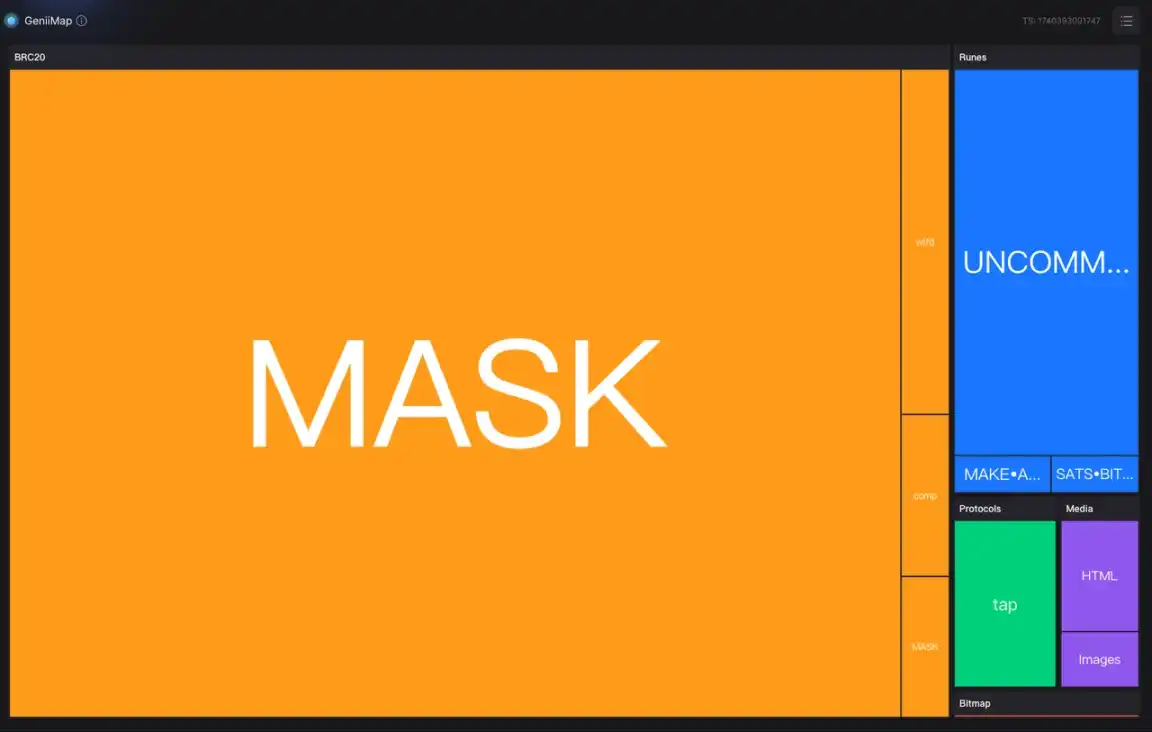
The total minting volume of MASK is 2.1 million tokens, with each token containing 10 coins. The current market price is around $0.18, with a total market value of approximately $3.06 million. As of the latest data, the minting progress of this project has reached 82.69%, and this increased activity has sparked widespread discussions in the market about the possibility of a new round of revival in the BRC-20 ecosystem.
From a deeper market logic perspective, the current crypto market is at a unique moment. As the conspiracy theories of the Solana and BSC ecosystems are widely questioned, the somewhat "fair" BRC-20 seems to have rekindled market attention. However, the market's memory has not faded with time, and the previous intense fluctuations in the Bitcoin ecosystem still cast a shadow over the market.
Watch Him Build a Tower High, Watch Him Watch It Fall
According to The Block data, starting from April 20, 2023, driven by the BRC-20 ecosystem, the number of transactions on the BTC network began to sharply rise, almost doubling in less than a month. The increase in transaction fees was even steeper, rising nearly tenfold in less than half a month. During the peak activity of the BRC-20 ecosystem, over 70% of on-chain transactions on the Bitcoin network were related to BRC-20 projects.
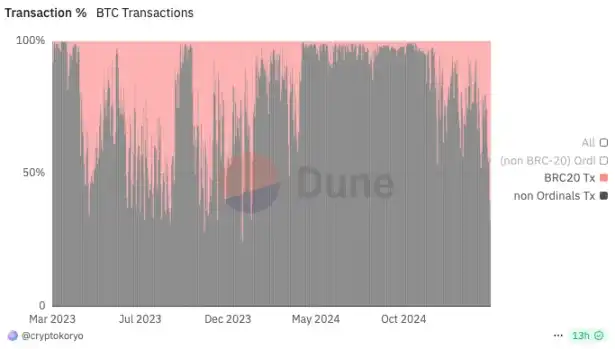
Behind this prosperous facade lies a fragile ecosystem foundation. After entering 2024, the Bitcoin ecosystem gradually fell into a downturn, a transformation that actually reflects the deep-seated challenges of the Bitcoin application layer. Although the market once had high hopes for the Bitcoin ecosystem, believing that innovation based on the script protocol could inject new vitality into the Bitcoin network, the actual development trajectory has deviated significantly from expectations.
Looking back at the development process of the BRC 20 ecosystem, we have to face a harsh reality. Most early popular projects experienced significant price retracements. ORDI dropped from a high of $87 to $11, Sats fell from 0.00000086 to 0.00000012, and other projects, including NFTs in the Bitcoin ecosystem, saw price drops of up to 90%, with many having already "returned to zero," leaving only a few projects with a strong grassroots culture.
This phenomenon is not accidental but rather the outward manifestation of deep-seated market structural issues. The BRC 20 protocol, from its design inception, embraced "true fairness" as a core principle. Through a fully transparent on-chain mechanism that eliminated reserves and scientist mechanisms, it aimed to provide all market participants with a truly equal opportunity to participate. While this design theoretically achieved the highest level of decentralization, it revealed significant limitations in practice.
The Paradox of Fairness and Market Control
From a market structure perspective, the scientist mechanism and initial chip distribution system in traditional crypto projects are essentially market regulation tools. Although these mechanisms are often criticized as manifestations of centralization, they play an indispensable role in maintaining market stability. Through these mechanisms, project teams can control market fluctuations to a certain extent, providing necessary price support for the project's long-term development.
However, the fully open minting mechanism in the BRC 20 ecosystem, while maximizing participation fairness, also resulted in highly dispersed chip structures. In the absence of effective price support mechanisms, market volatility tends to be more pronounced. In such scenarios, shifts in market sentiment can easily trigger chain reactions, leading to rapid price declines.
A deeper issue lies in the motivation of large funds to participate. In traditional crypto projects, large funds can influence market trends through various mechanisms to generate profits. However, under the inscription mechanism of BRC 20, this operational space is greatly reduced. When these so-called "whales" or "institutions" find it challenging to establish effective chip control, they naturally turn to other markets that offer easier fund management opportunities. This creates a paradox: the pursuit of absolute fairness may paradoxically lead to market instability, ultimately harming the interests of all participants. In such cases, the market needs to find a balance between complete fairness and necessary market stability.
The resurgence of the MASK project to some extent demonstrates that the market's yearning for a fair mechanism has not completely faded, regardless of whether this project still remains a "meteor." However, establishing an effective market stability mechanism while maintaining basic fairness remains a core challenge facing the entire crypto ecosystem. This requires innovation at the protocol design level and may involve introducing new mechanisms to balance decentralization and market stability, two seemingly contradictory goals.
You may also like

Mastercard Launches Agent Pay for AI, Plans to Record AI Agent Payment Authorizations on Polygon
Mastercard launched Agent Pay for AI, a new payment protocol designed to help AI agents make small payments such as pay-per-use access to data and APIs. The system plans to record human-granted AI agent permissions on Polygon, focusing on verifiable authorization, identity, and payment controls.

Curve Deploys Llamalend v2 on Optimism With 250,000 OP Incentives
Curve launched Llamalend v2 on Optimism with 250,000 OP incentives from the Optimism Foundation. The upgrade expands Llamalend beyond its earlier crvUSD-focused model, adding broader collateral support, LlamaRisk market reviews, and the ability to use Curve LP tokens as collateral.

Raydium Old Liquidity Pool Reportedly Exploited, With $1.34 Million Moved to Ethereum and Tornado Cash
An old Raydium liquidity pool was reportedly exploited for around $1.34 million in USDC, RAY, and wSOL, with the stolen funds bridged to Ethereum and deposited into Tornado Cash. The incident highlights the tail risks of legacy DeFi pools, old contracts, and cross-chain fund laundering paths.

Kalshi Executive Challenges “SBF Backed AI Unicorns” Narrative, Says Leopold Aschenbrenner Was Key Figure
Kalshi executive John Wang questioned the “SBF backed AI unicorns” narrative, saying Leopold Aschenbrenner was the key figure behind major AI investment decisions.

Pantera Capital Partner: How Tokenization is Restructuring the Private Equity and Early Investment Ecosystem?

New York Proposes Stricter Stablecoin Issuer Rules Aligned With Federal GENIUS Act
NYDFS proposed stricter stablecoin issuer rules aligned with the GENIUS Act, covering reserves, custody, redemption timelines, audits, and capital buffers.
Every exchange is a "Universal Exchange."

The counterattack of traditional finance: Alliance chains are quietly reviving

CryptoQuant Says Bitcoin Profitable Supply Is Near 45% Pressure Zone as On-Chain Data Points to Market Repricing
CryptoQuant said Bitcoin’s profitable supply is nearing the 45% pressure zone, signaling rising market stress, unrealized losses, and a possible on-chain repricing phase.

Bitcoin Falls Below 200-Week Moving Average as On-Chain Data Shows Over Half of Supply in Loss
Bitcoin dropped below its 200-week moving average as on-chain data showed over 50% of circulating supply is now in loss, signaling rising market stress.

CFTC Reportedly Plans New Prediction Market Rules Focused on Manipulation Risk and Public Interest Review
The CFTC is reportedly preparing new prediction market rules focused on manipulation risk, public interest review, and retail trader protections.

Meet the new WEEX trial fund—your gateway to greater profits

WEEX Labs Lands at Dutch Blockchain Week: A Disruptive Crypto × AI Conversation Sets Sail in Amsterdam
SK Hynix Reportedly Plans U.S. ADR Listing as Early as August, With SEC Approval Possible in Late June
SK Hynix may pursue a U.S. ADR listing as early as August, with SEC approval reportedly possible in late June amid strong AI chip supply chain demand.

SpaceX vs Tesla vs xAI: Which Elon Musk Trade Has the Biggest Upside in 2026?
OpenAI Reveals It Has Confidentially Submitted an S-1 to the SEC, Keeping the Door Open for a Future IPO
On June 9, according to an OpenAI announcement, the company recently confidentially submitted a draft S-1 registration statement to the U.S. Securities and Exchange Commission (SEC), beginning the preliminary compliance process for a potential initial public offering. OpenAI said it chose to disclose this proactively because it expected the news might leak; however, the company has not yet set a specific listing timeline, and related arrangements may still take some time.
Latest research from 13 top universities including Cornell University: The current state, challenges, and misconceptions of the fusion of Crypto and AI
Deconstructing Anthropic: The Best AI Company, Possibly Also a Type of Organizational Invention
Mastercard Launches Agent Pay for AI, Plans to Record AI Agent Payment Authorizations on Polygon
Mastercard launched Agent Pay for AI, a new payment protocol designed to help AI agents make small payments such as pay-per-use access to data and APIs. The system plans to record human-granted AI agent permissions on Polygon, focusing on verifiable authorization, identity, and payment controls.
Curve Deploys Llamalend v2 on Optimism With 250,000 OP Incentives
Curve launched Llamalend v2 on Optimism with 250,000 OP incentives from the Optimism Foundation. The upgrade expands Llamalend beyond its earlier crvUSD-focused model, adding broader collateral support, LlamaRisk market reviews, and the ability to use Curve LP tokens as collateral.
Raydium Old Liquidity Pool Reportedly Exploited, With $1.34 Million Moved to Ethereum and Tornado Cash
An old Raydium liquidity pool was reportedly exploited for around $1.34 million in USDC, RAY, and wSOL, with the stolen funds bridged to Ethereum and deposited into Tornado Cash. The incident highlights the tail risks of legacy DeFi pools, old contracts, and cross-chain fund laundering paths.
Kalshi Executive Challenges “SBF Backed AI Unicorns” Narrative, Says Leopold Aschenbrenner Was Key Figure
Kalshi executive John Wang questioned the “SBF backed AI unicorns” narrative, saying Leopold Aschenbrenner was the key figure behind major AI investment decisions.
Pantera Capital Partner: How Tokenization is Restructuring the Private Equity and Early Investment Ecosystem?
New York Proposes Stricter Stablecoin Issuer Rules Aligned With Federal GENIUS Act
NYDFS proposed stricter stablecoin issuer rules aligned with the GENIUS Act, covering reserves, custody, redemption timelines, audits, and capital buffers.


