
- Buy Crypto
- Markets
 Futures
- Spot
- Copy Trade
- Earn
- More
Bitcoin Price Prediction: BTC Holds $95K as Belgium Bank Enters Crypto and Quantum Risk Challenges

Key Takeaways
- Belgium’s KBC Bank introduces regulated crypto trading within the framework of the Markets in Crypto-Assets (MiCA), significantly impacting European institutional crypto acceptance.
- Iran experiences a $7.8 billion surge in its cryptocurrency ecosystem due to economic instability and governmental sanctions, highlighting Bitcoin’s role as a financial refuge.
- Concerns about advances in quantum computing lead to debate among investors, with some reallocating Bitcoin investments while developers argue for long-term resilience.
- Technical analysis shows Bitcoin is supported above $95,000 with a potential bullish breakout, driven by favorable market conditions and price patterns.
WEEX Crypto News, 2026-01-19 11:53:36
Bitcoin (BTC) is experiencing a remarkable phase in its evolution, holding a steady position near the $95,000 benchmark. This pricing stability comes amidst a backdrop of innovative regulatory developments and shifting market perceptions that could drastically alter the landscape for cryptocurrency investors and the strategies they employ. Among the key developments shaping this narrative are Belgium’s entry into regulated crypto trading, the burgeoning Iranian cryptocurrency market in response to internal economic dynamics, and burgeoning discussions about the implications of quantum computing on Bitcoin’s security protocols.
Belgium Bank Opens Crypto Trading
In a watershed moment for Belgium’s financial industry, KBC Bank is leading as the first Belgian bank to embrace regulated cryptocurrency trading under the newly initiated Markets in Crypto-Assets (MiCA) framework. Launching operations on February 16, KBC’s Bolero platform will enable customers to trade Bitcoin and Ethereum with the assurance of regulatory oversight. This development is part of a broader acceptance trend of digital assets in Europe, reinforcing Bitcoin’s dual standing as both a dynamic growth vehicle and a robust hedge against economic uncertainty. KBC’s adoption signifies a significant institutional endorsement that could catalyze further institutional interest and participation across the European continent.
Though no Belgian MiCA licenses currently appear in the European Securities and Markets Authority (ESMA) register, KBC has asserted its compliance with MiCA stipulations. By notifying the National Bank of Belgium, KBC fortifies its position in a landscape where regulatory policies are still being solidified. This regulated entry not only offers retail investors a credible and secure entrée into digital currency markets but also underscores the maturing attitude of traditional financial institutions towards cryptocurrency adoption, despite ongoing discussions and adjustments within regulatory frameworks.
Iran’s $7.8 Billion Crypto Surge
Amid a maelstrom of domestic turmoil, inflationary pressures, and geopolitical maneuvering, Iran’s cryptocurrency market reached an unprecedented expansion, peaking at $7.78 billion in 2025. This intensification was partly fueled by widespread public unrest, economic instability, and the devaluation of the Iranian rial. As citizens sought alternatives to bypass traditional financial constraints — exacerbated by internet blackouts and systemic banking restrictions — Bitcoin emerged as a financial buoy, enabling Iranians to safeguard their wealth against local turmoil and international sanctions pressures.
Remarkably, Chainalysis data unravels that over half of the late-2025 cryptocurrency inflows were routed through addresses associated with state-affiliated entities, including the Islamic Revolutionary Guard Corps (IRGC). This dual utilization of cryptocurrency illustrates both a tool for individual financial autonomy and a mechanism for state actors to navigate sanctions. Bitcoin’s role as a hedge during these volatile times underscores its increasing influence in markets characterized by instability, highlighting the power digital currencies can exert in nations under economic duress.
Quantum Risk Debate
The advancing horizon of quantum computing presents a new realm of discussion and trepidation among investors concerning Bitcoin’s future security measures. Jefferies strategist Christopher Wood recently made a decisive portfolio shift, replacing a 10% Bitcoin allocation with investments in physical gold and mining equities. This decision stems from concerns that quantum computing advancements could eventually challenge the cryptographic foundations that Bitcoin relies upon for security.
In contrast, Bitcoin developers advocate that the arrival of quantum computational threats is far from imminent. Industry experts, like Blockstream CEO Adam Back, estimate that the potential risks posed by quantum machines are decades away, thus providing a temporal buffer for the integration of quantum-resistant cryptographic solutions. While Wood’s apprehensions may dampen investor sentiment in the short term, ongoing technological research and innovations promise to reinforce Bitcoin’s resilience and adaptability over the longer term.
Will Bitcoin Break the $100K Barrier?
Amid these multifaceted developments, Bitcoin’s current trading range demonstrates a resilient neutrality with potential upward breakouts. Presently positioned near $95,188, BTC’s technical charts reveal a robust ascending structure marked by resilient support levels and a bullish flag pattern just below the $97,700 resistance. Should Bitcoin successfully breach this resistance, it could clear a path towards the psychological thresholds of $99,000 and $100,500.
Bitcoin’s standing above short-, medium-, and long-term Exponential Moving Averages (EMAs) further endorses its sustained momentum, offering a promising outlook for near-term bullish activity. Neutral yet slightly bullish Relative Strength Index (RSI) readings support this positive sentiment, indicating ample room for price continuation.
Recent candlestick formations, including a bullish engulfing pattern at the $93,000 level, coupled with small-bodied candles, suggest a consolidation phase preceding another potential price surge. This technical setting encourages traders to consider long positions, targeting the $99,000 to $100,500 range, with prudent stop-loss strategies anchored below $93,000.
Bitcoin Hyper: Bridging Bitcoin and Solana
In a parallel trajectory, Bitcoin Hyper emerges as a catalyst in harmonizing Bitcoin’s established security infrastructure with Solana’s unparalleled transaction speed. As Bitcoin ascends in user activity and the demand for efficient blockchain-based applications continues to rise, Bitcoin Hyper ($HYPER) presents a formidable frontier. By marrying Bitcoin’s security with Solana’s speed, Bitcoin Hyper facilitates the deployment of swift, cost-effective smart contracts, decentralized applications, and even meme coin generation.
Thoroughly vetted by Consult, the Bitcoin Hyper initiative underlines trust and scalability, crucial elements as it garners broader adoption in the crypto sphere. With presale figures surpassing $30.7 million and tokens at an appealing entry price of $0.013585, Bitcoin Hyper stands prominently as a bridge that interlinks two dominant ecosystems in the cryptoverse.
Conclusion
In sum, Bitcoin’s journey at this pivotal juncture encapsulates the transformative forces at play within the global cryptocurrency market. From Belgium’s regulated trading avenues to Iran’s reliance on Bitcoin amidst economic vicissitudes, and from quantum computing risks to emerging synergies like Bitcoin Hyper, each factor interweaves to shape a comprehensive picture of Bitcoin’s evolving role as a capital preserver and growth conduit.
As cryptocurrency continues to mature amidst rigorous scrutiny and dynamic market conditions, the potential for transformative growth remains robust, prophesying a future where Bitcoin could shatter new frontiers and usher in unprecedented financial architectures.
Frequently Asked Questions
What impact does Belgium’s KBC Bank launching crypto trading have on Bitcoin?
Belgium’s KBC Bank launching crypto trading represents a milestone in institutional acceptance of Bitcoin in Europe. It offers regulated and secure access for retail investors, fostering confidence and potentially catalyzing greater adoption.
Why has Iran turned to Bitcoin amidst economic challenges?
Iran has increasingly turned to Bitcoin due to its economic instability, currency devaluation, and sanctions pressures. Bitcoin offers a financial refuge, allowing individuals and state-linked entities to preserve and maneuver their wealth beyond traditional constraints.
How do quantum computing advancements pose risks to Bitcoin?
Quantum computing advancements could, in theory, challenge the cryptographic security that underpins Bitcoin. While this development is a long-term consideration, investors are wary, leading some to reallocate their Bitcoin assets into traditional safe-havens like gold.
What future price prospects are technical charts suggesting for Bitcoin?
Technical charts suggest Bitcoin is poised for a potential breakout, with prices holding firm above $95,000. A breach of the $97,700 resistance could propel BTC towards the $99,000 and $100,500 levels, given the current favorable technical indicators.
How does Bitcoin Hyper enhance Bitcoin’s ecosystem?
Bitcoin Hyper enhances Bitcoin’s ecosystem by integrating Solana-level speed and efficiency. This enables faster and cheaper transactions, smart contracts, and decentralized applications, expanding Bitcoin’s capabilities and utility in the blockchain space.
You may also like

Wall Street Shorts ETH: Vitalik is aware and has front-run, while Tom Lee remains oblivious

Social Capital CEO: How Equity Tokenization is Reshaping Capital Markets from US Stocks to SpaceX?

CoinGecko Report: Surge of 346% vs Dip of 20.8%, The Wild Rise of DEX

a16z: The Real Opportunity of Stablecoins Lies Not in Disruption but in Filling Gaps

Mining Exodus: Someone Holds $12.8 Billion AI Order

March 6 Market Key Intelligence, How Much Did You Miss?

a16z: The True Opportunity of Stablecoins is in Complementing, Not Disrupting

Predict LALIGA Matches, Shoot Daily & Win BTC, USDT and WXT on WEEX
The WEEX × LALIGA campaign brought together football excitement and crypto participation through a dynamic interactive experience. During the event, users predicted matches, completed trading tasks, and took daily shots to compete for rewards including BTC, USDT, WXT, and exclusive prizes.

Ray Dalio Dialogue: Why I'm Betting on Gold and Not Bitcoin

Who Took the Money in the AI Era? A Must-See Investment Checklist for HALO Asset Trading
Wall Street Bears Target Ethereum: Vitalik In the Know Takes Flight, Tom Lee Remains Bullish
Pump.fun Hacker Steals $2 Million, Receives 6-Year Prison Sentence, Opts for 'Self-Detonation'

6% Annual Percentage Yield as Musk Declares War on Traditional Banks
36 years, 4 wars, 1 script: How does capital price the world in conflict?

Mining Companies' Great Migration: Some Have Already Secured $12.8 Billion in AI Orders
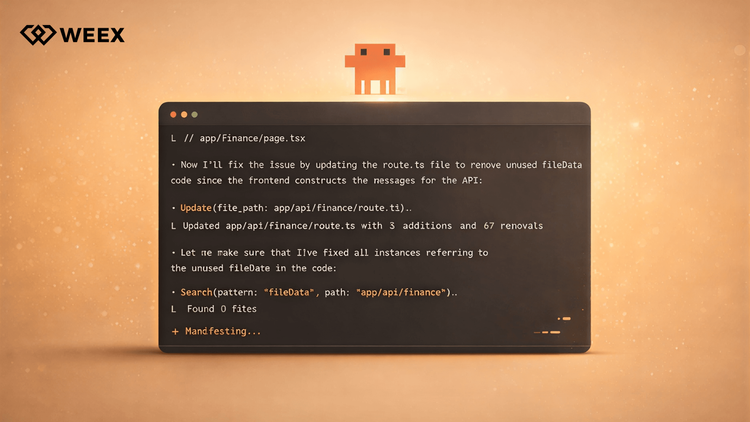
What Is Vibe Coding? How AI Is Changing Web3 & Crypto Development
What is vibe coding? Learn how AI coding tools are lowering the barrier to Web3 development and enabling anyone to build crypto applications.
The parent company of the New York Stock Exchange strategically invests in OKX: The intentions behind the $25 billion valuation

WEEX P2P update: Country/region restrictions for ad posting
To improve ad security and matching accuracy, WEEX P2P now allows advertisers to restrict who can trade with their ads based on country or region. Advertisers can select preferred counterparty locations for a safer, smoother trading experience.
I. Overview
When publishing P2P ads, advertisers can now set the following:
Allow only counterparties from selected countries or regions to trade with your ads.
With this feature, you can:
Target specific user groups more precisely.Reduce cross-region trading risks.Improve order matching quality.
II. Applicable scenarios
The following are some common scenarios:
Restrict payment methods: Limit orders to users in your country using supported local banks or wallets.Risk control: Avoid trading with users from high-risk regions.Operational strategy: Tailor ads to specific markets.
III. How to get started
On the ad posting page, find "Trading requirements":
Select "Trade with users from selected countries or regions only".Then select the countries or regions to add to the allowlist.Use the search box to quickly find a country or region.Once your settings are complete, submit the ad to apply the restrictions.
When an advertiser enables the "Country/Region Restriction" feature, users who do not meet the criteria will be blocked when placing an order and will see the following prompt:
If you encounter this issue when placing an order as a regular user, try the following solutions.
Choose another ad: Select ads that do not restrict your country/region, or ads that allow users from your location.Show local ads only: Prioritize ads available in the same country as your identity verification.
IV. Benefits
Compared with ads without country/region restrictions, this feature provides the following improvements.
Aspect
Improvement
Trading security
Reduces abnormal orders and fraud risk
Conversion efficiency
Matches ads with more relevant users
Order completion rate
Reduces failures caused by incompatible payment methods
V. FAQ
Q1: Why are some users not able to place orders on my ad?
A1: Their country or region may not be included in your allowlist.
Q2: Can I select multiple countries or regions when setting the restriction?
A2: Yes, multiple selections are supported.
Q3: Can I edit my published ads?
A3: Yes. You can edit your ad in the "My Ads" list. Changes will take effect immediately after saving.


 App
App