
- Buy Crypto
- Markets
 Futures
- Spot
- Copy Trade
- Earn
- More
Bitcoin Futures OI Shows Cautious Return in Risk Appetite

Key Takeaways
- Bitcoin futures open interest (OI) saw a 13% recovery since the start of the year, indicating a potential resurgence in risk appetite for crypto traders.
- The rise in futures OI follows a significant period of deleveraging from October through December, with exposure to Bitcoin derivatives dropping alongside a broad market correction.
- Analysts suggest that the current recovery could indicate a stronger base forming for potential bullish market movements, although open interest levels remain below their all-time high.
- Bitcoin options OI has surpassed futures OI, highlighting a shift in trading strategies that may lead to more market stability and reduced volatility.
WEEX Crypto News, 2026-01-19 08:24:24
In recent months, the Bitcoin futures market has experienced a notable shift as the open interest (OI)—a key measure of derivative market participation—has begun to recover. This upturn marks a 13% increase since the start of the year, a fact that analysts suggest could spell a cautious resurgence of risk appetite among crypto traders. This gradual increase has come on the heels of a marked decline in the latter part of the previous year, which was characterized by a significant deleveraging trend.
Understanding Open Interest and Its Impact
To fully grasp the situation, it’s essential to delve into what open interest represents in the realm of crypto derivatives. Open interest reflects the total number of outstanding derivative contracts—such as futures—that remain unsettled. Essentially, it’s a barometer of how many active positions are in play within the market at any given time. When the open interest rises, it signals that more traders are taking on leveraged positions. This often aligns with increased market confidence and a readiness to engage in riskier bets. On the contrary, when open interest declines, it typically marks a phase where traders are paring back their risk exposures, unwinding leveraged positions due to market corrections or a decrease in confidence.
In the case of Bitcoin futures, the open interest saw a steep drop of 17.5%, sliding from 381,000 BTC to 314,000 BTC over a three-month period. This decline coincided with a significant market correction, roughly 36% since early October, signaling a phase where traders were actively reducing risk and exposure.
The Path to Recovery
Signs of recovery in the Bitcoin futures market became apparent as open interest began climbing from a low of $54 billion on the first day of January to over $61 billion by the 19th. Even more telling was the surge in futures OI to an eight-week peak of $66 billion on January 15. Analysts indicate that these developments suggest a gradual return of risk appetite to the market. A careful investigation into the dynamics fueling this change reveals an intricate balance between risk management and renewed optimism among traders.
While the current figures show promise, it’s crucial to note that they still trail significantly—by 33%—behind the highs of early October when open interest was as lofty as $92 billion. This underscores a continued atmosphere of caution as the market seeks to re-establish itself on firmer ground. Analysts view this deleveraging phase not just as a pullback but also as a potentially constructive process that might lay the foundation for a more stable and confident market resurgence, often marking bottoming signals that reset market expectations.
The Role of Options in Market Stability
Another critical development in the crypto derivatives landscape has been the shift in prominence from futures to options. Recent data reveals that Bitcoin options open interest has exceeded that of futures, a shift that denotes significant implications for market dynamics. Options, unlike futures, offer the right but not the obligation to buy or sell at a predetermined strike price, thus providing a way to hedge bets with lower risk of forced liquidation. This characteristic makes options a strategic choice for traders looking to manage volatility and in turn foster stable market conditions.
Currently, options hold the highest open interest at the $100,000 strike price, with a whopping $2 billion on the Deribit exchange—a leader in the derivative trading space. The preference for options over futures implies a broader trend where sophisticated players are employing derivatives not merely for speculation, but as tools for strategic risk management and hedging, altering the traditional ebb and flow of market trends.
The Bigger Picture: Market Correction and Opportunities
The recent corrections and subsequent recovery in Bitcoin futures open interest provide a mirrored reflection of the broader market sentiment. The numbers serve as indicators of both cooling and reignition phases in crypto trading activities, helping traders and analysts gauge risk-reward profiles throughout these transitions. It’s worth noting that periods of high volatility and swift corrections are not unusual in the cryptocurrency sector. They offer opportunities as much as they do risks, where adept traders can potentially capitalize on the cycles of hype and hesitance.
Going forward, a close watch on the continual rise or drop in open interest—whether in futures or options—will be critical in forecasting potential shifts in market trajectories. Moreover, how traders perceive and adjust to these metrics will further inform the strategic decisions around leveraging positions in a market notorious for its unpredictable swings.
The Current Landscape and Future Outlook
As we forge ahead, the evolving landscape of Bitcoin futures and options points towards a more nuanced approach to trading. This changing dynamic is expected to foster an environment where careful risk management is pivotal, and where leveraging derivatives can be both a boon and a bane depending on the strategy employed. The balance between futures and options is particularly noteworthy as it signals an emerging shift in how wealth management is carried out in the crypto space, potentially earmarking a stabilized phase for the industry.
As Bitcoin futures open interest climbs towards recovery, albeit cautiously, it brings to the forefront the persistent allure and apprehension tied to cryptocurrency investments. Even as market participants tentatively resume their dance with risk, the lessons from past corrections remain fresh, guiding the collective psyche of traders toward calculated optimism.
Frequently Asked Questions
What is Bitcoin futures open interest?
Bitcoin futures open interest refers to the total number of outstanding futures contracts that remain unsettled at any given time. It provides insight into the volume of active bets in the market.
How has Bitcoin futures open interest changed recently?
Recently, Bitcoin futures open interest has seen a 13% increase from the start of the year, suggesting a cautious return of risk appetite following previous declines due to market corrections.
Why is open interest important in futures trading?
Open interest serves as an indicator of market activity and sentiment. Rising open interest often signifies increased trader confidence and willingness to take on risk, whereas declining open interest may suggest deleveraging and reduced market exposure.
How do options differ from futures in crypto trading?
Options offer traders the right, not the obligation, to buy or sell an asset at a set price, providing more flexibility and better risk management compared to futures, which obligate traders to execute the contract regardless of market conditions.
What impact do options have on market volatility?
Options can dampen market volatility since they are used more for hedging rather than speculative purposes, offering a method to stabilize and manage market fluctuations effectively.
You may also like

Wall Street Shorts ETH: Vitalik is aware and has front-run, while Tom Lee remains oblivious

Social Capital CEO: How Equity Tokenization is Reshaping Capital Markets from US Stocks to SpaceX?

CoinGecko Report: Surge of 346% vs Dip of 20.8%, The Wild Rise of DEX

a16z: The Real Opportunity of Stablecoins Lies Not in Disruption but in Filling Gaps

Mining Exodus: Someone Holds $12.8 Billion AI Order

March 6 Market Key Intelligence, How Much Did You Miss?

a16z: The True Opportunity of Stablecoins is in Complementing, Not Disrupting

Predict LALIGA Matches, Shoot Daily & Win BTC, USDT and WXT on WEEX
The WEEX × LALIGA campaign brought together football excitement and crypto participation through a dynamic interactive experience. During the event, users predicted matches, completed trading tasks, and took daily shots to compete for rewards including BTC, USDT, WXT, and exclusive prizes.

Ray Dalio Dialogue: Why I'm Betting on Gold and Not Bitcoin

Who Took the Money in the AI Era? A Must-See Investment Checklist for HALO Asset Trading
Wall Street Bears Target Ethereum: Vitalik In the Know Takes Flight, Tom Lee Remains Bullish
Pump.fun Hacker Steals $2 Million, Receives 6-Year Prison Sentence, Opts for 'Self-Detonation'

6% Annual Percentage Yield as Musk Declares War on Traditional Banks
36 years, 4 wars, 1 script: How does capital price the world in conflict?

Mining Companies' Great Migration: Some Have Already Secured $12.8 Billion in AI Orders
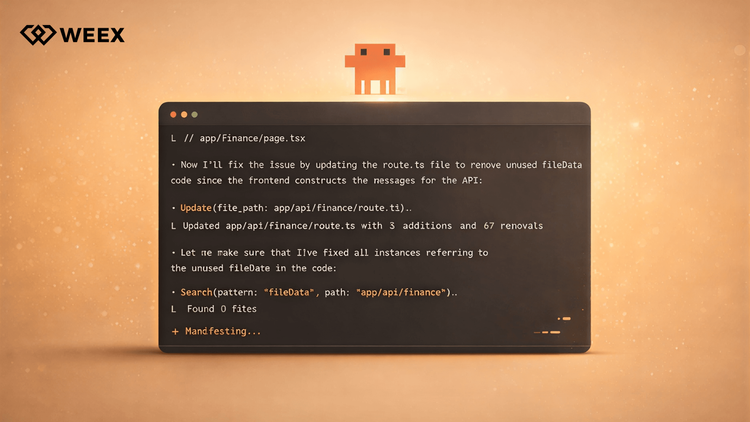
What Is Vibe Coding? How AI Is Changing Web3 & Crypto Development
What is vibe coding? Learn how AI coding tools are lowering the barrier to Web3 development and enabling anyone to build crypto applications.
The parent company of the New York Stock Exchange strategically invests in OKX: The intentions behind the $25 billion valuation

WEEX P2P update: Country/region restrictions for ad posting
To improve ad security and matching accuracy, WEEX P2P now allows advertisers to restrict who can trade with their ads based on country or region. Advertisers can select preferred counterparty locations for a safer, smoother trading experience.
I. Overview
When publishing P2P ads, advertisers can now set the following:
Allow only counterparties from selected countries or regions to trade with your ads.
With this feature, you can:
Target specific user groups more precisely.Reduce cross-region trading risks.Improve order matching quality.
II. Applicable scenarios
The following are some common scenarios:
Restrict payment methods: Limit orders to users in your country using supported local banks or wallets.Risk control: Avoid trading with users from high-risk regions.Operational strategy: Tailor ads to specific markets.
III. How to get started
On the ad posting page, find "Trading requirements":
Select "Trade with users from selected countries or regions only".Then select the countries or regions to add to the allowlist.Use the search box to quickly find a country or region.Once your settings are complete, submit the ad to apply the restrictions.
When an advertiser enables the "Country/Region Restriction" feature, users who do not meet the criteria will be blocked when placing an order and will see the following prompt:
If you encounter this issue when placing an order as a regular user, try the following solutions.
Choose another ad: Select ads that do not restrict your country/region, or ads that allow users from your location.Show local ads only: Prioritize ads available in the same country as your identity verification.
IV. Benefits
Compared with ads without country/region restrictions, this feature provides the following improvements.
Aspect
Improvement
Trading security
Reduces abnormal orders and fraud risk
Conversion efficiency
Matches ads with more relevant users
Order completion rate
Reduces failures caused by incompatible payment methods
V. FAQ
Q1: Why are some users not able to place orders on my ad?
A1: Their country or region may not be included in your allowlist.
Q2: Can I select multiple countries or regions when setting the restriction?
A2: Yes, multiple selections are supported.
Q3: Can I edit my published ads?
A3: Yes. You can edit your ad in the "My Ads" list. Changes will take effect immediately after saving.


 App
App