
Bitcoin 0.1 Reconstructed Byte by Byte: Satoshi Nakamoto's Machine Betrayed by Its Executable

 Prefer us on Google


A 17-year-old compile. On January 8, 2009, Satoshi Nakamoto announced his first Bitcoin client. The identity of its creator was already a topic of debate, as no one verified the delivered file. Now, a developer has taken on the challenge with his GitHub repository: recompiling bitcoin.exe byte by byte.
Key Points of This Article:
- A GitHub repository has recompilied bitcoin.exe from the original source code, with a file identical to that of 2009.
- The executable came from a PC running Windows XP, completed on January 10, 2009, with MinGW GCC 3.4.5.
- The distributed file exactly matches the published code, with no hidden programs in the executable.
- No verified copy of the launch day package has survived; only the one from January 10 exists.
Reconstructing the Toolchain of a 2009 Compile
Compiling is the process of transforming source code into an executable program. Thus, two machines never produce the same file, because their tools differ, which necessitates tracking down Satoshi's toolchain.
The difficulty is immense, as the repository had to gather packages scavenged from archives between 2006 and 2008. It was necessary to find the exact snapshot used by Satoshi.
Lacking access to Windows XP, the project replays the compilation under Linux using Wine, which mimics the 32-bit Windows of the time. The first attempt takes about 6 minutes, according to the repository's readme.
In the end, the output announces MATCH, since the reconstructed bitcoin.exe has the same SHA-256 as the original file, a program of 6,440,960 bytes. Additionally, the .rar archive replicates the fingerprints published by the Satoshi Nakamoto Institute.
Indeed, this identity proves a fact that has been missing for seventeen years, as the file distributed in 2009 indeed came from the code published with it. No hidden program slips into the executable, which had never been guaranteed by anyone.
What the Executable Tells Us About Satoshi
Next, the file acts as a digital fingerprint, as its internal traces name each library used, along with its version. The most telling is MinGW GCC 3.4.5, whose compilation path is found in the binary.
On its part, the readme of version 0.1.5 listed two possible compilers, including Visual C++ 6.0. The binary indeed came from MinGW, which settles a question that has been open for years.
In fact, a test of the Berkeley DB fails in a very precise manner, which only the system files of Windows XP produce. The repository here provides its strongest clue about the original operating system.
Moreover, the archive speaks as much as the program, as its headers retain manually set dates, down to the minute. Satoshi packaged his software with a WinRAR already over three years old, which the repository has recovered.
However, the bitcoin-0.1.0 from the repository is not the one from the launch day. The archive actually contains the update from January 10, as no verified copy of the launch package has survived to this day.
Furthermore, the script replicates three timestamps read from the original file, so the reconstruction repeats an action without discovering it independently. However, Satoshi had announced the color on January 8, 2009:
<< Windows only for now. >>
Satoshi Nakamoto, announcement of the first Bitcoin client
Nevertheless, the human enigma remains intact. Satoshi's computer does not appear in any document, and the repository says nothing about its user.
The bitcoins from the early days, however, do not sleep eternally. Last October, 100 BTC from the Satoshi era emerged from sixteen years of slumber.
In any case, anyone can restart the compilation and verify the result themselves, as the fingerprints of each file are published. It remains to be seen whether the true creator will ever allow his PC to be read in its bytes, he who holds 71 billion dollars in BTC.
-- Price
This content is provided for general informational purposes only and doesn't constitute financial, investment, legal, or tax advice. Any events, rewards, online promotions, or related information mentioned herein should not be considered a recommendation, solicitation, or invitation to purchase, sell, trade, or otherwise deal in any crypto assets. Crypto assets are highly volatile and may result in loss. The availability of WEEX services, products, and related events may vary by region. You are responsible for ensuring that your participation is in accordance with applicable local laws and regulations.
You may also like

Galaxy Believes Bitcoin Bear Market Ended in June, Recommends Buying and Holding

Empery Invests $65 Million to Acquire 25% Stake in AI Data Center

Bitcoin's next Fed test comes with a hidden problem in America's inflation data
The crypto market loses altitude, patience becomes a habit – Steady Lads

Bitcoin's flat trend vs. S&P 500 signals risk warning, says Bloomberg analyst
Cyberattack on GMO in Japan: Trading Accounts Compromised, GMO Coin Claims to be Unaffected

Mark Cuban compares Bitcoin to meme stocks
Electrum patches Bitcoin vulnerability allowing payment redirection
The Week Ahead: 4 Key Moments for the Crypto Market

Security Researcher Exploits PHP2Shell Vulnerability to Breach Bounty Website, Earns Approximately $2000 in Bitcoin Rewards
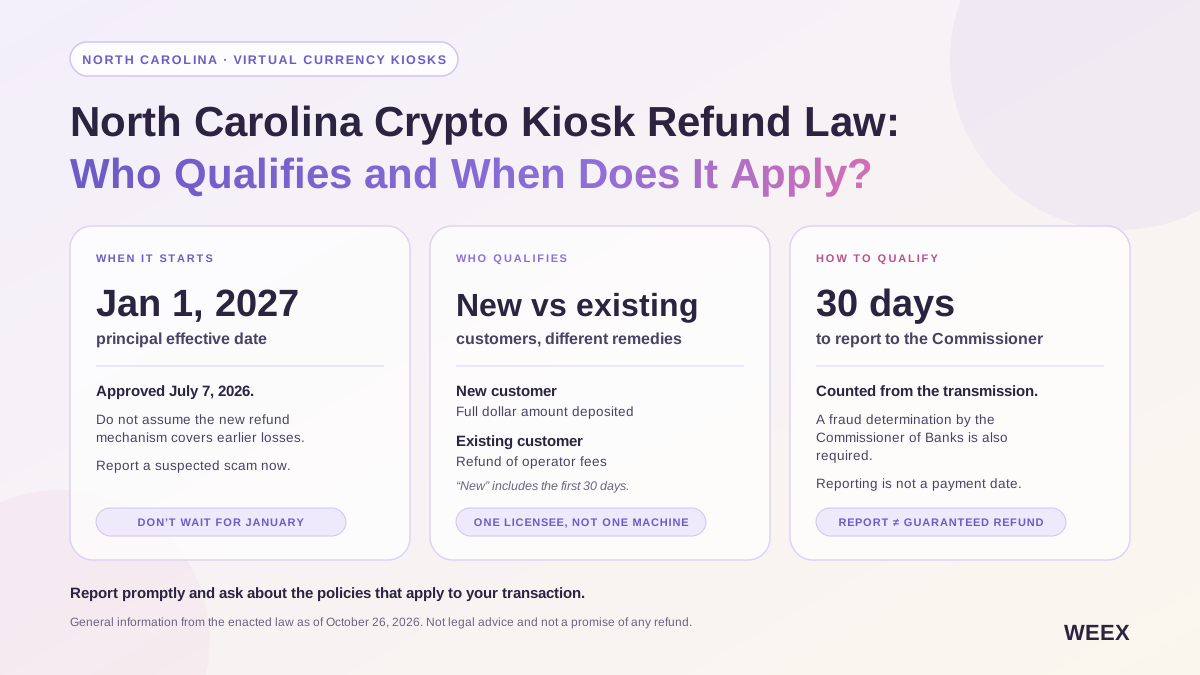
North Carolina Crypto Kiosk Refund Law: Who Qualifies and When Does It Apply?
Understand North Carolina’s crypto kiosk refund law: the January 2027 start date, who qualifies, reporting deadlines, and documents victims should keep.
US Startup Successfully Develops Artificial Gold, Highlighting Bitcoin Scarcity

Sam Price Claims Bitcoin Has Been Declared Dead Multiple Times

Mr&强 Analyzes Bitcoin Support and Resistance Areas

Franklin Templeton Launches Two Dividend Reinvestment Bitcoin ETFs

Interest on U.S. corporate bonds with CCC rating rises to 17.99 percent

LND Releases v0.21.5-beta.rc1 with Fee Estimate Limits

FOUNDATION Faces Spam Attack from Spoofed Domain Names

Bitcoin Core Changes Rules for Disclosing Security Vulnerabilities

New York Man Sentenced to 51 Months in Prison for Telecom Fraud and Money Laundering

[Bitcoin $0 Controversy②] "$0 is an Exaggeration"... Reasons Wall Street Disagrees

WEEX Exclusive:Gold Breaks Below $4,000, Bitcoin Pulls Back Below $80,000 | WEEX TradFi Daily(October 26, 2026)

Gold Breaks Below $4,000, Bitcoin Pulls Back Below $80,000 | WEEX TradFi Daily(October 26, 2026)
At the October 23 close, major indexes were mixed, with the Dow weaker. Brent crude rose to about $116.7, a near six-month high, and energy led; gold briefly fell below $4,000 as Bitcoin pulled back toward $80,000. Cybersecurity stocks strengthened last week, with CrowdStrike up nearly 12%. Markets are watching whether Bitcoin’s correction is nearing its end, along with earnings from Verizon, Cadence, Celestica and Amkor today.

The Superintendency of the Securities Market of Panama Excludes Cryptocurrencies from Its Oversight

Michael Saylor: Strategy's Core Business is Bitcoin-Based Digital Credit Products

Bitcoin and gold among worst-performing assets in 2023
X Adds Feature to Send $1 via Long Press on Like Button, Cryptocurrency Still Not Supported
Bitcoin Warns of Quantum Computer Threat Response Time of 2 Years

Paolo Ardoino wants AI to run Bitcoin mines. Who gets permission to act?

Sam Price Observes Significant Volatility in Ethereum Market
Galaxy Believes Bitcoin Bear Market Ended in June, Recommends Buying and Holding
Empery Invests $65 Million to Acquire 25% Stake in AI Data Center
Bitcoin's next Fed test comes with a hidden problem in America's inflation data
The crypto market loses altitude, patience becomes a habit – Steady Lads
Bitcoin's flat trend vs. S&P 500 signals risk warning, says Bloomberg analyst
Cyberattack on GMO in Japan: Trading Accounts Compromised, GMO Coin Claims to be Unaffected
Contents
Latest articles




Latest coin listings on WEEX


