
Banks Control Korean Won Stablecoin, Tech Companies Compete for Customers

 Prefer us on Google
South Korea is preparing to allow the issuance of Korean won stablecoins, but it plans to impose a special equity requirement on issuing institutions: bank shareholders must collectively hold more than 50%, while fintech companies can still be the largest single shareholder.
This seems like a win for banks. However, if users ultimately make payments, transfers, and cross-border remittances through the fintech company Toss, banks may only control the reserves and redemption process. The real entry point for generating payment data, user relationships, and transaction fees may still remain in the hands of tech companies.
At Least Four Banks in the Consortium?
On November 24, the Financial Services Commission of South Korea announced a government draft of the "Digital Asset Industry Innovation and User Protection Act." According to the draft, issuers of Korean won stablecoins need to obtain approval and have at least 5 billion won in capital.
The equity structure is at the center of the controversy.
The draft proposes that bank shareholders of the issuing institution must collectively hold more than 50%, while allowing fintech or tech companies to become the largest single shareholder.
These two conditions can coexist.
Thus, the issuing institution may have a structure where several banks collectively hold a majority, and a tech company holds the largest single share.
Collectively owning a majority does not necessarily mean that any single bank can independently decide the direction of the product.
If a tech company simultaneously holds the largest single share, user-facing products, and payment scenarios, its actual influence in product design and business expansion may exceed what is indicated by its equity percentage.
It is still uncertain how many banks each consortium needs. Tiger Research warns that if the "Banking Act" limits banks' holdings of non-financial company shares to 15% applies to stablecoin issuing institutions, each consortium will need at least four banks. Currently, the draft does not specify the relevant details, and everything awaits subsequent implementation regulations.
Issuance Rights Divided into Several Layers
The draft's requirements for Korean won stablecoins are very similar to bank products.
Issuing institutions need to hold 100% bank reserves, users can redeem at face value, and stablecoins cannot pay interest. This allows banks to control several of the most important security aspects: where reserves are held, whether redemptions can be completed, and how the issuing institution meets compliance requirements.
This can solve credit issues but does not automatically resolve usage issues.
Ordinary users will not naturally change their payment habits just because a stablecoin has sufficient reserves. Merchants will not immediately adopt a new settlement tool just because the issuing institution has obtained a license.
Users need an entry point.
This entry point could be a bank app or a fintech platform that already has a large number of users, merchants, and transfer scenarios. Whoever can integrate the Korean won stablecoin into daily payments, corporate collections, and cross-border remittance processes will have the opportunity to control the business relationships that emerge once it is in circulation.
Research firm Tiger Research has made a judgment: partnerships that help users utilize Korean won stablecoins may have a greater impact on business than the issuance volume of the stablecoins.
This judgment highlights the difference between issuance and usage.
An institution can issue many stablecoins, but if these assets only remain in reserve accounts and a few trading platforms, their impact on the payment market remains limited. Another company, even if it is not the main issuer, can still engage with users in every transaction as long as it controls wallets, merchants, and transfer interfaces.
KB and Toss Have Already Started Testing
KB Financial Group, a major South Korean financial group, completed a pilot of a Korean won stablecoin in May this year, with scenarios including merchant payments and cross-border remittances.
This route starts from the banking system. KB has accounts, clearing capabilities, and financial licenses, hoping to extend stablecoins to the payment end.
The South Korean fintech company Toss is taking the opposite direction.
In July, Toss collaborated with the Ethereum Layer 2 network Optimism and blockchain development team Sunnyside Labs to test stablecoin payments aimed at financial institutions. It first has users and payment products, then extends to stablecoin infrastructure.
The licenses that these two companies are competing for may not be the same.
KB hopes to turn the bank's accounts and credit into stablecoin payment capabilities. Toss, on the other hand, may turn its existing user entry points into distribution channels that both banks and stablecoin issuing consortiums need to access.
The proposed equity structure in the draft leaves room for cooperation between these two types of institutions, but also raises issues of control.
Banks need to collectively hold more than half, but each bank's holdings may be limited. Tech companies can become the largest single shareholders and may also control the product interfaces that users interact with most frequently. When the consortium needs to decide which merchants to connect with, which cross-border channels to support, and what technology networks to adopt, those who are closer to the users usually have opinions that are harder to bypass.
No Interest, Only Competition for Scenarios
The draft prohibits Korean won stablecoins from paying interest, which will directly change the competitive landscape.
If holding Korean won stablecoins does not generate interest, users lack the incentive to hold them long-term for profit. Issuers cannot simply rely on higher returns to attract funds; they must make the stablecoin more user-friendly.
Payment speed, exchange costs, merchant coverage, and cross-border remittance experiences will be more important than the scale of issuance.
This also explains why KB's pilot covers both merchant payments and cross-border remittances. If stablecoins only represent one unit of won on-chain, they will not be attractive enough to most users. They need to be more convenient in specific scenarios than bank transfers, credit cards, or existing cross-border remittances.
Toss's value lies here.
Users are already accustomed to completing transfers, payments, and financial services within one app, so adding a digital won will have a much lower learning cost. Even if banks are responsible for issuance and reserves, they may still need to rely on such platforms to reach users.
The final business distribution may become: banks manage reserves and redemptions, tech companies handle wallets, payments, and user operations, while merchants and cross-border service providers offer consumption scenarios.
The generation of revenue and data is not evenly distributed.
Reserve assets will bring banks capital accumulation and financial relationships; payment entry points may bring transaction fees, user behavior data, and opportunities for conversion to other financial products. Both sides will benefit, but who can form a more stable user relationship remains uncertain.
Foreign Stablecoins Also at the Door
The South Korean draft also proposes to allow foreign stablecoins that meet the Financial Services Commission's standards to circulate within South Korea.
This complicates the competition faced by Korean won stablecoins.
Local issuing institutions must meet requirements such as banks collectively holding more than half, 100% bank reserves, face value redemptions, and prohibition of interest payments. At the same time, compliant foreign products may also enter the market.
Specific admission standards have not yet been announced, and it is currently impossible to determine which foreign stablecoins will be allowed to circulate. However, as long as this entry point exists, local Korean won stablecoins cannot rely solely on regulatory status to gain users.
They also need to answer a practical question: why would users switch from products they are already familiar with?
Korean won stablecoins may have advantages in local merchant payments, bank account connections, and won-denominated scenarios. Foreign stablecoins may have broader trading scenarios and cross-border liquidity. Which one is easier to use still depends on how wallets, trading platforms, payment companies, and merchants integrate.
The issuance volume can only reflect how many assets have been minted, not how many people are actually using them for payments.
Banks May Be Responsible for the Safety Net
This draft leaves banks with a clear position.
Banks must collectively hold more than half, stablecoins need to be supported by bank reserves, and issuance and redemption are also under regulatory frameworks. In the event of a run or reserve issues, the banking system is the most important safety valve.
Tech companies may gain another form of power.
If platforms like Toss become the largest single shareholders of the consortium while also controlling users, apps, and merchant partnerships, they may not need to control a majority of shares to influence how stablecoins are used.
This division of labor is not unfamiliar in the traditional payment industry. Banks are responsible for accounts and funds, while payment companies are responsible for putting services in front of users. Stablecoins add new technologies and asset forms but do not eliminate the competition for entry points between the two.
The difference is that the issuing institutions of Korean won stablecoins may from the outset put banks and tech companies into the same equity structure. Both parties are partners and will also compete for product dominance and business profits.
The bill still needs to be reviewed by the South Korean National Assembly and announced by the president. According to Tiger Research's estimates, the bill may take effect a year after the president's announcement. Whether the bank holding restrictions apply to stablecoin issuers and how decision-making power is distributed within the consortium will await subsequent implementation regulations to clarify.
What can be confirmed now is that South Korea does not intend to hand over the Korean won stablecoin entirely to tech companies, nor does it plan to leave it solely to any one bank.
Multiple banks will jointly support the issuance end, while tech companies continue to compete for the user end.
Ultimately, what determines the value of this business may not be who issues the most Korean won stablecoins, but who gets users accustomed to entering through their own entry points when making payments, transfers, and cross-border remittances.
This article is for reference only and does not constitute any investment advice. The market has risks, and investment should be cautious.
This content is provided for general informational purposes only and doesn't constitute financial, investment, legal, or tax advice. Any events, rewards, online promotions, or related information mentioned herein should not be considered a recommendation, solicitation, or invitation to purchase, sell, trade, or otherwise deal in any crypto assets. Crypto assets are highly volatile and may result in loss. The availability of WEEX services, products, and related events may vary by region. You are responsible for ensuring that your participation is in accordance with applicable local laws and regulations.
You may also like
France: No mandatory declaration of crypto wallets exceeding €100,000

15,400 people lost over $13 million after copying the wallet of a crypto specialist
The Tech Sell-Off Is Creating the Best Buying Window in 2 Years. Here's What I'm Buying.

Why the Big Short Seller is Buying Tencent Against the Trend?
From Securing Private Keys to Constraining Agents: New Frontiers of Crypto Security in the AI Era
The AI Power Surge Returns to Rationality: Where to Find Valuation Lows

Prediction: Micron Stock Will Be at This Price at the End of 2027

How to Use Tokenized Stocks on the Blockchain?
Bitcoin ETF Surpasses 2,200 Institutional Holders, Primarily Investment Advisors

First Circle Capital Announces Final Closing of $26 Million Fund to Invest in Fintech in Africa
A New Path for API3: Fixed Supply, On-Chain Curation, and Infrastructure for AI Agents
Nestlé Expands into Wearable Devices, Plans to Match Nutritional Products with Health Data

ECB Governing Council Member Kocher Warns Against Lagging in Inflation Response

Over 20% of Generation Z Own Cryptocurrency, Barriers to Adoption for the General Public Include 'Fragmentation of Financial Services' = SoFi Survey

Where Will SpaceX Stock Be in 5 Years?

Ray Dalio's Latest Interview: Why Great Technologies Are Often Not Great Investments?

Will On-Chain BTC Lending Become Mainstream? Data and Institutional Trends Point to Traditional Finance
Is BTC Different This Time?

Tonight, the last major inflation report before the Federal Reserve's December decision is released!
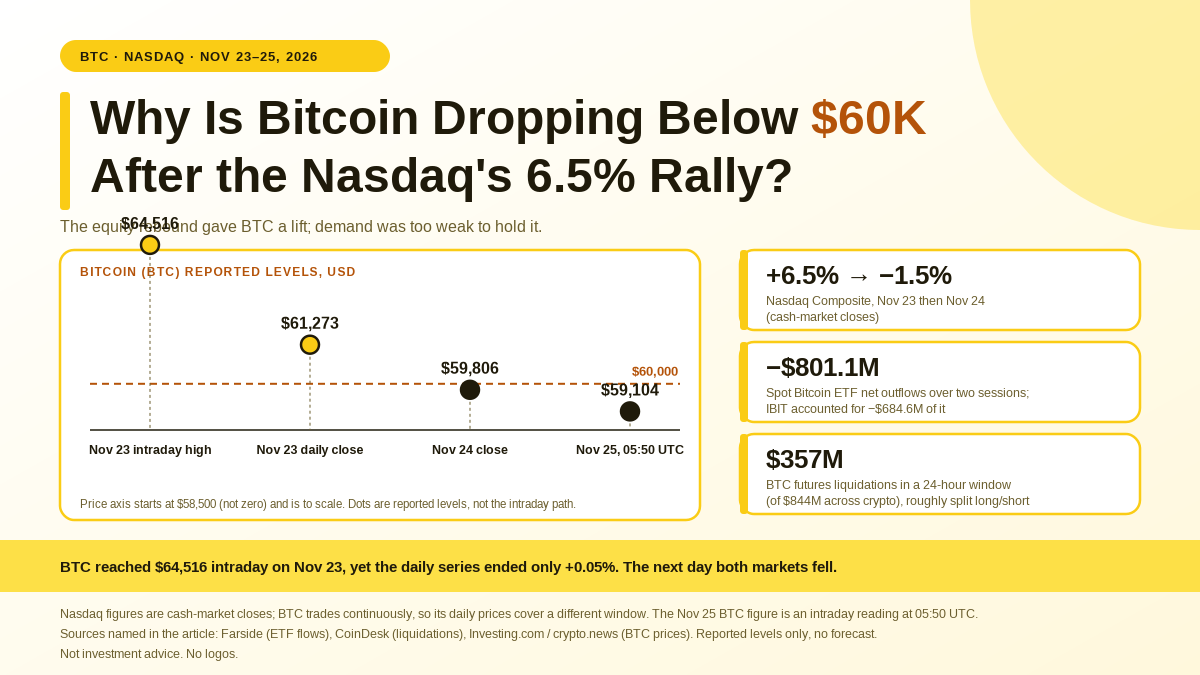
Why Is Bitcoin Dropping Below $60K After the Nasdaq’s 6.5% Rally?
Why is Bitcoin dropping below $60,000 after the Nasdaq rallied 6.5%? See what $801.1 million in ETF outflows, exchange flows, and liquidations reveal.

Report: AI Industry Leaders Divided Over Whether Humans Should Surrender Autonomous Decision-Making Power

Remy Cointreau Group's Stock Price Soars Amid Transformation Progress

Warren Buffett's Successor, Greg Abel, Has Quietly Purchased 3 Stocks Since the Start of the Fourth Quarter, Including Shares of a Legal Monopoly

Not Tesla. Not Nvidia. This "Magnificent Seven" Stock Could Be Overdue for a Big Rally.

Iliad Partners Announces Final Close of Its First Fund at $33.4 Million

Fidelity Lists AAVE, LINK and UNI: How Do Crypto Trading Fees Compare?
Jensen Huang's Situation May Be Even More Challenging Now

BlackRock Launches Tokenized Fund in Hong Kong! Reaches $100 Million, Supports HKD Stablecoin HKDAP for Subscription

Private Financing Market Mirrors IPO Market: Leading Companies Dominate

The Huge Concern for AI Stocks: Oversupply of Chips
France: No mandatory declaration of crypto wallets exceeding €100,000
15,400 people lost over $13 million after copying the wallet of a crypto specialist
The Tech Sell-Off Is Creating the Best Buying Window in 2 Years. Here's What I'm Buying.
Why the Big Short Seller is Buying Tencent Against the Trend?
From Securing Private Keys to Constraining Agents: New Frontiers of Crypto Security in the AI Era
The AI Power Surge Returns to Rationality: Where to Find Valuation Lows
Latest articles




Latest coin listings on WEEX


