
Is BTC Different This Time?

 Prefer us on Google
Author: Chen Xiaomeng
The crypto is over, the big pie is over, the AI bubble has burst, and the crypto circle is a dung circle.
Recently, a wave of big ups and downs has made many old OGs unable to hold on, and they are questioning whether the cycle theory is over, saying that MSTR and Wall Street have given up on the big pie. But hold on, as someone who has experienced the previous two cycles, let’s first sort out what happened before.
1. 2018 Bear Market: From $20,000 to $3,200 (Retracement of about 84%)
First Half: This time is different, I don’t believe it will drop deeply.
- Wall Street's Bottom Support Theory: At the end of 2017, the Chicago Mercantile Exchange launched BTC futures, and the market generally believed that the formal financial channel had opened, and Wall Street funds would take over the chips, preventing a repeat of the prolonged decline after the 2014 Mt. Gox incident.
- $6,000 Mining Cost as a Hard Bottom: In the first half of 2018, BTC hovered around $6,000 for several months, and the network's computing power scale was unprecedented. There was a strong consensus that miners would not sell below their cost. Until November of that year, when the BCH hash war broke out, this hard bottom was directly breached and halved.
- Technical Landing and Public Chain Fundamentals: Unlike 2013, which relied solely on retail speculation, in 2017, Ethereum and various public chains raised massive funds through ICOs, and the market believed that behind it was a revolution in the next-generation internet infrastructure, with a real ecosystem to support it.
- Seasonal Washout Explanation: When it just fell below $10,000, the market popularized narratives such as Wall Street's year-end bonuses being spent and the pressure of cashing out during the Asian Spring Festival, treating the cycle peak as a short-term correction.
Second Half: This time it’s completely over.
- ICO Scams Overdraw All Credibility: More than 90% of ICO projects went to zero and ran away, and mainstream media characterized it as a tulip bubble. The general view was that the crypto industry was left with only its essence of pyramid schemes, and no new funds would enter the market.
- Hash War Shattered Beliefs: The BCH hard fork evolved into a hash war between Wu Jihan and Craig Wright, with mining tycoons publicly selling BTC to fund the war, leading to cracks in the core consensus of decentralization and digital gold.
- No-Coin Blockchain Narrative: Traditional banks and tech giants loudly laid out alliance chains, and regulators emphasized that blockchain does not equal Bitcoin, leading the market to generally doubt that the underlying technology would be co-opted by big companies, while BTC itself had no application value.
- Spot ETF Indefinitely Delayed: The U.S. SEC repeatedly rejected spot ETF applications, and pessimistic sentiment deemed that the doors of traditional capital had been completely welded shut.
2. 2022 Bear Market: From $69,000 to $15,500 (Retracement of about 77%)
First Half: This time is different, I don’t believe it will drop deeply.
- Super Cycle and Extended Cycle Theory: The super cycle narrative, represented by Three Arrows Capital founder Zhu Su, swept the internet, believing that after the market size increased, there would no longer be violent bear markets, or that bull market cycles would be extended, and $100,000 was just a matter of time.
- Institutional Bull and Sovereign Endorsement: Tesla buying coins, MicroStrategy continuously dollar-cost averaging, Grayscale locking in massive amounts, along with El Salvador listing BTC as legal tender. Bulls firmly believed that the chips had completely shifted from retail to long-term institutional hands, and it was impossible to fall below the previous cycle's high of $20,000.
- High Inflation Hedge Narrative: In the face of soaring inflation rates in Europe and America, the market bet that BTC would fulfill its anti-inflation digital gold attributes, but underestimated the bloodletting effect of the Federal Reserve's aggressive interest rate hikes on global liquidity.
- On-Chain Real Yield Moat: Compared to 2018, which only had white papers, this round had a huge DeFi lock-up, stablecoin volume, and NFT trading boom, leading many to believe that the industry had moved out of the wild period, and the fundamentals were sufficient to support valuations.
Second Half: This time it’s completely over.
- BTC Has Never Experienced Macro Rate Hikes and Recession: This was the most lethal bearish logic at the end of 2022. BTC was born in 2009, and for the previous decade, it had been in a low-interest and liquidity environment; when the Federal Reserve began its most aggressive rate hike cycle in forty years and risk-free U.S. Treasury yields approached 5%, the market generally believed that the four-year halving rule had completely failed, and zero-yield risk assets had no appeal.
- Industry-Wide Credit Collapse: Luna's algorithmic stablecoin went to zero in a week, Three Arrows Capital went bankrupt, and leading crypto lending platforms successively halted operations, culminating in the collapse of FTX, which had touted itself as the "most compliant" due to misappropriating customer assets. At that time, the entire network was filled with despair that the industry was fundamentally rotten, and traditional funds would not dare to touch it for another decade.
- First Time Breaking Previous Cycle High: In June 2022, BTC broke through $20,000 and ultimately bottomed at $15,500, breaking the historical iron law of never falling below the previous bull market high, completely shattering the psychological defenses of many old players, and the market unanimously turned bearish to $10,000 or even $8,000.
- Comprehensive Regulatory Crackdown and Disruption: After the FTX explosion, the U.S. SEC launched a wave of lawsuits, and regulators simultaneously cut off the fiat deposit and withdrawal channels of several crypto-friendly banks, with pessimists believing that crypto assets would be completely marginalized.
3. Comparison of the Previous Two Bear Markets
Top and Bottom Ranges and Retracements:
1. Nearly $20,000 → $3,200 (about 84%)
2. $69,000 → $15,500 (about 77%)
First Half------Don’t believe in deep bears
1. CME Futures, $6,000 Miner Hard Bottom, ICO Public Chain Revolution
2. Super Cycle, MicroStrategy and Tesla's Institutional Holdings, Anti-Inflation Narrative
Second Half------This time it’s over
1. ICOs Completely Stink, No-Coin Blockchain Replaces BTC
2. First Time Facing the Fed's Aggressive Rate Hikes, Centralized Institutions' Credit Zeroed, Regulatory Crackdown
Looking at it from a broader perspective, the scripts of these two rounds are almost the same underlying emotions rehashed: when the top just turns bearish, everyone always treats the newly entering buying power carriers as a permanent moat that eliminates the cycle; when it reaches the end, they always treat the unique explosions or macro headwinds of the current round as a death sentence declaring the end of the industry. In contrast to the current bear market that has fallen from $126,000 in 2026, the first half was dominated by spot ETFs and Wall Street institutions completely smoothing out the four-year cycle, with no more bear markets, and now that it has dropped back to the $50,000 to $60,000 range, the voices have quickly switched to the halving effect marginally diminishing, retail liquidity being drained by meme coins, and BTC completely becoming a macro risk asset.
The lines have changed, but the rhythm of emotional shifts is strikingly similar to the previous two rounds.
4. So What About This Time?
First Half: When just peaking and falling back, bulls firmly believe the four-year cycle is dead.
At the end of 2025 to early 2026, when it just retreated from the high point, the mainstream consensus in the market was almost reached------the past kind of wild bear market that could easily halve again is over:
- Wall Street Spot ETF Smoothing Cycle Theory: BlackRock, Fidelity, Galaxy Digital, and many analysts publicly declare that "the four-year cycle is invalid." The core logic is that institutional funds hold positions for 3 to 5 years and will not panic like retail investors, and BTC will enter a slow bull long cycle from now on, or evolve into a macro liquidity cycle every five years.
- MicroStrategy and Corporate Treasury Flywheel Support: The crypto treasury model represented by MicroStrategy has become a new favorite in the U.S. stock market, and the market firmly believes that through bond issuance and preferred stock issuance to continuously buy coins, a steady stream of compliant buying power has been formed, locking up the circulating chips in the market.
- National Strategic Reserves and Policy Amulet: The U.S. policy has turned friendly, and sovereign reserves and compliance bills are advancing, leading bulls to believe that BTC has completed its "normalization." Even if there is a pullback, the market generally expects it to only oscillate between $70,000 and $100,000, with another sprint to $150,000 to $250,000 possible in 2026.
- Exchange Balance Exhaustion Theory: On-chain data shows that the BTC holding ratio of centralized exchanges has dropped to a new low since 2017, leading bulls to judge that selling pressure has completely dried up, and there is simply no way to trigger a deep bear market in the market.
Second Half: After breaking below $60,000, this time it’s over in the eyes of the bears.
After experiencing a rally from $58,000 to $86,000 from June to September 2026, the market fell again from the end of October to November. Pessimistic sentiment quickly took over the narrative:
- ETF Turned from Moat to Institutional ATM: The once-lauded spot ETF, after the trend weakened, became the coldest selling pressure channel. Since 2026, ETFs have repeatedly seen net outflows for several consecutive weeks, with a single-day net outflow exceeding $640 million at the end of October.
- Federal Reserve Resumes Rate Hikes and 5% U.S. Treasury Crushes Valuations: In September 2026, the Federal Reserve, led by Kevin Warsh, unexpectedly resumed rate hikes after three years, coupled with the rebound in October CPI data and the 10-year U.S. Treasury yield breaking through 5%. The bearish logic is very straightforward: risk-free U.S. Treasuries can yield over 5%, while high-volatility zero-yield assets have no allocation value.
- AI Completely Draining Global Liquidity and Narrative: This is a unique double-kill pain point in this round. On one hand, funds are continuously withdrawn from the crypto market, shifting to the AI sector and the IPO feast of AI unicorns like Anthropic; on the other hand, when AI concept stocks in the U.S. stock market plummeted in November, BTC also fell in sync with Nvidia, being mocked by the market as "rising can't keep up with AI, falling has become the high-volatility tech stock's little brother".
- Corporate Treasury Backlash and High-Leverage Death Spiral: MicroStrategy's stock price plummeted from its peak, and its premium narrowed significantly, leading the market to repeatedly amplify the panic of "treasury companies being forced to sell coins to stop losses." Meanwhile, the overall network's contract leverage ratio is increasing, and even a 5% daily fluctuation can trigger over $1 billion in successive liquidations, causing both institutions and retail investors to engage in a mutual slaughter.
- Security Trust Cracks and Quantum Computing Shadows: The theft at Binance and multiple wallet vulnerability incidents at the end of October directly ignited this wave of selling, coupled with renewed concerns about tightened crypto regulation after the U.S. midterm elections, which dampened the willingness of incremental funds to enter. At the same time, the potential threat of quantum computing to early public key addresses has been repeatedly highlighted in the panic of the bear market.
- Infrastructure Won, But Coin Prices Lost Divergence Theory: Even BlackRock, JPMorgan, and Franklin Templeton are accelerating the promotion of tokenization of national debt and RWA, while Hyundai Motor and some Latin American countries are using USDT for real trade settlements. Thus, a highly deflated narrative emerged within the circle------traditional financial giants have co-opted blockchain infrastructure, but these new businesses do not need BTC to surge, and the future dividends will no longer belong to the secondary market and crypto natives.
5. What Do I Think This Round Will Be Like?
Let me say this first, I don’t understand technical analysis, I don’t look at K-lines, I don’t know what pressure levels are, which ones have broken through, which ones have defended, which ones have golden crosses, and which ones have dead crosses. I think they are useless.
(1) Halving Takes a Backseat, Macro Rates Take the Wheel
In April 2028, the fifth halving will occur, reducing the block reward to 1.5625 coins, with the annual inflation rate pressed to around 0.4%. Compared to the daily redemption volume of hundreds of millions of dollars for spot ETFs, the marginal impact of new selling pressure from miners on prices has become negligible, and halving remains more of a psychological anchor and narrative catalyst.
What will truly determine when the next round starts is when the current round of inflation and monetary tightening reaches a turning point. So far, the Federal Reserve's benchmark interest rate remains in the range of 3.75% to 4.00%, and the minutes of the Federal Reserve meeting released in November still signal the possibility of further rate hikes. As long as high rates and strong U.S. Treasury yields continue to drain liquidity, it will be difficult for the market to break out of a one-sided bull.
(2) Completely Say Goodbye to the General Rise of Altcoins
This round of bear market has completely returned high FDV, low circulation, and purely story-driven token issuance models to their original form. In the next round of capital entering, it will not spill over indiscriminately like in 2021.
From being drained by AI to providing a financial base for AI
The most frustrating aspect of the crypto market in 2026 is that funds and attention have been completely drawn away by the AI sector. However, looking at it from a longer perspective, the next round of narratives that are most likely to break the circle lies precisely in the convergence of the two. When AI entities are deployed on a large scale and need to autonomously complete cross-platform micropayments, computing power procurement, and fund settlements, traditional bank account systems naturally reject non-human entities, while permissionless on-chain stablecoins and DeFi settlement layers are ready-made optimal solutions.
Corporate Treasury and Sovereign Entry Entering the Second Stage
This is essentially the first large-scale stress test for MicroStrategy and a number of U.S. stock crypto treasury companies. Those compliant carriers that survive this round of leverage clearing and prove that they will not easily trigger a liquidation spiral will become more mature financing and coin-buying amplifiers in the next round. At the same time, many sovereign funds, pensions, and traditional family offices that did not dare to chase high above $120,000 will instead complete their bottom allocation during the low period around $50,000 to $60,000.
6. When Will the Bull Come?!
It’s actually very simple:
*** (1) BTC Completely Becomes a High-Elastic Tech Stock AI is the Future, Crypto has Marginalized This Time It Really Won’t Rise Again------Leverage Clearing, Volatility Drops to Freezing Point, Long-Term Chips Complete Handovers***
*** (2) Just a Bear Market Rebound, U.S. Treasury Rates Are Still So High, After Rising, It Should Be Sold------The Vast Majority Are Constantly Shorting or Selling Off in Hesitation and Missed Opportunities***
*** (3) Sovereign Reserves and AI Settlements Have Locked Up All Chips, This Time There Is Completely No Bear Market------Is This Time Different?***
So, every time is different, every time is the same, keep a calm mindset~
It’s Just a Cycle
This content is provided for general informational purposes only and doesn't constitute financial, investment, legal, or tax advice. Any events, rewards, online promotions, or related information mentioned herein should not be considered a recommendation, solicitation, or invitation to purchase, sell, trade, or otherwise deal in any crypto assets. Crypto assets are highly volatile and may result in loss. The availability of WEEX services, products, and related events may vary by region. You are responsible for ensuring that your participation is in accordance with applicable local laws and regulations.
You may also like

Tonight, the last major inflation report before the Federal Reserve's December decision is released!
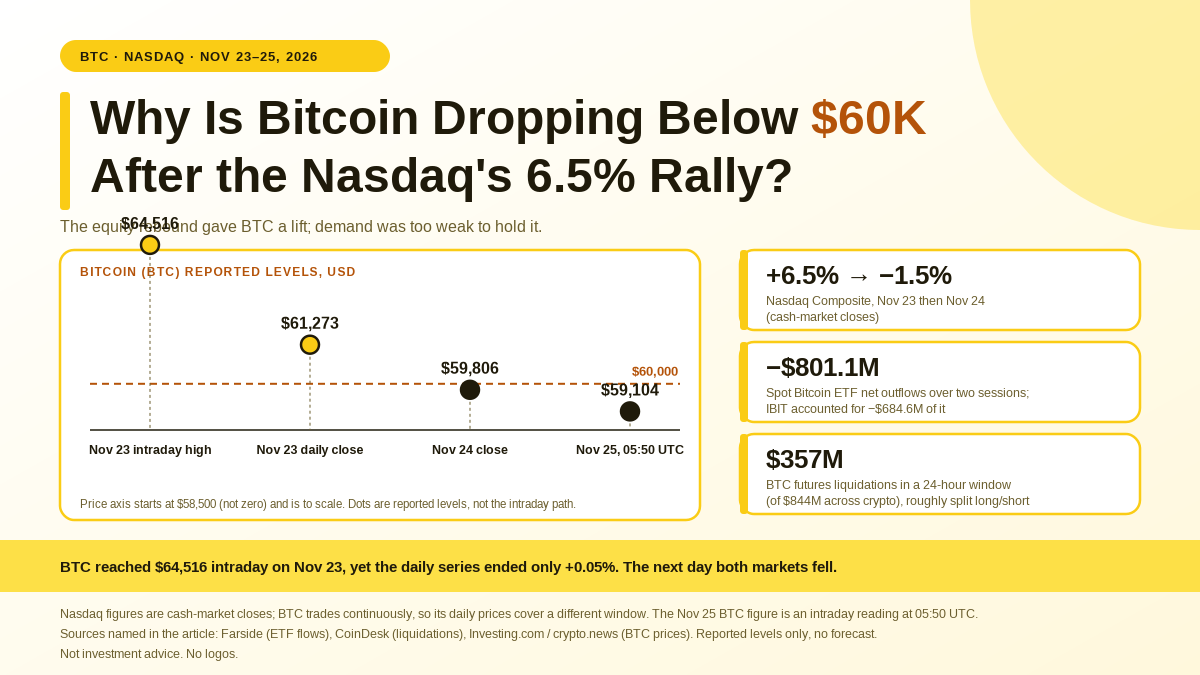
Why Is Bitcoin Dropping Below $60K After the Nasdaq’s 6.5% Rally?
Why is Bitcoin dropping below $60,000 after the Nasdaq rallied 6.5%? See what $801.1 million in ETF outflows, exchange flows, and liquidations reveal.

Report: AI Industry Leaders Divided Over Whether Humans Should Surrender Autonomous Decision-Making Power

Remy Cointreau Group's Stock Price Soars Amid Transformation Progress

Warren Buffett's Successor, Greg Abel, Has Quietly Purchased 3 Stocks Since the Start of the Fourth Quarter, Including Shares of a Legal Monopoly

Not Tesla. Not Nvidia. This "Magnificent Seven" Stock Could Be Overdue for a Big Rally.
Iliad Partners Announces Final Close of Its First Fund at $33.4 Million

Fidelity Lists AAVE, LINK and UNI: How Do Crypto Trading Fees Compare?
Jensen Huang's Situation May Be Even More Challenging Now

BlackRock Launches Tokenized Fund in Hong Kong! Reaches $100 Million, Supports HKD Stablecoin HKDAP for Subscription

Private Financing Market Mirrors IPO Market: Leading Companies Dominate

The Huge Concern for AI Stocks: Oversupply of Chips
Diverging Market Views on Wall Street for 2026: Tom Lee vs. Castle Securities, Caution Against a Repeat of 2018 Market Risks
Bitcoin, US Stocks, and Gold: Which Will Bottom First?

SBI Solana Global Launches: Joint Venture with Sumitomo Mitsui FG and Solana Foundation for Stablecoin Payments and RWA Projects

Controllable Freezing, Unregulated Refunds: The On-Chain Power and Rule Vacuums of Stablecoin Duopoly

Prediction: Here's What Anthropic's Valuation Will Be in 2027, According to History

Interpretation of the Report 'Reporting Suspicious Crypto Activity: Bridging Supervisory Expectations and Operational Realities'

Mercedes-Benz Shifts Electric Vehicle Strategy: Focusing on Core Models, Phasing Out EQ Series

Bank of America Warns of Underestimated 'Hard Landing' Risk in 2027! Recommends 'GRAB' to Hedge Against Volatility, Consider Chips After Dollar Peaks

Meta and Amazon Negotiate to Lift Block on Muse Shopping AI Agent, Advertising and Search Become Core Disputes

The Next Stablecoin: A Potential Market of Nearly $300 Billion with 50 Times Growth Opportunity

Cautious Korean Investment in Anthropic, Less Popular than SpaceX IPO

Grubhub Expects to Lose $100 Million in 2026
OpenAI Prepares 'Athena' Data Tool to Enhance AI Agent Accuracy

Anthropic Launches on Same Day as GTA VI, Video Game Transactions Currently Prevail

Dell: Token Demand to Increase 87 Times by 2030, No Downward Trend in Memory Prices by 2027

Bitcoin Retests $60,000 Support, AI Stocks Give Back Previous Gains | WEEX TradFi Daily Market Brief (November 25, 2026)
Dragged by stock market sell-offs, Bitcoin and Ethereum fell to the $60,000 and $1,700 integer levels respectively. The head of research at 21Shares believes that if the current pullback pattern continues, Bitcoin may probe lower. The three major stock indices mixed, with Neocloud and optical module sectors plunging collectively. On November 25 ET, focus on October core PCE data and Deere earnings.

Do RWA Tokens Grant Claims to Underlying Assets? A Comparison of ONDO, OUSG, and PAXG

Jensen Huang's Power Play: 30 Years Dominating the Industry, 3 Years in Washington
Tonight, the last major inflation report before the Federal Reserve's December decision is released!
Why Is Bitcoin Dropping Below $60K After the Nasdaq’s 6.5% Rally?
Why is Bitcoin dropping below $60,000 after the Nasdaq rallied 6.5%? See what $801.1 million in ETF outflows, exchange flows, and liquidations reveal.
Report: AI Industry Leaders Divided Over Whether Humans Should Surrender Autonomous Decision-Making Power
Remy Cointreau Group's Stock Price Soars Amid Transformation Progress
Warren Buffett's Successor, Greg Abel, Has Quietly Purchased 3 Stocks Since the Start of the Fourth Quarter, Including Shares of a Legal Monopoly
Not Tesla. Not Nvidia. This "Magnificent Seven" Stock Could Be Overdue for a Big Rally.
Latest articles
Latest coin listings on WEEX


