
- Buy Crypto
- Markets
 Futures
- Spot
- Copy Trade
- Earn
- More
Asia Market Open: Bitcoin Experiences 3% Drop Amid Trump’s Tariff Threat on Europe

Key Takeaways:
- Bitcoin experienced a 3% decline, trading around $92,000 during early Asian trading due to US tariff threats.
- President Trump announced potential tariffs on eight European countries linked to a bid involving Greenland.
- Stock futures in the US, Japan’s Nikkei, and European indices showed declines as global markets reacted.
- Increased volatility in commodities with gold hitting records and cryptocurrencies witnessing significant liquidations.
- European diplomats prepare retaliatory measures amid concerns of financial instability and capital flight.
WEEX Crypto News, 2026-01-19 11:49:31
In the dynamic landscape of global finance, few elements trigger swift and widespread reactions across markets as abruptly as geopolitical tensions and economic policy changes. This was evident when Bitcoin witnessed a 3% dip, trading around $92,000 on an early Monday morning in Asia. This slump came amidst a backdrop of heightened uncertainty instigated by President Donald Trump’s threats to impose new tariffs on several European countries. This move, intertwined with his controversial push for US ownership of Greenland, rattled the already delicate state of global trade relations.
Unpacking the Tariff Threat
President Trump’s pronouncements involve applying a further 10% import tariff on goods from Denmark, Norway, Sweden, France, Germany, the Netherlands, Finland, and Britain starting February 1st, escalating to 25% by June if negotiations fail. Such actions have been vocally opposed by European officials who view these tariffs as coercive, exacerbating ongoing transatlantic tensions.
Economic analysts point out that the ramifications of these tariffs extend beyond simple trade disruptions. European market players quickly began pricing in the potential fallout, fearing a prolonged trade war. The once clear skies of international commerce are overcast with uncertainty, threatening economic stability and investor confidence on both sides of the Atlantic.
Market Response to Holiday Liquidity Constraints
The timing of this geopolitical shock posed an additional challenge. As the announcement coincided with a US market holiday, spot market participation was absent, leaving the futures market as the initial arena for price discovery and risk assessment. Consequently, US stock futures faltered, with the S&P 500 and Nasdaq futures experiencing downturns of 0.7% and 1%, respectively, during Asian trading hours. The sentiment swiftly permeated into Asian markets, illustrated by Japan’s Nikkei shedding 1% and the MSCI Asia Pacific index excluding Japan also declining slightly. European futures mirrored this downward trend with Euro Stoxx 50 and DAX futures both facing a 1.1% decline.
Currency movements were equally telling. Investors reduced exposure to risk, favoring currencies deemed to provide safe harbor, causing the US dollar to fall by approximately 0.3% against the yen and 0.2% against the Swiss franc, though the euro held firm following an initial dip.
Cryptocurrencies and Commodities in a Tumultuous Tussle
While fiat currencies and stocks adjusted to Trump’s announcements, commodities and cryptocurrencies painted a volatile picture of the market landscape. Gold sprinted to a new pinnacle, rising 1.5%, as investors sought refuge in assets traditionally considered as risk hedges. Silver followed suit with significant gains. Conversely, oil markets, characterized by an oversupply and potential reduced demand due to tariff impacts, saw both Brent and US crude prices dwindle.
In the realm of digital currencies, Bitcoin’s price drop was accompanied by an unwinding of leveraged positions. The cryptocurrency market, operating ceaselessly beyond traditional financial market hours, processes developments within moments, triggering a cascade of long position liquidations. This sharp adjustment serves as a vivid reminder of the inherent volatility in cryptocurrency markets, often more sensitive to macroeconomic and geopolitical perturbations compared to conventional assets.
European Union’s Cautious Calculations
The European Union, in reaction to Trump’s salvo, deliberated intensifying efforts to dissuade these tariff introductions while concurrently laying the groundwork for potential retaliation. EU diplomats, meeting in Brussels, discussed resurrecting a previously designed tariff strategy against US goods worth billions of euros. A potential retaliatory approach includes invoking the underused Anti-Coercion Instrument to limit the US’s access to European tenders, investment, and service transactions. This strategy highlights an evolving chess match of geopolitical brinkmanship, where economic consequences ripple through every sector and market.
Financial Strategists Eye Potential Capital Flight
Diving deeper beneath the veneer of tariff disputes lies a possibly more disruptive threat—capital flight. Financial experts have raised alarms over potential shifts in the capital landscape, driven by uncertainties in transatlantic trade relations. European investors, holding roughly $8 trillion in US assets, may reconsider their portfolios amid escalating tensions. This reallocation, effectively the ‘weaponization of capital’ as posited by Deutsche Bank, poses an unforeseen risk to market stability, potentially eclipsing the direct implications of the tariffs themselves.
Other Catalysts and Uncertainties in the Market Landscape
Against this complex backdrop, other scheduled economic events add layers of uncertainty. China is set to release key economic growth figures, shedding light on its trajectory during these turbulent times. Meanwhile, the Bank of Japan convenes to possibly discuss monetary policy adjustments, adding another piece to the puzzle of global economic maneuvering. In the US, economic data expected later in the week will inform investors about the likely paths for Federal Reserve policy adjustments, crucial for financial strategies moving forward.
Lastly, as world leaders converge on Davos, the Alpine forum is set to be dominated by discussions on trade, security, and the emerging disputes over Greenland. Such summits underscore the intricate interplay between politics and markets, where narratives of global leadership shape not just diplomatic standings but also economic outcomes across continents.
FAQs
How did Trump’s tariff threats on Europe impact Bitcoin’s price?
The announcement of new tariffs by President Trump led to broad market unrest, catalyzing a risk-off mood among investors. This sentiment heavily influenced Bitcoin, causing it to drop by approximately 3% due to a liquidation of leveraged positions in the market.
Why did the markets react strongly despite the tariffs not yet being implemented?
Markets often react to the implications of political announcements rather than the events themselves. The threat of tariffs introduces uncertainty, prompting risk aversion behaviors among investors, leading them to reallocate resources away from riskier assets like stocks and cryptocurrencies to safer havens such as gold and stable currencies.
What measures are European officials considering in response to the US tariff threats?
European leaders are preparing possible countermeasures, including the reactivation of tariffs on US imports and the potential use of the Anti-Coercion Instrument, which could restrict American access to European economic opportunities in terms of tenders and investments.
Why are strategists warning about potential capital flight due to the tariffs?
Capital flight becomes a concern when uncertainties in political or economic policies threaten the security of investments. With European investors holding substantial US assets, a shift to withdraw or reallocate could disrupt financial markets significantly, potentially causing more damage than the tariffs themselves.
What other economic events could influence the global markets in this context?
Several key events are on the horizon, including the release of China’s economic growth data, the Bank of Japan’s monetary policy meeting, and upcoming US economic indicators. Collectively, these will help shape global market sentiments and strategic decision-making amid the prevailing uncertainties.
In navigating this intricate web of international financial interactions, stakeholders must remain vigilant, adapting rapidly to the flux induced by policy shifts and geopolitical developments.
You may also like

Wall Street Shorts ETH: Vitalik is aware and has front-run, while Tom Lee remains oblivious

Social Capital CEO: How Equity Tokenization is Reshaping Capital Markets from US Stocks to SpaceX?

CoinGecko Report: Surge of 346% vs Dip of 20.8%, The Wild Rise of DEX

a16z: The Real Opportunity of Stablecoins Lies Not in Disruption but in Filling Gaps

Mining Exodus: Someone Holds $12.8 Billion AI Order

March 6 Market Key Intelligence, How Much Did You Miss?

a16z: The True Opportunity of Stablecoins is in Complementing, Not Disrupting

Predict LALIGA Matches, Shoot Daily & Win BTC, USDT and WXT on WEEX
The WEEX × LALIGA campaign brought together football excitement and crypto participation through a dynamic interactive experience. During the event, users predicted matches, completed trading tasks, and took daily shots to compete for rewards including BTC, USDT, WXT, and exclusive prizes.

Ray Dalio Dialogue: Why I'm Betting on Gold and Not Bitcoin

Who Took the Money in the AI Era? A Must-See Investment Checklist for HALO Asset Trading
Wall Street Bears Target Ethereum: Vitalik In the Know Takes Flight, Tom Lee Remains Bullish
Pump.fun Hacker Steals $2 Million, Receives 6-Year Prison Sentence, Opts for 'Self-Detonation'

6% Annual Percentage Yield as Musk Declares War on Traditional Banks
36 years, 4 wars, 1 script: How does capital price the world in conflict?

Mining Companies' Great Migration: Some Have Already Secured $12.8 Billion in AI Orders
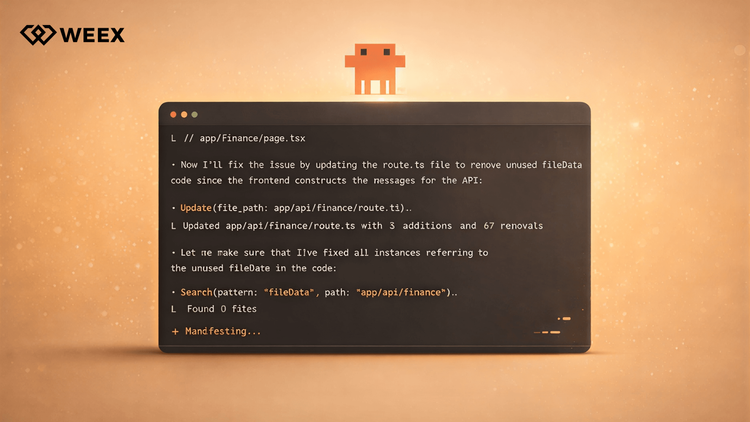
What Is Vibe Coding? How AI Is Changing Web3 & Crypto Development
What is vibe coding? Learn how AI coding tools are lowering the barrier to Web3 development and enabling anyone to build crypto applications.
The parent company of the New York Stock Exchange strategically invests in OKX: The intentions behind the $25 billion valuation

WEEX P2P update: Country/region restrictions for ad posting
To improve ad security and matching accuracy, WEEX P2P now allows advertisers to restrict who can trade with their ads based on country or region. Advertisers can select preferred counterparty locations for a safer, smoother trading experience.
I. Overview
When publishing P2P ads, advertisers can now set the following:
Allow only counterparties from selected countries or regions to trade with your ads.
With this feature, you can:
Target specific user groups more precisely.Reduce cross-region trading risks.Improve order matching quality.
II. Applicable scenarios
The following are some common scenarios:
Restrict payment methods: Limit orders to users in your country using supported local banks or wallets.Risk control: Avoid trading with users from high-risk regions.Operational strategy: Tailor ads to specific markets.
III. How to get started
On the ad posting page, find "Trading requirements":
Select "Trade with users from selected countries or regions only".Then select the countries or regions to add to the allowlist.Use the search box to quickly find a country or region.Once your settings are complete, submit the ad to apply the restrictions.
When an advertiser enables the "Country/Region Restriction" feature, users who do not meet the criteria will be blocked when placing an order and will see the following prompt:
If you encounter this issue when placing an order as a regular user, try the following solutions.
Choose another ad: Select ads that do not restrict your country/region, or ads that allow users from your location.Show local ads only: Prioritize ads available in the same country as your identity verification.
IV. Benefits
Compared with ads without country/region restrictions, this feature provides the following improvements.
Aspect
Improvement
Trading security
Reduces abnormal orders and fraud risk
Conversion efficiency
Matches ads with more relevant users
Order completion rate
Reduces failures caused by incompatible payment methods
V. FAQ
Q1: Why are some users not able to place orders on my ad?
A1: Their country or region may not be included in your allowlist.
Q2: Can I select multiple countries or regions when setting the restriction?
A2: Yes, multiple selections are supported.
Q3: Can I edit my published ads?
A3: Yes. You can edit your ad in the "My Ads" list. Changes will take effect immediately after saving.


 App
App