
Aave Expands Stock-Backed USDC Loans on Base for Eligible Investors

 Prefer us on Google


TL;DR: The case study listed seven stocks accepted as collateral at the time and said the market supports continuous borrowing and repayment. Geographic eligibility, securities rights, market liquidity and oracle design matter.
A Base case study dated October 22 described Aave V4's Equities Hub, launched in September, allowing eligible non-U.S. investors to borrow USDC against selected Coinbase tokenized U.S. equities without first selling the shares.
The announcement and the numbers
The most concrete starting point is the dated disclosure from Aave. It offers a specific basis for assessing Aave's tokenized-equity lending on Base without turning the story into unsupported price speculation.
The case study listed seven stocks accepted as collateral at the time and said the market supports continuous borrowing and repayment. Collateral valuations rely on price feeds whose equity-market coverage differs across weekday and off-hours trading.
There is a practical market question underneath the announcement: how quickly can USDC borrowing against tokenized equities change real activity, rather than merely expand a list of proposed services? For investors, the distinction matters because product news and actual changes to liquidity or demand are not interchangeable.
Why the development matters
The question for market participants is what Aave's tokenized-equity lending on Base establishes today and what remains uncertain. An immediate reaction is not the same as evidence of a durable economic outcome.
The application demonstrates how programmable securities could gain uses beyond simple transfers. Combining equity exposure with on-chain lending, however, also connects traditional market schedules and corporate events to DeFi risk engines.
DeFi applications make financial rules executable through code, but code still depends on market inputs, transaction ordering and the availability of liquidity. A smart contract can follow its programmed conditions precisely even when those conditions produce an outcome a user did not expect.
From a market perspective, the first task is to separate the scale of the announcement from the scale of economic activity that has actually occurred. A company may report a large addressable market, an institutional name or a future capability, but those are not equivalent to settled transactions or recurring fee income. This is why the primary disclosure is a better starting point than a trading narrative attached to it.
Risks the headline does not resolve
None of this removes the need for independent assessment. The published evidence identifies a development, while its risk and long-term economics are still open to examination.
Borrowing against a tokenized stock lets an investor obtain liquidity while retaining market exposure to the share. That introduces leverage: if the value of collateral falls relative to the debt, a protocol may require repayment or liquidate some of the collateral.
Geographic eligibility, securities rights, market liquidity and oracle design matter. A continuously open loan market does not mean the underlying stock's cash market is open or that token redemptions are instantaneous under every condition.
For developers, execution quality involves more than a quoted price or an advertised feature. Gas costs, settlement success, oracle quality, permissions and incident handling all shape whether an integration is safe and convenient in real markets.
-- Price
The milestones to watch
The immediate checklist is relatively straightforward: look for verifiable implementation details and avoid interpreting a stated target as an outcome that has already occurred.
Watch whether additional equity collateral is approved and how the lending market handles holidays, sudden gaps in stock prices and unexpected liquidations. A useful product must keep those risks understandable to borrowers.
Investors also need to separate changes in infrastructure from changes in token demand. Revenue may accrue to a company, a protocol treasury or a service provider without necessarily creating a one-for-one benefit for holders of a related token. Market impact depends on adoption, competition and the design of whatever fees or incentives are involved.
A durable signal would be consistent follow-through: actual usage, transparent reporting and a credible explanation of risk. Short-term token-price moves can be driven by macroeconomic conditions or leverage and may say little about whether the product or initiative succeeds over months and years.
Primary source: Aave's primary announcement. This reporting reflects information available on October 31, 2026; targets, estimates and statements about future plans are attributed to their issuers.
This article was written by the News Desk and edited by Samuel Rae.
This content is provided for general informational purposes only and doesn't constitute financial, investment, legal, or tax advice. Any events, rewards, online promotions, or related information mentioned herein should not be considered a recommendation, solicitation, or invitation to purchase, sell, trade, or otherwise deal in any crypto assets. Crypto assets are highly volatile and may result in loss. The availability of WEEX services, products, and related events may vary by region. You are responsible for ensuring that your participation is in accordance with applicable local laws and regulations.
You may also like

Prediction: This Will Be Intel’s Stock Price After 1 Year (Hint: It Implies a Nice Jump)

Stacks (STX) outlook for 2027: What could drive STX demand?

Guterres Calls for Additional Taxes on Energy Companies

Cities and States Representing 60% of U.S. Economy Commit to Collaborate with the UN on Tracking Carbon Emissions

Startup Voya Energy Proposes Solution to Replace Noisy Diesel Generators in Data Centers

55 million ZETA to be destroyed, ZetaChain continues to operate after shutdown announcement

SK Group Executives Hold Meeting from 12th to 14th to Discuss Semiconductor, AI, and Energy Business Strategies

Indian Stock Market Rebounds, Becomes Safe Haven Amid AI Stock Sell-off

Barclays: Japan's Import Prices Rise 24.8% in October

CNOOC Discovers High-Yield Oil and Gas Well in Bohai Sea with Daily Production of 800,000 Cubic Meters

Aave V3.8 Launches, Covering 15 Markets with Reentrancy Protection

唐华斑竹: Avalanche Chain May Become the Standard for Security Tokenization

Decrypt Becomes First News Publisher to Offer Perps Trading, Powered by Solana's Phoenix

Moody's Projects Global Credit Deterioration by 2027 and Warns of the Impact of Rates and AI

What Is Elysium Crypto? The Hyperliquid Layer 2, Gas Fees, and Token Confusion Explained
Learn what Elysium is, why it uses HYPE for gas, how KNTQ buybacks are designed, and how to distinguish bridge TVL from actual DeFi activity.

From Sidechains to zk-Rollups: Tacit Chain Aims to Redefine Payments with Default Privacy
Midterm Election Risks Disrupt Helix AI Infrastructure Project, Increasing Uncertainty for Samsung Investments

European Natural Gas Futures Prices Exceed €85

Moody's Raises India's Economic Growth Forecast to 7%

Immutable Chain's Transition to OP Stack: What Changes for Users

Two Carbon Capture Standards Released

US Absence from UN Climate Summit, Trump Calls Global Warming a Hoax

ETH Burn Rate Fails to Keep Up with Issuance, Is Vitalik Starting to Discuss Value Storage?

Ethlabs Suggests Delaying Hoodi Testnet Fork Date, External Audit Expected to be Released Before November 16
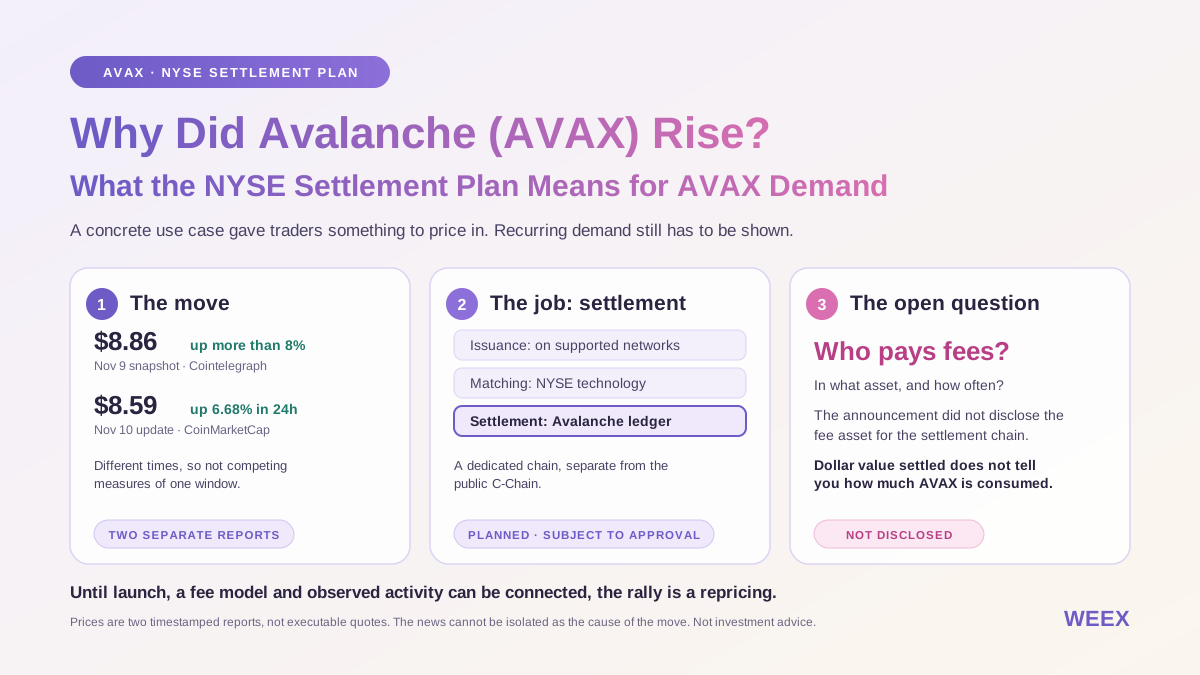
Why Did Avalanche (AVAX) Rise? What the NYSE Settlement Plan Means for AVAX Demand
See why Avalanche (AVAX) rallied after the NYSE settlement announcement, how the dedicated chain would work, and what could create demand for AVAX.

How to Resolve Data Center Controversies? This U.S. State Wants to Tokenize Computing Power to Share Benefits with Residents

Wall Street Morning Briefing: Market Soars on Oil Prices and AI Recovery, Nvidia Falls Alone, Data Centers Become Political Regulation Focus, CPI Lacks Year-on-Year Comparison Adds Variables

Ethereum's 2028 Challenge: Quantum Resistance Roadmap Hits Release Bottleneck
Understanding the DEX 'Hyperliquid': A Practical Workshop|Japan Digital Economy Federation

Envision Star River Base Completed in One Year with 120MW Capacity at One-Fifth the Cost of Similar U.S. Projects
Prediction: This Will Be Intel’s Stock Price After 1 Year (Hint: It Implies a Nice Jump)
Stacks (STX) outlook for 2027: What could drive STX demand?
Guterres Calls for Additional Taxes on Energy Companies
Cities and States Representing 60% of U.S. Economy Commit to Collaborate with the UN on Tracking Carbon Emissions
Startup Voya Energy Proposes Solution to Replace Noisy Diesel Generators in Data Centers
55 million ZETA to be destroyed, ZetaChain continues to operate after shutdown announcement
Latest articles


Latest coin listings on WEEX


