
3-year-old bug triggers $1.3 million drain and forces 10-day blockchain halt

 Prefer us on Google


A routine Radix code refactor created a vault flaw that enabled a roughly $1.3 million theft and later forced validators to halt the blockchain.
The Radix Foundation said Sept. 17 that an RDX Works development team introduced the defect during a June 2023 cleanup of the Radix Engine, the software layer that executes transactions and enforces asset ownership across the network. The vulnerability remained undetected for more than three years before an attacker exploited it on Aug. 31.
A community reconstruction of the ledger shows the attacker withdrew about 458,915 USDC, 72,420 USDT, 61.08 ETH, 6.35 wrapped Bitcoin, 536.16 SOL and 32.91 BNB across 26 transactions. The assets were worth roughly $1.26 million using Aug. 31 market prices, and the attackers took another 13,000 XRD from a vault to pay transaction fees. The two stablecoins alone accounted for about $531,335.
The stolen assets were sent through Hyperlane to Ethereum, BNB Chain, and Solana, then sold for ETH, Radix said. Hyperlane itself operated as designed: the attacker had already obtained the assets through the Radix Engine before using the bridge to move them elsewhere. No private keys were compromised.
However, the immediate loss understated the potential exposure. Radix investigators concluded the flaw could have been used against any vault on the network, putting tokens and other assets beyond the bridged holdings targeted by the attacker at risk.
As a result, network validators deliberately took enough stake offline to prevent it from reaching consensus and stopping additional transactions while developers worked on a fix.
Radix audit miss turns maintenance bug into systemic failure
The vulnerability had already survived an independent security review before the attacker found it.
Zellic audited the Radix protocol in 2024, including the engine kernel containing the defect. The review did not detect the authorization flaw, even though the vulnerable code had been introduced during the previous year's refactor.
The bug changed how the engine handled vault references. A transaction could identify another user's vault by its internal address and pass that reference into purpose-built smart-contract code. The engine then allowed ordinary withdrawal functions to be called without properly enforcing the ownership boundary that should have rejected the request.
That gave the attacker access to assets held by user accounts, applications and liquidity pools without obtaining the owners' signatures.
The Foundation said the attacker completed 26 exploit transactions between 16:02 and 16:57 UTC on Aug. 31. Once investigators determined the vulnerability existed in the execution layer rather than a single application, validators coordinated to stop transaction finalization.
The halt lasted more than 10 days. A protocol fix added checks preventing a restricted vault reference from being used for an ordinary withdrawal, and user transactions resumed Sept. 11, according to the community ledger reconstruction.
The incident also produced secondary losses in liquidity pools after the attacker removed bridged assets from one side of trading pairs. The distorted prices allowed another account to extract millions of XRD from affected pools, showing how an execution-layer failure can keep causing economic damage even after the initial assets have left the network.
Radix said it is adding regression tests, strengthening its security review process, and formalizing the emergency procedure validators used to break network liveness.
The Foundation also said future security work must account for increasingly capable AI-assisted code-analysis tools, which it believes may have helped the attacker identify the years-old defect.
For developers and validators, the next challenge is preventing similarly routine maintenance work from silently altering security assumptions that external audits may miss.
That task extends beyond repairing the exploited code. Radix now has to strengthen the review process around changes to authorization logic while restoring confidence among users and liquidity providers whose assets ultimately depend on the engine enforcing those boundaries correctly.
-- Price
This content is provided for general informational purposes only and doesn't constitute financial, investment, legal, or tax advice. Any events, rewards, online promotions, or related information mentioned herein should not be considered a recommendation, solicitation, or invitation to purchase, sell, trade, or otherwise deal in any crypto assets. Crypto assets are highly volatile and may result in loss. The availability of WEEX services, products, and related events may vary by region. You are responsible for ensuring that your participation is in accordance with applicable local laws and regulations.
You may also like

When is the launch date of Bitcoin Hyper? Testnet, tokens, and mainnet are separate milestones

Jon Leaves Hyperlane to Join Open Standard as Marketing Head

TRON Industry Weekly Report: Stagflation May Lead BTC to Test $80,000 Support Again, Detailed Explanation of Building Chain Abstract Web3 Experience Infrastructure Newton

Autheo THEO token plunges 92% after suspected bridge exploit

Radix Foundation Fixes Vault Authorization Vulnerability, Cross-Chain Asset Withdrawal Incident Resolved

$7.6 Trillion AI Infrastructure Investment Pressures Hyper-scalers' Cash Flow

Hyperliquid opens low-latency data access under $1K

What is revenge trading? The trading minute

Circle vs OUSD: The Battle Between Open Standard (OUSD) and Floating Reserves of Stablecoins

Iore Acquires Cryptocurrency HYPE, First Acquisition by a Listed Company in Japan
Humanity Discloses H Token Dual-Chain Attack Details, With Losses on Ethereum and BSC Exceeding $36 Million
Humanity said the H token attack across Ethereum and BSC caused more than $36 million in losses after leaked ProxyAdmin keys enabled malicious contract upgrades and token minting.

15,400 people lost over $13 million after copying the wallet of a crypto specialist

The Tech Sell-Off Is Creating the Best Buying Window in 2 Years. Here's What I'm Buying.

Why the Big Short Seller is Buying Tencent Against the Trend?

From Securing Private Keys to Constraining Agents: New Frontiers of Crypto Security in the AI Era

The AI Power Surge Returns to Rationality: Where to Find Valuation Lows

Prediction: Micron Stock Will Be at This Price at the End of 2027

How to Use Tokenized Stocks on the Blockchain?

Bitcoin ETF Surpasses 2,200 Institutional Holders, Primarily Investment Advisors

First Circle Capital Announces Final Closing of $26 Million Fund to Invest in Fintech in Africa
A New Path for API3: Fixed Supply, On-Chain Curation, and Infrastructure for AI Agents

Nestlé Expands into Wearable Devices, Plans to Match Nutritional Products with Health Data
ECB Governing Council Member Kocher Warns Against Lagging in Inflation Response

Over 20% of Generation Z Own Cryptocurrency, Barriers to Adoption for the General Public Include 'Fragmentation of Financial Services' = SoFi Survey
Where Will SpaceX Stock Be in 5 Years?

Ray Dalio's Latest Interview: Why Great Technologies Are Often Not Great Investments?

Will On-Chain BTC Lending Become Mainstream? Data and Institutional Trends Point to Traditional Finance

Is BTC Different This Time?

Tonight, the last major inflation report before the Federal Reserve's December decision is released!
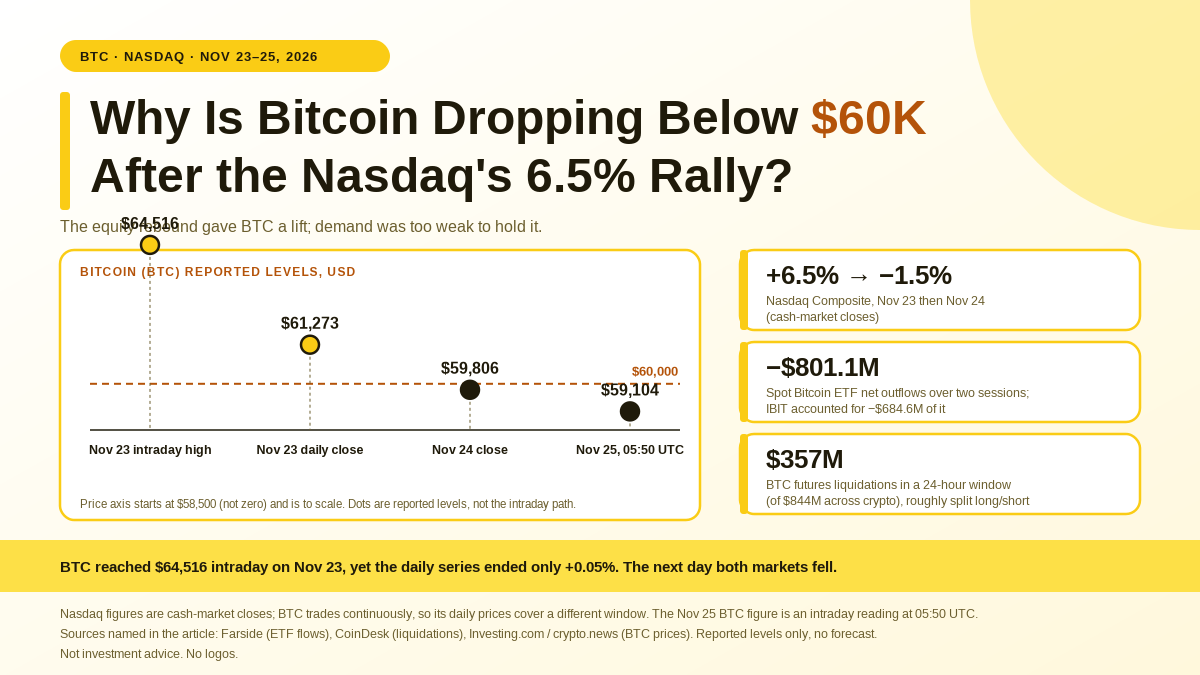
Why Is Bitcoin Dropping Below $60K After the Nasdaq’s 6.5% Rally?
Why is Bitcoin dropping below $60,000 after the Nasdaq rallied 6.5%? See what $801.1 million in ETF outflows, exchange flows, and liquidations reveal.
When is the launch date of Bitcoin Hyper? Testnet, tokens, and mainnet are separate milestones
Jon Leaves Hyperlane to Join Open Standard as Marketing Head
TRON Industry Weekly Report: Stagflation May Lead BTC to Test $80,000 Support Again, Detailed Explanation of Building Chain Abstract Web3 Experience Infrastructure Newton
Autheo THEO token plunges 92% after suspected bridge exploit
Radix Foundation Fixes Vault Authorization Vulnerability, Cross-Chain Asset Withdrawal Incident Resolved
$7.6 Trillion AI Infrastructure Investment Pressures Hyper-scalers' Cash Flow
Latest articles


Latest coin listings on WEEX


