
One Order Book for Dollars and Stablecoins. How It Works

 Prefer us on Google


On one exchange, pairs like BTC/USD, BTC/USDC, BTC/USDT, and BTC/USDG can coexist simultaneously. Each sells the same asset, but transactions occur in different currencies. Typically, such markets have separate order books. A buyer of BTC with USDC cannot take a seller's order from BTC/USD, even if USDC is priced almost exactly at $1.
Exchanges approach this differently. For instance, OKX changed this scheme for some markets in September 2026. The platform merged USD and USDC liquidity. Orders now go into a common order book, and users select the settlement currency separately. The set of available assets depends on the market and jurisdiction. In the case of OKX, these include USD, USDC, USDG, and for certain markets, RLUSD. The price of the asset and the currency used for payment no longer have to match.
One Market Instead of Several
An order book is a queue of buy and sell orders with specified prices and volumes. Suppose there are about 20 BTC available at the current price in BTC/USDC, and another 50 BTC are in the adjacent BTC/USD. A trader with USDC needs to buy 30 BTC. With separate markets, after the first 20 BTC, they would have to either go deeper into the order book and pay more or convert their currency beforehand and switch to BTC/USD.
In a unified order book, liquidity is not limited to orders from participants using USDC. This fragmentation issue is precisely what OKX's Unified USD Orderbook addresses. Multiple settlement currencies gain access to a single order book.
How USDC Meets USD
Let’s imagine two participants. One sells BTC and wants to receive USD. The other buys BTC but holds USDC in their account. On a regular exchange, their orders would be in different order books. In a combined system, they can meet in a single order.
Suppose a user on OKX opens the dollar market and separately selects the currency in the Trade with field. The second participant in the transaction can use another supported settlement asset. If the orders match, the exchange conducts internal settlements between the currencies. The buyer does not need to convert USDC to USD themselves first.
The exchange does not charge a separate fee for using another supported settlement currency. The market becomes unified, but the actual currencies—USDC, USDG, and other stablecoins—continue to exist on the balance as different assets.
USD on the Screen, USDC in the API
The September migration clearly shows how the exchange interface can differ from its internal structure. From September 23, old USD instruments and new USDC instruments operated in parallel for a while. Users and developers had the opportunity to transfer orders and reconfigure trading systems.
On September 30, the old USD instruments were removed from trading, and the remaining open orders were canceled. At the API level, the corresponding Crypto-USDC instruments became the baseline. Meanwhile, in the user interface, the combined markets continue to display as Crypto/USD.
Thus, a person can see BTC/USD, while a trading bot operates with BTC-USDC. If a user wants to settle specifically in USD, this is additionally passed in the order parameters. For regular manual trading, this difference is almost imperceptible. For algorithmic strategies, an incorrect instrument identifier can completely halt trading.
-- Price
Liquidity and Settlement Currency Are Different Things
Previously, the name BTC/USDC simultaneously defined both the order book and the settlement currency. In the new model, these functions are separated. BTC can have a single dollar price and a common order queue, while one client settles in USDC, another in USD, and a third in another supported dollar asset.
This is particularly noticeable with large orders. If around the current price in separate markets there are conditionally 50 BTC in USD, 20 BTC in USDC, and 10 BTC in USDG, each client usually sees only their part of the liquidity. After merging, these volumes can participate in a single order matching process. The actual price of a large transaction still depends on the current order book, but the market itself becomes less fragmented.
What Market Makers Get
In certain pairs, market makers have to maintain quotes simultaneously in BTC/USD, BTC/USDC, BTC/USDG, and other similar markets. Capital is distributed among several order books. If the flow of clients sharply shifts from one pair to another, funds must be moved to follow the demand.
In a general order book, one queue of orders can serve users with different settlement assets. This reduces the number of parallel markets that need to be maintained.
As new dollar tokens emerge, the effect becomes more noticeable. If separate pairs with BTC, ETH, SOL, and dozens of other assets are created for each new stablecoin, the number of order books quickly increases.
Risk of Decoupling from the Dollar
The consolidation of order books works well as long as dollar stablecoins trade close to $1. However, USDC, USDG, and RLUSD remain tokens from different issuers with their own reserves, issuance, and redemption rules. If one of them deviates significantly from the dollar, simple interchangeability ceases to function.
The public rules of OKX do not disclose a separate calculation formula for scenarios of strong de-pegging. The platform itself controls the list of currencies that can be used in a specific market and can change it.
Such a case has already occurred. In May 2026, OKX stopped accepting USDC for new orders in USDT/USD, while maintaining the ability to use other supported settlement assets. Therefore, a general order book does not mean that the exchange considers all dollar tokens to be equal in risk.
One Principle --- Also for Derivatives
A similar model is used in USD-margin futures. Instead of separate contracts for each settlement currency, participants can trade the common liquidity of one instrument while choosing the settlement asset separately.
At OKX, the European version of such futures supports USD, USDC, and USDG. The selected currency is used for calculating fees, profits and losses, financing, and margin. For the market, there remains one price and one order book, while the financial result for a specific client is accounted in the chosen asset.
How This Works on Other Exchanges
There is currently no unified model. Gemini has been combining dollar liquidity with GUSD, USDC, and RLUSD since November 2025. For example, the dollar and stablecoin variants of the BTC market use a common base liquidity, although the set of available instruments depends on the client's region.
Gate launched the Unified USD Order Book on September 1, 2026. It included USD, USDC, USD1, and RLUSD. The user selects the settlement currency, and orders for one base asset go into the common order book. The platform performs internal conversion between parties within the system. Gate currently has a notable limitation: the unified model applies to spot trading and does not extend to isolated and cross-margin trading.
Binance maintains a more traditional structure. BTC/USD, BTC/USDC, and BTC/USDT exist as separate spot markets with their own order books. To access the liquidity of another pair, the user must switch to it separately.
Bybit operates similarly in the spot market: BTC/USDT and BTC/USDC are independent trading pairs. However, the user's capital is combined at another level through the Unified Trading Account.
This is an important distinction. The Unified Trading Account collects assets and collateral within one account but does not turn several spot pairs into one order book. At OKX, Gemini, and Gate, it is precisely the trading liquidity that is consolidated. At Binance and Bybit, the main dollar pairs remain separate markets for now.
What Changes for the Trader
For the user, the main consequence is less dependence on which specific dollar asset is held in the account. If the required liquidity was previously in a neighboring pair, additional conversion was necessary or one had to settle for a less deep order book.
A unified market allows the use of several settlement currencies against one order book. However, a common order book does not make the stablecoins themselves identical. The issuer, reserves, redemption possibilities, and the risk of losing the peg still pertain to the specific token.
As a result, a single transaction is divided into three independent elements: the asset price, available liquidity, and the currency in which the user actually settles.
This content is provided for general informational purposes only and doesn't constitute financial, investment, legal, or tax advice. Any events, rewards, online promotions, or related information mentioned herein should not be considered a recommendation, solicitation, or invitation to purchase, sell, trade, or otherwise deal in any crypto assets. Crypto assets are highly volatile and may result in loss. The availability of WEEX services, products, and related events may vary by region. You are responsible for ensuring that your participation is in accordance with applicable local laws and regulations.
You may also like
Cyberattack on the ports of Marseille and La Rochelle? Hackers paid 1 dollar in crypto
![[Exclusive] Coinbase Transaction Data Shows 100 Million Trades Misrepresented... Data Analysis Firm Corrects Errors](/public-static/20_9098579959.png?format=avif)
[Exclusive] Coinbase Transaction Data Shows 100 Million Trades Misrepresented... Data Analysis Firm Corrects Errors
Wall Street Morning Report: U.S. Inflation Resurfaces, AI Credit Risks Spread, Chip Stocks Fall for Six Consecutive Days
Arthur Hayes: Focus on Established DeFi Projects with Cash Flow

Anthropic Reports $16.8 Billion Revenue in Q3, IPO Feasibility Strengthened
Hot CPI Lifts Hike Bets; Risk Assets Pull Back | WEEX TradFi Daily(October 15, 2026)
Major indexes closed lower on October 14, with the Nasdaq leading the decline. September unadjusted CPI rose to 3.7% year on year, above forecasts, and core CPI also beat expectations. Traders sharply raised this month’s hike probability to about 43.7% and fully priced two more hikes by the end of January. Chip stocks were sold again. Bitcoin broke below $83,000 and last traded near $81,700, while spot gold and silver fell. Crypto-related stocks were under pressure, but PYTH rose against the tape. October 15 brings PPI, retail sales and key
WEEX Exclusive:Hot CPI Lifts Hike Bets; Risk Assets Pull Back | WEEX TradFi Daily(October 15, 2026)

Sam Price Observes Changes in Bitcoin ETF Net Inflows

G20 warns that stablecoins may lose value even if fully backed
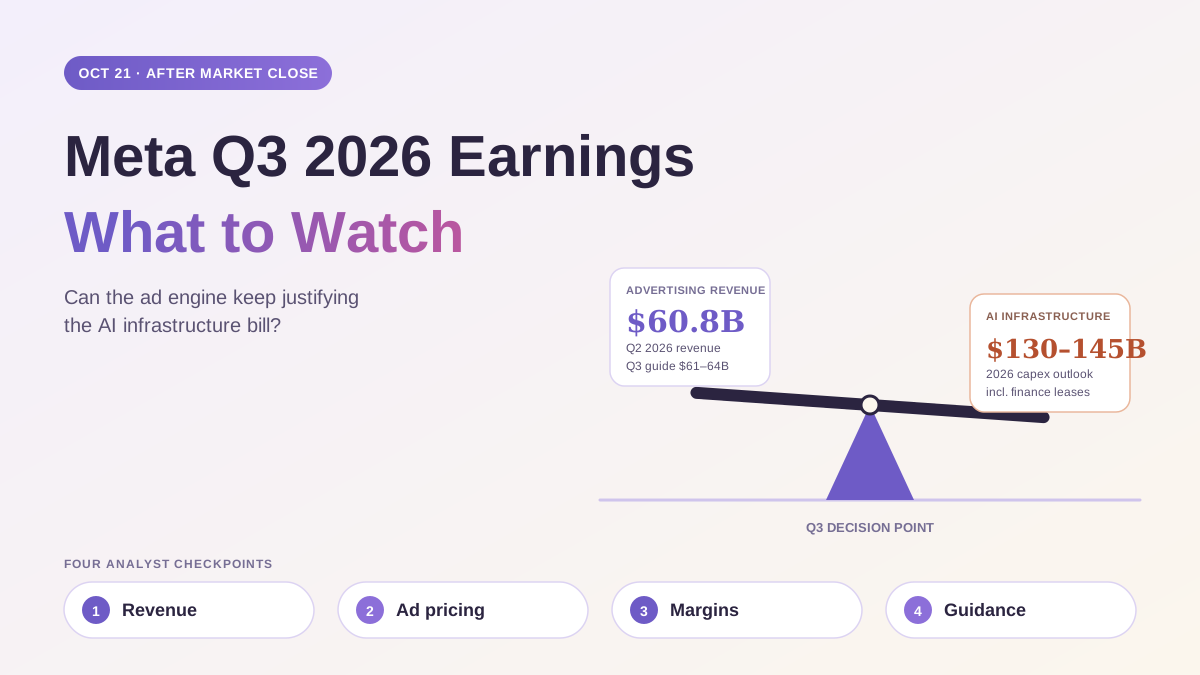
Meta Stock Earnings: What to Watch in Meta Platforms’ Q3 2026 Results
Meta reports Q3 2026 results on October 21. See the advertising, AI spending, margin, and guidance signals that could move META stock.

Starting a Business with Crypto Payments: What Changes in 2027

September CPI in the US: What Inflation Tells the Investor
Why Only 2% of $10 Billion in US Treasury Bonds Enter DeFi?

Ethereum ETF Funds Break Out of Outflow Series with Inflows of $24.8 Million

Arca: Four Investment Directions for Crypto Assets

When Will Bitcoin Surpass Its Previous High? Insights from ChatGPT, Claude, and Gemini

When Currency Becomes Programmable, the Next Stop for the Crypto Industry May Be to Rewrite Token Rules

The Hook Ecosystem Begins to Stir! Who Will Be the Next Dark Horse?
"CARF Introduced Before Virtual Asset Taxation... Need for Review of Implementation Basis"

Liquidity Structure of Domestic Cryptocurrency Exchanges and Conditions for Introducing LP – Bitplanet

Tencent Tests Personal Investment Analysis Assistant Rena, Supports WeChat Connection
Financial Stability Board Highlights Unclear Bankruptcy Laws for Stablecoin Failures

Why Most Public Chains Are Doomed to Fail, According to Real Vision Founder

The Era of Industry: Q3 2026 Virtual Asset Industry Investment Status Report – Tiger Research

Paul Tudor Jones Expects Challenges for US Stocks in 2027, Shorting US Stocks Throughout the Year While Holding Long Positions in Oil

唐华斑竹 Reports Han Lin to Speak at Oxford Union

We Overestimate the Value of Stablecoin Issuance While Underestimating the Power of Localized Financial Services
Mesh Acquires Bluvo to Accelerate Global Payment Network Development

A Generation's P2P

Ethereum Staking: Interactive Brokers Launches Service for Eligible Clients via ZeroHash
Cyberattack on the ports of Marseille and La Rochelle? Hackers paid 1 dollar in crypto
[Exclusive] Coinbase Transaction Data Shows 100 Million Trades Misrepresented... Data Analysis Firm Corrects Errors
Wall Street Morning Report: U.S. Inflation Resurfaces, AI Credit Risks Spread, Chip Stocks Fall for Six Consecutive Days
Arthur Hayes: Focus on Established DeFi Projects with Cash Flow
Anthropic Reports $16.8 Billion Revenue in Q3, IPO Feasibility Strengthened
Hot CPI Lifts Hike Bets; Risk Assets Pull Back | WEEX TradFi Daily(October 15, 2026)
Major indexes closed lower on October 14, with the Nasdaq leading the decline. September unadjusted CPI rose to 3.7% year on year, above forecasts, and core CPI also beat expectations. Traders sharply raised this month’s hike probability to about 43.7% and fully priced two more hikes by the end of January. Chip stocks were sold again. Bitcoin broke below $83,000 and last traded near $81,700, while spot gold and silver fell. Crypto-related stocks were under pressure, but PYTH rose against the tape. October 15 brings PPI, retail sales and key
Contents
Latest articles


Latest coin listings on WEEX


