
On-chain Tracking of Meme 'Token Factory': Clearing in 3 Seconds, Millions of Dollars Flowing In and Out

 Prefer us on Google


36 wallets transferred funds in the same second, revealing the script flaws behind the Meme coin harvesting network.
Written by: @the_smart_ape
Compiled by: AididiaoJP, Foresight News
One wallet holds $1,026,800 USDC and has never made a transaction. Its funds come from two aggregation wallets, which are continuously funded by 32 token issuance wallets. Tracing the funding chain upwards, I discovered a conspiracy group of 43 wallets involved in Meme coin operations: bulk token issuance, bundled purchases in the same block, dumping within seconds, and then layering profits into aggregation wallets.
Since January 2026, this conspiracy group has issued over 6,855 Meme coins on Pump.fun and continues to do so.
Starting from Meme Coin Fun
The clue starts from fun, with the contract address: 7nRtEVneLhdc4L4dHyiExoSZoSMJx9VEBTr7wbmDpump.
On October 22, fun went live, and the token was issued 8 seconds after a tweet. The issuer bought in, and three other wallets followed suit in the same block. Four seconds later, the issuer cleared their position.
Unusually, this coin did not immediately drop to zero. Ten minutes later, its market cap was about $150,000.
The issuer and their bundled wallets made a profit of 13.6 SOL on this coin. They had already exited before the coin took off.
So I investigated who this issuer was, tracing the funds downwards. The money first went into an aggregation wallet, then converted to USDC, and deposited into a wallet holding a million dollars. Behind that wallet, there are still 31 token issuance wallets continuously funding.
43 Wallets, Clearly Defined Roles
The structure of this network is:
- 43 wallets: 32 token issuance wallets, 8 transit wallets, 3 bundled wallets;
- Over 6,855 Meme coins issued since January 2026;
- 2 aggregation wallets;
- 1 sediment wallet: holding $1,026,800 USDC, untouched to date.
The rhythm of token issuance has also changed. Before June, about 30 wallets issued tokens simultaneously; after July, only one issuer was used at a time. The current issuer is called DRXPafDu, who has issued 1,118 coins from September 9 until now.
Five Steps to Issue a Token
The process for each token issuance is almost identical:
- The issuer creates the token and buys 10% to 15% of the supply in the same transaction.
- In the same block, three other wallets in the network follow with purchases.
- External buyers enter: sniper bots, follow bots, and those who think they bought in early.
- The issuer clears their position. Median time: 3 seconds.
- Profits first go to the aggregation wallet, then into the sediment wallet.
Bundling is not random. I checked 160 token issuances, and all 461 bundled purchases were concentrated in the token issuance block. Among them, 90% followed immediately after the transaction creation, ranking in the 1st, 2nd, and 3rd positions; none appeared in later blocks.
This indicates that the token issuance and the three follow-up purchases were sent out together, leaving external buyers no chance to squeeze in.
The issuer does not wait either. The current issuer has issued coins 693 times, with 88% sold out within 5 seconds.
-- Price
Follow-up Wallets, Interconnected
What surprised me the most is that the three wallets buying after the issuer are not newly created. They are other token issuance wallets within the same network.
For example, Wallet A issues a token, and Wallets B, C, and D buy in; when Wallet B issues a token, Wallets A, C, and E buy in again. One of the wallets, 3cCqweS8..., participated in the issuance of 8 different issuers.
This is not a group of retail investors coincidentally following; it is the same batch of wallets lifting each other, like an assembly line.
Ironclad Evidence of One Person Operating: 36 Wallets Transferring in the Same Block
Transferring money to the same place is not enough to prove it is the same person. What truly indicates the issue is the following.
On October 14 at 15:39:14, 36 wallets cleared their SOL in the same block into the aggregation wallet. Two minutes later, another wallet followed. Three minutes after the bulk transfer, the aggregation wallet transferred out $71,874 USDC to the sediment wallet.
It is hard to get 36 people to transfer in the same block; this can only be done by a script.
And it’s not just once. The aggregation wallet receives payments in batches, with the same batch of wallets appearing repeatedly on the same day.
On September 9 at 1:07 AM, the old issuer XXXX5JNG issued the 938th coin, making the last issuance. At 4:05 AM, a new aggregation wallet was funded. Six minutes later, the new issuer DRXPafDu completed the first issuance with three brand new bundled wallets.
Five days prior, XXXX5JNG had just transferred 247 SOL to this new issuer.
There is even more direct evidence: the issuer's first purchase, among hundreds of issuances, is precisely the same in token quantity. 110.9m tokens exchanged for 3.55 SOL appeared 966 times; 112.1m tokens exchanged for 3.56 SOL appeared 797 times. The same tool, the same configuration.
Sediment Wallet: Only Inflows, No Outflows
The sediment wallet address is:
8wZf1QPda7HeQQYPXebVu8HGEKcCoiSoT7KsuwYLWtFX
It is an ordinary wallet controlled by a single private key. Since May 9, there have been 188 transactions, all inflows, with 0 transactions signed by it. The real senders are only two: aggregation wallet #1 transferred in $742,271 USDC, and aggregation wallet #2 transferred in $284,539 USDC.
The first SOL of this sediment wallet came from a token issuance wallet in the network.
Who is Behind It? Only the Exchanges Know
I do not know.
This address has no KOLScan data, no .sol domain name, and no one has mentioned it on X. The wallets I traced were funded by KuCoin, Bybit, and Binance. Only these exchanges can match the address with real identities.
I also compared this token issuance network with nearly 1,000 known KOL wallets: no overlaps and no transfers.
Who is Paying
Every SOL the issuer withdraws comes from those who buy in after them.
Most of these coins drop to zero within seconds. Among the coins issued by the current issuer, about 3% will take off like fun. But even if they take off, the operator has already exited.
How to Avoid Becoming Their Exit Liquidity
- Open the token issuance block. If three wallets follow closely behind the issuer, that indicates bundled buying.
- Check the issuer's history. Issuing 50 coins in a day indicates this is a conspiracy group, not a project team.
- Check if the issuer has already sold out. In this network, selling only takes 3 seconds.
- Do not buy in the seconds before a coin issued by a continuous issuer goes live.
Address List
- Sediment Wallet: 8wZf1QPda7HeQQYPXebVu8HGEKcCoiSoT7KsuwYLWtFX
- Aggregation Wallet #1: DNmciAfumzbkNRxpPym5kiEsquD69JY3Nvj1T8nWGBqD
- Aggregation Wallet #2: Hu92NuUGb9XMKaaqQnBaDfUGph7PnVRmoAtiKpPDrKUu
- Current Issuer: DRXPafDunsHAMoo6hqyak9J5LfqT1MKBQEp5iUJMFvb7
- Old Issuer: XXXX5JNGhjPpQEsqcFChLtzv4V1HWyqUaW8tEwyjBfW
The current issuer is still issuing tokens.
This content is provided for general informational purposes only and doesn't constitute financial, investment, legal, or tax advice. Any events, rewards, online promotions, or related information mentioned herein should not be considered a recommendation, solicitation, or invitation to purchase, sell, trade, or otherwise deal in any crypto assets. Crypto assets are highly volatile and may result in loss. The availability of WEEX services, products, and related events may vary by region. You are responsible for ensuring that your participation is in accordance with applicable local laws and regulations.
You may also like

McDonald's McRib Doesn't Actually Boost Bitcoin's Price, Sorry Everyone
Argentine Court Concludes Criminal Investigation Against President Milei and 10 Others Over LIBRA Fraud Allegations
Anthropic IPO Filing Lifts AI Sentiment; BTC Holds Near $80,000 | WEEX TradFi Daily (October 27, 2026)
All three major indexes closed higher on October 26. Anthropic formally filed for a listing, rekindling AI speculation; the Philadelphia Semiconductor Index rose about 3% on the day, and Tesla reached a more-than-three-month high. Bitcoin was near $80,200, down for three consecutive weeks and testing $80,000 for a third time. Local assets plunged after the election result. The October 27 focus is the opening of the Federal Reserve meeting and earnings from Visa, PayPal and others.

WEEX Exclusive:Anthropic IPO Filing Lifts AI Sentiment; BTC Holds Near $80,000 | WEEX TradFi Daily (October 27, 2026)

TheSolstice Profits Approximately $200,000 Through Bundling Operations
Introducing the Best Meme Coins on the Ripple Network: A Review of 5 Popular XRPL Tokens
Mark Cuban compares Bitcoin to meme stocks

Shaw, Founder of ai16z, Introduces Pump.fun Contract Reverse Engineering Plan
[Column] Robinhood Chain: The Meme Coin Craze May Be Over, But Growth Continues

Bonk Guy Suffers Millions in Trading Losses, Advises Traders to Patiently Wait for Market Opportunities
Speculation as a Theme of the Last Decade: Focus on Prediction Markets and Perpetual Futures Exchanges = Delphi Digital

Court in Argentina Dismisses Case Against Javier Milei Over Libra Token

唐华斑竹 Discusses New Features of Meme Launchpad
90% of Revenue from Meme Coins, Yet Valuation Rivals Pump: What Should Meteora Be Worth?
CZ Warns of Security Risks in Crypto Wallets, Visa Plans to Acquire Fireblocks
Ansem Optimistic About Building Business Around Speculative Trading

Trump Coin Profits Reach $2.4 Billion Amid Democratic Political Corruption Offensive

David Schwartz Supports Fuzzy Cards Project
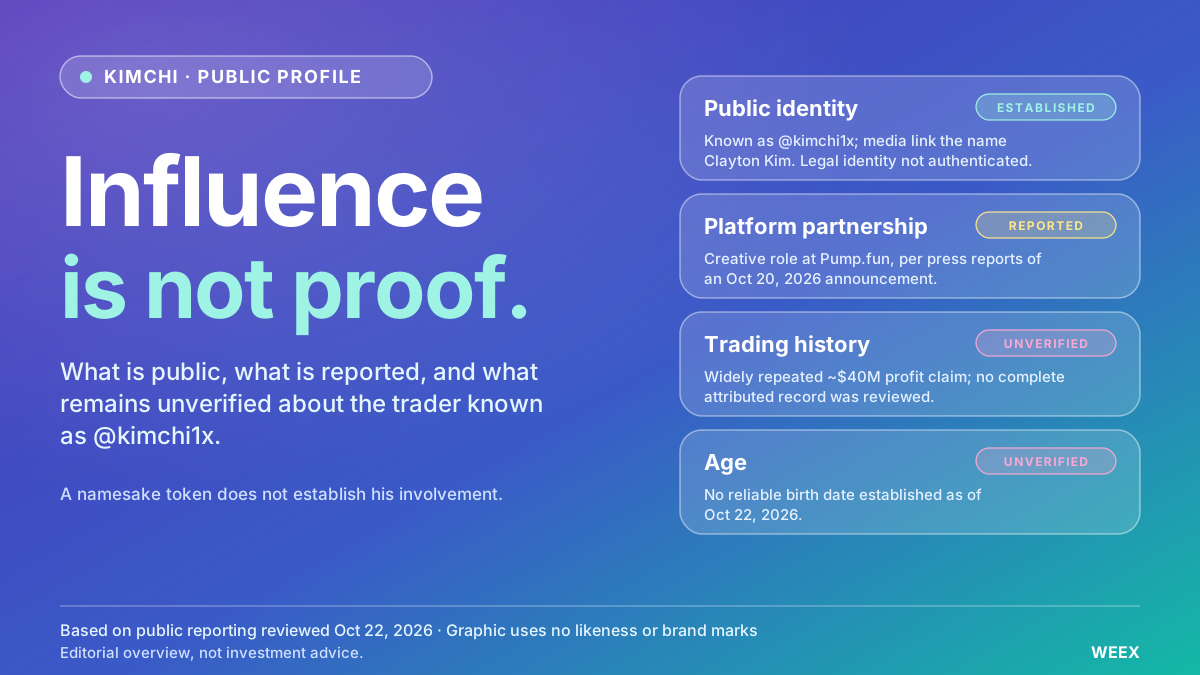
Who Is Kimchi Crypto Trader? Age, Real Name, and Trading Background
Who is Kimchi crypto trader? Check what is known about his age, the name Clayton Kim, trading background, profit claims, and Pump.fun partnership.

Earning Millions Monthly: How Crypto Frontends Make So Much Money?

GTA 6's fictional token Dacity Coin sparks speculation for Solana's similarly named token

Dogecoin Foundation Supports the Establishment of Dogecoin Labs to Promote the Practical Application of DOGE

Interview with Robinhood's Senior Vice President Johann: No Competition in Public Chains, Focusing on DeFi and AI Agent for Next-Gen Finance

SpaceX Q3 Revenue Beats and Strengthens After Hours| WEEX TradFi Daily(October 21, 2026)
On October 20, equity indexes were mixed. The S&P 500 closed slightly higher, while the Nasdaq was roughly flat. SpaceX reported third-quarter revenue of $14.58 billion and net income of $4.4 billion, both well above forecasts, and rose about 3% after hours. Bitcoin traded near $83,000, while ZEC led majors with a more-than-10% gain in 24 hours. Memory, optical and crypto-finance names rose from the prior evening, and CoreWeave and SMCI bounced off lows. Tesla, Meta and other companies report on October 21.

WEEX Exclusive:SpaceX Q3 Revenue Beats and Strengthens After Hours| WEEX TradFi Daily(October 21, 2026)
Four Pillars Researcher Claims Robinhood Chain is Still Preparing for Growth

Charles Hoskinson's Meme Coin Plummets Over 90% in Just Hours
CFTC Chair: Breaking State-Level Fragmentation to Make the U.S. a Global Crypto Hub

Decline in Trading Activity for Robinhood Chain Meme Coins, On-chain Funds Flowing to Stablecoin Lending

Ripple to Address XRP Ledger Security at Swell 2026
McDonald's McRib Doesn't Actually Boost Bitcoin's Price, Sorry Everyone
Argentine Court Concludes Criminal Investigation Against President Milei and 10 Others Over LIBRA Fraud Allegations
Anthropic IPO Filing Lifts AI Sentiment; BTC Holds Near $80,000 | WEEX TradFi Daily (October 27, 2026)
All three major indexes closed higher on October 26. Anthropic formally filed for a listing, rekindling AI speculation; the Philadelphia Semiconductor Index rose about 3% on the day, and Tesla reached a more-than-three-month high. Bitcoin was near $80,200, down for three consecutive weeks and testing $80,000 for a third time. Local assets plunged after the election result. The October 27 focus is the opening of the Federal Reserve meeting and earnings from Visa, PayPal and others.
WEEX Exclusive:Anthropic IPO Filing Lifts AI Sentiment; BTC Holds Near $80,000 | WEEX TradFi Daily (October 27, 2026)
TheSolstice Profits Approximately $200,000 Through Bundling Operations
Introducing the Best Meme Coins on the Ripple Network: A Review of 5 Popular XRPL Tokens
Contents
Latest articles






Latest coin listings on WEEX


