
Ethereum’s Joseph Lubin explains why ETH could rival Bitcoin and gold

 Prefer us on Google


Ethereum co-founder Joseph Lubin has argued that ETH could become an important store of value during a period of rising inflation and economic uncertainty, predicting that the cryptocurrency will gain more uses as financial services move onto blockchain networks.
Summary
- Ethereum co-founder Joseph Lubin says ETH could become an important store of value during economic instability.
- Lubin argues that Ethereum offers financial applications and programmable transactions beyond the features of Bitcoin and gold.
- Vitalik Buterin has called for ETH's long-term value to depend less on transaction fee burning.
- Lubin predicts quantum-safe ETH by 2028, while Ethereum's published network roadmap targets December 2029.
- Ethereum traded near $2,050 on November 11, down approximately 3% over the previous 24 hours.
In a Wednesday post on X, Lubin warned that national currencies and other assets could lose purchasing power during economic and social instability. He compared Ethereum with Bitcoin and gold, arguing that ETH offers additional features through decentralized finance, stablecoins and smart contracts.
"We are almost certainly heading into a period of high inflation and extreme economic and social volatility," he wrote.
At the same time, the comments follow recent remarks from Ethereum co-founder Vitalik Buterin, who has called for ETH to be viewed primarily as a store of value instead of an asset whose worth depends on transaction fees being burned.
Joseph Lubin explains why Ethereum could rival Bitcoin and gold
Lubin's argument centers on Ethereum's ability to function as money while supporting financial applications that operate without traditional intermediaries.
"Gold and BTC are high-powered money and excellent stores of value. ETH goes further," he stated.
The Consensys CEO identified Ethereum's resistance to censorship, its use as collateral and its programmable transactions among the characteristics supporting his position.
Like Bitcoin, ETH does not represent a debt obligation issued by a government or financial institution. However, Ethereum supports smart contracts that allow developers to build applications for lending, borrowing, trading and payments.
Lubin described Ethereum's base network as capable of processing financial agreements involving both small payments and transactions worth billions of dollars.
He argued that its decentralized structure could help protect users from financial restrictions imposed by governments or other centralized authorities.
Why ETH is the store of value for what's coming
We are almost certainly heading into a period of high inflation and extreme economic and social volatility. As inflation and risk erode the purchasing power of nation-state money and many other assets, it will matter more than ever... https://t.co/MXuapK9kPI
--- Joseph Lubin (@ethereumJoseph) November 11, 2026
His post further addressed Ethereum's monetary supply, describing ETH as disinflationary and capable of becoming deflationary during periods of heavy network activity.
Ethereum's EIP-1559 mechanism destroys a portion of transaction fees, although the amount burned varies with network usage and does not always exceed new token issuance.
Vitalik Buterin backs ETH as a store of value over fee burning
Lubin's comments arrive days after Buterin questioned the argument that Ethereum's long-term valuation should depend heavily on reducing token supply through transaction fee burns.
On November 8, Buterin said Ethereum should concentrate on decentralization, security and resistance to external control.
As crypto.news previously reported, Buterin argued that efforts to maximize fee burning could conflict with Ethereum's ability to provide affordable and decentralized services.
"ETH as store of value (SoV)" makes more sense than focusing on ETH as a fee-burning token, he wrote.
Buterin maintained that Ethereum should retain EIP-1559 even if the network continues burning fewer tokens than it issues.
He explained that Ethereum's monetary value should come from its usefulness as an asset held within a secure, decentralized financial system.
Lubin took a similar position while emphasizing the potential demand for ETH as collateral in lending markets and other financial applications.
Lubin predicts quantum-safe Ethereum by 2028
Among Lubin's longer-term predictions was a timeline for making Ethereum more resistant to future security threats involving quantum computing and artificial intelligence.
"By the end of 2027, or partway through 2028 at the latest, ETH will be quantum-safe and AI-safe money," he wrote.
Ethereum developers have been working on cryptographic upgrades intended to protect wallets, transactions and network consensus from increasingly powerful computers.
The Ethereum Foundation's published roadmap targets quantum resistance across the execution, consensus and data layers by December 2029.
Those plans include replacing cryptographic systems that could become vulnerable to sufficiently powerful quantum computers.
The Foundation's September roadmap identifies post-quantum signatures and other security improvements as ongoing research and development priorities.
Lubin's earlier timeline is his own prediction, while the Foundation's published target covers the network's three main protocol layers.
His post further predicted that artificial intelligence (AI) would accelerate economic growth and create demand for blockchain-based financial agreements involving people and automated systems.
-- Price
Ethereum price trades near $2,050 despite Lubin's long-term outlook
Ethereum was trading around $2,050 on November 11, down approximately 3% over 24 hours, according to crypto.news market data.
The cryptocurrency had traded between approximately $2,000 and $2,100 during the period, with daily trading volume reaching $14.22 billion.
Selling pressure has continued despite institutional purchases, with Ethereum-linked wallet activity showing transactions involving large holders during the recent decline.
Lubin's comments focused on Ethereum's longer-term adoption, particularly its potential role in financial markets and the use of stablecoins.
He said Ethereum hosts substantial stablecoin activity and expects companies and governments to increasingly use blockchain networks for financial transactions.
However, competition remains active. During the third quarter, TRON overtook Ethereum in average USDT supply, holding $90.75 billion against Ethereum's $87.73 billion, according to Token Terminal.
Lubin expects Ethereum's base network and layer-2 systems to support more financial activity as businesses adopt blockchain applications.
He predicted that ETH's monetary premium would continue growing as individuals, corporations and governments hold the asset for transactions and financial agreements.
This content is provided for general informational purposes only and doesn't constitute financial, investment, legal, or tax advice. Any events, rewards, online promotions, or related information mentioned herein should not be considered a recommendation, solicitation, or invitation to purchase, sell, trade, or otherwise deal in any crypto assets. Crypto assets are highly volatile and may result in loss. The availability of WEEX services, products, and related events may vary by region. You are responsible for ensuring that your participation is in accordance with applicable local laws and regulations.
You may also like

Davie Analyzes ETH Strategy, Focuses on Key Support and Resistance Levels

Arch Lending launches Bitcoin refinancing with 1-point rate target

Unocoin Submits Investigation into BitGo Ethereum Address Withdrawals

xStocks Tokenized Stocks Natively Run on OP Mainnet, ether.fi Launches Minting and Redemption Features

SoFi Integrates SoFiUSD into Polygon Payment Network

Deutsche Bank Introduces Custody Services for Five Cryptocurrencies

BitGo Mint Adds USDC Minting and Redemption Features
Aave Proposes to Limit the Use of Several Crypto Assets as Collateral Worth $1.33 Billion

BlockUnion and Lido Ecosystem Foundation Reach Strategic Cooperation

Bankless: After Shrinking On-chain TVL, MEGA Bets $30 Million on AI Inference Market

Péter Szilágyi Suggests Disconnecting Smart Devices from the Network

US 401(k) Rule Proposal Allows Cryptocurrency Allocation, Barriers for Altcoins

Canaan turns to Bitcoin holdings as mining machine sales fall 96%
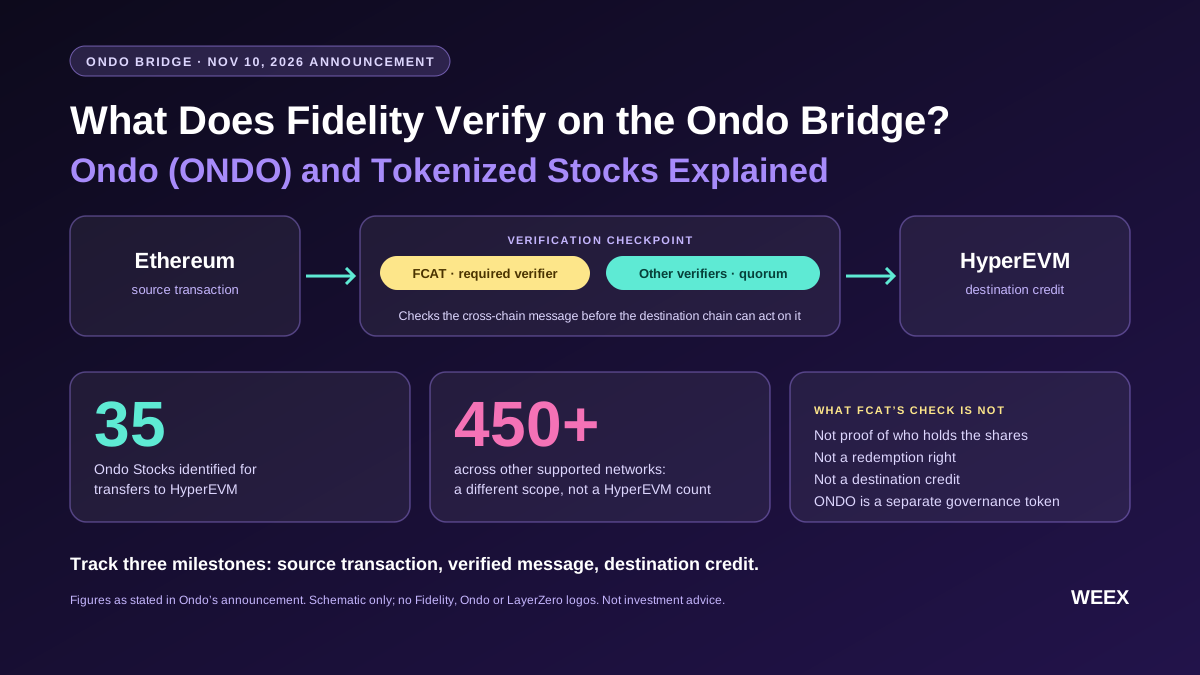
What Does Fidelity Verify on the Ondo Bridge? Ondo (ONDO) and Tokenized Stocks Explained
Learn what Fidelity’s FCAT verifies on the Ondo Bridge, how to check a tokenized stock transfer, and why Ondo Stocks differ from the ONDO token.

Hawkeye's Plan for Tokenized Shares: How Will the Shareholder Register Work?
Base’s USDC transfer footprint does not prove merchant reach, data shows

Willy Woo Argues Bitcoin Not in Bear Market Amid Fear Sentiment

Ethereum Spot ETF Sees Net Outflow of $145 Million Yesterday, Continuing Five-Day Trend

Ethereum Releases eth/73 Proof Wrapper Propagation EIP Draft
BitMine posts $2.8B quarterly profit driven by Ethereum gains, but yearly net loss surpasses $6B

[Full Text] Han Seo-hee: "Even if trade payments are sent via stablecoins, they may not be received domestically"

Ethlabs Proposes Post-Quantum and AI Security for Ethereum by 2027

How Should Institutions Manage Exchange Exposure After a Series of Thefts?

NVIDIA Board Prepares to Dismiss Jensen Huang, Hong Kong Police Arrest 22 in Money Laundering Operation
Golem Project Raises 820,000 ETH on Its 10th Anniversary, 100,000 ETH Staked

Dogecoin's Mainnet DogeOS Launch Imminent

MSCI to Remove Strategy from Global Index, Billions in Fund Flows at Risk

PNC lets businesses accept USDC without keeping the crypto

Israel Discount Bank to Open Bitcoin and Ethereum Trading in App Starting November 26

Israel Discount Bank to Open Bitcoin and Ethereum Trading in App from November 26
Davie Analyzes ETH Strategy, Focuses on Key Support and Resistance Levels
Arch Lending launches Bitcoin refinancing with 1-point rate target
Unocoin Submits Investigation into BitGo Ethereum Address Withdrawals
xStocks Tokenized Stocks Natively Run on OP Mainnet, ether.fi Launches Minting and Redemption Features
SoFi Integrates SoFiUSD into Polygon Payment Network
Deutsche Bank Introduces Custody Services for Five Cryptocurrencies
Latest articles


Latest coin listings on WEEX


