
Bitcoin: Arthur Hayes Sees an Opportunity in the AI Bubble

 Prefer us on Google


The rise of artificial intelligence raises questions about investments, public debt, and financial markets. For Arthur Hayes, the chief investment officer at Maelstrom, the bursting of this bubble could benefit Bitcoin. He believes that the rescue plans for the affected companies would increase the money supply and favor safe-haven assets. However, this bullish outlook faces several obstacles, including risks related to quantum computers and capital outflows from U.S. spot ETFs.
In Brief
- Arthur Hayes believes that the bursting of the AI bubble could trigger financial rescues favorable to Bitcoin.
- An increase in the money supply and inflation could enhance the appeal of safe-haven assets.
- Fidelity notes a record correlation of 0.6 between Bitcoin and the yields of U.S. ten-year bonds in 2026.
- Quantum threats and outflows of $228 million from U.S. Bitcoin ETFs limit bullish prospects.
Arthur Hayes Anticipates a Bitcoin Rebound After the AI Bubble
In a recent interview with Luke Martin, Arthur Hayes explained why the bursting of the artificial intelligence bubble could support Bitcoin. The head of Maelstrom considers that the expenditures in this sector raise questions about its profitability. He also believes that the financial difficulties of large companies could lead Washington to intervene.
Hayes specifically mentions Anthropic, OpenAI, and SpaceX, which would benefit from U.S. government support. According to him, these companies are not yet generating sufficient profits to justify their situation. He therefore anticipates support measures if their difficulties worsen. Such interventions could alter financial conditions and enhance the appeal of cryptocurrencies.
In this scenario, authorities would inject more money to limit the consequences of a crisis. This increase in the money supply could then fuel inflation and reduce purchasing power. Investors would then seek to protect their wealth with assets like gold and Bitcoin. Hayes associates this mechanism with monetary devaluation, which can favor assets perceived as stores of value.
The market already offers a point of comparison. This week, the price of Bitcoin defended the $80,000 mark despite massive sell-offs affecting chip manufacturers and tech stocks. These sell-offs were reportedly two to five times greater than those observed on Bitcoin. However, this resistance illustrates a price evolution without confirming Hayes's envisioned scenario.
U.S. Debt and Bond Yields Strengthen Bullish Expectations
Arthur Hayes is not the only one mentioning a favorable environment for cryptocurrencies. Ceteris Paribus, director of research at Delphi Research, also emphasizes the importance of financial flows on the internet. According to him, the monetary depreciation linked to debt and a potential rescue of the AI sector could fuel capital inflows into Bitcoin.
Financial flows on the internet are very positive. The depreciation due to the current debt situation and the Ponzi-like rescue of AI generate significant BTC flows.
Ceteris Paribus, director of research at Delphi, source: AMBCRYPTO.
The US public debt has reached $40.3 trillion and continues to grow, regardless of the ruling party. A support plan for artificial intelligence companies could further increase this burden. Consequently, investors may pay closer attention to federal spending and its effects on the value of the currency.
Fidelity also notes a growing link between bond yields and Bitcoin. According to the asset manager, their correlation with 10-year US Treasuries reached 0.6 in 2026. Over the past two months, yields have increased by 10%, while BTC has gained 30%. These parallel developments fuel the hypothesis of potential support for the market.
The correlation between Bitcoin and the yields of 10-year US Treasuries reaches 0.6 in 2025, according to Fidelity.
If this relationship holds, rising yields could accompany a further increase in Bitcoin. However, Fidelity emphasizes a broader budgetary issue: debt interest could soon become the largest federal expenditure. In this context, investors may place greater importance on alternative stores of value, although this evolution does not guarantee a sustainable rise in prices.
-- Price
Quantum Threat and ETF Outflows Limit Prospects
Despite these arguments, several risks could hinder Bitcoin's progress. Ceteris Paribus particularly notes that advancements in artificial intelligence and Google's progress in quantum computing heighten concerns. In the long term, this technology could undermine certain cryptographic protections and weigh on investor confidence.
The researcher nonetheless believes that monetary depreciation will remain a favorable factor. However, he estimates that BTC will no longer be the only sought-after store of value for investors. According to this analysis, the quantum threat could limit expected gains, even if debt tensions support demand.
Exchange-traded fund flows also provide a mixed signal. US spot Bitcoin ETFs recorded an additional $228 million in outflows this week. This marks their second consecutive week of withdrawals in October, indicating less favorable institutional demand in the short term.
The slowdown in profit-taking could signal a floor around $80,000, according to Glassnode.
However, Glassnode observes a slowdown in profit-taking after this phase of weekly capitulation. This development could signal the formation of a floor around $80,000. However, it is not sufficient to confirm this level sustainably.
In the short term, Bitcoin will therefore depend on the evolution of financial flows, bond yields, and technological risks. A potential bailout of the artificial intelligence sector could support safe-haven assets, but ETF outflows and the quantum threat remain cautionary factors.
This content is provided for general informational purposes only and doesn't constitute financial, investment, legal, or tax advice. Any events, rewards, online promotions, or related information mentioned herein should not be considered a recommendation, solicitation, or invitation to purchase, sell, trade, or otherwise deal in any crypto assets. Crypto assets are highly volatile and may result in loss. The availability of WEEX services, products, and related events may vary by region. You are responsible for ensuring that your participation is in accordance with applicable local laws and regulations.
You may also like

Cyberattack on GMO in Japan: Trading Accounts Compromised, GMO Coin Claims to be Unaffected

Mark Cuban compares Bitcoin to meme stocks

Electrum patches Bitcoin vulnerability allowing payment redirection

The Week Ahead: 4 Key Moments for the Crypto Market

Security Researcher Exploits PHP2Shell Vulnerability to Breach Bounty Website, Earns Approximately $2000 in Bitcoin Rewards
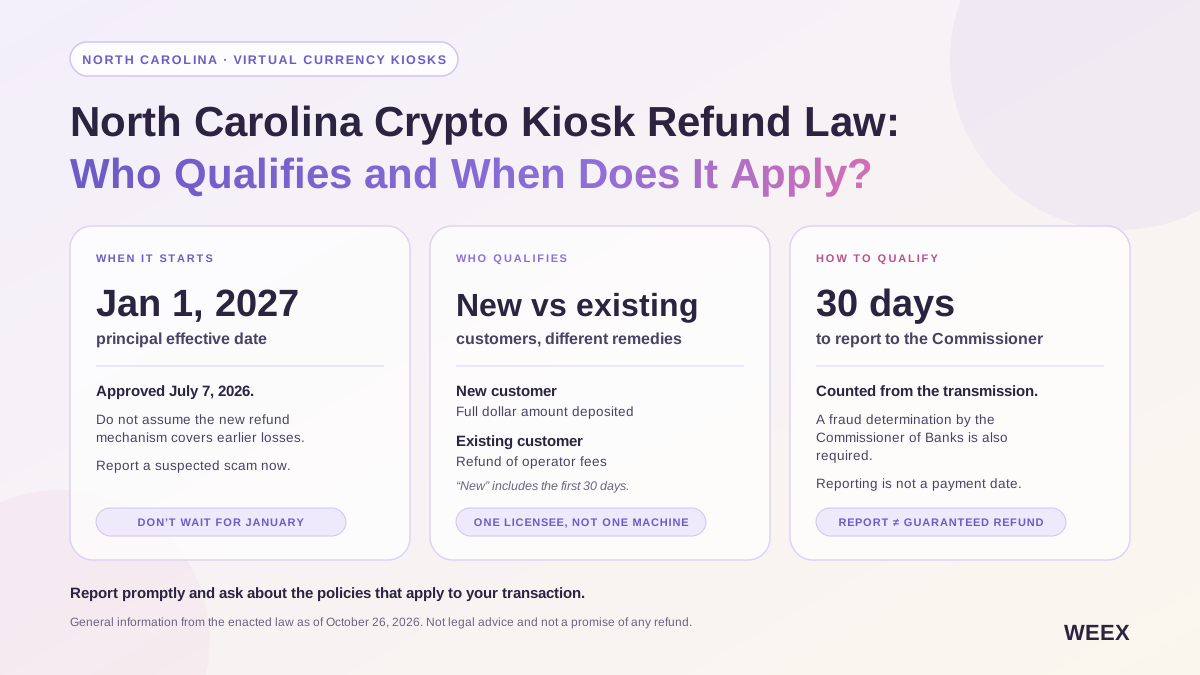
North Carolina Crypto Kiosk Refund Law: Who Qualifies and When Does It Apply?
Understand North Carolina’s crypto kiosk refund law: the January 2027 start date, who qualifies, reporting deadlines, and documents victims should keep.
US Startup Successfully Develops Artificial Gold, Highlighting Bitcoin Scarcity

Sam Price Claims Bitcoin Has Been Declared Dead Multiple Times

Mr&强 Analyzes Bitcoin Support and Resistance Areas

Franklin Templeton Launches Two Dividend Reinvestment Bitcoin ETFs

Interest on U.S. corporate bonds with CCC rating rises to 17.99 percent

LND Releases v0.21.5-beta.rc1 with Fee Estimate Limits

FOUNDATION Faces Spam Attack from Spoofed Domain Names

Bitcoin Core Changes Rules for Disclosing Security Vulnerabilities

New York Man Sentenced to 51 Months in Prison for Telecom Fraud and Money Laundering

[Bitcoin $0 Controversy②] "$0 is an Exaggeration"... Reasons Wall Street Disagrees

WEEX Exclusive:Gold Breaks Below $4,000, Bitcoin Pulls Back Below $80,000 | WEEX TradFi Daily(October 26, 2026)

Gold Breaks Below $4,000, Bitcoin Pulls Back Below $80,000 | WEEX TradFi Daily(October 26, 2026)
At the October 23 close, major indexes were mixed, with the Dow weaker. Brent crude rose to about $116.7, a near six-month high, and energy led; gold briefly fell below $4,000 as Bitcoin pulled back toward $80,000. Cybersecurity stocks strengthened last week, with CrowdStrike up nearly 12%. Markets are watching whether Bitcoin’s correction is nearing its end, along with earnings from Verizon, Cadence, Celestica and Amkor today.

The Superintendency of the Securities Market of Panama Excludes Cryptocurrencies from Its Oversight

Michael Saylor: Strategy's Core Business is Bitcoin-Based Digital Credit Products

Bitcoin and gold among worst-performing assets in 2023
X Adds Feature to Send $1 via Long Press on Like Button, Cryptocurrency Still Not Supported
Bitcoin Warns of Quantum Computer Threat Response Time of 2 Years

Paolo Ardoino wants AI to run Bitcoin mines. Who gets permission to act?

Sam Price Observes Significant Volatility in Ethereum Market

PHP2Shell: The Debate on Whether It Is as Easy to Exploit as It Seemed

China Plans National Blockchain Network by 2030

Bitcoin Preferred Shares: The Billion-Dollar Dilemma of Strategy and Strive

Sam Price Analyzes Bitcoin ETF Net Inflow Trends

The turnover of the cryptocurrency market in Russia is estimated at $376 billion
Cyberattack on GMO in Japan: Trading Accounts Compromised, GMO Coin Claims to be Unaffected
Mark Cuban compares Bitcoin to meme stocks
Electrum patches Bitcoin vulnerability allowing payment redirection
The Week Ahead: 4 Key Moments for the Crypto Market
Security Researcher Exploits PHP2Shell Vulnerability to Breach Bounty Website, Earns Approximately $2000 in Bitcoin Rewards
North Carolina Crypto Kiosk Refund Law: Who Qualifies and When Does It Apply?
Understand North Carolina’s crypto kiosk refund law: the January 2027 start date, who qualifies, reporting deadlines, and documents victims should keep.
Contents
Latest articles





Latest coin listings on WEEX


