Bank of America’s Hartnett on 2027 U.S. Stocks: Soft Landing at 7777, Full Bubble at 8888, Hard Landing at 6666

 Prefer us on Google



Bank of America’s Chief Investment Strategist Michael Hartnett has released a new outlook report for 2027, setting three scenarios for the S&P 500 index: a breadth-driven "soft landing" baseline scenario (around 7777 points), a "full bubble" driven by AI and government intervention (around 8888 points), and a market that is extremely unprepared for a "hard landing" breakdown scenario (around 6666 points).
Hartnett believes that the current market pricing of the macro economy is severely distorted, with a significant underpricing of the hard landing scenario—only 3% of investors expect a hard landing, according to Bank of America’s November Global Fund Manager Survey, while the expectations for a soft landing and no landing are 50% and 42%, respectively.
The core basis for this judgment is positioning and expectations: Asset allocators are generally overweight in stocks and commodities, underweight in cash and bonds, with stock fund inflows in 2026 projected to reach an annualized $1.5 trillion, setting a historical record. At the same time, sell-side analysts uniformly expect nominal GDP growth of 5% to 6% and global earnings growth of 15% to 20%, both built on the K-shaped wealth effect and AI capital expenditure as the two main engines, which Hartnett believes are weakening.
On the operational level, Hartnett’s tactical advice is to preserve capital in the coming months, waiting for the spring rate hike cycle and the dollar to peak, and then to buy cyclical "C" assets—chips, commodities, and cryptocurrencies, especially consumer stocks—after Wall Street’s narrative shifts from rate hikes to rate cuts. At the same time, use "GRAB" as a hedge—government bonds, real estate, AAA-rated assets, and bullion, as these four asset classes currently have very low institutional allocations.
Hartnett also points out that his institution, Bank of America, has an official forecast that is hawkish: the Federal Reserve is not only expected to refrain from cutting rates in 2027 but also to raise rates three more times, with the federal funds rate ending the year at 4.50% to 4.75%, higher than Goldman Sachs and Morgan Stanley’s forecasts. The so-called "21 rate cuts" belong to other central banks.
Baseline Scenario and Three Scenario Projections: Soft Landing at 7777, Bubble at 8888, Hard Landing at 6666
The report indicates that between the three scenarios, the bubble and recession differ by 2222 points, meaning that a 10 percentage point probability shift from "no landing" to "hard landing" corresponds to about 220 points in the S&P.
Breadth/Soft Landing (around 7777 points)—waiting for rate cuts, buying "C" assets. This is Hartnett’s own camp, characterized by positive returns in both credit and the stock market in 2027, with the bull market continuing but the driving force shifting from concentration to breadth.
Two key questions are "when will rate hikes end" and "will they end before a recession," with his answer being the second quarter of next year and "yes," because inflation will fall before the unemployment rate, and policymakers are too concerned about social consequences to allow a recession. In this scenario, earnings growth is about 10%, and risk assets will restart their upward trend after rate hikes end in March to April, with valuations of the equal-weight S&P at 16 times, mid-cap stocks at 14 times, global stocks at 14 times, and global stocks excluding the U.S. at 11 times no longer being expensive.
Bubble/No Landing (S&P around 8888 points)—the realization of this scenario requires super-large cloud vendors to further increase their current $1.3 trillion capital expenditure budget in 2027 (current tech giants have a free cash flow of -$283 billion).
Trigger conditions include (brought by Washington):
The U.S. government intervenes in the bond market to lower financing costs and credit spreads for the tech industry; midterm elections do not hinder the expansion of about 100 gigawatts of data center capacity over the next two years; the Democrat-controlled Congress supports the AI industry while exchanging for universal healthcare legislation; falling commodity prices reduce data center construction costs; Generation Z and Generation X maintain a structural habit of buying on dips.
Hartnett believes that before any credit events or large-scale capital outflows from tech stocks occur, this scenario is overpriced. The bubble scenario is extremely bullish on tech and extremely bearish on bonds.
Bust/Hard Landing (around 6666 points)—this is the risk where the current market pricing is completely wrong. Hartnett presents three arguments in the report:
First, no one expects it, with only 3% of fund managers anticipating a hard landing;
Second, predictions are too high, with a consensus expecting nominal GDP growth of 5% to 6% and global earnings growth of 15% to 20%, while the K-shaped household wealth and AI capital expenditure supporting both are weakening;
Third, positions are full, with allocators overweight in stocks and commodities and underweight in cash and bonds, with stock inflows in 2026 at an annualized $1.5 trillion, a record level.
Bank of America believes that once credit spreads widen and unemployment rises, puncturing the boom, a true bear market will arrive. The hedging tools are "GRAB": government bonds, AI negatively correlated real estate, defensive AAA-rated assets, and precious metals (gold and silver), which are the most convenient tools for policymakers to end a recession.
The report also points out that the 6666 points are only 7% lower than Wednesday’s close and less than 4% lower than last Friday’s close, 666 points higher than Morgan Stanley’s bearish scenario of 6000 points, making it seem mild as a "true bear market."
Monetary Policy Expectations: No Rate Cuts from the Fed This Year, Terminal Rate Higher than Wall Street Peers
Hartnett’s tactical judgment is based on the narrative switch from "rate hikes to rate cuts in the spring of next year." However, Bank of America’s forecast table shows that the federal funds rate will be 4.00% to 4.25% by the end of this year and 4.50% to 4.75% by the end of next year; from the current 3.75% to 4.00%, this corresponds to three rate hikes, with no rate cuts from the Fed in 2027. The 21 rate cuts come from other central banks, such as the European Central Bank lowering to 2.25% after one rate hike.
Among the three investment banks, Bank of America is the most hawkish on the Fed. Goldman Sachs expects rate hikes in December and March next year, with the first rate cut in December 2027; Morgan Stanley expects the Fed to stop at 4.25% to 4.50% in March next year and maintain that until 2028; Bank of America is 25 basis points higher than both and maintains that level.
The differences among the three are also evident in other aspects: Bank of America has the lowest stock allocation, the lowest earnings forecast, the most hawkish stance on the Fed, and is the only one wanting to go long on the euro.
In comparison, Goldman Sachs and Morgan Stanley had previously released outlooks: Goldman Sachs recommends buying bonds, shorting euros, and hedging against "AI hangover," with a target for the S&P of 8700; Morgan Stanley has the largest overweight in stocks, zero cash, and the same target for the S&P of 8700. The two banks have the same index target. The "baseline scenario" mentioned by Goldman Sachs and Morgan Stanley is 188 points lower than the "bubble" described by Bank of America’s chief strategist.
The only consensus among the three is: Brent will close in the $70 range next year, and the currently overlooked gold will rise 30% to 47%. Bank of America expects Brent crude to fall to $76; the dollar to peak in the first quarter; and gold to soar to $5000, with copper prices rising to $16000.
Additionally, Hartnett’s chart on the cover shows that sell-side bottom-up analysts have not read these outlooks: the market consensus expects global earnings growth of 17% next year, compared to 37% this year. Bank of America states it will be below 10%, while Goldman Sachs (referring to it as "the great halving") states the S&P will be 11%, and Hartnett’s own soft landing scenario requires about 10%.
Reversal and Pause of the Four Major Trading Themes of the 2020s
The report summarizes the four major trading themes that define the 2020s and predicts their fates will diverge next year:
Trades About to Reverse:
ABB (Anything But Bonds): Previously catalyzed by debt and deficits, the 30-year U.S. Treasury bond price has a return rate from high to low of -62%. This trend will reverse next year.
ABC: Bank of America expects the Chinese stock market to reverse next year.
Trades About to Pause:
ABD (Anything But Dollars): Catalyzed by concerns over currency depreciation, Bitcoin and gold achieved annualized gains of 44% and 23%, respectively, before peaking. This trade will hit the pause button in the first half of next year.
AI (All-In on AI): Catalyzed by disruptive technology, the Nasdaq’s market value has increased by $26 trillion since March 2023. This trade will also be on pause in the first half of next year.
-- Price
Potential Surprises and Shocks in 2027
The report lists tail risks that could disrupt the baseline scenario, with bearish surprises being particularly noteworthy:
Bullish Surprises: Peace replacing war leads to oil and inflation collapse (allowing the Fed to cut rates in the second half of the year); policies significantly improve housing and healthcare affordability, triggering a consumption boom among the general public.
Bearish Surprises:
AI Credit Event: A dramatic drop in DRAM/chip prices leads to a shrinkage in collateral value, triggering a credit crisis (currently, a large amount of debt is secured by chips themselves).
Debt-Induced Recession: As U.S. economic growth slows, concerns over debt cause yields to rise instead of fall, pushing the economy into recession.
Fed Gets Serious: Wall Street is shocked to find that the Fed is serious about its 2% inflation target and will not intervene to save the market.
A Year is Long: The Unexpected List is More Readable than the Baseline Scenario
The report notes that looking back at 2026, the best trades were long oil and short crypto, long energy and short discretionary consumption, long semiconductors and short telecom, long small-cap value and short large-cap growth, long cybersecurity and short defense; the winning themes of 2026:
War > Peace, Prosperity > Recession, K-shaped > C-shaped, Rate Hikes > Rate Cuts, Greed > Fear, AI Issuance > AI Unemployment, IPO > Buybacks, Concentration > Breadth.
A year ago, the market consensus was "full speed ahead": global earnings expectations were for a 9% increase, with the first half scenario being CPI dropping to 2% and 10-year yields at 3.5%, with the Fed easing. The actual earnings growth rate was about four times the expected rate at that time, with all other variables reversing.
Hartnett’s assertion in December 2025 that "all commodity charts will look like gold and oil as the best reverse trades of 2026" has been validated, and he also recommended shorting super-large cloud vendor bonds before the market realized it.
But the lesson is: In August 2025, he pointed out that historically bull markets peak in September 2027 at 9914 points, and now his bubble scenario upper limit is about 1000 points lower than that level, with the baseline scenario about 2000 points lower.
The report concludes that among the three scenarios, the hard landing is the only one not priced in; the 8888 points have only one path—brought by Washington.
This content is provided for general informational purposes only and doesn't constitute financial, investment, legal, or tax advice. Any events, rewards, online promotions, or related information mentioned herein should not be considered a recommendation, solicitation, or invitation to purchase, sell, trade, or otherwise deal in any crypto assets. Crypto assets are highly volatile and may result in loss. The availability of WEEX services, products, and related events may vary by region. You are responsible for ensuring that your participation is in accordance with applicable local laws and regulations.
You may also like

Top LEO Satellite Stocks to Watch in 2026

TSMC Stock Price Prediction for December 2026

Alliance DAO Co-founder Predicts Strong Rebound in US Stocks Over Next 2 to 3 Months, S&P 500 May Break 8000 Points

RWA Enters the Era of 'Big Infrastructure': The Competition Just Begins After Asset Tokenization

2026 Global Venture Capital Review: AI Absorbs 90% of Financing Growth, Established Funds Still Struggle to Exit

If You Put $10,000 in the Schwab U.S. Dividend Equity ETF 10 Years Ago, Here's What You'd Have Now

Vitalik Proposes Open Sourcing Semiconductor Design, Mentions Wallet Tampering

Black Friday Approaches, Market Discounts First: No Escape for US Stocks and Crypto
Asian Stock Markets Rebound, Chinese Assets Lead the Surge, AI Trading Prospects Await Observation

From Visa Experiments to KYA Governance: Who Defines the Financial Boundaries of Agents?

Record Monthly Outflow: What Happened to Bitcoin ETFs?

Bitcoin Ranges Narrowly; Regional Equities Close Early Friday | WEEX Daily Market Brief (November 27, 2026)
Bitcoin and Ethereum traded in narrow ranges, continuing to test support at $60,000 and $1,700.Fidelity applied for a spot Chainlink ETF.Regional equities opened higher and advanced, led by AI large-model and optical communications stocks.Equities will close early on November 27, with Meituan earnings in focus.

Venezuelan Oil Tycoon Backed by Trump: All I Did Was Create Output for My Country

Why Has the Hottest Robotics Sector Become a 'Startup Graveyard' Despite $100 Billion Investment?

Former Goldman Sachs FICC Executive Herman Jin: AI Is Not the Problem, Liquidity Is; Semiconductor Turning Point May Be in Q1 2027

Elon Musk's Plan to Gift Every American Child a Share of SpaceX Annually: What's Behind It?

Stablecoins Are Just the Throne: Who Holds the Real Key to On-Chain Finance?

Black Friday Kicks Off Trillion-Dollar Shopping Season! From Retail Foot Traffic Recovery to AI Buying Resurgence, Will Global Stock Markets Stage a "December Comeback" as Expected?

Conversation with Robinhood CEO: How Can Ordinary People Reclaim Wealth in the AI Era?
Deutsche Bank Predicts Three Rate Hikes and S&P 500 at 9000 Points by 2027, Driven by the Same Force

CITIC Securities: October Steel Prices Decline, Focus on High-Dividend Leaders

UNCTAD Report: Global Maritime Trade Volume Expected to Grow Zero by 2026
Meta Platforms Just Partnered With Walmart. Here's Why Investors Should Pay Attention

Glassnode Report: Institutional Funds Withdraw, Crypto Market Enters Defensive Cycle
South Korean Investors Sell 10 Trillion Won in Financial Assets to Enter Real Estate Market

Is DeFi Insurance Beyond Rescue?

Who is Pricing Stripe at $200 Billion?
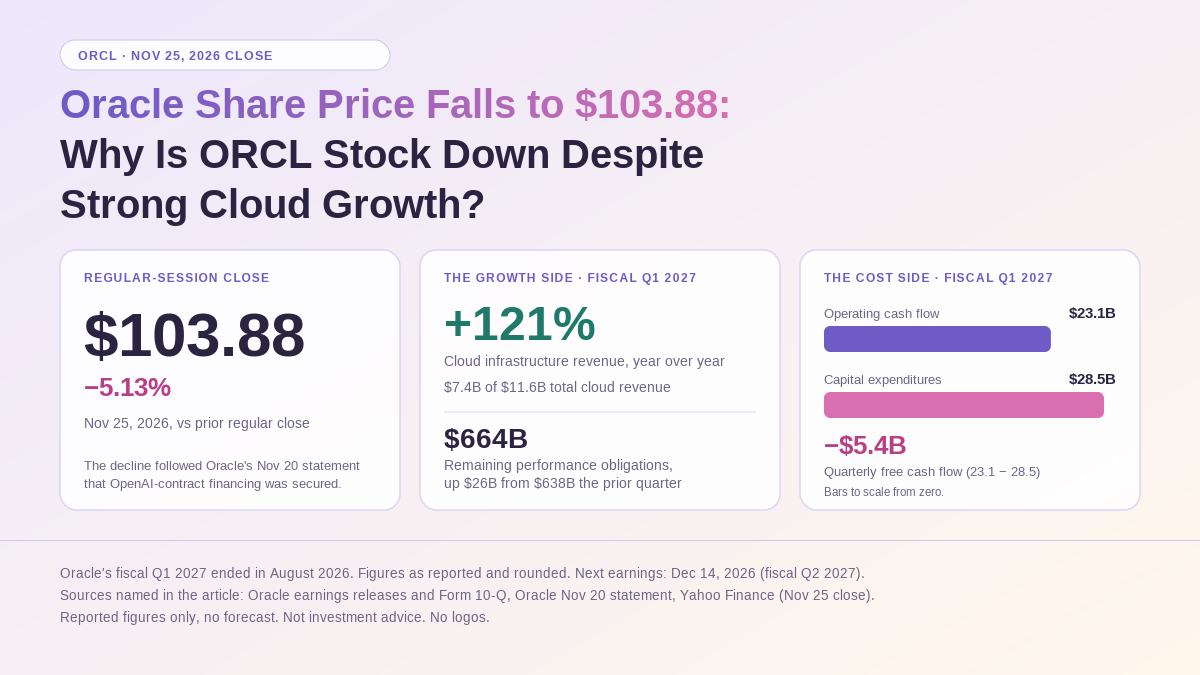
Oracle Share Price Falls to $103.88: Why Is ORCL Stock Down Despite Strong Cloud Growth?
Oracle shares fell 5.13% to $103.88. See what its $664 billion backlog, OpenAI financing, and negative free cash flow mean ahead of December earnings.

Options Market | Nvidia Sees $4.27 Million in Call Premiums from Four-Legged Sell Orders; SanDisk Continues to Decline with Investors Selling Year-End Puts for $2.7 Million

Wall Street Shifts Defensive Strategy to Fintech! Wedbush Covers 15 Stocks, Favoring Visa, Mastercard, and Robinhood
Top LEO Satellite Stocks to Watch in 2026
TSMC Stock Price Prediction for December 2026
Alliance DAO Co-founder Predicts Strong Rebound in US Stocks Over Next 2 to 3 Months, S&P 500 May Break 8000 Points
RWA Enters the Era of 'Big Infrastructure': The Competition Just Begins After Asset Tokenization
2026 Global Venture Capital Review: AI Absorbs 90% of Financing Growth, Established Funds Still Struggle to Exit
If You Put $10,000 in the Schwab U.S. Dividend Equity ETF 10 Years Ago, Here's What You'd Have Now
Latest articles


Latest coin listings on WEEX



